全球央行购金

Search documents
金-锌锭-大宗商品热点解读
2026-03-26 13:20
Summary of Key Points from Conference Call Records Industry Overview - **Gold and Zinc Industry**: The records focus on the gold and zinc markets, highlighting significant changes in consumption patterns and price forecasts for both commodities. Key Insights on Gold Market - **Consumption Shift**: In 2025, China's gold consumption structure underwent a milestone change, with gold bars and coins consumption (501.238 tons, +35.14%) surpassing jewelry consumption (363.836 tons, -31.6%), indicating a shift from consumption to investment dominance in the market [4][1]. - **Price Forecast**: Short-term gold prices are expected to be pressured by delayed interest rate cuts from the Federal Reserve and a strong dollar, with COMEX gold prices projected to fluctuate between $4,200 and $5,200 per ounce. Long-term support is anticipated from U.S. debt expansion and strong global central bank gold purchases (700-850 tons annually) [6][1]. - **Production and Import Data**: In 2025, domestic gold production was 381.339 tons (+1.09%), and imported gold was 170.681 tons (+8.8%). Total consumption was 950.096 tons (-3.57%) [4][1]. Key Insights on Zinc Market - **Supply and Demand Dynamics**: The global refined zinc market is expected to face a surplus in 2026, with optimistic projections indicating a surplus of 240,000 tons. Domestic refined zinc production is expected to increase by approximately 170,000 tons, primarily from the Wanyang project (+100,000 tons) and the Huoshaoyun project [1][9]. - **Price Trends**: Zinc prices are projected to decline, with expectations for Shanghai zinc prices to range between 21,000 and 25,000 RMB/ton in 2026. In April, prices are expected to remain weak due to high inventory levels and demand pressures [2][19]. - **Downstream Consumption Changes**: The traditional drivers for zinc consumption are weakening, with the share of galvanized consumption expected to drop from 65% to 55% due to declining real estate investment and new construction [1][15]. Additional Important Insights - **Zinc Smelting Challenges**: The zinc smelting sector is facing dual pressures from high overseas electricity prices and low domestic processing fees (TC), with smelting profits heavily reliant on by-product sulfuric acid prices, which have increased by 23.46% year-to-date [1][11]. - **Market Inventory Levels**: As of March 2026, domestic zinc inventories are at 260,000 tons, with significant increases in London zinc inventories as well, indicating a potential oversupply situation [18][19]. - **Geopolitical and Economic Influences**: The geopolitical landscape, particularly in the Middle East, and macroeconomic factors such as U.S. monetary policy are influencing both gold and zinc prices, with expectations of continued volatility in the markets [6][8][19]. This summary encapsulates the critical points from the conference call records, providing a comprehensive overview of the gold and zinc markets, their current dynamics, and future outlooks.
山金国际(000975):年报点评:销售节奏影响产量兑现,成本护城河依然稳固
LIANCHU SECURITIES· 2026-03-26 11:26
Investment Rating - The investment rating for the company is "Accumulate" (maintained) [6] Core Insights - The company achieved a revenue of 17.099 billion yuan in 2025, representing a year-on-year growth of 25.86%. Operating profit reached 4.304 billion yuan, up 35.33% year-on-year, while net profit attributable to shareholders was 2.972 billion yuan, reflecting a 36.75% increase compared to the previous year [3][4] - The production and sales of mineral gold saw a slight decline, with annual production at 7.11 tons, down 5.47% year-on-year, and sales at 7.11 tons, down 11.68% year-on-year. The sales performance was impacted by seasonal adjustments in sales rhythm [4] - The strong rise in gold prices was a key driver of the company's impressive performance, with the average selling price of gold significantly increasing to 774.08 yuan per gram, a substantial rise of 40.84% year-on-year [5] - The company maintained a significant cost advantage, with the combined amortized cost per gram of gold decreasing to 142.18 yuan, down 3.22 yuan year-on-year. This cost advantage is attributed to the high-quality mining assets and ongoing cost-reduction initiatives [6][9] Financial Performance Summary - In 2025, the company reported a revenue of 17.099 billion yuan, with a year-on-year growth of 25.86%. The net profit attributable to shareholders was 2.972 billion yuan, marking a 36.75% increase [3][13] - The projected revenues for 2026, 2027, and 2028 are 21.709 billion yuan, 24.172 billion yuan, and 28.182 billion yuan, respectively, with corresponding net profits of 6.269 billion yuan, 7.788 billion yuan, and 10.069 billion yuan [12][13] - The company's gross margin is expected to improve significantly, reaching 47.5% in 2026 and 58.1% by 2028 [13][27] Production and Sales Insights - The company plans to produce between 7 to 8 tons of gold in 2026, with other metals expected to maintain production levels similar to 2025 [4] - The inventory of mineral gold at the end of 2025 was 1.03 tons, a significant increase of 90.74% compared to the previous year [4] Market and Price Trends - By the end of 2025, the London spot gold price had risen by 62.79% since the beginning of the year, while the Shanghai Gold Exchange price increased by 56.74% [5] - The report indicates that the gold price is expected to enter a phase of consolidation in the short term, with long-term bullish trends remaining intact due to ongoing global economic factors [11][12]

2026年黄金价格走势深度分析(最新预测+影响因素详解)
Sou Hu Cai Jing· 2026-02-27 01:50
Core Viewpoint - The global gold market is experiencing high volatility in February 2026, with prices fluctuating around $5188 per ounce, driven by factors such as Federal Reserve interest rate expectations, central bank gold purchases, and geopolitical risks [1][3][6]. Price Trend Analysis - **Early February**: Gold prices surged from $5020 to $5248.89 per ounce, supported by rising expectations of a Federal Reserve rate cut and significant central bank gold purchases, totaling 320 tons [3][4]. - **Mid-February**: Prices corrected to around $5130 per ounce due to profit-taking and hawkish statements from Federal Reserve officials, with a 1.1% decline in domestic gold T+D prices [4]. - **Late February**: Prices stabilized around $5188.51 per ounce, influenced by ongoing geopolitical tensions and continued central bank gold purchases [5]. Key Influencing Factors - **Federal Reserve Monetary Policy**: The Fed's policy is a primary driver of gold prices, with expectations of rate cuts influencing market sentiment. Predictions for 2026 vary, with some institutions forecasting multiple rate cuts while others anticipate stability or even rate hikes [6][12]. - **Global Central Bank Gold Purchases**: Central banks are expected to maintain high levels of gold purchases, with 2026 projections between 700-850 tons, significantly supporting gold prices [7][12]. - **Geopolitical Risks**: Ongoing geopolitical tensions, particularly in the Middle East, are contributing to short-term volatility in gold prices, as investors seek safe-haven assets [8][12]. Price Movement Logic - **Reasons for Price Increase**: The primary drivers for potential price increases include expectations of Federal Reserve rate cuts, continuous central bank gold purchases, and persistent geopolitical risks [12]. - **Reasons for Price Decrease**: Potential risks for price declines include less aggressive Fed policies than expected, easing geopolitical tensions, and short-term profit-taking [13]. Price Forecasts - **Institutional Predictions**: Predictions for gold prices in 2026 show a bullish outlook from major institutions, with target prices ranging from $5400 to $6300 per ounce, driven by central bank purchases and geopolitical factors [14][15]. - **Market Sentiment**: Influencers on social media platforms suggest a long-term price range of $5000 to $6300 per ounce, with expectations of reaching $6000 by year-end [14][16]. Investment Recommendations - **Long-term Strategy**: Investors are advised to prioritize gold ETFs and physical gold, maintaining a position of 10%-15% of their portfolio, with opportunities to increase holdings during price corrections [17]. - **Short-term Strategy**: Focus on trading around key support and resistance levels, with timely profit-taking and loss-cutting strategies [17].

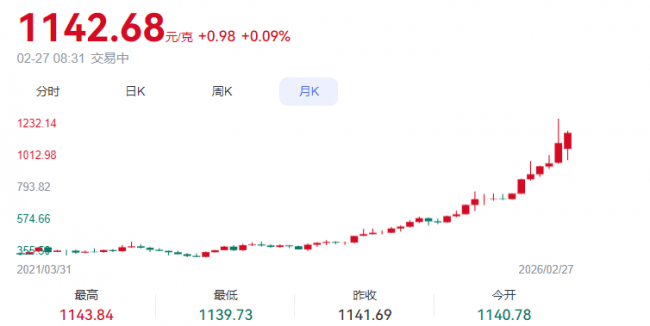
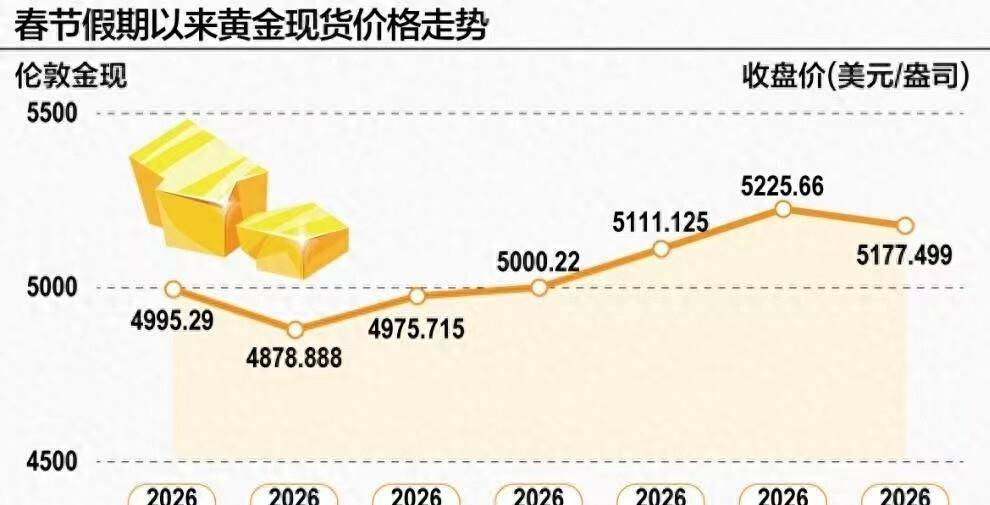
春节金价坐过山车:从跌破4900到重返5177,到底发生了什么?
Sou Hu Cai Jing· 2026-02-26 18:03
Core Viewpoint - The recent fluctuations in gold prices have been dramatic, with prices experiencing a significant drop followed by a rapid recovery, highlighting the volatility and underlying market dynamics influencing gold as an asset class [1][3][10]. Group 1: Price Movements - Gold prices surged to a historical peak of $5598.75 on January 29, 2026, marking a nearly 30% increase within a month, driven by geopolitical risks and central bank purchases [4][6]. - Following this peak, gold prices plummeted by 9.25% on January 30, 2026, due to market reactions to U.S. Federal Reserve leadership changes and increased margin requirements, leading to a rapid sell-off [6][10]. - After the initial crash, gold prices rebounded strongly, closing at $5177.499 on February 24, 2026, indicating a "V-shaped" recovery fueled by renewed geopolitical tensions and a reassessment of market fundamentals [7][8]. Group 2: Market Drivers - Geopolitical tensions, particularly in the Middle East, have been a primary driver for gold's appeal as a safe-haven asset, prompting increased investment during periods of instability [7][8]. - Central banks globally have continued to increase their gold reserves, with a reported net purchase of 863 tons in 2025, providing a structural support for gold prices [8][14]. - Market sentiment has swung between extreme optimism and pessimism, influenced by speculative trading and macroeconomic indicators, particularly relating to U.S. monetary policy [13][14]. Group 3: Consumer and Investment Behavior - In the consumer market, traditional demand for gold remains strong despite price volatility, with increased sales of smaller, intricately designed gold items during festive seasons [10][11]. - The investment landscape has seen significant capital flows into and out of gold ETFs, reflecting the emotional volatility of investors in response to price changes [11][13]. - The disparity between retail gold prices and recovery values highlights the consumer behavior shift towards viewing gold purchases as primarily consumption rather than investment [11]. Group 4: Structural Changes in the Market - The ongoing trend of central banks diversifying their reserves by increasing gold holdings is reshaping the supply-demand dynamics in the gold market, creating a long-term structural support for prices [14]. - The relationship between gold and the U.S. dollar remains critical, with fluctuations in the dollar's strength directly impacting gold prices [13][14]. - The current market environment suggests that gold is evolving from a mere commodity to a central asset in the global financial order, influenced by geopolitical and economic factors [14].
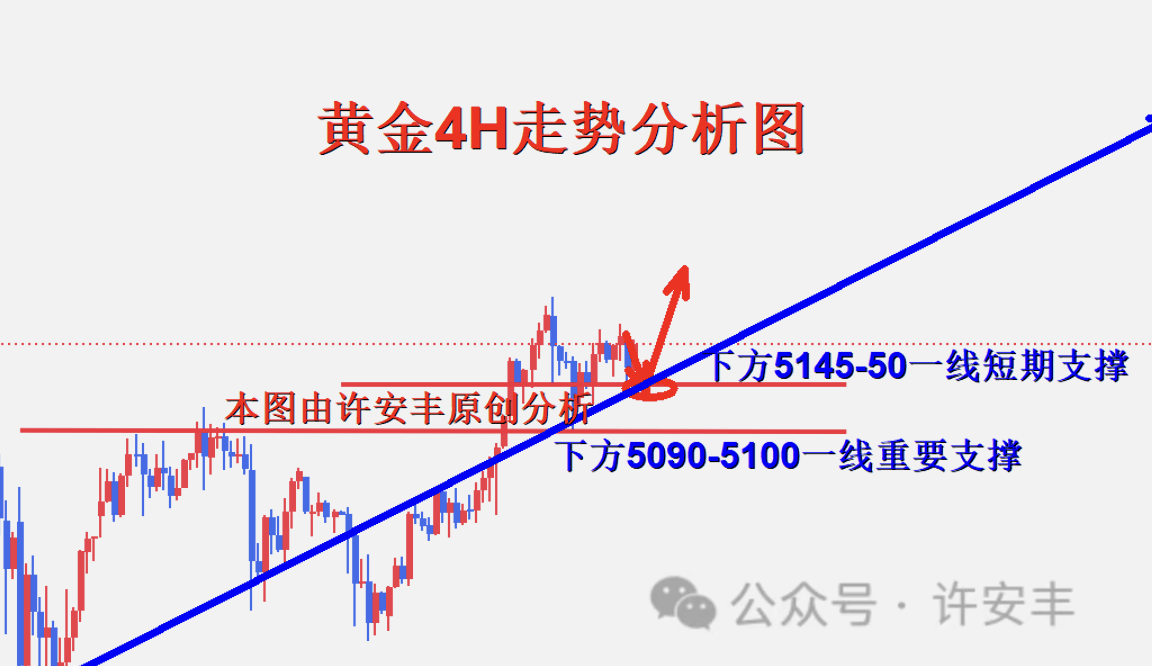
许安丰:2.26黄金早盘区间震荡蓄力,多头趋势仍维持不变
Sou Hu Cai Jing· 2026-02-26 02:37
Core Viewpoint - The overall trend for gold remains bullish despite short-term fluctuations, with a focus on key support levels and a strategy of buying on dips [1][2] Group 1: Market Analysis - Gold prices are currently experiencing range-bound fluctuations, with a focus on the support levels around 5145-50 and 5090-5100 [1] - The market is influenced by hawkish signals from the Federal Reserve, emphasizing that inflation has not yet reached targets, which delays interest rate cuts [1] - Geopolitical risks are still present, but the trend of global central banks purchasing gold continues to provide a supportive floor for gold prices [1] Group 2: Trading Strategy - The recommended trading strategy involves buying gold on dips at the 5140-5150 range and adding positions at 5090-5100, with a stop-loss set at 5082 and a target of 5250-5270 [1] - Short-term resistance is noted at the 5270-5280 range, while support is identified at 5140-5145 and 5090-5100 [2] - A cautious approach with a focus on buying on dips is advised for trading operations [2]
A股马年开门红,逢低关注“科技+资源品”双主线
British Securities· 2026-02-25 01:27
Market Overview - The A-share market experienced a "red opening" on the first trading day of the Year of the Horse, with the Shanghai Composite Index surpassing the 4100-point mark and the Shenzhen Component Index rising over 1%, setting a positive tone for post-holiday market trends [2][9][10] - Despite the positive opening, there was a notable structural differentiation in market performance, with cyclical sectors like petrochemicals and non-ferrous metals leading gains, influenced by external factors such as the escalating US-Iran situation and internal price increase logic [2][10] Capital Flow and Market Sentiment - The return of capital post-holiday was in line with expectations, significantly boosting market liquidity, as evidenced by a notable increase in trading volume, with total turnover reaching 22,021 billion [6][10] - However, the weak performance of the Hong Kong market has somewhat dampened risk appetite in the A-share market, indicating a cautious overall market sentiment on the first trading day [10][11] Future Market Outlook - The upcoming important meetings are expected to clarify policy directions for the "14th Five-Year Plan," with anticipated policy benefits likely to gradually materialize, suggesting a probable continuation of a fluctuating upward trend in the market [3][9] - Key areas to monitor include the sustainability of price increase logic in cyclical sectors and signs of stabilization in the technology sector following recent corrections [3][9] Investment Strategy - Investors are advised to focus on the dual main lines of "technology + resource products," specifically targeting cyclical sectors benefiting from price increases and geopolitical catalysts, such as petrochemicals and non-ferrous metals [3][9] - Additionally, long-term trends in technology sectors, including AI computing power, semiconductors, and humanoid robots, should be considered for opportunistic investments during any temporary pullbacks [3][9]
国际破高位,国内金饰逼近1600元,普通人该买还是该卖?
Sou Hu Cai Jing· 2026-02-23 21:18
Core Viewpoint - The article highlights the significant disparity between the raw material cost of gold and its retail price, emphasizing the added value from branding, craftsmanship, and market dynamics in the gold jewelry sector [1][3][4]. Price Disparity - The international spot gold price reached approximately $5149 per ounce, translating to about 370 RMB per gram, while retail prices for gold jewelry in major brands like Chow Tai Fook are around 1545 RMB per gram, indicating an 80% markup attributed to added value [1][3][4]. - The price for gold jewelry in major retail stores is significantly higher than the base price of raw gold, with a gap of nearly 450 RMB per gram between retail prices and the benchmark price [4][6]. Market Segmentation - The gold market is segmented into different tiers: high-end retail stores, wholesale markets, and banks, each with distinct pricing structures. Retail prices are inflated due to branding and craftsmanship, while wholesale prices are closer to the raw material cost [6][7][9]. - In the Shenzhen Luohu district's Water Bay International Jewelry Trading Center, the price for raw gold is around 1298 RMB per gram, significantly lower than retail prices, highlighting a preference for raw materials over branded products among some consumers [6][7]. Consumer Behavior - Consumers are increasingly aware of the cost structure in gold purchases, with many opting for lower-cost alternatives like bank gold bars or wholesale gold processing to avoid high brand premiums [15][18]. - The demand for gold remains strong post-Chinese New Year, driven by cultural practices such as weddings and gifting, which keeps retail prices elevated [15][18]. Regulatory Environment - Recent regulatory measures in Shenzhen aim to standardize gold market operations and prevent illegal trading practices, emphasizing the need for transparency and consumer protection [15][16][18]. - The regulations prohibit illegal activities such as unauthorized gold trading and misleading marketing practices, aiming to safeguard consumer interests in the gold market [16][18]. Market Dynamics - The rise in gold prices is influenced by various factors, including geopolitical tensions and changes in U.S. monetary policy, which have led to increased demand for gold as a safe-haven asset [12][13]. - Central banks globally are increasing their gold reserves, with China's central bank having added to its holdings for 14 consecutive months, indicating a structural support for gold prices [13][15]. Investment Strategies - Different investor strategies are emerging in response to high gold prices, with conservative investors favoring bank gold accumulation or gold ETFs for their lower costs and liquidity [18][22]. - Trend traders are focusing on technical analysis and market news, with significant price fluctuations observed in recent months, indicating a volatile trading environment [19][21]. Recovery Market - The gold recovery market operates on a standardized pricing model based solely on purity and weight, with little regard for the original purchase price or brand, reflecting a stark contrast to retail pricing [9][10]. - Consumers are advised to choose reputable recovery channels to avoid scams, with proper verification and monitoring recommended during transactions [21][22].

注意!今日金价再迎异动,黄金接下来或将出现大惊喜
Sou Hu Cai Jing· 2026-02-23 02:03
Core Viewpoint - The international gold market experienced a significant surge on February 22, 2026, with prices breaking through the psychological barrier of $5,100 per ounce, reaching a peak of $5,107, marking a daily increase of $117 or 2.35%, and closing at $5,104.24 [1][17] Price Discrepancy - The domestic gold market remained closed due to the Spring Festival holiday, with Shanghai Gold Exchange's T D gold price at 1,108.5 yuan per gram and the main futures contract at 1,110.1 yuan per gram, showing a slight decline compared to the last trading day before the holiday [3] - The stark contrast between the international price surge and the domestic market's stagnation led to confusion in gold pricing across different circulation channels, with retail prices at major brands like Chow Tai Fook reaching 1,560 yuan per gram, significantly higher than bank investment gold bars priced around 1,123.5 to 1,133.52 yuan per gram [3][4] Wholesale and Recovery Prices - In the upstream market, the wholesale price for 999 pure gold at Shenzhen's Shui Bei International Jewelry Trading Center was approximately 1,274 yuan per gram, with additional processing fees for consumers [4] - The gold recovery market showed a different pricing logic, with recovery prices for pure gold at about 1,100 yuan per gram, closely aligned with raw gold market prices, regardless of brand [6] Market Drivers - The surge in international gold prices was driven by heightened geopolitical risks, particularly the significant military buildup by the U.S. in the Middle East, leading to increased safe-haven buying in gold [6] - Expectations of a potential interest rate cut by the Federal Reserve in 2026, with a projected cumulative reduction of 50 to 75 basis points, contributed to a weaker dollar, further boosting gold prices [6][17] Central Bank Purchases - Global central banks have maintained a net buying trend for 16 consecutive years, with 2025 seeing a net purchase of 863 tons of gold, indicating strong structural support for gold prices [7][9] - The People's Bank of China has been actively increasing its gold reserves, reaching 7,419 million ounces by the end of January 2026, marking the 15th consecutive month of increases [9] Market Volatility - The gold market has experienced extreme volatility, with prices soaring from around $4,500 per ounce in January 2026 to a peak of $5,598.75, followed by a sharp drop of 9.25% in a single day [9][10] - Technical indicators showed extreme market sentiment, with the relative strength index exceeding 90 before the January price drop, indicating overbought conditions [10] Investment Strategies - Ordinary investors have shown varied strategies in response to gold price fluctuations, with some opting for gold ETFs that closely track domestic gold prices, while others prefer bank investment gold bars despite higher premiums [10][12] - The gold jewelry consumption market has seen a decline in demand volume, with global gold jewelry demand dropping to 1,542 tons in 2025, while the total consumption value increased by 18% to a record $172 billion [12] Changing Market Dynamics - The structure of market participants is evolving, with traditional Wall Street funds showing lower participation, while central banks, retail investors, and long-term option market funds are becoming more prominent [13] - The pricing logic of gold is undergoing significant changes, with geopolitical risk premiums and reassessment of the global monetary credit system becoming more critical drivers than traditional correlations with U.S. Treasury yields [13] Consumer Awareness - Consumers need to distinguish between investment and consumption in the gold market, as purchasing branded jewelry often involves high premiums that do not translate into recovery value [15] - Professional recommendations suggest that gold should constitute 5% to 15% of household investable assets, primarily as a risk hedging tool rather than for high returns [15]
金价,行情拐点已清晰明了,不出意外,金价很有可能会重演历史
Sou Hu Cai Jing· 2026-02-22 05:53
Core Viewpoint - The gold market experienced a significant reversal on February 21, 2026, with spot gold prices rising from a low of $4981.2 to above $5098.85, marking a daily increase of over 2.35% [1]. Technical Analysis - The K-line chart formed a hammer pattern with a long lower shadow, indicating strong buying support at the $4980 to $5000 range, suggesting a rebound from a bottom [3]. - Technical indicators such as MACD, KDJ, and RSI show signs of recovery after a rapid correction, indicating that previous high-risk levels have been released [3][6]. Market Dynamics - Central banks, including the People's Bank of China, have been consistently increasing their gold reserves, with China's reserves reaching 2307.57 tons by the end of January 2026, marking the 15th consecutive month of increases [4]. - There has been a noticeable inflow of funds into gold ETFs around February 21, indicating a shift in institutional investor sentiment from risk aversion to increased allocation [4]. Macroeconomic Environment - The market is reassessing the Federal Reserve's monetary policy for 2026, with January's CPI showing a year-on-year increase of 2.4%, reigniting hopes for interest rate cuts [6]. - Expectations of a cumulative rate cut of approximately 63 basis points by the Fed, with the first cut potentially in July, enhance gold's appeal as a non-yielding asset [6]. Historical Context - Historical parallels suggest that the current gold market conditions resemble previous turning points, such as in December 2015, August 2018, and November 2022, where significant price rebounds followed similar patterns of rapid corrections and strong support [7][9]. Underlying Logic - The anticipated shift in the Fed's monetary policy towards easing is expected to provide systemic support for gold prices [10]. - The trend of central banks purchasing gold has evolved into a long-term strategic allocation, contributing to a solid demand base for gold [10]. - Current market adjustments are viewed as healthy profit-taking and position exchanges rather than signs of a market top, indicating a continuation of the bullish trend [10]. Consumer and Investment Insights - There are two distinct types of gold: investment gold, which is aimed at preservation and appreciation, and consumer gold, which includes jewelry and carries higher premiums [12]. - Investment gold, such as gold bars and ETFs, typically has lower premiums and better liquidity, while consumer gold prices are significantly higher due to branding and craftsmanship costs [12]. Short-term Market Risks - Gold prices around the $5000 mark face psychological and technical pressures, with potential fluctuations due to U.S. economic data affecting the dollar index [14]. - The market's next direction will depend on the evolution of core driving factors and the dynamics between bullish and bearish positions at critical price levels [14].

黄金白银强势反弹,国际市场动荡,地缘政治风险与美联储降息预期共同推动贵金属市场深V反弹
Sou Hu Cai Jing· 2026-02-21 01:25
Core Insights - The international gold market has seen a significant surge, with spot gold prices surpassing $5000 per ounce, reaching a peak of $5021.25, while silver prices also increased by over 2% to above $78, indicating a strong market rebound after a recent downturn [1][3] Group 1: Market Dynamics - As of February 19, 2026, London spot gold was quoted at $5014.62, up $39.79, reflecting a 0.80% increase, while New York futures reached $5035.7 [3] - Domestic gold prices in China remained stable due to the Spring Festival holiday, with prices for major gold contracts at 1108.5 yuan per gram and 1110.1 yuan per gram [3] - Retail prices for gold jewelry have increased, with brands like Chow Tai Fook and Lao Feng Xiang raising their prices to 1560 yuan and 1556 yuan per gram, respectively [3] Group 2: Key Drivers of Price Increase - Geopolitical risks have intensified, particularly concerning U.S.-Iran relations, leading to increased demand for gold and silver as safe-haven assets [3][5] - Market expectations regarding the Federal Reserve's monetary policy have shifted, with potential interest rate cuts anticipated, which supports gold and silver prices by lowering the opportunity cost of holding these non-yielding assets [5] - Central banks globally have continued to purchase gold, with net purchases reaching 863 tons in 2025, indicating sustained demand and potential for future increases in gold reserves, particularly in emerging markets [5] Group 3: Silver Market Insights - Silver has outperformed gold in this rally, driven by its dual role as both a precious and industrial metal, with over 58% of its demand coming from industrial applications [6] - The photovoltaic industry is a significant growth driver for silver demand, with new solar technologies requiring 30% to 100% more silver per gigawatt compared to traditional solar cells [6][8] - Other industrial applications, such as AI and electric vehicles, are also increasing silver demand, with usage in AI servers being 3 to 5 times higher than traditional servers and electric vehicles using 2 to 3 times more silver than conventional cars [8] Group 4: Market Volatility and Future Predictions - The silver market has experienced extreme volatility, with prices previously reaching $120 before a sharp decline of over 27% due to external market factors [8] - Financial institutions have varying predictions for gold and silver prices, with UBS forecasting gold could reach $6200 per ounce by mid-2026, while other banks like ANZ and Morgan Stanley provide more conservative estimates [9] - Some analysts express caution regarding silver's rapid price increase, suggesting potential technical corrections, especially if the gold-silver ratio falls below historical averages [11]