
外卖平台服务管理

Search documents
事关你的外卖,“新国标”发布!
Xin Lang Cai Jing· 2025-12-08 05:37
Core Viewpoint - The National Market Regulation Administration has implemented a recommended national standard for food delivery platforms to address issues such as "ghost deliveries," irrational competition, and insufficient protection of delivery personnel's rights. Merchant Management - To combat "ghost deliveries," merchants must provide a video with store location for verification, and platforms must conduct both initial and dynamic audits based on potential risks [3] - Platforms are encouraged to provide "order surge" warnings to merchants and inform consumers of busy statuses to promote rational ordering [4] Pricing Behavior - The standard outlines three types of fees: technology service fees, delivery service fees, and promotional service fees [5] - Platforms must disclose complete settlement details to merchants, including fee composition, rates, and actual amounts received [6] Competition Issues - Platforms must bear the costs of promotional activities and cannot impose unreasonable conditions on merchants for participation [7] - Merchants' promotional autonomy must be respected, preventing platforms from forcing or indirectly coercing merchants into selling below cost [7] Delivery Personnel Rights Protection - Platforms should limit delivery personnel's working hours and establish fatigue alerts and mandatory rest periods, prohibiting forced overtime through algorithms or incentives [9] - Delivery routing algorithms must consider various factors for efficient planning, with a maximum average speed of 15 km/h for electric bicycles [9] - Responsibilities for compliance, social security, and labor compensation must be clearly defined for both platforms and partner companies [9] Consumer Rights Protection - Platforms must establish a consumer rights protection system to ensure timely responses and safeguard consumers' rights to information, choice, and safety [10] - Price promotions must be applied equally to consumers under the same conditions, avoiding unreasonable differential treatment [10] - Automatic renewals or extensions must be clearly communicated to consumers in advance [10] Personal Information Protection - Platforms must collect consumer personal information reasonably and ensure informed consent, prohibiting unsolicited commercial communications without consent [11] Complaint and Appeal Processes - Platforms must clarify procedures for merchant violations, ensuring responses to merchant appeals within 3 hours and completion of reviews within 4 days [12] - Clear channels and simplified processes for delivery personnel appeals must be established [13] - A tiered response mechanism for consumer complaints should be implemented, with immediate human responses for serious issues [14]

跟着新国标下的外卖骑手“跑单”:强制休息不影响跑单节奏,担心限速会影响单量和收入
Xin Lang Cai Jing· 2025-12-06 09:27
Core Viewpoint - The implementation of the new national standard for food delivery platforms aims to optimize management, improve service quality, and promote healthy competition within the industry, with specific regulations on delivery time and rider work hours [1][4]. Group 1: Work Hours and Fatigue Management - The new standard stipulates that delivery riders should not work more than 8 hours a day, and if they exceed this limit, they must confirm their willingness to continue [4][7]. - Platforms are required to issue fatigue alerts after 4 consecutive hours of work, mandating a 20-minute pause in order assignments [4][8]. - The majority of riders, like Lao Ran, find the new regulations align with their natural work rhythms, often taking breaks after 4-5 hours of work [7][9]. Group 2: Delivery Algorithms and Incentives - The new regulations prohibit platforms from using algorithms or incentives to force riders into overtime work [8]. - Riders have reported that delivery algorithms have improved, allowing for more efficient routing and reduced overtime incidents [8][10]. - Platforms now allow riders to choose the number of orders they take simultaneously, with options ranging from 2 to 12 orders, which helps manage workload and efficiency [8][11]. Group 3: Delivery Time and Speed Regulations - The new standard mandates that the average speed for electric bicycles during deliveries should not exceed 15 km/h [10][12]. - Riders have expressed concerns that longer delivery times could lead to lower pay per order, as they may opt to take on more orders to maintain earnings [11][12]. - Current practices show that riders typically operate at speeds of 35 to 40 km/h, which they believe allows them to manage multiple orders effectively [12].

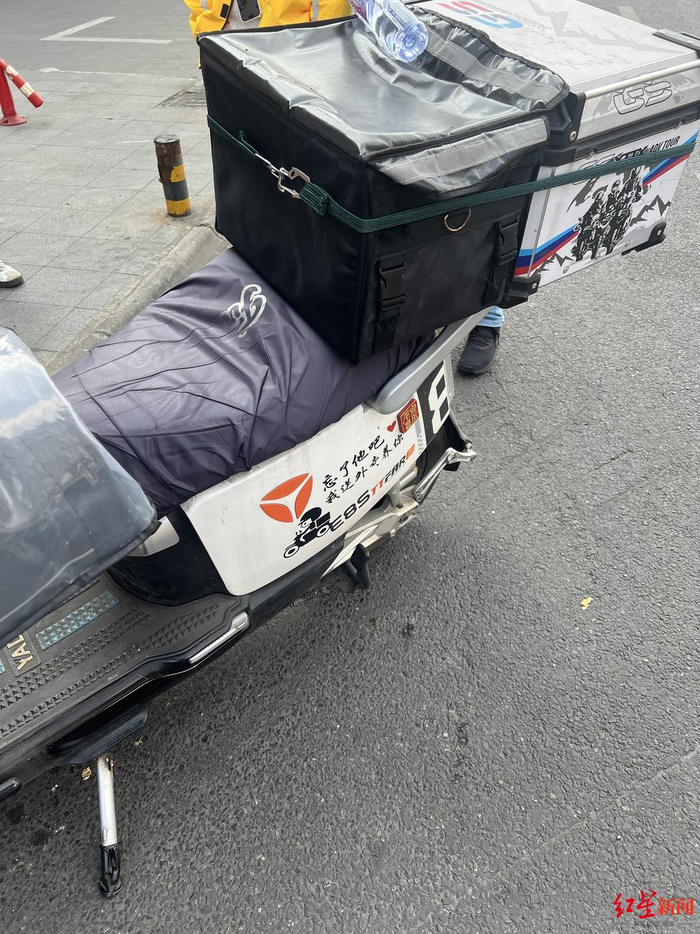
外卖新国标来了!“新”在哪?
券商中国· 2025-12-05 23:39
Core Viewpoint - The article discusses the implementation of a recommended national standard for food delivery platforms to address issues such as "ghost deliveries," irrational competition, and insufficient protection of delivery personnel's rights. Merchant Management - To tackle the "ghost delivery" issue, merchants must provide a video with store location for verification, ensuring consistency with business licenses [1] - The approval process includes both initial and dynamic audits, with a mechanism to trigger dynamic reviews upon detecting potential risks [2] Operational Management - Delivery personnel's addresses will be verified, and "dine-in" labels will be marked to improve service clarity [3] Addressing "Order Surge" Issues - Platforms are encouraged to provide "order surge" warnings to merchants and inform consumers about busy statuses to promote rational ordering [4] Pricing Behavior - To combat "excessive and arbitrary charges," the fee structure will include technology service fees, delivery service fees, and promotional service fees [5] - Platforms must disclose complete settlement details to merchants, including all fee components and actual amounts received [6] Addressing "Irrational Competition" - Platforms must bear the costs of promotional activities and cannot transfer these costs to merchants or impose unreasonable conditions for participation [7] - Merchants' promotional autonomy must be protected, preventing platforms from forcing participation that leads to selling below cost [8] Protection of Delivery Personnel's Rights - Platforms should limit delivery personnel's working hours and establish fatigue alerts and mandatory rest periods, avoiding forced overtime through algorithms or incentives [9] - Delivery routing algorithms must consider various factors for efficient planning, with a maximum average speed of 15 km/h for electric bicycles [9] - Responsibilities for compliance with labor laws, social security, and fair compensation must be clearly defined for both platforms and partner companies [9] Consumer Rights Protection - A consumer rights protection system must be established to ensure timely responses and safeguard consumers' rights to information, choice, and safety [10] - Pricing promotions must be applied equally to consumers under the same conditions, avoiding unreasonable differential treatment [10] - Platforms must ensure reasonable collection of personal information, requiring consumer consent before sending commercial communications [11] Complaint and Appeal Processes - Platforms must clarify the procedures for recognizing and handling violations, ensuring merchant appeals are responded to within 3 hours and reviewed within 4 days [12] - Delivery personnel should have clear channels and simplified processes for submitting appeals [14] - A tiered response mechanism for consumer complaints must be established, with immediate human responses for serious issues [15]

外卖“新国标”聚焦哪些热点问题?一组海报看懂
Ren Min Wang· 2025-12-05 11:21
Core Viewpoint - The National Market Regulation Administration has approved a recommended national standard titled "Basic Requirements for Delivery Platform Service Management" to address issues such as "ghost deliveries," irrational competition, and insufficient protection of delivery personnel's rights. Group 1: Merchant Management - Platforms are required to verify merchants' licenses and actual operating environments, marking those that meet conditions with a "dine-in" label [3] - Delivery platforms must conduct random checks on merchant information, with a minimum monthly sampling rate of 5%, to enhance dynamic audits of daily operations [3] Group 2: Promotion Regulations - The standard distinguishes between "platform price promotions" and "merchant price promotions," stating that the costs of platform promotions should be borne by the platform itself and not passed on to merchants or delivery personnel [4] - Platforms must inform merchants of promotional activities at least 7 days in advance, providing adequate preparation time [4] Group 3: Marketing Practices - Merchants' subsidies to consumers cannot be presented as platform subsidies, and exaggerated marketing tactics such as hidden fees or "zero-cost purchases" are prohibited [5] - Platforms must avoid actions that disrupt market price perception and normal order [5] Group 4: Delivery Personnel Rights - Delivery personnel working during public holidays or adverse weather conditions must receive subsidies or work allowances from platforms or partner companies [6] - Platforms and partner companies should not impose penalties on delivery personnel through deductions for delays [6]
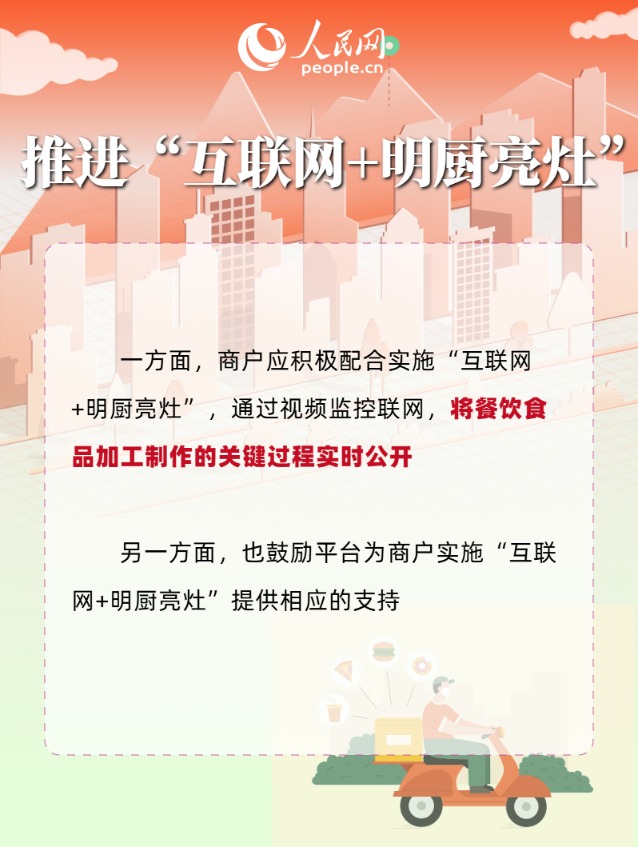
淘宝闪购、美团、京东外卖齐发声明
Guan Cha Zhe Wang· 2025-12-05 08:15
Core Viewpoint - The market regulatory authority has implemented a recommended national standard for food delivery platforms to address issues such as "ghost deliveries," irrational competition, and insufficient protection of delivery personnel rights [1] Group 1: Key Focus Areas of the Standard - Focus on merchant management within platforms, emphasizing the responsibility of platforms to manage and serve merchants effectively, including compliance with food safety standards [1] - Focus on platform fees and promotional activities, aiming to clarify fee structures and promote fair competition by ensuring transparency in pricing and promotional rules [1] - Focus on labor management for delivery personnel, proposing measures to protect their rights, including reasonable working hours, professional training, and diverse protection mechanisms [1] - Focus on dispute resolution within platforms, encouraging the establishment of a consumer rights protection system and transparent complaint handling processes [1] Group 2: Industry Response - Major platforms such as Taobao Shangu, Meituan, and JD Delivery have publicly committed to implementing the national standard, recognizing its importance for fair competition and service quality [2] - These platforms participated in the drafting and discussion of the standard, expressing their commitment to integrate its requirements into their operations and improve service management for merchants and delivery personnel [2] - The platforms view the implementation of this standard as an opportunity to promote industry regulation, quality service, rational competition, and a win-win ecosystem, contributing to the sustainable development of the food delivery sector [2]



剑指“幽灵外卖”“外卖员权益”,外卖服务管理有国标了 美团、京东外卖、淘宝闪购发声
Mei Ri Jing Ji Xin Wen· 2025-12-05 08:13
Core Viewpoint - The introduction of the national standard for food delivery platforms aims to address long-standing issues such as "ghost deliveries," the protection of delivery personnel's rights, and irrational competition among platforms, thereby enhancing the overall service management and transparency in the industry [1][2][3]. Group 1: National Standard Implementation - The national standard titled "Basic Requirements for Food Delivery Platform Service Management" was released by the State Administration for Market Regulation on December 4, 2023, and major platforms like Meituan, JD Delivery, and Taobao Shanguo announced voluntary compliance [1][2]. - The standard mandates that merchants actively participate in the "Internet + Bright Kitchen" initiative, which involves real-time video monitoring of food preparation processes, and platforms are required to support this implementation [1][3]. Group 2: Merchant Management - The standard emphasizes the need for stricter management of merchants to combat "ghost deliveries" and "explosive orders," requiring merchants to provide location-verified videos and ensuring that platforms conduct monthly checks on at least 5% of merchant operations [3][4]. - It also highlights the importance of food safety risk identification and mandates verification of merchant information in cases of customer complaints or discrepancies in operational addresses [3]. Group 3: Pricing Behavior - The standard addresses issues of excessive and irrational pricing by platforms, stating that the costs of promotional activities should be borne by the platforms themselves and not passed on to merchants or delivery personnel [4]. - It prohibits platforms from penalizing merchants who do not participate in promotions by reducing their visibility or limiting their traffic [4]. Group 4: Delivery Personnel Rights - The standard calls for the optimization of scheduling algorithms and the protection of delivery personnel's rights, including fair compensation and the provision of subsidies during adverse conditions [5]. - It specifies that penalties for delivery delays should not involve deductions from earnings, promoting a more equitable treatment of delivery workers [5]. Group 5: Consumer Rights Protection - The standard addresses consumer rights by prohibiting practices such as "big data killing" and personal information leakage, ensuring that promotional pricing is applied equally to all consumers under similar conditions [5]. - It mandates clear notifications for automatic renewals and extensions to protect consumer interests [5]. Group 6: Industry Transition - The food delivery market is shifting from a focus on aggressive subsidies and competition to a model emphasizing food safety, service quality, and social responsibility, marking a transition to a "quality competition" phase [2][6]. - Recent financial reports indicate that major platforms have incurred significant costs in their competitive strategies, leading to a collective reflection on sustainable development paths within the industry [6][7]. - The introduction of the national standard is seen as a catalyst for this transition, providing clear guidelines for enhancing service quality and operational transparency [7].
美团、京东外卖、淘宝闪购集体声明:自愿执行!外卖新国标:骑手连续接单超4小时,暂停派单20分钟,保障骑手平均每周至少休息一天
Mei Ri Jing Ji Xin Wen· 2025-12-05 06:03
Core Viewpoint - The recent implementation of the national standard "Basic Requirements for Delivery Platform Services" aims to address issues in the food delivery industry, including "ghost deliveries," irrational competition, and insufficient protection of delivery personnel's rights. Group 1: Delivery Personnel Rights Protection - The new standard mandates that delivery platforms and partner companies must ensure adequate rest for delivery personnel, limiting their daily working hours to a maximum of 8 hours and requiring a fatigue alert after 4 continuous hours of work [5][6]. - Platforms are prohibited from using algorithms or incentives to force delivery personnel into overtime work, emphasizing the need for a fatigue alert mechanism and ensuring at least one day off per week for delivery personnel [6][15]. Group 2: Merchant Management - Merchants are required to provide a video for location verification, and platforms must ensure consistency between the video and merchant licenses [8]. - Platforms are encouraged to provide "order surge" alerts to merchants and consumers to promote rational ordering behavior [11]. Group 3: Pricing and Fees - The standard outlines three types of fees: technology service fees, delivery service fees, and promotional service fees, with a requirement for platforms to disclose detailed billing information to merchants [12][13]. - Platforms must not transfer promotional costs to merchants or impose unreasonable conditions for participation in promotional activities [13][14]. Group 4: Consumer Rights Protection - Platforms are required to establish a consumer rights protection system that ensures timely responses and safeguards consumer rights, including the right to information and fair treatment [15]. - Personal information collection must be reasonable and consensual, with restrictions on unsolicited commercial communications [15]. Group 5: Complaint and Appeal Mechanisms - Platforms must clarify the procedures for merchant and delivery personnel appeals, ensuring timely responses and simplified processes [16][17]. - A tiered response mechanism for consumer complaints must be established, with immediate human responses for serious safety issues [18].
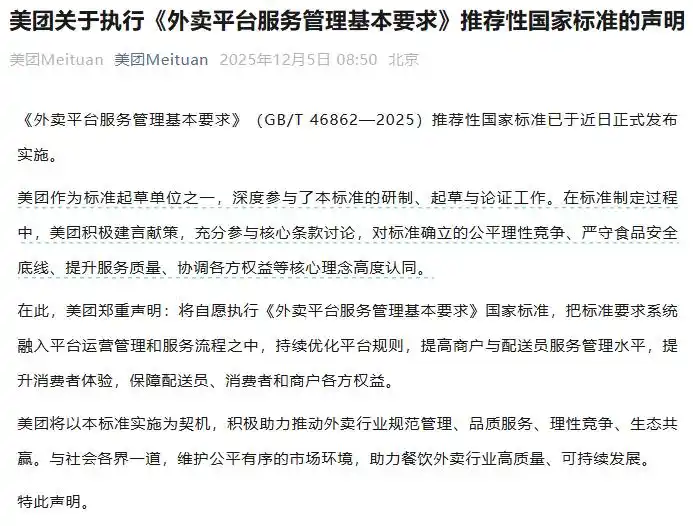
外卖“新国标”来了!新在哪?(附一图读懂)
Xin Hua She· 2025-12-05 05:22
Core Viewpoint - The newly implemented national standard for food delivery platforms aims to enhance management practices, improve service quality, and foster a win-win situation for all stakeholders in the food delivery industry [1]. Group 1: Industry Standards - The standard addresses prominent issues within the food delivery sector, focusing on merchant management, food safety responsibilities, and consumer protection [1]. - It emphasizes the importance of food safety, urging platforms to take responsibility for ensuring the safety of food delivered to consumers [1]. Group 2: Market Competition - The standard aims to simplify fee structures and regulate promotional activities to create a fair and orderly competitive environment within the market [1]. - By addressing these aspects, the standard seeks to promote healthy competition and innovation in the food delivery industry [1]. Group 3: Labor Rights - The standard also focuses on labor management, particularly concerning the rights and protections of delivery personnel, including aspects like remuneration, working hours, and social security [1]. - This initiative is intended to strengthen the protection of delivery workers' rights and improve their working conditions [1].
美团将执行《外卖平台服务管理基本要求》
Di Yi Cai Jing· 2025-12-05 02:12
Core Viewpoint - The market regulatory authority has approved the release of a recommended national standard for food delivery platform service management, focusing on platform fees, promotional activities, competition order regulation, and delivery personnel rights protection [1] Group 1 - The new national standard titled "Basic Requirements for Food Delivery Platform Service Management" has been officially approved [1] - The standard emphasizes the regulation of platform fees and promotional behaviors to enhance competition order [1] - The standard also aims to strengthen the protection of delivery personnel's rights [1] Group 2 - Meituan, as one of the drafting units, has announced its commitment to implement the national standard [1] - Meituan has been deeply involved in the research, drafting, and validation of this standard [1]
外卖“新国标”,立下了哪些“新规矩”?
Yang Shi Xin Wen· 2025-12-05 01:08
Core Viewpoint - The newly implemented "New National Standard" for food delivery platforms aims to address various issues related to the rights of delivery riders and small restaurant businesses, while enhancing the overall governance of the food delivery market [1][2][4][5]. Group 1: Focus Areas of the New Standard - The standard emphasizes the need for platforms to take responsibility for the qualification review of merchants and to protect the fair trading rights of merchants, as well as the rights of delivery riders [1][2]. - It aims to fill gaps in existing regulations by providing detailed guidelines for service management in the food delivery sector, thus promoting better governance [1][3]. Group 2: Platform Responsibilities and Governance - The standard highlights that the responsibility for market governance should not rest solely on the platforms, but requires collaboration from various societal forces [2]. - Platforms are required to implement their responsibilities actively, and regulatory bodies must ensure compliance with the new standards, rewarding compliant platforms and addressing those that fail to meet requirements [2]. Group 3: Technology and Future Directions - The standard sets a baseline for platform responsibilities and encourages the use of technology, such as big data and artificial intelligence, to develop risk identification models for better governance [3]. - It suggests that successful practices from the implementation of the standard could eventually evolve into mandatory legal requirements, contributing to a dynamic regulatory framework [3]. Group 4: Protection of Delivery Riders' Rights - The standard plays a crucial role in enhancing the protection of delivery riders' rights, addressing issues such as income security, rest time, and safety [4]. - Specific provisions include prohibiting excessive fines for delays and ensuring that riders are not pressured into unsafe behaviors, such as running red lights [4]. Group 5: Safeguarding Small Restaurant Businesses - The standard responds to concerns regarding the rights of small restaurant businesses, which often face disadvantages when negotiating with larger platforms [5]. - It prohibits platforms from coercing small merchants into financial contributions for promotional battles and mandates transparency in fee structures, thereby balancing power dynamics [5].