大宗商品市场分化

Search documents
金价一年创50多次历史新高
Sou Hu Cai Jing· 2026-01-01 13:04
Group 1 - The commodity market in 2025 shows a clear divergence, with precious metals leading and the energy sector under pressure [1] - Gold prices have reached over 50 historical highs, outperforming major US stock indices and the US dollar index [1] - Key driving factors for gold's performance include central bank purchases, a favorable environment due to Federal Reserve interest rate cuts, a resurgence in currency devaluation trades, and an influx of ETF funds [1] Group 2 - Silver has significantly outperformed gold, with COMEX silver futures increasing more than twice as much as gold in 2025 [1] - The overall commodity sector is facing challenges, particularly with crude oil prices remaining weak [1] - Both WTI and Brent crude oil futures have seen declines approaching 20% [1]
疯狂的金银,进击的铜锂,失意的原油
Hua Er Jie Jian Wen· 2025-12-31 23:18
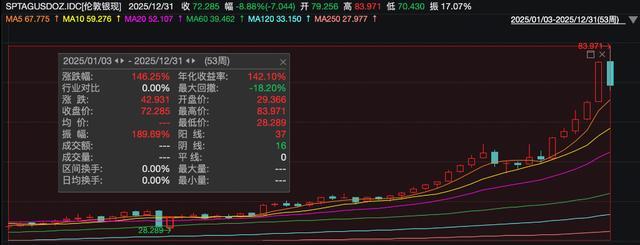
Core Insights - The commodity market in 2025 exhibited a historic divergence, with precious metals leading a significant bull market while energy and agricultural products faced a bear market [1][2]. Precious Metals - Silver surged over 146%, marking the largest annual increase in history, while gold rose more than 60%, achieving its strongest performance since 1979 [1][3]. - The price of silver reached a historical high of approximately $83 per ounce, driven by factors such as policy revaluation, supply constraints, industrial demand, and increased investment demand due to geopolitical risks [3]. - Gold prices also hit a record of $4,550 per ounce, with predictions suggesting it may challenge the $5,000 mark by Q1 2026, influenced by geopolitical risks and central bank purchases [5]. Industrial Metals - Copper experienced a nearly 44% increase, reaching a historical high of $12,960 per ton, supported by structural changes in market dynamics and supply constraints [2][8]. - Other industrial metals also showed strong performance, with aluminum rising 17% and tin prices increasing due to supply disruptions [10]. Lithium Market - Lithium carbonate prices rebounded strongly in 2025, with an annual increase of over 50%, driven by improved supply-demand dynamics in the electric vehicle and energy storage sectors [11]. Energy Market - The energy sector faced challenges, with WTI crude oil prices declining over 15%, marking the largest annual drop since 2020, due to oversupply concerns from non-OPEC+ countries [12][13]. - Analysts predict that the oversupply situation will persist into 2026, with oil prices expected to fluctuate between $50 and $70 per barrel unless significant supply disruptions occur [12]. Agricultural Products - The agricultural market struggled, with cocoa prices plummeting 48% due to a shift from supply tightness to abundance [15]. - Other agricultural commodities like raw sugar and robusta coffee also faced downward pressure, while soybeans showed slight gains [15].

原油供需仍偏向过剩 期货盘面仍将继续偏弱运行
Jin Tou Wang· 2025-12-29 06:02
Group 1 - The domestic futures market for energy chemicals shows mixed performance, with crude oil futures experiencing a downward trend, closing at 441.5 yuan per barrel, down 2.10% from the previous session [1] - Analysts from Everbright Futures indicate that the commodity market is experiencing significant differentiation, with traditional energy prices continuing to decline due to a loose supply-demand balance, while safe-haven metals and resource commodities are gaining traction amid ample market liquidity [2] - Hualian Futures notes that despite high U.S. crude oil production and increased OPEC+ output, global oil inventories remain elevated, leading to an overall oversupply in the crude oil market, although geopolitical factors should be monitored closely [2] Group 2 - Ningzheng Futures highlights investor concerns over global supply surplus and the potential for a peace agreement between Ukraine and the U.S., which has contributed to a decline in international oil prices by over 2% [3] - The overall sentiment in the market remains bearish, with expectations that even if the Russia-Ukraine conflict is resolved, Russia will not significantly increase oil supply in the short term, adhering to OPEC+ targets [3]
美国政府停摆38天,竟引发大宗商品市场裂变!油价、铜价、黄金的三角谜题
Sou Hu Cai Jing· 2025-11-14 04:53
Group 1: Oil Market Dynamics - A significant change in the price spread between the near-term and long-term WTI crude oil contracts has occurred, with the long-term contract price exceeding the near-term for the first time since February, indicating a "contango" structure and a clear signal of oversupply [1] - OPEC's latest report acknowledges a shift in the global oil market from under-supply to oversupply in Q3, with daily supply exceeding demand by 500,000 barrels, driven by record-high U.S. oil production and OPEC's decision to increase output to maintain market share [3] - The U.S. Energy Information Administration (EIA) has raised its forecast for U.S. crude oil production to 13.58 million barrels per day by 2026, heightening concerns over inventory accumulation [3] Group 2: Commodity Market Trends - The market has reacted negatively to the oil sell-off, with WTI crude futures dropping 4.2% to $58.49 per barrel, marking the largest decline since June, while copper prices rose 1.08% to $10,944 per ton, reflecting a divergence in commodity market trends [3] - The ongoing U.S. government shutdown has delayed key economic data releases, leading to expectations of weaker economic indicators that may prompt the Federal Reserve to lower interest rates in December, which in turn has weakened the dollar and supported copper prices [5] - The global copper supply is under pressure due to production issues in major mines, with the International Copper Study Group (ICSG) predicting a 150,000-ton shortage in global copper supply by 2025, reinforcing upward price momentum [5] Group 3: Gold Market Insights - Gold's appeal as a safe-haven asset has been amplified by expectations of Federal Reserve rate cuts and ongoing geopolitical uncertainties, with global gold ETF holdings reaching a five-year high of 3,892 tons in October [7] - Central banks, particularly in emerging markets, are increasing gold reserves to reduce reliance on the dollar, with annual purchases expected to remain between 70-80 tons over the next two years, providing long-term support for gold prices [7] - The divergence in price movements among oil, copper, and gold is attributed to differing driving factors, with oil prices being more directly influenced by supply-demand fundamentals, while copper and gold are supported by financial attributes and supply constraints [8][10]

大宗商品市场分化加剧!农产品期货涨跌互现,原油震荡跌破66美元
Sou Hu Cai Jing· 2025-07-28 06:35
Group 1: Commodity Market Overview - The commodity market is experiencing complex trends, with significant divergence in agricultural futures across different exchanges [1] - Oil prices are showing frequent fluctuations, indicating ongoing market attention to supply and demand dynamics [1] - Precious metals are also undergoing price adjustments, with investor sentiment oscillating between safe-haven demand and economic expectations [1] Group 2: Agricultural Futures Market - The Intercontinental Exchange (ICE) agricultural futures show mixed performance, with raw sugar futures down 1.75% to 16.28 cents/pound and cotton futures down 0.70% to 68.23 cents/pound on July 25 [3] - Cocoa futures increased by 2.62% to $8,337.00/ton, while coffee futures fell by 2.30% to 297.85 cents/pound [3] - The Chicago Board of Trade (CBOT) also saw price adjustments, with soybean futures down 0.24% to 1,021.75 cents/bushel, corn futures down 0.42% to 419.00 cents/bushel, and wheat futures down 0.42% to 539.25 cents/bushel on July 25 [3] Group 3: Oil Market Dynamics - WTI crude oil futures are showing a volatile trend, closing at $65.16/barrel on July 26, down 1.32%, with a weekly decline of approximately 1.35% [4] - Brent crude oil futures also fell by 1.07% to $68.44/barrel, with a weekly drop of 1.21% [4] - The price fluctuations indicate a cautious market sentiment, with WTI crude oil prices hovering around $65/barrel, remaining below the $70/barrel threshold, reflecting complex changes in supply and demand fundamentals [4]