
央国企市值管理

Search documents
公用事业行业研究:算电融合+两会临近+低配低估,电力行情超前演绎
SINOLINK SECURITIES· 2026-03-01 08:21
Investment Rating - The industry is rated as "Buy" with an expected increase of over 15% in the next 3-6 months [4]. Core Insights - The integration of computing power and electricity, the upcoming Two Sessions, and the low allocation and undervaluation of the sector are driving increased attention and investment momentum [1]. - The report outlines a three-phase investment rhythm: the current phase focusing on coal price increases driven by electricity demand elasticity, the second phase around the first quarter report focusing on stable performance in thermal power, and the third phase during the flood season from April to June focusing on hydropower [1]. - The report emphasizes that the performance of coal and thermal power companies will be the core driver of the sector, with a focus on earnings per share (EPS) upgrades and valuation increases during the rising coal price phase [1]. Summary by Sections Coal Sector - Emphasis on the elasticity of electricity demand and feedback on coal prices, with key companies including Yancoal Energy, China Shenhua, and Shaanxi Coal [3]. - The first half of the year is expected to see high growth in electricity demand due to a low base, particularly in energy-intensive manufacturing sectors [2]. - The report highlights the potential for coal power generation to exceed expectations due to low base effects and increased demand from overseas data centers [2]. Thermal Power Sector - Assessment of market-oriented trading and new capacity pricing policies impacting Q1 performance stability, with a focus on the public utility nature of thermal power [3]. - Companies such as Sheneng Shares, Huaneng International Power, and Guodian Power are highlighted for their stable dividend value despite current challenges [3]. Hydropower Sector - Monitoring of hydrological data improvements during the main flood season, which may elevate performance expectations, with companies like State Power Investment Corporation and Yangtze Power being of interest [3]. Central State-Owned Enterprises - Attention to the marginal changes in market value management and capital operations of large central state-owned enterprises, including Guiguan Power and Huadian International [3].
重视统一电力市场,煤与煤电+市值管理
Zhong Guo Neng Yuan Wang· 2026-02-25 02:48
Core Viewpoint - The electricity reform has entered a new stage, emphasizing the establishment of a unified electricity market system by 2030, with market-based trading accounting for approximately 70% of total electricity consumption by then [2] Group 1: Electricity Market Reform - The State Council issued the "Implementation Opinions on Improving the National Unified Electricity Market System," highlighting the goal of basic establishment by 2030 and a market-based trading electricity share of around 70% by 2030, up from 64% by the end of 2025 [2] - The reform is structured in three phases: government pricing, market-based trading, and a unified electricity market, with the current phase being the third [2] - The report suggests that future trading will involve cross-regional, cross-source, and cross-grid transactions, utilizing various market types to realize the value of electricity, capacity, auxiliary services, and environmental benefits [2] Group 2: Coal and Electricity Demand - There is a focus on the elasticity of coal demand in the first half of the year, with expectations of high growth due to a low base effect, particularly in energy-intensive manufacturing sectors [3] - The report anticipates that coal-fired electricity generation may also see high growth in the first half of the year, as the base for coal-fired generation in early 2025 is relatively low, with a year-on-year decline of 2.15% [3] - The demand for coal may be further driven by the growth of overseas data centers and industrialization, potentially leading to increased coal consumption and tighter import coal supplies [3] Group 3: Investment Opportunities - The report emphasizes the importance of coal demand elasticity and coal price feedback, recommending attention to companies like Yanzhou Coal Mining, China Shenhua Energy, and Shaanxi Coal and Chemical Industry [4] - For thermal power, the stability of Q1 performance under new market trading and capacity pricing policies is assessed, with a focus on dividend stability in the current market environment [4] - The report highlights investment opportunities in state-owned enterprises with a market capitalization around 60 billion, such as Guiguan Electric Power and Huadian International [5]
公用事业行业研究重视统一电力市场,煤与煤电+市值管理
SINOLINK SECURITIES· 2026-02-24 00:30
Investment Rating - The industry investment rating is not explicitly stated in the provided documents, but it can be inferred that there is a positive outlook for coal and power generation sectors based on the analysis of demand elasticity and market conditions [5]. Core Insights - The electricity reform has entered a new phase, emphasizing the establishment of a unified national electricity market, with a target for market-based trading to account for approximately 70% of total electricity consumption by 2030 [2]. - There is a focus on the demand elasticity of coal in the first half of the year, with expectations of high growth in electricity consumption due to a low base effect, particularly in energy-intensive manufacturing sectors [3]. - The report highlights the potential for coal power generation to benefit from a low base in the first half of the year, with a projected increase in coal power generation despite competition from renewable sources [3]. - The report suggests that the demand for coal may exceed expectations due to the growth of overseas data centers and industrialization, which could lead to tighter import coal supplies [3]. - There is an emphasis on the importance of value management for state-owned enterprises, particularly those with market capitalization around 60 billion, indicating a focus on capital operations and market positioning [4]. Summary by Sections Electricity Market Reform - The government aims to complete the national unified electricity market system by 2030, with a phased approach transitioning from government pricing to market-based trading [2]. - Key aspects include optimizing resource allocation, encouraging participation from all types of power sources, and improving governance to prevent market manipulation [2]. Coal and Power Generation - The first half of the year is expected to show high growth in coal power generation due to a low base from the previous year, with a significant decline in coal power generation in early 2025 [3]. - The report identifies specific companies such as Yanzhou Coal Mining Company, China Shenhua Energy, and Shaanxi Coal and Chemical Industry as key players to watch in the coal sector [3]. State-Owned Enterprises - There is a focus on enhancing the market value management of large state-owned enterprises, with specific attention to companies like Guizhou Power and Huadian International [4]. - The report suggests monitoring hydropower performance during the flood season and the impact of market fluctuations on investment strategies [4].
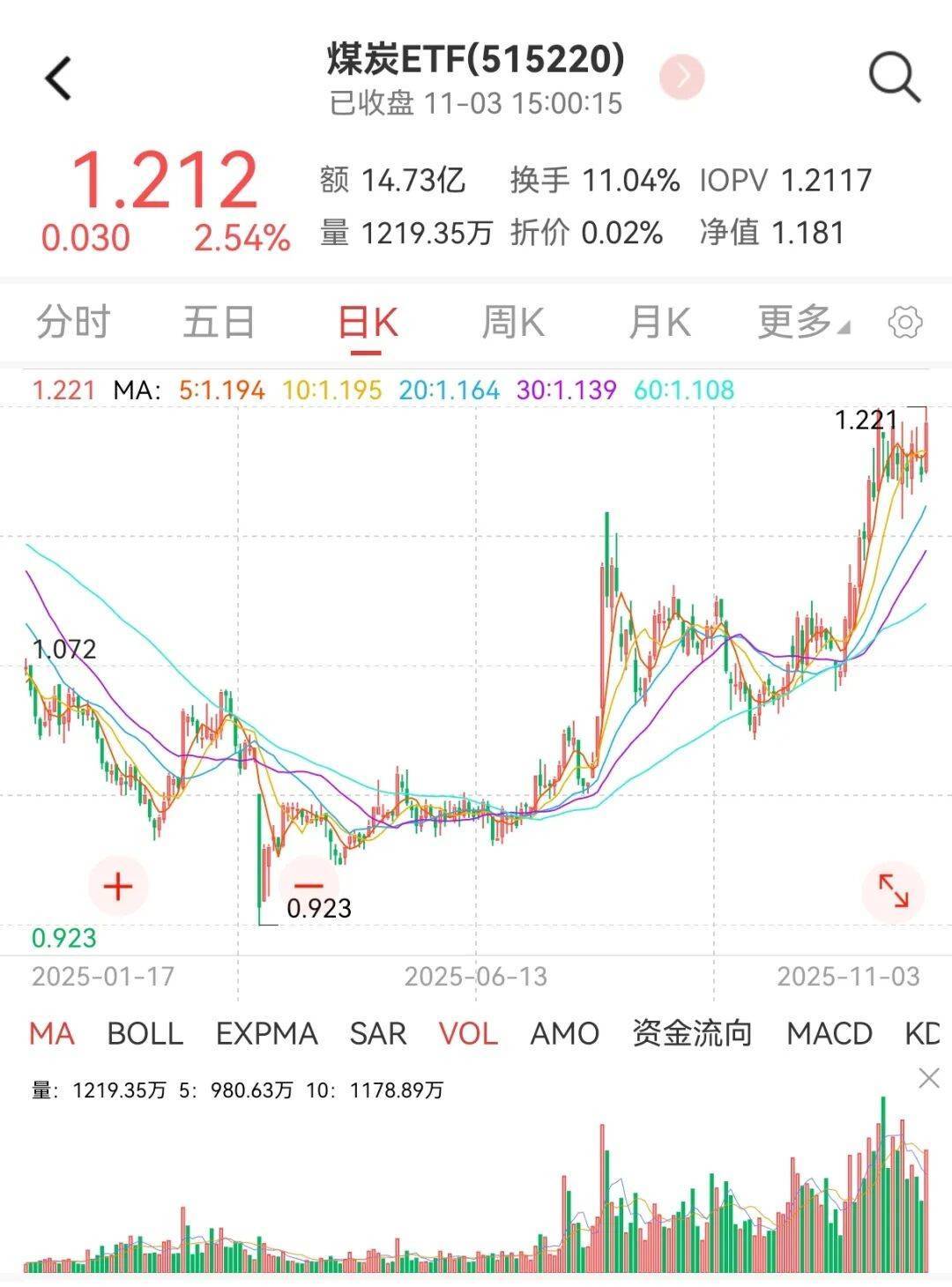
动力煤和焦煤价格同步走强,关注煤炭ETF(515220)
Sou Hu Cai Jing· 2025-11-04 01:15
Group 1 - The core viewpoint is that the coal market is experiencing a price rebound due to seasonal demand and supply constraints, with expectations of a shift in the supply-demand balance in the fourth quarter [2][4] - Both thermal coal and coking coal prices have strengthened since June, driven by a decrease in inventory at northern ports and increased replenishment demand [2] - On the supply side, strict safety and environmental regulations have limited coal production, with expectations of marginal increases in national raw coal output being unlikely in the fourth quarter [2] Group 2 - The demand side is bolstered by the upcoming winter heating season, leading to increased replenishment efforts from large power plants and downstream users, resulting in significant declines in port and on-site inventories [2] - The coal sector is characterized by strong defensive and high elastic properties, making it suitable for investment, especially with the potential for both performance and valuation recovery in the fourth quarter [4] - The coal sector benefits from a favorable valuation, strong dividend yield, and a supportive macroeconomic environment, including relaxed fiscal policies and state-owned enterprise market management strategies [4]

11月3日大盘简评
Mei Ri Jing Ji Xin Wen· 2025-11-03 12:11
Market Overview - The A-share market showed a rebound today, with the Shanghai Composite Index rising by 0.55% to 3976.52 points and the Shenzhen Component Index increasing by 0.19% to 13404.06 points. The total trading volume exceeded 2.1 trillion yuan, with over 3500 stocks gaining. The market sentiment is shifting from profit improvement expectations to verification of profit improvements, indicating a change in market style. A-shares remain undervalued compared to global markets, and the liquidity is expected to improve as the USD enters a rate-cutting cycle, maintaining a slow bull market outlook for A-shares [1]. Coal Industry - The coal industry saw an increase of 2.52% today. The fundamentals suggest that coal supply will strengthen in Q4, with resilient demand, making coal prices likely to rise. The coal sector has strong valuation certainty and significant dividend advantages, and as coal prices and performance elasticity materialize, the sector may benefit from a Davis double effect. In the medium to long term, the industry is expected to benefit from favorable factors such as "anti-involution" and state-owned enterprise market value management. It is recommended to pay attention to the Coal ETF (515220) for investment opportunities [1]. Hong Kong Stock Market - The Hong Kong stock market rose by 0.97% to 26158.36 points, with a general strength in new energy vehicle companies. Sector-wise, the valuations of information technology, consumer discretionary, and utilities in the Hong Kong market are relatively low compared to A-shares and US stocks. The Hang Seng Technology Index offers good value. With external liquidity improving and capital inflows supporting the market, the outlook for Hong Kong stocks remains positive. It is recommended to continue allocating to the Hong Kong Technology ETF (513020) and the Hong Kong Stock Connect 50 ETF (159712) [1]. Photovoltaic Industry - The Photovoltaic 50 ETF (159864) increased by 3.73% today. Recently, 17 leading polysilicon companies are set to establish a joint platform, marking substantial progress in supply-side reforms. The recent quarterly reports from major companies in the photovoltaic supply chain show a continuous narrowing of losses, with several leading firms exceeding performance expectations for Q3 2025. Policy-wise, the "14th Five-Year Plan" suggests unifying market rules to eliminate local protectionism and market fragmentation, addressing "involution" competition. The combination of policy support, market clearing, and technological iteration is expected to support the industry’s return to healthy operations. The end of the year may serve as a critical observation point for the implementation of "anti-involution" policies, with potential developments in silicon material mergers and production limits. Investors interested in this sector should keep an eye on the Photovoltaic 50 ETF (159864) [2]. Technology Sector - As Q4 begins, the sentiment for technology growth has fluctuated, leading to increased market volatility and a retreat in equity risk appetite, with some funds shifting from aggressive to defensive strategies. The dividend index, which has a high resource weight, is more sensitive to the leading gains in coal and oil & gas sectors. In the short term, the value of dividend-style allocations is highlighted during market fluctuations. In the long term, the new "National Nine Articles" guidance, combined with a decline in risk-free yields, indicates a higher allocation value for dividend assets. The Dividend State-Owned Enterprise ETF (510720) and Cash Flow ETF (159399) are recommended for ongoing evaluation of dividends [2].
★价值创造为本 治理优化为基 战略升级为径 央国企强化市值管理加速估值重塑
Zhong Guo Zheng Quan Bao· 2025-07-03 01:56
Core Viewpoint - Central state-owned enterprises (SOEs) are actively implementing value management strategies to enhance their market capitalization and overall company value, transitioning from policy advocacy to practical execution [1][2][4]. Group 1: Central SOEs' Value Management Initiatives - Multiple central SOEs, including State Grid and China Huaneng, have held performance briefings emphasizing "value management" and "company value" as key themes [1]. - China Huaneng has increased its shareholding in its listed companies four times over the past two years, with a total market capitalization exceeding 300 billion yuan [2]. - China Electric Power Construction has set a core goal of addressing "net asset value issues" and is systematically advancing its value management plan [2]. Group 2: Local Government Support for Value Management - Local governments in Shanghai, Fujian, and Jilin have introduced policies to incorporate value management into the economic development strategies of state-owned enterprises [3]. - Shanghai's recent action plan aims to enhance the value management systems of state-controlled listed companies [3]. - Fujian's measures have integrated value management into the performance assessment of state-owned listed companies, marking a shift from "soft constraints" to "hard indicators" [3]. Group 3: Market Outlook and Future Expectations - Analysts predict that the value management efforts of central SOEs will accelerate in the second half of the year, particularly for those companies with net asset value issues [5]. - The ongoing value management initiatives are expected to create new opportunities for the revaluation of central SOEs in the capital market [4][5]. - Companies that actively engage in value management are likely to gain market favor, while those that do not may face increased pressure [6].
系统综合施策 推动央国企上市公司做好市值管理
Shang Hai Zheng Quan Bao· 2025-06-06 19:07
Core Insights - Central state-owned enterprises (SOEs) are accelerating their market value management efforts to enhance both intrinsic and market value, although some companies are still in the learning phase [2][3] Group 1: Importance of Market Value Management - Market value management serves national strategies and promotes high-quality economic development, aligning SOEs' growth with national strategic goals [3] - It enhances enterprise value and ensures the preservation and appreciation of state-owned assets through optimized resource allocation and improved operational efficiency [3][4] - Effective market value management can stabilize market expectations and boost investor confidence, especially during market volatility [4] Group 2: Policy Evolution - The evolution of market value management policies for central SOEs reflects the adjustment of national economic strategies and the needs of capital market development, progressing through three stages from 2004 to the present [5] - The current phase emphasizes formal regulations and high-quality development, with recent guidelines from regulatory bodies providing clearer directives for SOEs [5] Group 3: Assessment Indicators - The assessment framework for market value management includes over 20 indicators categorized into value creation and value realization, covering various aspects of corporate performance [6][10] - Key indicators for value creation focus on fundamental performance metrics and growth rates, while value realization indicators assess market performance and investor relations [8][11] Group 4: Implementation Strategies - Establishing a scientific organizational structure for market value management is crucial, including the formation of dedicated committees and project management offices [14][15] - Engaging professional market value management service providers can enhance the effectiveness of strategies and ensure comprehensive understanding of the current situation [16] - Implementing assessment-driven strategies is essential for achieving key performance indicators related to profitability, asset management, and operational efficiency [17] Group 5: Comprehensive Strategies - Optimizing resource allocation to enhance intrinsic value is fundamental, focusing on core business areas and improving operational efficiency [20] - Strengthening investor relations through multi-channel communication mechanisms is vital for enhancing market recognition and investor confidence [21] - Utilizing market value management tools effectively, such as stock buybacks and dividend policies, can maximize enterprise value [22] - Emphasizing long-term value creation and aligning market value management with long-term corporate strategies is essential for sustainable growth [23] - Building a professional talent pool to support market value management initiatives is necessary for sustainable development [24] - Leveraging technology to enhance management efficiency and support data-driven decision-making in market value management is increasingly important [25]
突发!600190停牌预退市!央国企市值管理放大招,这16只潜力股要火?
Zheng Quan Shi Bao Wang· 2025-05-29 23:53
Group 1 - *ST Jinguang (600190) will be subject to mandatory delisting due to major violations, with trading suspension starting from May 30, 2025 [2] - The company was found to have inflated profits through false trade activities and misreporting, with inflated profits of 36.10 million yuan in 2022, 68.09 million yuan in 2023, and 15.38 million yuan in Q1 2024 [2] - The stock will enter a delisting transition period for 15 trading days after the delisting decision, followed by a five-day period before being officially delisted [2] Group 2 - Central state-owned enterprises (SOEs) are accelerating market value management, with several companies releasing market value management systems [4] - Local and enterprise-level efforts are expected to enhance the pace of market value management, particularly for low-priced and low-market-cap companies, by the second half of 2025 [4] - 16 potential stocks have been identified based on criteria of stock price below 8 yuan and market capitalization below 8 billion yuan [5] Group 3 - Jishi Media, a local state-owned enterprise, is focusing on strategic emerging industries and digital transformation to enhance its asset scale and profitability [5][6] - The company reported a revenue of 499 million yuan in Q1, a year-on-year increase of 23.14%, marking the highest growth rate since its listing [7] - The company is actively collaborating on digital infrastructure projects to boost its capabilities in various sectors [6] Group 4 - Two potential stocks, Liyuan New Energy and ST Chenming, have seen continuous institutional buying over the past two years, with significant net purchases recorded [8] - Liyuan New Energy focuses on wind and solar power generation, with a notable increase in social security fund holdings [8]

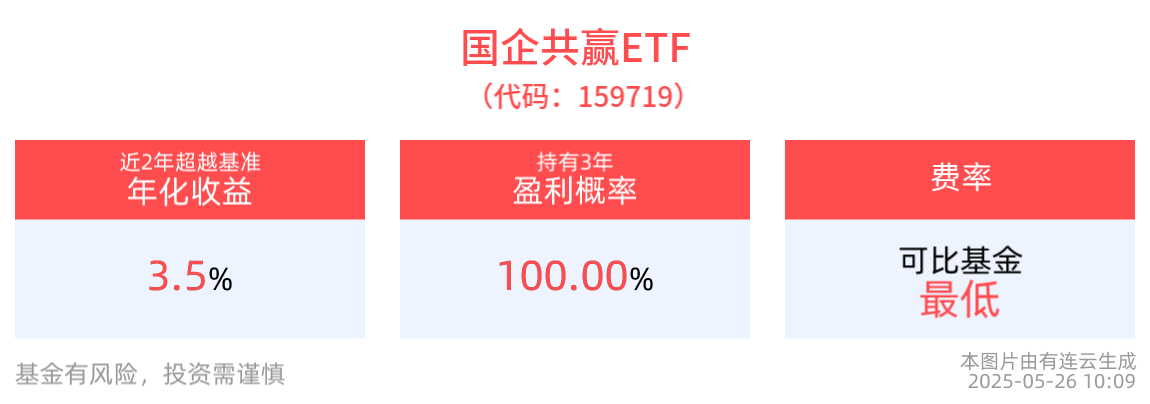
国企改革迎来关键时期!国企共赢ETF(159719)盘中翻红,大湾区ETF(512970)震荡
Sou Hu Cai Jing· 2025-05-26 02:34
Group 1: National Enterprise Reform - The core viewpoint is that 2025 is expected to be a pivotal year for state-owned enterprise (SOE) reform, with significant advancements anticipated in market-oriented transformations [2] - Recent meetings held by major central enterprises, including State Grid and China Huaneng, have focused on promoting company value and implementing market-oriented value management systems [2] - Policies from regions like Shanghai and Fujian are encouraging enterprises to enhance their market value management, indicating a shift from policy advocacy to practical implementation [2] Group 2: ETF Performance - As of May 26, 2025, the National Enterprise Win-Win ETF (159719) has seen a slight increase of 0.13%, with a weekly rise of 0.40% as of May 23 [1] - Over the past three years, the net value of the National Enterprise Win-Win ETF has increased by 44.35%, placing it in the top 3.74% of its category [1] - The Greater Bay Area ETF (512970) has experienced a decline of 0.42% recently, but its net value has risen by 19.73% over the past five years [4] Group 3: Index Tracking - The National Enterprise Win-Win ETF closely tracks the FTSE China National Enterprise Open Win-Win Index, which reflects the performance of Chinese state-owned enterprises listed in mainland China and Hong Kong [5] - The index consists of 100 constituent stocks, including 80 A-share companies and 20 companies listed in Hong Kong, focusing on globalization and sustainable development [5] - The Greater Bay Area ETF tracks the CSI Guangdong-Hong Kong-Macau Greater Bay Area Development Theme Index, with the top ten weighted stocks accounting for 53.26% of the index [7][9]
南财早新闻|美国与欧盟的关税谈判期限延长至7月9日;《网络交易平台收费行为合规指南》公开征求意见
2 1 Shi Ji Jing Ji Bao Dao· 2025-05-26 00:19
Company Developments - Huawei launched the Ascend Supernode technology at the Ascend AI Developer Summit, achieving high-speed interconnection with 384 cards, making it the largest supernode in the industry [6] - Zhongke Shuguang and Haiguang Information announced a strategic restructuring, marking the first absorption merger transaction following the revision of the "Management Measures for Major Asset Restructuring of Listed Companies" on May 16 [6] - Bangyan Technology decided to terminate the issuance of shares and cash for asset acquisition due to a lack of consensus among related parties, prioritizing the interests of the company and all shareholders [6] Investment News - The Hong Kong government reported that new stock fundraising exceeded HKD 76 billion this year, more than seven times the amount from the same period last year, reaching nearly 90% of last year's total [3] - CITIC Securities noted that the recent surge in A-share companies going public in Hong Kong is driven by outbound strategies, regulatory conveniences, and improved liquidity in the Hong Kong market, suggesting a potential shift in pricing power for core assets [3] - Over 130 A-share companies have received foreign institutional research in May, with companies in electronics, integrated circuits, industrial machinery, and pharmaceuticals being particularly favored [3] Market Dynamics - Several state-owned enterprises, including State Grid and China Huaneng, held collective performance briefings to promote company value, indicating a shift from policy advocacy to substantive implementation of market value management [4] - Sixteen fund companies, including E Fund and Huaxia, announced the issuance of floating-rate fund products, set to begin on May 27, with most products closing for subscription in mid-June [4] - Three new stocks are available for subscription this week, with Youyou Green Energy's offering price at CNY 89.60 per share, making it the second-highest IPO price in A-shares this year [5]