
农副食品

Search documents
2026年1-2月经济数据:投资升、生产强、消费稳
Donghai Securities· 2026-03-16 12:18
Economic Overview - In January-February 2026, the total retail sales of consumer goods increased by 2.8% year-on-year, up from 0.9% in the previous period[2] - Fixed asset investment (FAI) showed a cumulative year-on-year increase of 1.8%, reversing from a decline of 3.8% previously[2] - The industrial added value of enterprises above designated size grew by 6.3% year-on-year, surpassing the previous value of 5.2%[2] Investment Insights - The rebound in investment growth is a key highlight, supported by policies from the last quarter of the previous year and early implementation of this year's policies[2] - Infrastructure investment surged to 11.4% growth, driven by major projects and fiscal policies[3] - Manufacturing investment returned to positive growth at 3.1%, with equipment updates and high-tech manufacturing leading the way[3] Consumption Trends - Service consumption showed strong performance with a cumulative year-on-year growth of 5.6%, benefiting from the Spring Festival effect[2] - Excluding automobiles, retail sales of consumer goods showed resilience, with significant growth in categories like communication equipment (17.8%) and office supplies (5.8%)[2] - The retail growth of gold and jewelry reached 13.0%, indicating a recovery in luxury consumption[2] Risks and Considerations - Potential risks include the possibility of policy implementation falling short of expectations and geopolitical tensions affecting market stability[3]
这两个0.2% 传递什么信号?
Ren Min Ri Bao· 2026-02-14 03:12
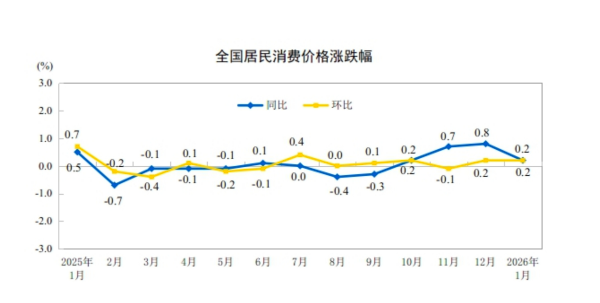
Core Insights - The Consumer Price Index (CPI) in January showed a month-on-month increase of 0.2% and a year-on-year increase of 0.2%, indicating a positive signal of recovering consumer demand and steady market potential [1] - The core CPI rose by 0.3% month-on-month, marking the highest increase in six months, reflecting a sustained recovery trend in the domestic consumption market [1] - The year-on-year mild increase in CPI is attributed to multiple positive factors, showcasing an optimized consumption structure and the dual growth of service consumption and upgraded goods [1] Detailed Summary - The core CPI, which excludes food and energy prices, is less affected by short-term factors and better reflects the overall trend of domestic consumer demand [1] - The slight year-on-year changes in CPI are evident in various market details, such as increased prices in agricultural products due to pre-holiday stocking, rising travel-related service prices driven by released tourism demand, and sustained growth in entertainment and life service consumption during the holiday season [1] - The robust performance of the core CPI serves as a "barometer" for consumption recovery, with expectations of improved employment and income, further releasing domestic demand potential as macro policies are implemented and the national unified market is developed [2]
这两个0.2%,传递什么信号?
Xin Lang Cai Jing· 2026-02-14 01:55
Group 1 - The Consumer Price Index (CPI) in January showed a month-on-month increase of 0.2% and a year-on-year increase of 0.2%, indicating a continuous recovery in consumer demand and the steady release of market potential [1] - The core CPI rose by 0.3% month-on-month, marking the highest increase in six months, reflecting a positive trend in the domestic consumption market [1] - The year-on-year increase in CPI is attributed to multiple positive factors, showcasing an optimized consumption structure and stable prices for essential goods, alongside a boost in service consumption and upgraded product spending [1] Group 2 - The stable performance of core CPI serves as a "barometer" for the recovery of consumption, with expectations of improved employment and income further releasing domestic demand potential [2]
春节错月致1月CPI同比涨幅回落,反内卷带动相关领域价格改善
Di Yi Cai Jing· 2026-02-11 04:17
Group 1: Consumer Price Index (CPI) - In January, the CPI increased by 0.2% month-on-month and year-on-year, reflecting a decrease of 0.6 percentage points compared to December [1] - The decline in CPI is attributed to the Spring Festival timing and a significant drop in energy prices, which decreased by 5.0%, impacting CPI by approximately 0.34 percentage points [3] - Core CPI, excluding food and energy, rose by 0.8% year-on-year and 0.3% month-on-month, marking the highest increase in six months, indicating a steady recovery in consumer demand [3] Group 2: Producer Price Index (PPI) - The PPI rose by 0.4% month-on-month in January, marking the fourth consecutive month of increase, with an expansion of 0.2 percentage points from the previous month [5] - Factors contributing to the PPI increase include the ongoing construction of a unified national market and rising demand in certain industries [5] - Prices in sectors such as photovoltaic, battery, cement, and steel have shown positive improvements due to the "anti-involution" policies implemented last year [5] Group 3: Industry-Specific Price Changes - In January, prices for cement manufacturing and lithium-ion battery manufacturing increased by 0.1%, continuing a four-month upward trend [5] - The price of photovoltaic equipment and components shifted from a 0.2% decrease to a 1.9% increase, while basic chemical raw materials saw a 0.7% increase [5] - The prices of non-ferrous metal mining and smelting industries rose significantly, with silver smelting prices increasing by 38.2% and copper smelting by 8.4% [6] Group 4: Future Price Trends - The National Bureau of Statistics indicates that favorable factors for moderate price recovery are accumulating, supported by policies aimed at boosting consumption and stabilizing market expectations [6] - The implementation of coordinated fiscal and financial policies is expected to gradually expand consumer demand, providing a foundation for stable price operations [6] - Emphasis on industry self-regulation and capacity management is anticipated to further enhance price recovery in key sectors [6]

新一轮村第一书记和农村工作指导员到岗
Xin Lang Cai Jing· 2026-02-04 17:28
Core Viewpoint - The article highlights the ongoing efforts of the local government in promoting rural development through the deployment of village first secretaries and rural work instructors, aiming to enhance village economies and improve the livelihoods of residents [1] Group 1: Deployment of Personnel - Since January, the city has dispatched the 14th batch of village first secretaries and rural work instructors, focusing on matching personnel with village needs based on their skills and the specific requirements of the villages [1] - A total of 304 personnel have been selected, including 38 at the provincial level, 94 at the municipal level, and 172 at the county level, primarily assigned to relatively weaker villages [1] Group 2: Economic Impact and Initiatives - In Stone Corner Village, the first secretary has leveraged local resources to enhance tourism and related industries, generating an annual income increase of 10 million yuan for 14 administrative villages and approximately 13 million yuan for surrounding businesses [2] - The "Xikou Good Products" brand has been developed to address the challenges of small and scattered agricultural products, resulting in nearly 400,000 yuan in collective income for the village [2] - In Fengyingtan Village, the first secretary has initiated a project combining traditional medicine and tea cultivation, securing 4.38 million yuan in project funding and generating 950,000 yuan in income for the collective and villagers [3] Group 3: Support Mechanisms - The city has established a mechanism where each dispatched personnel is supported by their entire unit, creating a collaborative environment for rural development [2] - The approach aims to make the assisted villages a focal point for departmental work, community feedback, and innovative practices [2]
【广发宏观王丹】1月中观景气结构暂延续前期特征
郭磊宏观茶座· 2026-02-02 06:36
Core Viewpoint - The January PMI shows a decline of 0.8 points, primarily driven by seasonal factors and a significant drop in consumer goods and high-energy industries, indicating a divergence between new and old economies [1][5][23]. Industry Analysis - **Consumer Goods**: The automotive sector, electrical machinery (including home appliances), agricultural products, chemical fibers, and textiles have all weakened. Passenger car retail sales from January 1-18 fell by 37% compared to the previous month, influenced by the expiration of tax exemptions and reduced subsidies [2][10]. - **High-Energy Industries**: The petrochemical and chemical sectors experienced a decline, with Brent crude oil prices rising from $61 per barrel at the end of 2025 to $71 per barrel by the end of January, potentially constraining downstream production [2][10]. - **Metals**: Non-ferrous and ferrous industries saw increases of 4.0 and 2.0 points, respectively, driven by global pricing expectations and pre-season stockpiling [2][10]. - **High-End Manufacturing**: Sectors such as computer communication electronics and specialized equipment improved, with increases of 6.9 and 4.7 points, respectively, driven by surging AI demand and price hikes from chip manufacturers [2][10]. Economic Divergence - The January data indicates a widening gap between new and old economies, with high-tech manufacturing and upstream raw materials showing strong performance, while consumer manufacturing and the petrochemical industry faced significant seasonal declines [5][23]. Construction Industry - The construction sector saw a significant decline of 4.0 points to 48.8, exceeding seasonal expectations. The drop was attributed to low temperatures and the upcoming Spring Festival, with residential construction declining by 3.0 points [4][16][17]. Service Industry - The service sector experienced a slight decrease of 0.2 points to 49.5, remaining in a contraction zone for three consecutive months. Financial services maintained high activity levels, while transportation and information services saw declines [21][22]. Summary - Overall, January's economic structure reflects the ongoing divergence between new and old industries, with highlights in high-tech manufacturing and upstream materials. The significant seasonal drop in consumer goods, petrochemicals, and construction sectors may explain the persistence of last year's asset trends [5][23].

出口或仍上升——实体经济图谱2026年第4周【陈兴团队·华福宏观】
陈兴宏观研究· 2026-01-25 08:06
Core Insights - In the fourth week of January, there are positive signs in terminal demand with market activity recovering, second-hand housing sales performing well, and an increase in theme park visitor numbers. However, automotive sales remain low year-on-year, and service consumption shows divergence with a lackluster film box office performance [2] Real Estate - In the first four weeks of January, new home sales in 42 cities saw a narrowing decline, improving from -25.6% to -22.5% year-on-year, while second-hand home sales in 19 cities turned positive at 13.1% from -27.7% [4] - The average sales volume of new homes in 42 cities improved to a decline of -19.5% from -34.9% the previous week, and second-hand home sales in 19 cities increased to 44.4% from -6.9% [4] Automotive - In the first 18 days of January, retail and wholesale sales of passenger cars saw an expanded year-on-year decline, with retail sales down by 28% and wholesale sales down by 35% [6] - The production of semi-steel tires increased to 74.6%, indicating potential strength in wholesale orders despite weak retail performance [8] Textile and Apparel - In December, the textile and apparel sub-industry experienced a decline in export growth, with textile yarn exports down by 4.2% year-on-year and clothing exports down by 10.2% [12] Agricultural Products - The agricultural product wholesale price index increased this week, with pork prices rising by 2.4% and egg prices by 6.3% [16] Film Industry - The film box office revenue and audience numbers both declined, with box office revenue around 280 million yuan, reflecting a year-on-year drop of 23.1% [20] Leisure and Entertainment - Theme park visitor numbers increased slightly, with Shanghai Disneyland seeing a rise to 54,000 visitors, although still down by 10.8% year-on-year [23] Employment - The national employment volume index decreased to 1.6, while the employment price index rose to 22.8, indicating a higher employment volume compared to last year but lower prices [28] Chemical Industry - The PTA industry chain saw most product prices rise, while the operating rates generally declined due to maintenance and reduced demand from downstream textile enterprises [33] Steel Industry - Steel prices and profit margins decreased, but steel production growth turned positive at 0.3%, indicating a recovery in output despite seasonal demand weakness [37] Cement Industry - National cement prices continued to decline, with a decrease in the cement enterprise capacity ratio, indicating a slowdown in production [43] Glass Industry - The average price of float glass increased slightly, but inventory levels rose, suggesting limited demand support [48] Oil Industry - Oil prices showed mixed trends, with Brent crude down and WTI crude up, influenced by geopolitical uncertainties and seasonal refinery demand [52] Non-ferrous Metals - Prices for major non-ferrous metals rose, with copper and aluminum inventories increasing, reflecting market dynamics influenced by geopolitical factors [57] Coal Industry - Thermal coal prices fell due to reduced demand from warmer weather, while coking coal prices increased, indicating mixed trends in the coal market [62] Freight Transport - In the first 18 days of January, sea freight growth increased while land transport growth declined, reflecting changes in shipping demand [64] Passenger Transport - Domestic flight operations increased, while subway passenger volumes in 20 cities showed slight declines, indicating a recovery in long-distance travel [69] Power Industry - The average daily coal consumption of major power generation groups turned positive at 6.7% year-on-year, driven by increased heating demand [73]

实体经济图谱2026年第4周:出口或仍上升
Huafu Securities· 2026-01-25 06:09
Economic Indicators - In the fourth week of January, the average new home sales in 42 cities improved from a year-on-year decline of -25.6% to -22.5%[3] - The year-on-year sales of second-hand homes in 19 cities turned positive at 13.1%, improving from a previous decline of -27.7%[3] - The average wholesale price index for agricultural products increased, with pork prices rising by 2.4% month-on-month[26] Consumer Behavior - Movie box office revenue decreased to approximately 280 million yuan, with a year-on-year decline of -23.1%[36] - The average daily visitor count at Shanghai Disneyland rose to 54,000, but the year-on-year growth turned negative at -10.8%[39] - The average daily coal consumption of six major power generation groups increased by 6.7% year-on-year, driven by colder weather in northern regions[105] Industrial Production - The operating rate of semi-steel tires remained high, while the production growth rate of sample steel mills turned positive[5] - The PTA industry chain saw most product prices rise, although the load rates generally declined[51] - The steel production growth rate for sample steel mills turned positive at 0.3% year-on-year, with inventory levels recovering[57] Transportation and Logistics - The container throughput at key ports showed a year-on-year decline, while the overall cargo throughput increased[94] - Domestic flight operations increased, indicating a recovery in air travel demand[99]
2025年山东规模以上工业增加值同比增长7.6%,高出全国平均水平1.7个百分点
Qi Lu Wan Bao· 2026-01-23 10:49
Core Insights - Shandong Province's industrial economy is projected to show stable growth and structural optimization by 2025, driven by policy support, innovation, and precise services [1][3]. Economic Performance - The industrial added value of Shandong is expected to grow by 7.6% year-on-year, surpassing the national average by 1.7 percentage points [3]. - The manufacturing sector leads with an 8.7% growth rate, while mining and utilities sectors grow by 4.5% and 0.9% respectively, indicating a solid foundation for industrial stability [3]. Industry Highlights - Out of 41 industrial categories, 36 are expected to show year-on-year growth, maintaining a growth rate of over 85% [3]. - Key industries such as automotive, chemical raw materials, electrical machinery, general equipment, and agricultural products are projected to grow by 16.5%, 14.7%, 12.5%, 11.6%, and 10.5% respectively, showcasing a robust growth pattern [3]. New Productive Forces - The equipment manufacturing sector is anticipated to grow by 11.4%, with high-end manufacturing areas like new energy vehicles and industrial robots showing significant production increases [3]. Enterprise Support - The "Enterprise Big Visit" initiative has visited 227,000 enterprises, resolving over 11,000 development issues, enhancing the overall business environment [4]. - The "Luqin Help" service platform has effectively addressed 1,944 enterprise challenges with a completion rate of 99.1%, improving the support for businesses [4]. Future Outlook - Despite the positive growth, challenges remain due to external environmental changes and domestic supply-demand imbalances, necessitating continued focus on growth stabilization and structural adjustments [4].
行业景气度系列十:去库延续,需求仍待改善
Hua Tai Qi Huo· 2026-01-05 01:16
Report Industry Investment Rating - Not provided in the given content Core Viewpoints Manufacturing - Overall: In December, the manufacturing PMI's five - year percentile was at 57.6%, with a change of 37.3%. Four industries had their manufacturing PMI in the expansion range, 4 less than the previous month and 3 less than the same period last year [4]. - Supply: Slightly declined. The 3 - month average of the manufacturing PMI production index in December was 50.5, a 0.1 - percentage - point decrease from the previous month. Five industries showed month - on - month improvement, while 10 industries declined [4]. - Demand: Still needed improvement. The 3 - month average of the manufacturing PMI new orders in December was 49.6, a 0.4 - percentage - point increase from the previous month. Three industries showed month - on - month improvement, and 12 industries declined [4]. - Inventory: Continued destocking. The 3 - month average of the manufacturing PMI finished - goods inventory in December remained flat at 47.9. Five industries saw inventory increase, and 10 industries saw inventory decrease [4]. Non - Manufacturing - Overall: In December, the non - manufacturing PMI's five - year percentile was at 22.0%, with a change of 10.2%. Eleven industries had their non - manufacturing PMI in the expansion range, 5 more than the previous month and 1 more than the same period last year [5]. - Supply: Employment remained at a low level. The 3 - month average of the non - manufacturing PMI employee index in December was 45.5, a 0.4 - percentage - point increase from the previous month. Both the service and construction sectors increased by 0.4 percentage points [5]. - Demand: Still needed improvement. The 3 - month average of the non - manufacturing PMI new orders in December was 46.3, a 0.4 - percentage - point increase from the previous month. The service sector's new orders increased by 0.2 percentage points, and the construction sector's new orders increased by 1.7 percentage points [5]. - Inventory: Continued destocking. The 3 - month average of the non - manufacturing PMI inventory in December was 45.3, with no change from the previous month. The service sector's inventory remained unchanged, and the construction sector's inventory increased by 0.8 percentage points [5]. Summary by Directory Overview - Manufacturing PMI: In December, the manufacturing PMI's five - year percentile was at 57.6%, with a change of 37.3%. Four industries had their manufacturing PMI in the expansion range, 4 less than the previous month and 3 less than the same period last year [10]. - Non - Manufacturing PMI: In December, the non - manufacturing PMI's five - year percentile was at 22.0%, with a change of 10.2%. Eleven industries had their non - manufacturing PMI in the expansion range, 5 more than the previous month and 1 more than the same period last year [10]. Demand - Manufacturing: The 3 - month average of the manufacturing PMI new orders in December was 49.6, a 0.4 - percentage - point increase from the previous month. Three industries showed month - on - month improvement, and 12 industries declined. - Non - Manufacturing: The 3 - month average of the non - manufacturing PMI new orders in December was 46.3, a 0.4 - percentage - point increase from the previous month. The service sector's new orders increased by 0.2 percentage points, and the construction sector's new orders increased by 1.7 percentage points. Five industries showed month - on - month improvement, and 10 industries declined. Pay attention to the improvement in textiles and pharmaceuticals and the decline in petroleum [16]. Supply - Manufacturing: The 3 - month average of the manufacturing PMI production index in December was 50.5, a 0.1 - percentage - point decrease from the previous month. Five industries showed month - on - month improvement, and 10 industries declined. The manufacturing PMI employee index in December was 48.3, a 0.1 - percentage - point decrease from the previous month. Five industries showed month - on - month improvement, and 10 industries declined. - Non - Manufacturing: The 3 - month average of the non - manufacturing PMI employee index in December was 45.5, a 0.4 - percentage - point increase from the previous month. The service and construction sectors both increased by 0.4 percentage points. Eleven industries showed month - on - month improvement, and 3 industries declined. Pay attention to the decline in non - ferrous metals and农副食品 and the improvement in ferrous metals [25]. Price - Manufacturing: The 3 - month average of the manufacturing PMI ex - factory price index in December was 48.2, a 0.2 - percentage - point increase from the previous month. Seven industries saw their ex - factory prices improve, and 8 industries declined. In terms of profit, the profit trend in December increased by 0.4 percentage points, and the overall continued to converge. - Non - Manufacturing: The 3 - month average of the non - manufacturing charge price index in December was 48.3, a 0.2 - percentage - point increase from the previous month. The service sector increased by 0.3 percentage points, and the construction sector decreased by 0.2 percentage points. Eight industries showed month - on - month improvement, and 7 industries declined. In terms of profit, the profit in December remained unchanged. The service sector decreased by 0.1 percentage points, and the construction sector increased by 0.5 percentage points. Pay attention to the improvement in non - ferrous metals and the decline in petroleum [34]. Inventory - Manufacturing: The 3 - month average of the manufacturing PMI finished - goods inventory in December remained flat at 47.9. Five industries saw inventory increase, and 10 industries saw inventory decrease. The manufacturing PMI raw - material inventory in November decreased by 0.2 percentage points to 47.5. Seven industries saw inventory increase, and 8 industries saw inventory decrease. - Non - Manufacturing: The 3 - month average of the non - manufacturing PMI inventory in December was 45.3, with no change from the previous month. The service sector's inventory remained unchanged, and the construction sector's inventory increased by 0.8 percentage points. Five industries saw inventory increase, and 10 industries saw inventory decrease. Pay attention to the destocking of non - metallic products and the increase in construction inventory [42]. Main Manufacturing Industry PMI Charts - The report provides data on the PMI of various manufacturing industries, including general equipment, special equipment, automobiles, computers, motors, pharmaceuticals,农副食品, textiles, non - ferrous metals, petroleum, chemicals, ferrous metals, non - metallic products, metal products, and chemical fiber and rubber products, showing values, month - on - month changes, three - year averages, and year - on - year changes [53][54][57][58][59][66][67][68].