
居民消费率提升

Search documents
国联民生陶川:科技创新须“叫好又叫座”,三大动能驱动2026
2 1 Shi Ji Jing Ji Bao Dao· 2025-12-17 09:20
Core Insights - The core viewpoint emphasizes the necessity for technological innovation to be rooted in industrial applications, transitioning from theoretical concepts to practical implementations to drive solid economic growth [1][3]. Group 1: Economic and Market Outlook - The global economy is expected to enter a "tide receding" phase, with the end of the Russia-Ukraine conflict, a clear interest rate reduction path from the new Federal Reserve chair, and a significant decrease in trade policy uncertainty [1]. - Domestic economic growth will focus on three main drivers: enhancing industrial momentum through the establishment of a modern industrial system, boosting productivity via technological advancements, and increasing growth through consumer spending [1][2]. - These three aspects are interconnected and are anticipated to create more expectations for the capital market in 2026, opening up more space for value reassessment [1]. Group 2: Value Reassessment in A-shares - The three main sources of reassessment momentum for A-shares in 2026 include: the implementation of a modern industrial system leading to a rebound in PPI and recovery in manufacturing profits, the emphasis on practical technological applications to avoid "theoretical innovations," and the acceleration of consumer spending driven by changes in fiscal expenditure structure [2]. - The current discussions around the AI bubble in the US stock market highlight a "heavy burden" perspective, where US tech giants are expanding overseas to alleviate profit pressures, but potential triggers for a bubble burst could arise from unfulfilled commercial prospects or the Federal Reserve pausing interest rate cuts due to inflation concerns [2]. - The reassessment of A-shares this year is multifaceted, with macro-level factors such as the central government's elevated focus on the capital market and easing geopolitical tensions between the US and China contributing to the reassessment process [2]. Group 3: Key Economic Drivers - The three critical drivers for China's economy and capital market development in 2026 are: seeking momentum from industry, productivity from technology, and growth from consumer spending [3]. - It is essential for technological innovation to be effectively implemented to avoid value reassessment becoming unfounded, with investors advised to focus on the actual progress of technology transfer and industrial applications [3].

2026年宏观经济与政策展望:势启新章处:破局与再平衡-西南证券
Sou Hu Cai Jing· 2025-12-15 16:12
Group 1 - The economic growth target for 2026 is expected to remain around 5%, with an actual growth rate of approximately 4.9% and a nominal GDP growth rate rising to about 4.2% [1][12][49] - Investment in the manufacturing sector is projected to grow by 5.2% driven by high-end and intelligent upgrades, while infrastructure investment is expected to increase by 6% due to major projects [1][30] - Real estate investment is anticipated to see a narrowing decline to -10%, with a focus on stabilizing new housing supply under the "good housing" standard [33][37] Group 2 - The consumer market is expected to grow significantly, with an optimistic forecast of a 5% increase in retail sales, particularly in county-level consumption and services such as healthcare and education [1][43][51] - The CPI and PPI are projected to rebound to 0.5% and a range of -1% to 0, respectively, indicating a focus on price stability [1][12] - The policy environment will continue to be supportive, with fiscal policies maintaining a loose stance, including a budget deficit rate potentially exceeding 4% and an expansion of special bond issuance [1][2][30] Group 3 - Global capital flows are shifting towards a geopolitical orientation, with China transitioning from a recipient of foreign investment to an exporter, particularly in future industries and critical metals [2][30] - The domestic development model is shifting from "investment in things" to "investment in people," aiming for a dynamic balance between efficiency and equity, with a projected increase of nearly 8 trillion yuan in consumer scale during the "14th Five-Year Plan" [2][30] - The economic landscape is showing structural differentiation, with the U.S. experiencing a cooling job market and Europe showing varied economic strength, while emerging markets face slowing growth [2][30]


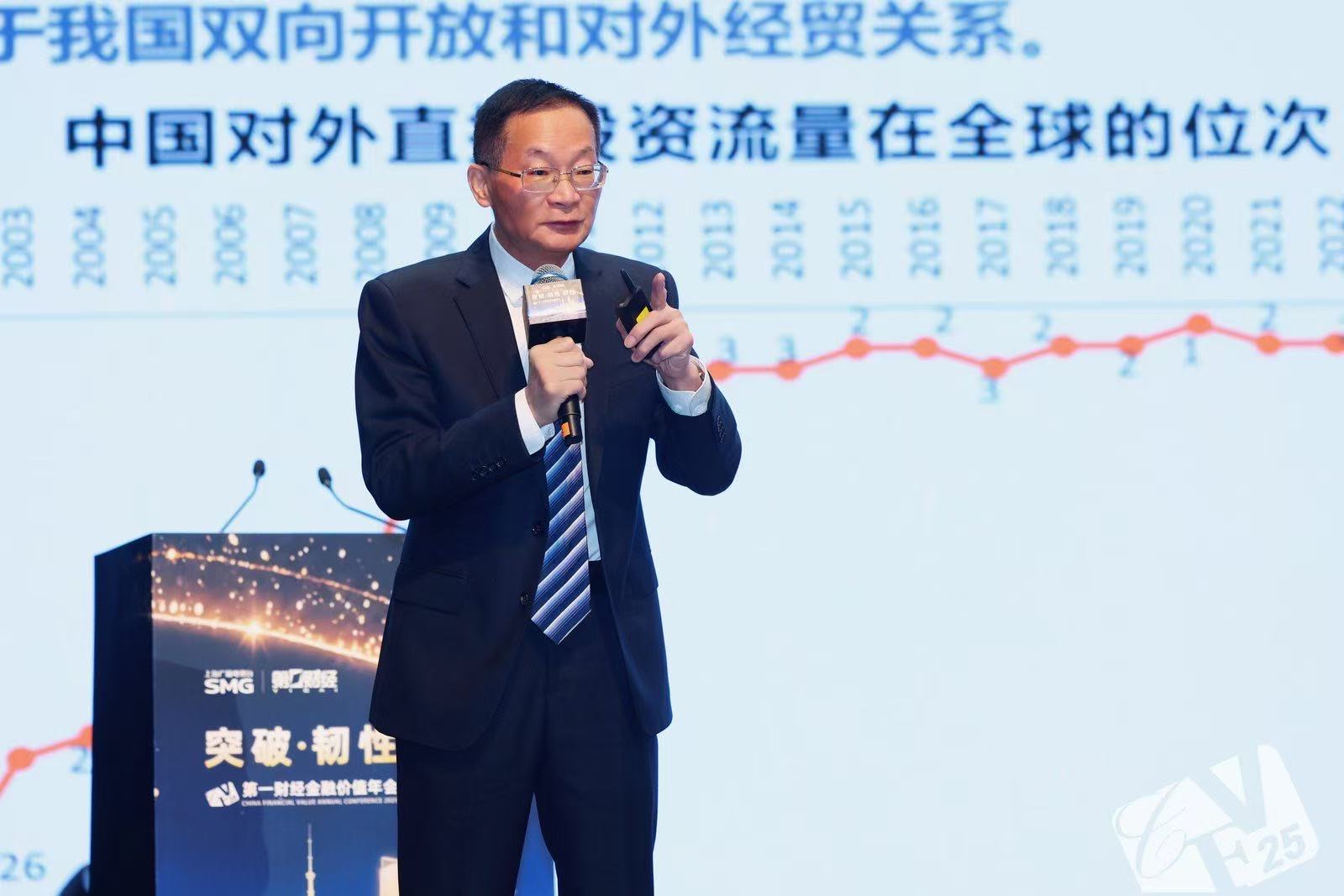
“2025第一财经金融价值年会”聚焦全球动荡中的中国经济新确定性
Di Yi Cai Jing· 2025-11-21 15:12
Group 1 - The global economy is seeking a new balance amid downward pressures and structural challenges, with geopolitical conflicts and supply chain restructuring posing significant tests [1] - The "2025 First Financial Annual Financial Value Conference" held in Shanghai focused on key topics such as the internationalization of the RMB, new trends in the Chinese economy, and paths to enhance household consumption [1] - The conference highlighted influential figures in the financial industry who have significantly impacted industry transformation and market research [1] Group 2 - Three key trends are shaping the current global landscape: deep adjustments in globalization, the rise of protectionism, and the integration of technology with the economy [2] - China is entering a "dual investment" phase, balancing both inbound and outbound investments [2] Group 3 - Since the Belt and Road Initiative, China's outbound direct investment (ODI) has rapidly increased, surpassing foreign direct investment (FDI) in 2015 and maintaining a leading position in most years [3] - The structure of China's trade partners has diversified, with exports to the US, EU, and ASEAN decreasing from 50.8% in 2019 to 45.5% in 2024, while exports to Belt and Road countries have risen to approximately 47% [3] Group 4 - The internationalization of the RMB is expected to accelerate during the 14th Five-Year Plan, with significant breakthroughs in trade settlement, payment systems, and reserve allocation over the past 16 years [3][5] - The necessity for RMB internationalization has increased due to changes in the global trade landscape and rising dollar credit risks [5] Group 5 - The new core variable of China's economy is the new quality productivity, driven by technological innovation and deep integration with the industrial chain [5] - The contribution of real estate to the economy has decreased to about 10%, while the stock market is benefiting from emerging industries and economic recovery [12] Group 6 - The long-term trend of the Chinese stock market remains upward, with investment opportunities in sectors such as innovative pharmaceuticals, new energy vehicles, semiconductors, and artificial intelligence [12] - The conference included discussions on wealth growth in a low-interest-rate environment, emphasizing a shift from single yield pursuit to long-term stable allocation strategies [12][13]
国泰海通晨报-20251105
GUOTAI HAITONG SECURITIES· 2025-11-05 05:45
Group 1: Macro Research - The "14th Five-Year Plan" emphasizes the need to significantly increase the resident consumption rate, setting a more realistic target of around 50% for the next five years [2][23][25] - The report analyzes the reasons behind the low consumption rate in China, identifying factors such as ineffective redistribution effects, limited channels for property income, and fluctuating average consumption propensity [3][25][26] - It is projected that by 2030, the resident consumption rate in China could rise to a range of 42%-47%, potentially boosting nominal GDP growth by 2.9-3.9 percentage points [3][26] Group 2: Overseas Strategy Research - Global indices mostly rose, with MSCI Global up by 0.6%, and North American holdings reaching historical highs [6][28] - The earnings expectations for U.S. tech stocks were significantly revised upwards during the earnings season, with the S&P 500's EPS forecast for 2025 adjusted to 270 [8][29] - The report highlights a recovery in economic sentiment across major markets, supported by the Federal Reserve's interest rate cuts and improved relations between China and the U.S. [8][29] Group 3: Industry Deep Dive - Semiconductor Storage Controllers - The global SSD controller market is expected to grow rapidly, with a projected market size of approximately $24.965 billion in 2024, increasing to $27.763 billion in 2025, and a compound annual growth rate of about 14.4% from 2025 to 2032 [10][11] - The industry is characterized by a coexistence of independent manufacturers and IDM firms, with independent firms holding a significant market share due to their diverse customer base and technical services [11][13] - Emerging demands from AI, data centers, automotive electronics, and industrial IoT are driving the upgrade of high-end SSD controllers, presenting new growth opportunities [10][11][13] Group 4: Industry Research - Food and Beverage - The food and beverage sector experienced a decline in revenue and net profit in Q3 2025, with revenues down 6% year-on-year and net profits down 13% [14][15] - The report indicates a significant drop in the white liquor segment, with revenues down 18% and net profits down 22% in Q3 2025, suggesting a need for market adjustments [15][16] - The beverage sector shows structural growth, with recommendations for companies like Dongpeng Beverage and Nongfu Spring, while also highlighting the resilience of beer and snack segments [14][16]