投资便利化

Search documents
【环球财经】科特迪瓦投资促进中心2021年至2025年期间累计批准私营投资额约76亿美元
Xin Hua Cai Jing· 2026-02-21 02:21
Core Insights - The Ivorian Investment Promotion Center (CEPICI) has approved a total of private investments amounting to 42,420 billion West African francs (approximately 7.6 billion USD) from 2021 to 2025, indicating strong investor confidence in Côte d'Ivoire's economic potential [1] Investment Data - In 2025, the approved private investment amount reached 8,120 billion West African francs, reflecting a year-on-year growth of 9.6% [1] - The main sectors for approved investments include services, industry, and agriculture [1] - A total of 154 investment projects were approved in 2025, slightly higher than the 146 projects approved in 2024 [1] - The number of newly registered enterprises reached 26,948, representing a year-on-year increase of 6% [1] Business Environment - The current business environment in Côte d'Ivoire continues to show positive signals [1] Future Outlook - Looking ahead to 2026, CEPICI plans to enhance investment facilitation measures, accelerate project implementation, and focus on industrial clusters and renewable energy sectors as part of the national development plan [1]
印尼 — 美国贸易协定要点一览
Xin Lang Cai Jing· 2026-02-20 11:36
Core Points - Indonesia and the United States have finalized a trade agreement that reduces U.S. tariffs on Indonesian exports from 32% to 19% [1][15] - The agreement aims to address non-tariff barriers that have disadvantaged U.S. exports [1][15] Tariff Reductions and Exemptions - Over 1,800 Indonesian products, including palm oil, coffee, and cocoa, will receive tariff exemptions [2][16] - Indonesia will eliminate tariffs on over 99% of U.S. products entering Indonesia, and both countries have agreed to remove non-tariff barriers [3][17] Key Minerals - Indonesia will lift restrictions on exports of industrial goods, including critical minerals, and enhance cooperation with U.S. companies in mining and processing [4][18] - The agreement ensures that foreign investment facilities will not face capacity overproduction and will be treated equally in terms of taxes and regulations [4][18] Procurement and Investment - Indonesia plans to import goods and services from the U.S. with a total value of up to $38.4 billion, including approximately $15 billion in energy products and $4.5 billion in agricultural products [5][19] - Indonesia is required to import specific agricultural products annually, including beef, certain fruits, rice, and ethanol [6][20] - Indonesia aims to attract at least $10 billion in direct investment from the U.S. for projects in engineering, procurement, construction, and energy development [7][21] Investment Facilitation - The agreement prohibits Indonesia from imposing restrictions on U.S. investors' equity in local companies through mining divestment requirements [8][22] - U.S. investors will be exempt from a regulation requiring natural resource exporters to retain earnings in Indonesia for a certain period, which will be reviewed within 12 months of the agreement's effectiveness [8][22] Digital Trade - Indonesia must communicate with the U.S. before signing any new digital trade agreements that could harm U.S. interests [9][24] - Indonesia is prohibited from imposing discriminatory digital service taxes on U.S. companies and cannot require U.S. digital service providers to support local news agencies through paid licensing or data sharing [10][24] - The country cannot mandate data localization for U.S. digital service providers, although regulatory authorities may access information stored abroad for oversight purposes [11][24] Bioethanol Usage - Indonesia is required to ensure that by 2028, the blending ratio of bioethanol in transportation fuels reaches a maximum of 5% [12][25] - The blending ratio is expected to increase to 10% by 2030, with a goal of reaching up to 20% when conditions allow [23][25] - Indonesia must not implement measures that obstruct U.S. bioethanol imports [25] National Security Coordination - The U.S. must notify Indonesia of any trade restrictions imposed on third countries for economic or national security reasons, and Indonesia will take equivalent measures to align with U.S. policies [13][25] - Indonesia agrees to take action against third-country companies operating within its territory that harm U.S. trade interests [13][25] - Indonesia will establish rules to combat transshipment activities aimed at evading U.S. tariffs [14][25]
海南“封关”真相:瞄准的根本不是香港,而是整个东南亚
Sou Hu Cai Jing· 2025-12-26 00:07
Core Viewpoint - The discussion around Hainan's "full island closure" indicates a strategic shift in China's economic policy, focusing on creating a manufacturing hub rather than merely a shopping paradise [1][2]. Group 1: Strategic Moves - The first strategy emphasizes "zero tariff production" rather than "duty-free shopping," transforming Hainan into a vast bonded zone for foreign investment, allowing companies to import production materials and core equipment without tariffs [4][6]. - The target clientele includes cost-sensitive high-tech and advanced manufacturing enterprises that benefit from reduced import costs [8]. - The second strategy aims to attract back production capacity that has relocated to Southeast Asia by offering zero-tariff imports and tax exemptions for processed goods entering the mainland market [9][10]. Group 2: Economic Restructuring - The new policies in Hainan are designed to counteract the trend of labor-intensive industries moving to countries like Vietnam and Indonesia, effectively creating a competitive environment for these industries to return [11]. - The third strategy positions Hainan as a "pressure testing ground" for high-standard trade liberalization and investment facilitation policies, allowing for experimentation with new regulations in a controlled environment [13]. - Hainan's ultimate goal is to become a global hub for high-end production factors and a source of emerging industries, countering external pressures for decoupling and disconnection [15].

扩大外商投资需下绣花功夫
Sou Hu Cai Jing· 2025-12-07 22:57
Group 1 - The Ministry of Commerce emphasizes expanding market access for foreign investment, focusing on the service sector, and further opening pilot areas in telecommunications and healthcare, reflecting China's commitment to increasing openness [1] - The shift in foreign investment policy from scale expansion to quality improvement indicates a deeper institutional opening, moving from factor openness to institutional openness [1] - The service sector, which currently accounts for a significant portion of the national economy, is seen as a critical area for economic transformation and upgrading [1] Group 2 - The transition from "access" to "operation" highlights the importance of optimizing services and regulatory frameworks for foreign enterprises, indicating a shift from merely lowering entry barriers to enhancing service quality [2] - The Ministry of Commerce aims to address specific market access challenges faced by foreign enterprises through targeted policies, emphasizing the need for tailored solutions based on industry and regional differences [2] - The proposal to improve the foreign investment service guarantee system and ensure national treatment aims to create a transparent and predictable institutional environment, which is essential for attracting global resources [3]
扩大外商投资市场准入需下“绣花功夫”
Zhong Guo Jing Ji Wang· 2025-12-03 01:33
Group 1 - The core viewpoint emphasizes the Chinese government's commitment to expanding foreign investment market access, particularly in the service sector, with a focus on telecommunications and healthcare as pilot areas [1] - The shift in foreign investment policy is moving from scale expansion to quality enhancement, indicating a deeper institutional opening beyond just factor openness [1] - The service sector, which constitutes a significant portion of the national economy, is seen as a critical area for economic transformation and upgrading [1] Group 2 - The Ministry of Commerce has highlighted the importance of transitioning from "market access" to "operational facilitation," indicating that optimizing services is crucial for foreign enterprises [2] - The focus is on deepening institutional reforms and improving supporting measures to enhance investment facilitation and the business environment [2] - Addressing specific challenges faced by foreign enterprises requires tailored policies and precise strategies, emphasizing the need for localized solutions [2] Group 3 - The "14th Five-Year Plan" suggests establishing a robust service guarantee system for foreign investment, ensuring national treatment and promoting efficient and secure cross-border data flow [3] - A high-quality market access framework is essential to attract global resources, supported by a favorable policy environment and a complete industrial system [3] - The combination of service sector openness, operational facilitation, and targeted problem-solving is expected to encourage foreign investment in the Chinese market [3]
“亚太地区保持长期繁荣的重要保障”——访秘鲁国立圣马科斯大学亚洲问题研究中心主任卡洛斯·阿基诺
Ren Min Ri Bao· 2025-11-03 02:45
Core Viewpoint - Open and cooperative approaches are fundamental drivers for the prosperity and development of the Asia-Pacific region, as emphasized by Carlos Aquino, Director of the Asia Issues Research Center at the National University of San Marcos in Peru [1]. Group 1: APEC's Role and Impact - APEC promotes trade liberalization, investment facilitation, regional connectivity, and innovative cooperation, contributing significantly to regional economic growth, social progress, and inclusive development [1]. - According to a survey report by People's Daily, 85% of respondents recognize APEC's positive role in promoting regional economic development, social progress, and improving livelihoods, indicating that openness, inclusiveness, and mutual benefit remain the main themes in the Asia-Pacific region [1]. - APEC enhances the ability of member economies to respond to global economic uncertainties and geopolitical risks [1]. Group 2: Climate Change and Cooperation - In addressing global challenges like climate change, APEC members have formed a close cooperation network in areas such as clean energy, ecological agriculture, and low-carbon technologies, achieving mutual benefits [1]. - APEC cooperation fosters consensus and action plans among member economies in resilience of supply chains, green transformation, and digital economy development, which are crucial for the long-term prosperity of the Asia-Pacific region [1]. Group 3: China's Role in APEC - China's advocacy for openness, inclusiveness, and mutual benefit aligns closely with APEC's cooperative philosophy, providing significant support for the development of the Asia-Pacific region through high-level opening up and initiatives like the Belt and Road [1]. - China's stable economic growth and commitment to openness are vital for the development of the Asia-Pacific region, offering important support for countries like Peru in areas such as green transformation, digital economy, and infrastructure construction [1]. - The cooperation between China and Peru serves as a model for South-South cooperation within the APEC framework, with strong complementarity in trade and investment [1]. Group 4: Future Expectations - With China set to host APEC in 2026, there are high expectations for China to lead the region towards higher quality and more sustainable development, enhancing confidence and momentum for global economic growth [2].
颜洪平:制度集成创新的海南探索
Jing Ji Ri Bao· 2025-10-28 00:08
Core Viewpoint - The construction of Hainan Free Trade Port is a significant initiative by the Chinese government to enhance high-level opening-up and promote economic globalization, aiming to establish a transparent and efficient market environment that aligns with international standards [2][7]. Group 1: High-Level Opening-Up - The 20th Central Committee of the Communist Party of China emphasizes the importance of expanding high-level opening-up as a fundamental national policy, aiming to build a new open economic system and enhance international cooperation and competition [1][2]. - Hainan is positioned as a key area for reform and opening-up, serving as a testing ground for the implementation of free trade port policies and systems [2][3]. Group 2: Institutional Innovation - Hainan focuses on institutional integrated innovation to enhance economic vitality, optimizing institutional supply and expanding the applicability of policies to reduce operational costs for businesses [3][5]. - The province has released over 20 batches of institutional innovation cases to improve regulatory services and promote efficiency [3]. Group 3: Trade Liberalization - After the implementation of customs operations, Hainan will adopt a policy characterized by "one line open, two lines controlled, and free within the island," significantly reducing tariff barriers and simplifying customs processes [4]. - The proportion of zero-tariff goods for "one line" imports will increase from 21% to 74%, facilitating smoother trade within the island [4]. Group 4: Investment Facilitation - Hainan aims to create an attractive investment environment by simplifying investment access processes and lowering entry barriers, thereby enhancing its appeal to global capital [5]. - The province will implement a negative list for foreign investment that is the shortest in the country, promoting a market-oriented and law-based business environment [5]. Group 5: Cross-Border Resource Flow - Hainan is focusing on facilitating the cross-border flow of key factors such as people, logistics, capital, and data, optimizing the allocation of domestic and international resources [6]. - Policies will be implemented to ease entry and exit for personnel, with visa exemptions for individuals from 85 countries, and tax incentives for high-end talent working in the free trade port [6]. Group 6: Long-Term Development Strategy - The construction of Hainan Free Trade Port is a long-term and complex project that requires gradual and systematic efforts, with a focus on aligning with international high-standard economic and trade rules [7]. - Future efforts will include enhancing legal frameworks, improving port management, and expanding autonomous opening-up to foster a replicable and scalable model for higher-level economic development [7].
“互利天下”的智慧:从广东外贸一千年看当下开放底气
2 1 Shi Ji Jing Ji Bao Dao· 2025-10-15 13:53
Core Viewpoint - The exhibition "Mutual Benefit in the World: A Thousand Years of Guangdong Foreign Trade" showcases over 200 artifacts, systematically tracing the development of Guangdong's foreign trade since the Tang Dynasty, highlighting its evolution into a global trade hub [2][4]. Summary by Sections Historical Development - The exhibition is divided into four chapters: "Maritime Trade Benefits the Nation," "Merchant Ships Gather," "East-West Exchange," and "New Chapters of Tides," illustrating the historical trajectory of Guangdong's foreign trade from its institutional beginnings to its current global status [2]. - Guangdong's geographical advantages, such as its long coastline and numerous ports, have historically facilitated maritime trade, supported by local manufacturing capabilities [2][7]. - The establishment of the Maritime Trade Office during the Tang Dynasty and the subsequent development of trade regulations during the Song Dynasty laid the groundwork for Guangdong's trade system [8]. Economic Impact - Guangdong's foreign trade volume is projected to exceed 9 trillion yuan by 2024, maintaining its position as China's top trading province for 39 consecutive years [2]. - The Canton Fair, established in 1957, has seen its export transaction volume increase over 200 times since its inception, reflecting the growth of China's foreign trade [4][5]. Global Trade Network - Guangdong has played a pivotal role in China's opening-up policy, particularly in the context of the Guangdong-Hong Kong-Macao Greater Bay Area, which has become a global trade center [4][6]. - The Canton Fair serves as a platform for international economic cooperation, with participation from over 218 countries and regions, showcasing Guangdong's significant role in the global trade network [3][6]. Cultural Significance - The exhibition not only highlights historical artifacts but also aims to create a strong brand for "Guangdong Foreign Trade," contributing to the understanding of China's commitment to openness in international relations [6][7]. - Artifacts from the exhibition, such as the Tang Dynasty ivory carving, provide evidence of Guangdong's active participation in global trade as early as the Tang Dynasty [7][9].
印尼—中国法律、文化与投资研究中心成立
Xin Hua Cai Jing· 2025-10-11 05:01
Core Points - The establishment of the Indonesia-China Legal, Cultural, and Investment Research Center (LCIC) aims to enhance cooperation in legal and investment fields between China and Indonesia [1][2] - The center will focus on four main areas: investment policy research, cross-departmental problem-solving, legal and cultural consulting, and information services [1] - The Indonesian government emphasizes the importance of a "dual certainty" system, which includes legal certainty and obligation certainty for investors [1] Group 1 - The LCIC is designed to promote sustainable development in cross-border cooperation by integrating legal, investment, and cultural dimensions [1] - The center is expected to serve as a think tank for legal coordination and policy formulation [1] - The Chinese government will continue to support investments in Indonesia and deepen industrial chain cooperation [2] Group 2 - The Indonesian Ministry of Justice has made progress in investment facilitation through digital platforms like "AHU Online" to accelerate business registration and licensing [2] - Indonesia is focusing on downstream industries and strategic industrial park development, welcoming Chinese investments in green energy, electric vehicle batteries, and high-tech industries [2] - The Indonesian government is committed to simplifying permits, promoting downstream industries, and ensuring transparent and sustainable investment practices [2]
中经资料:巴基斯坦证券市场一周回顾 (2025.08.25 - 2025.08.29)
Zhong Guo Jing Ji Wang· 2025-09-01 08:49
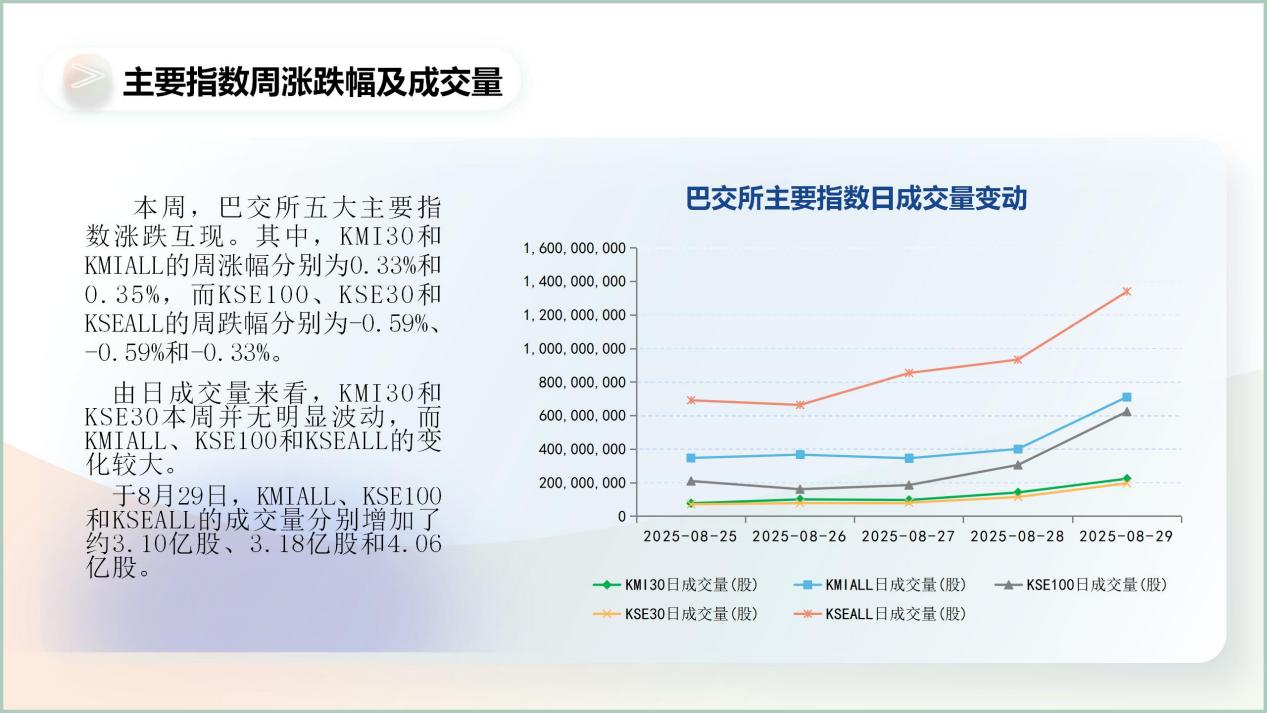
Market Performance - The major indices of the Pakistan Stock Exchange showed mixed performance this week, with KMI30 and KMIALL increasing by 0.33% and 0.35% respectively, while KSE100, KSE30, and KSEALL decreased by -0.59%, -0.59%, and -0.33% respectively [1] - The trading volume for KSE100 index decreased from 1.606 billion shares last week to 1.490 billion shares this week, with a weekly decline in percentage from 2.05% to -0.59% [3] Important News - Pakistan's revenue from various transportation services for the fiscal year 2024-2025 reached $981 million, a 27.9% increase from the previous fiscal year [11] - The oil sector's imports in July 2025 totaled $1.346 billion, a 6.42% increase compared to the same month last year [12] - In July 2025, Pakistan received $694.5 million in foreign loans and grants, which is only 3.5% of the annual target of $19 billion [12] - The Pakistani government is working on implementing solar solutions at Gwadar Port, with a committee formed to review the technical aspects [13] - The Ministry of Finance reported a positive economic outlook for the fiscal year 2025-2026, supported by previous fiscal year achievements and improved external and fiscal conditions [13] - The State Bank of Pakistan reported a net profit of 2.505 trillion PKR for the fiscal year 2024-2025, with total assets amounting to 26.480 trillion PKR [14] - The banking sector listed on the KSE-100 index achieved record half-year profitability in the first half of 2025, with a 19% year-on-year increase in after-tax profits [14]