
新能源汽车市场发展

Search documents
中汽协:1月份我国汽车行业保持平稳运行
Yang Shi Xin Wen· 2026-02-11 06:05
Core Viewpoint - The Chinese automotive industry maintained stable operations in January 2026, with a slight increase in production but a decrease in sales compared to the previous year [1] Production and Sales - In January, the automotive production reached 2.45 million units, while sales totaled 2.346 million units, reflecting a production growth of 0.01% year-on-year and a sales decline of 3.2% [1] - The new energy vehicle (NEV) sector showed stable performance, with production and sales of 1.041 million and 0.945 million units respectively, marking year-on-year increases of 2.5% and 0.1% [1] Commercial Vehicles - The commercial vehicle market continued its positive trend, with both production and sales experiencing double-digit year-on-year growth in January [1] Exports - Automotive exports continued to grow, with NEV exports reaching 302,000 units, representing a year-on-year increase of 100% [1] Policy Impact - The Chinese government has introduced a series of policies aimed at benefiting both consumers and businesses, which are expected to stimulate market demand and support stable industry operations [1] - The "Two New" policies are being implemented smoothly, with local governments following up with detailed implementation rules [1] - The "Accelerating the Cultivation of New Growth Points in Service Consumption Work Plan" focuses on key areas such as automotive after-market services to invigorate market activity [1]


崔东树:预计2026年1月车市可实现开门红 新能源车1季度有望微增5%
智通财经网· 2025-12-29 05:52
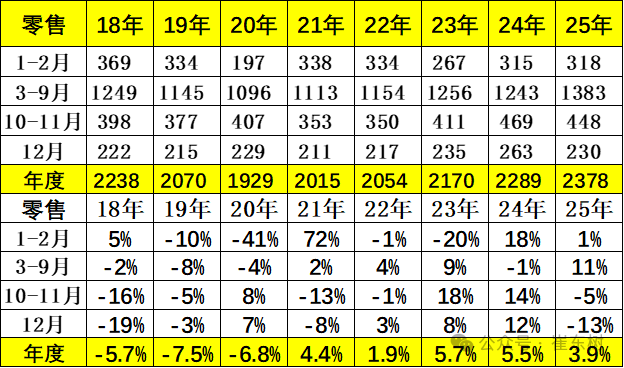
Core Viewpoint - The automotive market in China is expected to experience a positive start in January 2026, driven by continued proactive fiscal policies and moderate monetary policies, alongside early implementation of national subsidies [1][17]. Group 1: 2025 Market Overview - The overall retail sales of passenger vehicles in 2025 are projected to reach 2,378 million units, reflecting a year-on-year growth of 5.7% [2]. - In November 2025, retail sales reached 2.22 million units, a year-on-year decrease of 8% and a month-on-month decrease of 1% [3]. - The cumulative retail sales from January to November 2025 were 21.48 million units, showing a year-on-year increase of 5% [3]. Group 2: Price Competition and Market Dynamics - The automotive market is shifting from price wars to value-based competition, with consumers increasingly focusing on product quality, experience, and lifecycle services [6]. - The penetration rate of new energy vehicles (NEVs) in the domestic market reached 59.3% in November 2025, indicating a significant shift towards electric vehicles [7]. Group 3: New Energy Vehicle Trends - In November 2025, pure electric vehicle sales grew by 9.2% year-on-year, while range-extended vehicles saw a decline of 4.3% [8]. - The market share of new forces in the automotive industry reached 22.1% in November 2025, an increase of 5.9 percentage points compared to the previous year [11]. Group 4: Future Projections for 2026 - The first quarter of 2026 is expected to see stable year-on-year performance, with a projected 5% increase in new energy vehicles, despite a 25% decrease compared to the fourth quarter of 2025 [1][17]. - The second half of 2026 is anticipated to show significant improvement in market conditions, supported by favorable policies and market dynamics [19]. Group 5: Consumer Preferences and Market Segmentation - The demand for large space vehicles is expected to grow due to changing family structures and government policies encouraging larger families [21]. - The shift in subsidy structures for new energy vehicles in 2026 is likely to favor high-end models while reducing support for low-cost electric vehicles, leading to a significant market transformation [22].
乘联分会:11月份国内狭义乘用车市场零售销量达222.5万辆 同比下降8.1%
Zhi Tong Cai Jing· 2025-12-09 08:53
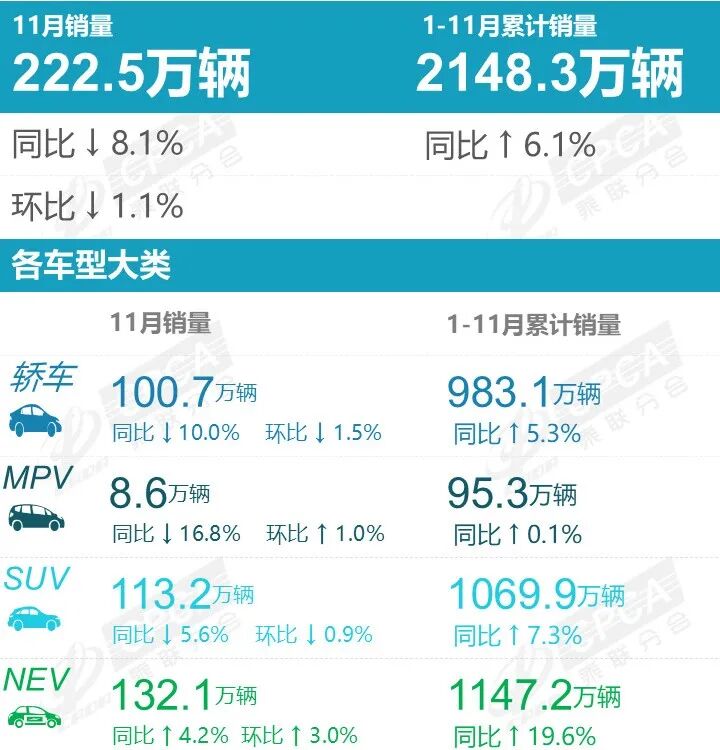
Core Insights - The domestic retail sales of narrow passenger vehicles in China reached 2.225 million units in November 2025, representing a year-on-year decline of 8.1% and a month-on-month decrease of 1.1%. Cumulatively, from January to November 2025, sales totaled 21.483 million units, showing a year-on-year growth of 6.1% [1][3]. Group 1: Market Performance - The retail growth trend for the year is characterized as "front low, middle high, and back flat," confirming initial predictions. The "dual new policies" have played a role in stabilizing the market and adjusting growth rates [3]. - In November, the penetration rate of new energy passenger vehicles in the domestic market reached 59.4%, with a penetration rate of 79.6% among domestic brands and 38.8% in the luxury vehicle segment [3]. Group 2: Manufacturer Sales Rankings - In November 2025, BYD Auto led the sales with 474,921 units, although this represented a year-on-year decline of 5.8%. Geely Auto followed with 310,428 units, showing a significant year-on-year increase of 24.1% [5]. - For the cumulative sales from January to November 2025, BYD Auto also ranked first with 4.131 million units sold, reflecting a year-on-year growth of 10.4%. Geely Auto's sales reached 2.788 million units, marking a substantial increase of 41.8% [6]. Group 3: New Energy Vehicle (NEV) Sales - In November 2025, BYD Auto again topped the NEV wholesale sales with 474,921 units, despite a year-on-year decline of 5.8%. Geely Auto's NEV sales increased by 53.4% year-on-year, reaching 187,798 units [9]. - Cumulatively, from January to November 2025, BYD Auto sold 4.131 million NEVs, achieving a year-on-year growth of 10.4%, while Geely Auto's NEV sales surged by 97.4% to 1.534 million units [11].




11月国内新能源乘用车零售增速7%,年累计增速20%
Dong Zheng Qi Huo· 2025-12-07 13:14
1. Report Industry Investment Rating No relevant content provided. 2. Core Views of the Report - China's new energy vehicle market penetration rate exceeded 30% in 2023 and 50% since 2024. In 2025, high - competitiveness new car products are continuously launched, and the call for "anti - involution" is growing louder [3][117][118]. - Overseas, trade protectionism in Europe and the United States is severe, posing risks to exports. Attention should be paid to new growth points such as countries along the Belt and Road and the Middle East. Overall, the development space of new energy vehicles in non - US regions is promising [3][116][118]. - In terms of the competitive landscape, the market share of domestic brands continues to expand. Companies with strong product strength, smooth overseas expansion, and stable supply should be focused on [3][118]. 3. Summary by Relevant Catalogs 3.1 Financial Market Tracking - The report shows the one - week price changes of relevant sectors and listed companies. For example, BYD's one - week price increase was 0.85%, SAIC Group's was 3.21%, while CATL's was 4.26%, and Rongbai Technology's dropped by 7.94% [12][14]. 3.2 Industrial Chain Data Tracking 3.2.1 China New Energy Vehicle Market Tracking - **Sales and Exports**: In November, the retail sales of new energy passenger vehicles were 1.354 million, a year - on - year increase of 7%, and the cumulative retail sales from January to November were 11.504 million, a year - on - year increase of 20% [1][104]. - **Inventory Changes**: Data on the monthly new inventory of new energy passenger vehicle channels and manufacturers are presented [25]. - **Delivery Volume of Chinese New Energy Vehicle Manufacturers**: Monthly delivery volume data of manufacturers such as Leapmotor, Li Auto, XPeng, and NIO are provided [29][30]. 3.2.2 Global and Overseas New Energy Vehicle Market Tracking - **Global Market**: Data on global new energy vehicle sales and penetration rate are presented [38][40]. - **European Market**: In October, the sales volume of new energy vehicles in Europe was 354,000, a year - on - year increase of 36.4%, and the cumulative sales from January to October were 3.205 million, a year - on - year increase of 31.9% [2][116]. - **North American Market**: In October, the sales volume of new energy vehicles in the US was 94,000, a year - on - year decrease of 32.4% and a month - on - month decrease of 50.9%. The cumulative sales from January to October were 1.425 million, a year - on - year increase of 9.1%. The penetration rate dropped from 15% in September to 7% in October [1][115]. - **Other Regions**: In October, the sales volume in other regions was 102,000, a year - on - year increase of 88.8%, and the cumulative sales from January to October were 884,000, a year - on - year increase of 59.8% [2][116]. 3.2.3 Power Battery Industry Chain - Data on power battery installation volume, export volume, weekly average price of battery cells, and material costs are presented. Also, data on the operating rates and prices of various battery materials such as ternary materials, lithium iron phosphate, and negative electrode materials are provided [78][82][88]. 3.2.4 Other Upstream Raw Materials - Data on the daily prices of raw materials such as rubber, glass, steel, and aluminum are presented [98][99]. 3.3 Hot News Summary 3.3.1 Industry Dynamics: China - According to the Passenger Car Association, from November 1 - 30, the retail sales of new energy vehicles increased by 7% year - on - year, and the cumulative retail sales since this year increased by 20% year - on - year [104]. - According to the Ministry of Commerce, in the first 11 months of this year, over 11.2 million cars were replaced under the trade - in program [106]. 3.3.2 Industry Dynamics: Overseas - In Germany, in November, the sales of pure - electric and plug - in hybrid electric vehicles increased by 58.5% and 57.4% respectively. The ban on fuel - powered vehicles was relaxed for plug - in hybrid electric vehicles [107]. - The US reduced the import tariff on South Korean cars to 15% and retroactively applied it from November 1 [110]. - The US announced a proposal to relax the corporate average fuel economy standards [111]. 3.3.3 Enterprise Dynamics - BYD's vehicle sales in November were 480,186, a year - on - year decrease of 5.3%. The cumulative sales from January to November were 4.182038 million, a year - on - year increase of 11.3% [112]. - Geely Auto's vehicle sales in November were 310,428, a year - on - year increase of 24%. The cumulative sales from January to November were 2.78775 million, a year - on - year increase of 42% [114].




TrendForce集邦咨询:2025年第三季新能源车销量年增31% 全年预计年增长25%
Zhi Tong Cai Jing· 2025-11-24 06:01
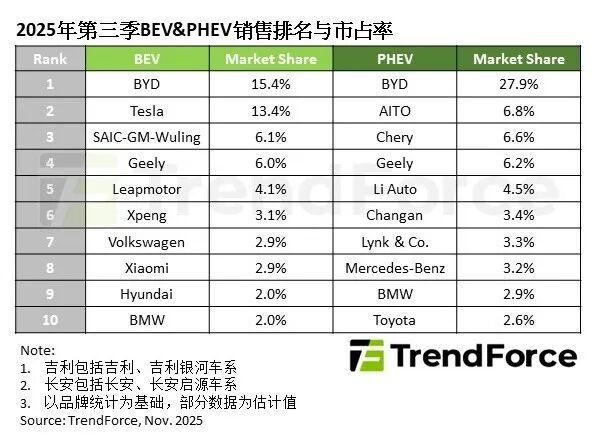
Core Insights - Global sales of new energy vehicles (NEVs) are projected to reach 5.39 million units in Q3 2025, representing a 31% year-on-year increase, with battery electric vehicles (BEVs) expected to account for 3.71 million units, a 48% increase, and plug-in hybrid electric vehicles (PHEVs) at 1.67 million units, a 4% increase [1] NEV Market Overview - BYD leads the BEV market with a 15.4% market share, while Tesla follows with 13.4% [2] - In the PHEV segment, BYD also holds the top position with a 27.9% market share, followed by AITO at 6.8% [2] Company Performance - BYD remains the BEV sales champion in Q3, although its sales decreased compared to Q2 [4] - Tesla showed strong performance in Q3 with a 29% quarter-on-quarter increase, driven by U.S. market subsidies and growth in China [4] - Geely and Leapmotor demonstrated significant growth, achieving market shares of 6% and 4.1% respectively, surpassing Xpeng for two consecutive quarters [4] - Volkswagen's ranking fell to seventh due to a decline in the Chinese market, offsetting gains in Europe and the U.S. [4] - Hyundai ranked ninth with a quarterly decline but year-on-year growth [4] - BMW's BEV sales continued to decrease, posing challenges to its annual growth targets [4] PHEV Market Dynamics - BYD faces saturation and intense competition in the Chinese PHEV market, with a quarterly increase but year-on-year decline in sales [5] - AITO, Chery, and Geely have risen to the second to fourth positions, with Chery's market share increasing to 6.6% [5] - Li Auto, despite being the second in sales in Q2, experienced both quarterly and yearly declines due to increasing competition from REEV models [5] - European brands like Mercedes-Benz and BMW saw quarterly declines but performed better than the previous year in the U.S. and parts of Europe [5] Future Projections - TrendForce forecasts global NEV sales to reach 20.43 million units in 2025, a 25% year-on-year increase [5] - For 2026, despite regional subsidy policy adjustments leading to market disparities, global NEV sales are expected to rise to 22.8 million units, a 12% growth [5]

1-10月中国新能源汽车产量1267.2万辆 同比增长28.1%
Zhong Guo Xin Wen Wang· 2025-11-20 09:18
Core Insights - The report highlights the rapid growth of China's new energy vehicle (NEV) market, with a production volume of 12.672 million units from January to October 2025, representing a year-on-year increase of 28.1% and a cumulative penetration rate of 46.4% [2] Group 1: Market Trends - The NEV market in China continues to show strong growth, driven by policy support, product innovation, and increased exports, positioning it as a core driver of the automotive industry [2] - In terms of vehicle types, as of September 2025, passenger cars accounted for 45.1% of the market share, while SUVs and MPVs held 43.9% and 3.6% respectively, with commercial vehicles like trucks and buses at 3.9% and 3.2% [3] Group 2: Battery Technology - The installed capacity of power batteries for NEVs reached 73.7 GWh in September 2025, marking a year-on-year growth of 39.9% [4] - The average battery capacity per vehicle was 53.0 kWh, reflecting a year-on-year increase of 17.3% [4] - The market structure for battery cells shows that square cells dominate with a 98.6% share, while lithium iron phosphate (LFP) continues to grow in market share due to its safety, cost, and longevity advantages [5] Group 3: Battery Suppliers - The top three battery manufacturers held a market share of 72.2% as of September 2025, with CATL leading at 42.1% [6] - Companies like Contemporary Amperex Technology Co., Limited (CATL) and others have shown significant growth, with some companies like Zhongchuang Innovation and Ruipu Lanjun experiencing year-on-year increases of 102.0% and 143.2% respectively [6] Group 4: Electric Motor Suppliers - The top ten electric motor suppliers accounted for 62.7% of the market share, with all companies in this group showing a month-on-month increase in supply [7] - Notable performers include Saike Technology, which benefited from high sales of Wuling vehicles, and Grebo, which saw growth due to its partnership with Geely [7] Group 5: Sodium-Ion Battery Development - Sodium-ion battery technology is rapidly advancing, with key advantages in low-temperature performance, fast charging capabilities, and safety [9] - Current applications for sodium-ion batteries include home energy storage, large-scale energy storage, two-wheeled vehicles, electric vehicles, and backup power sources [9] - Major companies like CATL, Zhongke Haina, and BYD are accelerating their research and development efforts in sodium-ion battery products [9]


中汽协:10月销售新能源汽车171.5万辆,渗透率首次超50%
Ju Chao Zi Xun· 2025-11-12 06:05
Overall Industry Performance - In October, China's automotive production and sales reached 3.359 million and 3.322 million units respectively, with month-on-month growth of 2.5% and 3%, and year-on-year growth of 12.1% and 8.8% [2] - Cumulatively from January to October, production and sales totaled 27.692 million and 27.687 million units, reflecting year-on-year growth of 13.2% and 12.4%, indicating a steady development pace in the industry [2] Passenger Vehicle Segment - In October, passenger vehicle production and sales were 2.995 million and 2.961 million units, with month-on-month growth of 3.3% and 3.6%, and year-on-year growth of 10.7% and 7.5% [2] - From January to October, passenger vehicle production and sales reached 24.237 million and 24.209 million units, with year-on-year growth of 13.5% and 12.9%, slightly above the overall automotive industry growth rates [2] New Energy Vehicles (NEVs) - NEVs continued to lead the market, with production and sales in October reaching 1.772 million and 1.715 million units, marking year-on-year growth of 21.1% and 20% [3] - NEVs accounted for 51.6% of total new vehicle sales in October, indicating that they have become a mainstream force in the automotive market [3] - Cumulatively, from January to October, NEV production and sales were 13.015 million and 12.943 million units, with year-on-year growth of 33.1% and 32.7%, and a cumulative market share of 46.7% [3] Export Performance - In October, total automotive exports reached 666,000 units, with month-on-month growth of 2.1% and year-on-year growth of 22.9% [4] - Cumulatively from January to October, automotive exports totaled 5.616 million units, reflecting a year-on-year increase of 15.7% [4] - NEV exports showed significant growth, with 256,000 units exported in October, representing month-on-month growth of 15.4% and year-on-year growth of 99.9% [4] - From January to October, NEV exports totaled 2.014 million units, with a year-on-year increase of 90.4%, showcasing strong competitiveness in the global market [4]
财联社汽车早报【11月12日】
Xin Lang Cai Jing· 2025-11-12 01:19
Group 1: Policy Adjustments and Market Trends - Hubei Province announced adjustments to the 2025 automobile trade-in subsidy policy, suspending the scrap update subsidy and optimizing the issuance of qualification vouchers to better meet consumer demand and promote healthy development of the automotive market [1] - The China Association of Automobile Manufacturers reported that from January to October, China's automobile production and sales reached 27.69 million units, with a year-on-year growth of over 10%. Notably, in October, new energy vehicle sales exceeded 50% of total new car sales for the first time, reaching 51.6% [1][2] - The implementation of the national trade-in policy has shown significant effects, with market order improving and price competition becoming more rational, as new car launches are breaking previous price limits rather than simply reducing prices [3] Group 2: Corporate Developments - John Roth will take over as the new president of General Motors China starting December 1, succeeding Steve Hill, who will assume a new role as Senior Vice President of Global Export and Retail Innovation [5][6] - The leadership change at General Motors aims to support the ongoing recovery of the Chinese market and promote growth in global exports [6] Group 3: Technological Advancements - Black Sesame Intelligence announced that its flagship product, the Huashan A1000 chip, has been successfully integrated into Desay SV's new low-speed unmanned vehicle, enhancing the safety of logistics operations [4]
10月份汽车产销量创同期新高 单月新能源汽车销量首次超总销量的50%
Zheng Quan Ri Bao· 2025-11-11 16:12
Core Insights - In October, China's automotive industry achieved record production and sales, with new energy vehicle (NEV) sales reaching 51.6% of total sales, indicating a significant shift towards high-quality development in the sector [1][4]. Production and Sales Performance - In October, automotive production and sales reached 3.359 million and 3.322 million units respectively, with month-on-month increases of 2.5% and 3%, and year-on-year increases of 12.1% and 8.8% [2]. - For the first ten months of the year, cumulative production and sales were 27.692 million and 27.687 million units, reflecting year-on-year growth of 13.2% and 12.4% [2]. - Passenger vehicles showed strong performance in October, with production and sales of 2.995 million and 2.961 million units, respectively, marking month-on-month increases of 3.3% and 3.6% [2]. - Chinese brand passenger vehicles accounted for 72.5% of total passenger vehicle sales in October, with sales of 2.148 million units, reflecting a year-on-year increase of 11.2% [2]. Commercial Vehicle Market - The commercial vehicle market also showed positive trends in October, with production and sales of 364,000 and 361,000 units, respectively, marking year-on-year growth of 25.4% and 21% [3]. - Notably, truck sales reached 311,000 units, with a year-on-year increase of 22.1%, and heavy truck sales surged by 60% [3]. New Energy Vehicles (NEVs) - NEV production and sales in October were 1.772 million and 1.715 million units, respectively, with year-on-year growth of 21.1% and 20%, marking a significant milestone as NEVs constituted 51.6% of total new vehicle sales [4]. - The rapid growth of NEVs is characterized by diversification, with pure electric vehicle sales at 1.109 million units (up 30.7%) and plug-in hybrid vehicle sales at 605,000 units (up 69.8%) [4]. - The increase in NEV market penetration is attributed to advancements in technology, leading to improved product competitiveness and reduced costs [4]. Export Growth - NEV exports reached 256,000 units in October, with a month-on-month increase of 15.4% and a year-on-year increase of 99.9% [5]. - For the first ten months, NEV exports totaled 2.014 million units, reflecting a year-on-year growth of 90.4%, showcasing China's global competitiveness in the NEV sector [5]. Policy and Market Demand - The rapid development of the NEV market is supported by government policies such as purchase subsidies and tax exemptions, which have effectively stimulated market demand [6]. - Consumer acceptance of NEVs continues to rise, with domestic sales of 1.459 million units in October, marking a month-on-month increase of 5.6% and a year-on-year increase of 12.1% [6]. - Future prospects for the automotive industry appear promising, with a focus on boosting consumption and optimizing policies to stabilize market expectations [6].
车市喜提“银十”,新能源助自主品牌提份额
Bei Jing Ri Bao Ke Hu Duan· 2025-11-10 23:15
Core Insights - The Chinese automotive market has achieved a successful "Silver October" with retail sales of 2.242 million passenger vehicles in October, a slight month-on-month decline of 0.1%, but still the second highest monthly sales of the year, following September [1] - The wholesale volume for passenger vehicles reached 2.932 million units in October, marking a year-on-year increase of 7.6% and a month-on-month increase of 4.9% [1] - The production volume was 2.951 million units, showing a year-on-year growth of 11.4% and a month-on-month growth of 3.7% [1] - Exports of passenger vehicles, including complete vehicles and CKD, reached 568,000 units, a year-on-year increase of 27.7% and a month-on-month increase of 7.5% [1] New Energy Vehicle Market - The wholesale volume of new energy passenger vehicles reached 1.621 million units in October, a year-on-year increase of 18.5% and a month-on-month increase of 8.5% [2] - Retail sales of new energy vehicles were 1.282 million units, reflecting a year-on-year growth of 7.3% [2] - The penetration rate of new energy vehicles in the domestic market reached 57.2% in October [2] - Exports of new energy passenger vehicles hit a historical high of 251,000 units, with a year-on-year increase of 104.2% [2] Electric Vehicle Segment - In October, the wholesale volume of pure electric vehicles was 1.02 million units, representing a year-on-year increase of 31.6% and a month-on-month increase of 7.5% [3] - The market share of pure electric vehicles reached 62.9%, while plug-in hybrids accounted for 29.6% and range-extended vehicles made up 7.5% [3] - The structure of new energy vehicle sales has shifted from 49% pure electric and 51% range-extended last year to 74% pure electric and 26% range-extended this year [3] Domestic Brand Performance - Domestic brands achieved retail sales of 1.55 million units in October, a year-on-year increase of 4% and a month-on-month increase of 3% [3] - The domestic retail market share of independent brands reached 68.7%, an increase of 3 percentage points year-on-year [3] - The top five state-owned groups, including SAIC, Dongfeng, Changan, Chery, and BAIC, saw a combined sales growth of 17% in October [4] - The market share of independent new energy brands from traditional automakers reached 15%, a year-on-year increase of 2.8 percentage points [4]