
无就业繁荣

Search documents
“独脚凳”还能坐多久?前所未有的“无就业繁荣”考验美国GDP增长极限
Sou Hu Cai Jing· 2026-02-19 03:29
Economic Growth and Employment - The U.S. economy is generating significant wealth but failing to create many jobs, with GDP growth projected at 2.7% for 2025, which is considered robust for a developed country [1] - This situation is being compared to the "jobless recovery" of the early 2000s, but the current scenario is unique as it is occurring without a preceding recession, marking a first in the post-war period [1][2] - Diane Swonk, Chief Economist at KPMG, notes the unusual nature of the current economic expansion, likening it to sitting on a one-legged stool, indicating instability [1] Corporate Investment and Consumer Spending - Despite trade and immigration policy changes limiting growth, the economy benefits from resilient consumer spending, rising stock prices, and a rebound in corporate investment driven by the AI boom [1] - Corporate investment ended 2025 strongly, with manufacturing output experiencing its largest increase in nearly a year as of January [1] Labor Market Dynamics - The current economic conditions are reminiscent of the early 2000s, with factors such as over-hiring, strong productivity growth, and increased policy uncertainty contributing to a fragile labor market [3] - The job market is particularly challenging for college-educated individuals, who are facing rising unemployment rates, contrasting with the declining rates for those without a college degree [3] Impact of Artificial Intelligence - Many white-collar workers are at the forefront of AI application in the workplace, which could significantly impact productivity and employment growth in the coming years [4] - The job market for office and administrative support roles has seen the largest increase in unemployment in 2025, indicating a broader trend of job loss concentrated in white-collar professions [5] Economic Forecasts and Employment Reports - The latest employment report indicates that job growth in 2025 is weaker than initially expected, although there was a rebound in hiring activity in January, particularly in healthcare and social assistance [7] - Economists express concerns that if productivity gains do not translate into higher wages for workers, sustaining economic growth will be challenging, especially as workers' bargaining power diminishes [7][8]
布米普特拉北京投资基金管理有限公司:美国12月非农新增5万人不及预期 前值大幅下修
Sou Hu Cai Jing· 2026-01-12 09:50
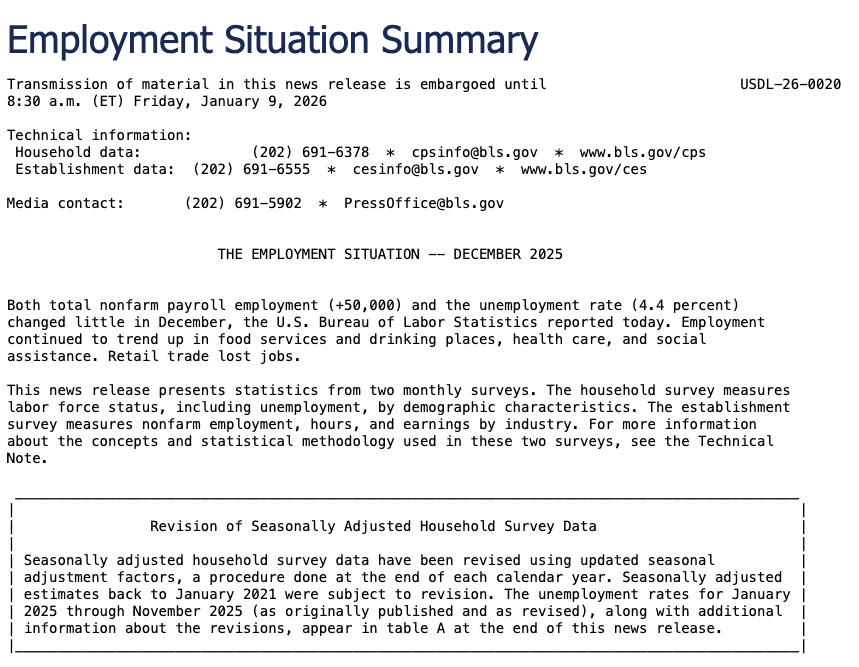
Core Insights - The U.S. non-farm payroll report for December 2025 revealed a complex picture with job growth falling short of expectations, while the unemployment rate decreased, and prior values were significantly revised downwards [1][3]. Employment Data Summary - In December 2025, the U.S. non-farm payroll increased by 50,000 jobs, significantly below the market expectation of 70,000 [3]. - The unemployment rate fell from a revised 4.5% in November to 4.4%, slightly better than anticipated [3]. - Revisions to previous months showed November's job growth adjusted down from 64,000 to 56,000, and October's data revised from a loss of 105,000 to a loss of 173,000, totaling a downward adjustment of 76,000 jobs over two months [3]. - The total non-farm employment growth for 2025 was 584,000, a significant slowdown compared to 2 million in 2024 [3]. Sector Contributions - The main contributors to job growth in December were the restaurant services, healthcare, and social assistance sectors, each adding tens of thousands of jobs [3]. - Conversely, the retail trade sector saw job losses, and public sector employment growth was nearly stagnant [3]. Wage Growth - Average hourly wages increased by 0.3% month-over-month, aligning with expectations, while the year-over-year increase of 3.8% was slightly above market estimates [3]. Market Reaction - The report led to a significant adjustment in interest rate futures, with traders lowering the probability of a Federal Reserve rate cut in the near term [5]. - The likelihood of a rate cut at the upcoming meeting was nearly zero, with March's probability dropping to about 30% and April's below 50% [5]. - The consensus suggests the Fed may consider its first rate cut in spring or summer [5]. Economic Context - The average monthly job growth in the private sector for 2025 was only 61,000, marking the weakest growth since 2003 without an economic recession [5]. - This phenomenon of "recruitment recession" or "jobless prosperity" has become a focal point for economists [5]. Analyst Perspectives - Analysts had mixed interpretations of the report, but many agreed it reinforced the Fed's cautious stance [7]. - The report indicated a moderate slowdown in the U.S. hiring environment, which may prompt the Fed to adopt a slow and careful approach to rate cuts to ensure continued economic expansion [7].


数据点评 | 就业“新稳态”——12月美国就业数据点评(申万宏观·赵伟团队)
赵伟宏观探索· 2026-01-11 16:04
Overview - The U.S. added 50,000 non-farm jobs in December, slightly below the expected 65,000, while the unemployment rate fell to 4.4% [1][7] - The labor force participation rate decreased by 0.1 percentage points to 62.4% [7][10] - Market reactions were muted following the data release, with slight fluctuations in the 10-year Treasury yield and the dollar index [1][10] Structure: Understanding the Divergence Between Non-Farm Employment and Unemployment Rate - December's employment in the goods-producing sector was weak, influenced by tariff impacts and other factors [18][20] - The construction sector saw a decrease of 11,000 jobs, while manufacturing employment declined further, reflecting the lagging effects of tariffs [18][20] - Private service sector jobs increased by 58,000, up from 32,000 in the previous month [18][20] - The decline in the unemployment rate to 4.4% was primarily due to tightening labor supply and temporary layoffs being reversed [25][28] Outlook: U.S. Economy Continues "Low-Growth Balance" and Fed Rate Cut Expectations May Be "Delayed" - The characteristics of the U.S. economy in 2026 may include a "low-growth balance" in employment and "jobless prosperity" [28][30] - The anticipated tax cuts in the first half of 2026 could stimulate consumer spending and inflation, potentially leading to a delayed pace of Fed rate cuts [30][34] - The market has adjusted its forecast for Fed rate cuts in 2026 from 2.25 times to 2.10 times following the employment data release [30][34]

非农喜忧参半 美联储降息概率全面走低
Sou Hu Cai Jing· 2026-01-11 13:51
Group 1 - The December 2025 non-farm payroll report showed an unexpected drop in the unemployment rate to 4.4%, providing a strong rationale for the Federal Reserve to maintain interest rates [2][5][6] - The report indicated a significant slowdown in job growth, with only 50,000 jobs added in December, compared to an expected 70,000, and a total of 584,000 jobs added in 2025, a sharp decline from 2 million in 2024 [3][4] - The hospitality sector led job growth in December with 27,000 new positions, while retail saw a decrease of 25,000 jobs [3][4] Group 2 - The average monthly job additions in the private sector for 2025 were 61,000, marking the weakest growth since 2003 during a period of economic expansion without corresponding job recovery [4] - The report's mixed signals suggest a "recruitment recession," where economic growth continues but hiring does not keep pace, creating a "no job prosperity" scenario [5][8] - Market expectations for Federal Reserve rate cuts have shifted, with predictions now leaning towards potential cuts in April or June 2026, rather than January [7][8]

数据点评 | 就业“新稳态”——12月美国就业数据点评(申万宏观·赵伟团队)
申万宏源宏观· 2026-01-11 03:33
Overview - The U.S. non-farm payrolls added 50,000 jobs in December, slightly below expectations of 65,000, while the unemployment rate fell to 4.4% [1][7] - The labor force participation rate decreased by 0.1 percentage points to 62.4% [1][7] - Market reactions were muted following the data release, with slight fluctuations in the 10-year Treasury yield and the dollar index [1][6] Structure: Understanding the Divergence Between Non-Farm Payrolls and Unemployment Rate - December's employment in the goods-producing sector was weak, reflecting impacts from tariffs and other factors [2][18] - The construction sector saw a decrease of 11,000 jobs, while manufacturing employment declined further, influenced by real estate market conditions and immigration factors [2][18] - Private service sector jobs increased by 58,000, up from 32,000 in the previous month [2][18] - The decline in the unemployment rate to 4.4% was primarily due to tightening labor supply and temporary layoffs being reversed, indicating a divergence in non-farm employment and unemployment rate trends [2][25] Outlook: U.S. Economy Continues "Low-Growth Balance" and Fed Rate Cut Expectations May Be "Delayed" - The characteristics of the U.S. economy in 2026 may include a "low-growth balance" in employment and "jobless prosperity" [3][28] - The economy is expected to maintain a "low-growth balance" due to synchronized supply and demand contractions, but factors like resilient consumer spending and AI capital expenditures may sustain "jobless prosperity" [3][28] - The anticipated tax cuts from the "Beautiful America Act" in the first half of 2026 could boost consumer spending and inflation, potentially delaying the Federal Reserve's rate cut schedule [3][30]


甲骨文涨近5%,盘后遭大空头做空,美股存储概念股普涨,美联储今年或至少降息两次
2 1 Shi Ji Jing Ji Bao Dao· 2026-01-10 14:54
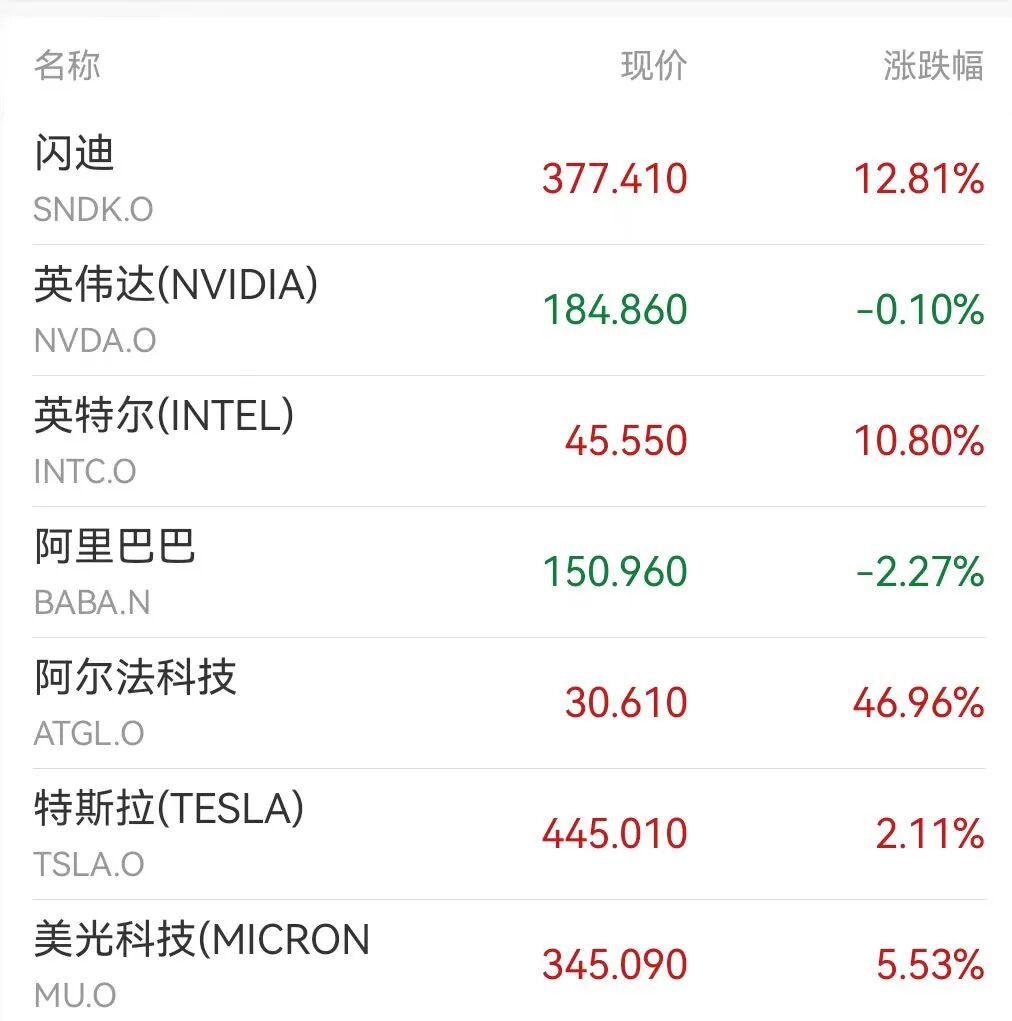
Group 1: Market Performance - The US stock market indices collectively rose, with the S&P 500 reaching a historical high, driven by gains in Intel and other chip manufacturers [1] - For the first complete trading week of 2026, the Dow Jones increased by 2.32%, the S&P 500 rose by 1.57%, and the Nasdaq gained 1.88% [1] Group 2: Semiconductor Sector - Storage concept stocks in the US saw widespread gains, with SanDisk rising by 12.8%, Micron Technology increasing by 5.5%, Seagate up by 6.87%, and Western Digital gaining 6.8% [1] - A report from Nomura Securities indicated that demand for enterprise-level SSDs using large-capacity 3D NAND remains strong, with SanDisk's product prices potentially surging over 100% quarter-on-quarter [1] Group 3: Individual Stock Movements - Intel's stock rose over 10%, while Oracle's stock increased by nearly 5%, despite Michael Burry holding put options on Oracle [2] - UBS downgraded Oracle's target price from $325 to $280, reflecting a cautious outlook on the company's stock performance [2]
甲骨文涨近5%,盘后遭大空头做空,美股存储概念股普涨,美联储今年或至少降息两次
21世纪经济报道· 2026-01-10 14:49
Group 1: Market Overview - The U.S. stock market indices collectively rose, with the S&P 500 reaching a historical high, driven by gains in Intel and other chip manufacturers [1] - For the first complete trading week of 2026, the Dow Jones increased by 2.32%, the S&P 500 rose by 1.57%, and the Nasdaq gained 1.88% [1] Group 2: Semiconductor Sector Performance - Semiconductor stocks saw significant gains, with SanDisk up 12.8%, Micron Technology up 5.5%, Seagate up 6.87%, and Western Digital up 6.8% [1] - A report from Nomura Securities indicated that demand for enterprise-level SSDs using large-capacity 3D NAND remains strong, with SanDisk's product prices potentially surging over 100% quarter-on-quarter [1] Group 3: Individual Stock Movements - Intel's stock rose over 10%, while Oracle's stock increased nearly 5%, despite Michael Burry holding put options on Oracle [2] - UBS downgraded Oracle's target price from $325 to $280 [2] Group 4: Employment and Economic Indicators - The U.S. labor market showed mixed signals, with December non-farm payrolls adding only 50,000 jobs, below the expected 55,000, and the unemployment rate dropping to 4.4% [5] - The labor force participation rate fell to 62.4%, indicating a shrinking labor force [5] - The overall non-farm employment growth for 2025 was the weakest since 2020, with an increase of only 584,000 jobs [5] Group 5: Federal Reserve Outlook - The employment report has led to a decrease in expectations for interest rate cuts by the Federal Reserve, with the probability of a rate cut in January dropping to 5% from 11% [5][6] - Market expectations suggest that the Federal Reserve may cut rates at least twice in 2026, with potential cuts in June and September [6]

美国失业率意外下行,美联储重启降息“遥遥无期”
2 1 Shi Ji Jing Ji Bao Dao· 2026-01-10 09:48
Group 1 - The U.S. labor market is experiencing a "no-job boom," where economic growth remains strong, but companies are not expanding hiring accordingly [3][5] - The December non-farm payroll report showed a slowdown in job growth, with only 50,000 jobs added, below the market expectation of 55,000 [1][2] - The unemployment rate decreased to 4.4% in December, better than the previous month and market expectations, but this decline is partly due to a drop in labor force participation [2][4] Group 2 - The overall labor force is shrinking, with some unemployed individuals leaving the labor market and not being counted as actively seeking work [2][3] - The report indicates a mixed outlook for the labor market, with slow hiring and layoffs, suggesting that the good news outweighs the bad [2][3] - The Federal Reserve's interest rate decisions may be influenced by the employment report, with expectations for rate cuts being pushed back to June [1][2]
美国12月非农喜忧参半,美联储6月前降息概率全面走低
Feng Huang Wang· 2026-01-09 14:51
Core Insights - The December non-farm payrolls increased by 50,000, below the expected 70,000, while the unemployment rate fell to 4.4%, better than the anticipated 4.5% [2] - The report reflects adjustments to previous months' employment figures, with November's job increase revised down from 64,000 to 56,000 and October's decrease adjusted from 105,000 to 173,000, totaling a downward revision of 76,000 jobs over two months [2] Employment Trends - In 2025, the total non-farm employment is projected to be 584,000, a significant decline from 2 million in 2024 [4] - The restaurant industry led job growth in December with an addition of 27,000 jobs, followed by healthcare with 21,000 and social assistance with 17,000. Conversely, retail reported a loss of 25,000 jobs, and government added only 2,000 jobs [4] - Average hourly wages rose by 0.3% in December, matching expectations, with a year-over-year increase of 3.8%, exceeding expectations by 0.2 percentage points [4] Federal Reserve Outlook - The average monthly job additions in the private sector for 2025 are estimated at 61,000, marking the weakest growth since the "jobless recovery" period post the dot-com bubble [4] - The unemployment rate was revised down to 4.375% in December from 4.536% in November, indicating a slight improvement in the labor market [4] - Market expectations suggest that the Federal Reserve may initiate rate cuts in April or June 2026, with another potential cut later in the year [7] Market Reactions - Following the decline in unemployment, U.S. stock index futures rose, while the dollar index experienced slight fluctuations but remained in a positive trend [8] - Precious metals like gold, silver, and copper maintained an upward trend amid the employment data release [10] Economic Perspectives - The employment report presents mixed signals, with slow hiring and layoffs, but overall conveys more positive than negative news [11] - The Federal Reserve is expected to focus on employment trends, indicating a cautious approach to rate cuts to sustain economic expansion [11] - The U.S. job market in 2025 is characterized as a "recruitment recession," where economic growth continues without corresponding job expansion, creating a dichotomy between Wall Street and the general public [11]
花旗:全球降息潮支撑经济温和增长 预计明年中国增速约5%
2 1 Shi Ji Jing Ji Bao Dao· 2025-11-18 08:22
Group 1: Global Economic Outlook - The global economy is showing unexpected resilience, with an estimated growth rate of approximately 2.7% for this year, slightly lower than last year's 2.8% and the trend growth rate of 3% [2] - Global inflation has continued to decline, with the overall rate now at 2%, returning to pre-pandemic levels, while core inflation remains moderate [2] Group 2: Tariff Impact on Trade - The average tariff rate on U.S. imports has surged from 2.5% at the beginning of the year to around 15%, the highest level since the 1930s [3] - The share of U.S. imports from China has decreased from 13% to 8% over the past year, while trade with Taiwan, Vietnam, Mexico, and Thailand has significantly increased [3] Group 3: Monetary Policy Trends - Approximately 25 out of 30 major central banks have implemented interest rate cuts this year, with expectations for continued cuts into next year [4] - The Federal Reserve is anticipated to lower rates multiple times by the end of next year due to a weak labor market, while the European Central Bank is expected to cut rates twice [4] Group 4: China's Economic Strategy - The "14th Five-Year Plan" emphasizes technological self-reliance and supply-demand rebalancing, aiming for a growth target of around 5% [6] - The GDP growth for the first three quarters has reached 5.2%, indicating a strong likelihood of achieving the annual growth target [6] Group 5: Fiscal and Monetary Policy in China - The fiscal policy is expected to lead, with a projected budget deficit rate of 4% and a total of 1.6 trillion yuan in special bonds to support economic growth [7] - Monetary policy is anticipated to remain moderately loose, with a potential interest rate cut of 20 basis points and a reserve requirement ratio cut of 50 basis points by 2026 [7] Group 6: Consumer and Structural Policies - Consumer stimulus will focus on structural policies, including a 300 billion yuan subsidy for trade-ins and increased investment in childcare and elderly care [8] - The external environment is improving, with expectations for a 13% growth in exports in 2024, supported by strong adaptability [8] Group 7: Capital Market Insights - The Chinese stock market is viewed positively, with 60% of the market being growth-oriented and 40% of profits related to AI, positioning China to potentially lead in the AI sector [9]