
企业信心指数

Search documents
德国2月企业信心指数报88.6,预估88.3
Mei Ri Jing Ji Xin Wen· 2026-02-23 09:09
Group 1 - The core point of the article is that Germany's business confidence index for February is reported at 88.6, which exceeds the forecast of 88.3 [1]
英国企业信心指数跃升至八个月高点 央行按兵不动预期强化
Zhi Tong Cai Jing· 2026-02-02 09:36
Group 1 - The UK business confidence index has risen to its highest level in eight months, indicating a potential recovery in economic growth following the budget announcement [1] - The Institute of Directors (IoD) reported that the business confidence index increased from -66% in December 2025 to -48% in January 2026, showing a rebound trend from near historical lows [1] - CEOs' confidence in their own companies rose to +14% in January from -4% in December, reflecting improved expectations for investment, hiring, and sales [1] Group 2 - Despite plans to increase taxes by £26 billion ($36 billion), businesses are largely exempt from these measures, while households are feeling the impact of increased taxation [2] - The hospitality sector, including pubs and live music venues, is receiving support from the Chancellor, which is crucial given the previous backlash against rising business tax rates [2] - The IoD noted that revenue expectations reached their highest point since September 2024, with key indicators tracking employee numbers and investment intentions also showing significant increases [2] Group 3 - The rise in business confidence and PMI is seen as a strong signal of economic recovery, while rising inflation indicators set a higher threshold for interest rate cuts by the Bank of England [3] - Economists expect the Bank of England to maintain interest rates at 3.75% in the upcoming meeting, with only one more rate cut anticipated this year [3] - The Monetary Policy Committee has been cautious since August 2024, having previously lowered rates from 5.25%, and there is a consensus to slow down the pace of rate cuts unless unexpected circumstances arise [3]
新西兰企业信心从30年高点回落 通胀预期升温引发政策关注
Xin Hua Cai Jing· 2026-01-29 05:26
Core Viewpoint - The ANZ Bank's latest monthly business outlook survey indicates a significant decline in New Zealand's business confidence index from a 30-year high in December 2025, suggesting potential challenges ahead for the economy [1] Group 1: Business Confidence - The net percentage of businesses expecting an improvement in future economic conditions dropped to 64.1% in January from 73.6% in December 2025, a decrease of nearly 10 percentage points [1] - The proportion of businesses anticipating growth in their own operations fell from 60.9% to 51.6% [1] Group 2: Economic Indicators - Despite the decline in confidence indicators, most sub-indicators reflecting actual economic activity remain at high levels, supporting strong GDP growth projections for Q4 2025 [1] - Analysts believe that New Zealand's economy still possesses a degree of resilience as it approaches early 2026 [1] Group 3: Inflation Pressures - Signals reflecting inflationary pressures have significantly increased, with a notable rise in businesses' pricing expectations [1] - This trend diverges from the current inflation forecast path of the Reserve Bank of New Zealand (RBNZ), potentially posing challenges for monetary policy and adding uncertainty to the economic outlook [1]
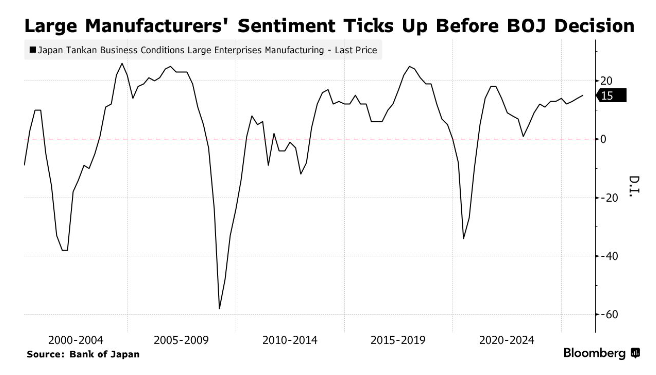
日本大型制造业信心跃升四年新高 央行加息预期再获强化
Zhi Tong Cai Jing· 2025-12-15 02:07
Group 1 - The confidence index for large manufacturers in Japan has risen to a four-year high, reinforcing market expectations for a potential interest rate hike by the Bank of Japan this week [1][3] - The Tankan survey revealed that the large manufacturing sentiment index increased from 14 in September to 15 in December, aligning with economists' median expectations [1] - The large non-manufacturing sentiment index remained steady at 34, close to its highest level since the early 1990s, indicating that more companies view their business conditions as "good" rather than "poor" [1] Group 2 - The Tankan survey indicates that Japanese companies have not significantly felt the impact of U.S. tariff policies, which the Bank of Japan has highlighted as a source of uncertainty [3] - The survey results provide the Bank of Japan with insights into how companies are responding to the U.S. tariff adjustments, particularly in the oil and coal manufacturing sector [3] - The continued weakness of the yen benefits export-oriented companies but raises operational costs for service sector firms, which employ a majority of Japan's workforce [3] Group 3 - Companies expect the yen to trade at 147.06 against the dollar for the current fiscal year, a further depreciation from the previous forecast of 145.68 [3] - The Bank of Japan's Governor, Kazuo Ueda, has emphasized that uncertainties surrounding U.S. tariff policies and initial progress in wage negotiations will be key factors in considering the next interest rate hike [3] - Concerns have arisen regarding the economic spillover effects from deteriorating Japan-China relations, particularly following comments made by Prime Minister Fumio Kishida about Taiwan, which have led to a significant drop in Chinese tourist numbers [3]

澳大利亚11月企业现况指数回落 信心指数亦下滑
Xin Hua Cai Jing· 2025-12-09 02:36
Group 1 - The core viewpoint of the article indicates a decline in the Australian business conditions index for November, reflecting a slowdown in sales and profits after several months of strong performance [1] - The National Australia Bank's survey shows that the business conditions index fell by 3 points to +7, moving away from the high level seen since March 2024 [1] - The business confidence index also decreased by 5 points to +1, suggesting a potential cooling in consumer demand following strong performance in October, while limited idle capacity aligns with recent high inflation [1] Group 2 - The Reserve Bank of Australia is expected to maintain the interest rate at 3.60% during its final policy meeting of the year, with cautious signals regarding further easing likely to be communicated [1]

u200b2025年10月捷克综合经济信心指数环比上涨
Shang Wu Bu Wang Zhan· 2025-11-13 16:29
Group 1 - The Czech composite economic confidence index increased by 2.1 points in October, reaching 104.0 [1] - The business confidence index rose by 1.8 points to 103.4 [1] - The consumer confidence index saw a significant increase of 3.9 points, reaching 107.4 [1] Group 2 - The industrial sector's economic confidence index rose by 4.3 points [1] - Some areas of the service sector experienced a slight increase of 0.6 points [1] - The economic confidence indices for trade and construction sectors decreased by 4.0 and 3.6 points, respectively [1]
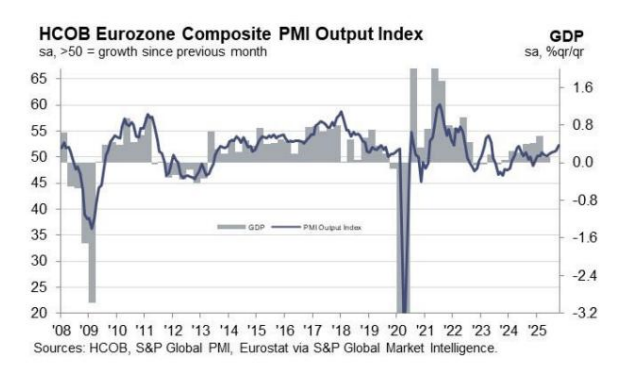
德国经济好转推动,欧元区10月综合PMI升至一年半来最高水平,制造业PMI升至荣枯线,服务业强劲增长
Hua Er Jie Jian Wen· 2025-10-24 10:01
Core Insights - Eurozone business activity unexpectedly accelerated in October, with the composite Purchasing Managers' Index (PMI) rising to its highest level since May 2024, indicating stronger economic momentum than market expectations [1][4]. Group 1: PMI Data - The October composite PMI for the Eurozone was reported at 52.2, up from 51.2 in September and significantly exceeding analysts' expectations of 51, marking the tenth consecutive month above the neutral level [1][4]. - The increase in PMI was primarily driven by the services sector, particularly strong performance in Germany, which offset ongoing weakness in France [1][4]. Group 2: Sector Performance - The services PMI in the Eurozone rose from 51.3 in September to 52.6 in October, reaching a 14-month high, while manufacturing showed only a slight improvement, with manufacturing output growth at 51.1, up from 50.0 in September [5][8]. - The overall manufacturing PMI increased from 49.8 in September to 50 in October, indicating a recovery from contraction to the neutral level [5][8]. Group 3: Employment Trends - Employment conditions showed a positive shift, with job growth resuming in October after a slight decline in September, and the pace of job creation in the services sector reached its fastest rate since June 2024 [8]. - However, manufacturing firms faced pressures to cut jobs at the fastest rate in four months due to weak demand [8]. Group 4: Economic Outlook - Despite the positive PMI data, business confidence fell to a five-month low, reflecting cautious sentiment regarding future prospects [8]. - The Eurozone's economic growth remains significantly behind that of the U.S., with challenges stemming from France's fiscal and political uncertainties and structural pressures in the manufacturing sector [8]. Group 5: Central Bank Policy - Market consensus suggests that the resilience of the Eurozone economy and moderate inflation pressures in the services sector will lead the European Central Bank to maintain its current interest rate policy [8]. - The inflation rate in the services sector remains moderate, with a slight increase in sales price inflation, but still close to long-term averages, which may support the ECB's stance against further rate cuts [8].
底气、朝气、锐气!多视角读懂货物贸易顶压增长 企业信心指数持续回升
Yang Shi Wang· 2025-10-14 06:38
Core Viewpoint - China's goods trade achieved a record high in the first three quarters of 2025, with total imports and exports reaching 33.61 trillion yuan, reflecting a year-on-year growth of 4% [1][18]. Trade Performance - In the first three quarters of 2025, China's exports amounted to 19.95 trillion yuan, increasing by 7.1%, marking eight consecutive quarters of growth, while imports totaled 13.66 trillion yuan, showing a slight decline of 0.2% [18]. - Trade with ASEAN reached 5.57 trillion yuan, up 9.6%, accounting for 16.6% of China's total foreign trade, maintaining ASEAN's position as China's largest trading partner [3][24]. Global Trade Position - As of the first seven months of 2025, China's share of global goods trade stood at 11.8%, reinforcing its status as the world's largest goods trading nation [4][11]. Trade Resilience - Despite facing a challenging external environment, China's goods trade demonstrated strong resilience, characterized by stable trade performance, new growth drivers, and proactive foreign trade entities [7][9]. - The number of foreign trade entities with import and export performance reached 700,000, surpassing the total for the entire year of 2024 [27]. Export Structure and Growth - The export structure is continuously optimizing, with industrial robot exports increasing by 54.9% and wind power equipment exports growing by 23.9% in the first three quarters [11][25]. - Processing trade reached 6.18 trillion yuan, up 6.9%, representing 18.4% of total foreign trade, and is moving towards higher value-added segments [25]. Business Confidence - Recent surveys indicate that the export enterprise confidence index has risen for five consecutive months, while the import enterprise confidence index has increased for three months [13][27]. - Private enterprises accounted for 19.16 trillion yuan in imports and exports, growing by 7.8%, and have shown continuous growth for 22 consecutive quarters, solidifying their role as the backbone of foreign trade [21].
【环球财经】9月巴西企业信心指数小幅回升
Xin Hua Cai Jing· 2025-10-02 06:51
Core Insights - The Brazilian business confidence index (ICE) rose by 0.5 points to 89.9 in September, ending a three-month decline trend [1] - Despite the increase, the index does not indicate a definitive end to the downward trend observed since June [1] Summary by Sections Business Confidence - The rise in business confidence in September is viewed as a positive signal, but it is not sufficient to conclude that the downward trend has been reversed [1] - The current situation index increased by 1.1 points to 93.8, while the expectations index fell by 0.3 points to 85.9, marking the lowest level since June 2020 [1] Sector Analysis - In September, 63% of surveyed businesses reported an increase in confidence, up from August, with improvements noted across all surveyed sectors [1] Economic Context - The data collection for this survey occurred from September 1 to 24, and analysts suggest that despite the slight recovery in business confidence, companies remain cautious about future economic prospects due to high interest rates and ongoing fiscal and external pressures [1]
【环球财经】意大利8月企业信心指数整体稳定
Xin Hua Cai Jing· 2025-08-28 17:46
Core Insights - The Italian National Institute of Statistics (ISTAT) reported that the business confidence index in Italy remained stable as of August 2025 [1] Industry Analysis - Business confidence in Italy showed a divergent trend across sectors: confidence in manufacturing, construction, and retail sectors declined, while the confidence in the market services sector significantly improved [1] - The decline in confidence in certain sectors was attributed to negative factors such as poor production or business expectations, inventory accumulation, and unfavorable order trends [1] - The recovery in market services confidence was primarily driven by positive developments in the transportation and warehousing, as well as information and communication industries [1]