
欧洲经济增长

Search documents
欧洲经济缓慢增长背后的内忧外患
Xin Lang Cai Jing· 2026-01-31 19:28
Economic Growth Outlook - The Eurozone GDP is projected to grow by 1.5% in 2025, while the EU GDP is expected to grow by 1.6%, slightly above market expectations [1] - The economic recovery in the Eurozone is described as weak, with a quarter-on-quarter growth of 0.3% for both the Eurozone and the EU in Q4 of the previous year [1][2] - Major economies like Germany, France, and Italy showed minimal growth, with France experiencing its lowest growth rate in three quarters due to weak domestic demand and declining investment [1] Manufacturing and Services Sector - The Eurozone's manufacturing activity continues to show signs of weakness, and service sector growth is also slow [2] - The January Composite Purchasing Managers' Index (PMI) for the Eurozone is at 51.5, indicating expansion but at a slower pace than expected [1] External and Internal Challenges - The European Central Bank has highlighted global trade tensions and geopolitical conflicts as significant factors affecting the economic outlook [3] - Structural issues within the EU, such as low productivity and high energy costs, are exacerbated by external challenges like rising trade barriers and slowing global demand [3] Employment and Industry Response - The job market is cooling, and many European manufacturing firms are resorting to production halts, layoffs, or inventory reductions in response to ongoing challenges [4][3] - Industry organizations have noted that pressures from energy costs and bureaucratic inefficiencies are leading to capacity closures and job cuts [3] Future Economic Projections - The EU Commission forecasts a slowdown in growth, with the Eurozone and EU expected to grow by 1.2% and 1.4% respectively in 2026 [5] - Structural resistance is anticipated to keep the Eurozone economy weak, with the need for fiscal stimulus to boost growth being a core issue [5][6] Currency and Trade Implications - The Euro's strength against the dollar, recently surpassing the 1.20 mark, poses challenges for Eurozone companies, particularly those reliant on exports to the U.S. [6] - Analysts suggest that the ongoing trade tensions and internal structural issues will likely keep the EU economy in a low-growth phase through 2026 [6]
国际观察丨欧洲经济缓慢增长背后的内忧外患
Xin Lang Cai Jing· 2026-01-31 12:15
Economic Growth Outlook - The Eurozone GDP is projected to grow by 1.5% in 2025, while the EU GDP is expected to grow by 1.6%, slightly above market expectations [1] - The Eurozone and EU economies grew by 0.3% quarter-on-quarter in Q4 of the previous year, with year-on-year growth of 1.3% and 1.4% respectively [1] Economic Performance of Major Economies - Major economies like Germany, France, and Italy experienced a quarter-on-quarter growth of 0.3%, 0.2%, and 0.3% respectively, while Spain and Portugal showed stronger growth at 0.8% [1] - France's growth was the lowest in three quarters due to weak domestic demand, reduced government spending, and declining fixed asset investment [1] Manufacturing and Services Sector - The Eurozone's January Composite Purchasing Managers' Index (PMI) was reported at 51.5, slightly below market expectations, indicating that business activity is still expanding but at a slower pace [1] - Manufacturing activity continues to show signs of weakness, and service sector growth is also slow, suggesting a challenging economic environment [2] Structural Challenges - The European Central Bank has highlighted global trade tensions and geopolitical conflicts as major factors affecting the economic outlook [3] - Structural issues such as low productivity, high energy costs, slow technological innovation, and complex regulatory compliance are exacerbating the challenges faced by the EU [3] Employment and Market Conditions - The manufacturing orders and exports in the Eurozone remain weak, and the job market is cooling, indicating that businesses are struggling with insufficient external demand and low confidence [4] Future Economic Projections - The European Commission's autumn economic outlook predicts that the Eurozone and EU will grow by 1.2% and 1.4% respectively in 2026, with structural resistance continuing to limit growth [5] - Analysts emphasize the need for fiscal stimulus to boost economic growth, but caution that without changes to the policy framework, long-term structural issues may persist [6] Currency and Trade Implications - The Euro has recently strengthened against the US dollar, which could negatively impact the export competitiveness and profits of Eurozone companies, as approximately 60% of revenues for companies in the Stoxx 600 index come from outside Europe [6]
【财经分析】欧洲经济缓慢增长背后的内忧外患
Xin Hua She· 2026-01-31 12:05
Economic Growth Outlook - The Eurozone GDP is projected to grow by 1.5% in 2025, while the EU GDP is expected to grow by 1.6%, slightly above market expectations [1] - The EU faces significant challenges in addressing external uncertainties and internal structural issues to unlock long-term economic growth potential [1] Economic Performance Indicators - In Q4 of the previous year, the Eurozone and EU economies grew by 0.3% quarter-on-quarter, with year-on-year growth of 1.3% and 1.4% respectively [2] - Major economies like Germany, France, and Italy showed modest growth, while Spain and Portugal emerged as key growth drivers with a 0.8% quarter-on-quarter increase [2] - The Eurozone's January composite PMI was reported at 51.5, indicating continued expansion but at a slower pace than expected [2] Structural Challenges - The European Central Bank highlighted global trade tensions and geopolitical conflicts as primary factors affecting the economic outlook [3] - Ongoing trade barriers and structural issues within the EU, such as low productivity and high energy costs, are exacerbating economic challenges [3] - Many European manufacturing firms are resorting to production halts, layoffs, or inventory reductions due to these pressures [3] Future Economic Projections - The EU Commission forecasts a slowdown in growth, with the Eurozone and EU expected to grow by 1.2% and 1.4% respectively in 2026 [5] - Structural resistance continues to hinder economic performance, with a focus on when fiscal stimulus will effectively boost growth [5] - The strong euro against the dollar poses risks to export competitiveness and profit margins for European companies, as approximately 60% of revenues for firms in the Stoxx 600 index come from outside Europe [6]
国际观察|欧洲经济缓慢增长背后的内忧外患
Xin Hua She· 2026-01-31 10:05
Economic Growth Outlook - The Eurozone GDP is projected to grow by 1.5% in 2025, while the EU GDP is expected to grow by 1.6%, slightly above market expectations [1] - The economic recovery in the Eurozone is described as weak, with a quarter-on-quarter growth of 0.3% for both the Eurozone and the EU in Q4 of the previous year, and year-on-year growth of 1.3% and 1.4% respectively [2] Internal and External Challenges - The European Central Bank has identified global trade tensions and geopolitical conflicts as major factors affecting the economic outlook [3] - Structural issues within the EU, such as low productivity, high energy costs, and slow technological innovation, are exacerbated by external challenges like rising trade barriers and global demand slowdown [3] Manufacturing and Employment Trends - Manufacturing orders and exports in the Eurozone remain weak, indicating that businesses are still struggling with insufficient external demand and low confidence [4] - Many European manufacturing firms are resorting to production halts, layoffs, or inventory reductions as a self-help measure, particularly in sectors like steel, automotive, and chemicals [3] Future Economic Projections - The European Commission's economic outlook report predicts that the Eurozone and EU will see growth rates of 1.2% and 1.4% respectively in 2026, highlighting ongoing structural challenges [5] - Analysts express concerns that fiscal stimulus measures may not effectively address long-term structural deficiencies without changes to policy frameworks [6] Currency and Trade Implications - The Euro has recently strengthened against the US dollar, which could negatively impact the export competitiveness and profitability of Eurozone companies, as approximately 60% of revenues for firms in the Stoxx 600 index come from outside Europe, with half from the US market [6]
欧洲经济录得温和增长,美元走弱隐现威胁
Xin Lang Cai Jing· 2026-01-30 11:51
Economic Growth - The European economy recorded moderate growth at the end of last year, overcoming turmoil caused by U.S. tariffs [1][4] - In the last three months of 2025, the economy of the 21 Eurozone countries grew by 0.3% quarter-on-quarter, maintaining the same growth rate as the third quarter; year-on-year growth was 1.3% compared to Q4 2024 [1][4] Trade and Tariffs - Earlier this year, U.S. President Donald Trump threatened to raise tariffs, raising concerns about a potential recession in Europe, but the current moderate growth has dispelled those fears [1][5] - A subsequent agreement set a tariff cap of 15% on EU goods, providing some certainty for businesses to continue operations and planning [5] Inflation and Consumer Behavior - After a significant inflation surge from 2022 to 2023, the inflation rate in Europe fell to 1.9% in December, coupled with rising wage levels, which improved consumer purchasing power and willingness to spend [2][5] Currency Exchange Rates - The latest threat to the European economy is the significant depreciation of the dollar against the euro, which has decreased the price competitiveness of European goods in key overseas markets [2][5] - Over the past 12 months, the euro has appreciated by 14.4% against the dollar, with the exchange rate reported at 1.19 on January 30 [2][5] Germany's Economic Performance - Germany's economy grew by 0.3% quarter-on-quarter in Q4, marking its best quarterly performance in three years, but still faces serious short-term and long-term challenges [3][6] - The German economy is expected to grow by 0.2% year-on-year in 2025, ending two consecutive years of output decline [3][6] - The German government has revised its 2026 economic growth forecast down from 1.3% to 1% [6] Challenges Facing Germany - Germany is grappling with several issues, including high energy prices due to the loss of Russian gas supplies, a shortage of skilled workers, increased competition from China in key export sectors, insufficient investment in growth-oriented infrastructure, and cumbersome administrative procedures [3][6] EU Economic Overview - The overall economy of the EU, which includes 27 member states, grew by 0.3% quarter-on-quarter in Q4 2025 and by 1.4% year-on-year compared to Q4 2024 [3][6] - Bulgaria officially joined the Eurozone in January, increasing the number of Eurozone member countries to 21 [6]
下周外盘看点丨美国PCE或搅动美联储 特朗普亮相达沃斯会说什么
Di Yi Cai Jing· 2026-01-18 02:31
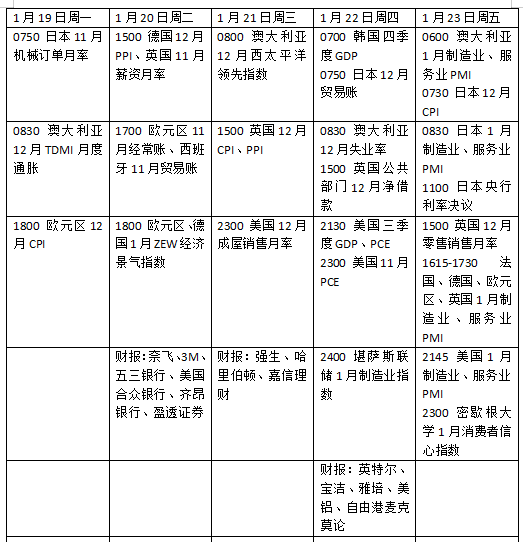
Market Overview - The U.S. stock market experienced a decline, with the Dow Jones falling by 0.29%, the Nasdaq by 0.66%, and the S&P 500 by 0.38% during the week [1] - European stock indices showed mixed results, with the UK FTSE 100 rising by 1.09%, the German DAX 30 by 0.14%, and the French CAC 40 dropping by 1.23% [1] Economic Indicators - Attention will shift to the U.S. GDP data, PCE inflation data, and consumer confidence index, which may provide insights into the Federal Reserve's policy direction [3] - The PCE inflation data for November is set to be released, which is a key indicator for the Federal Reserve [3] - The U.S. third-quarter GDP revision data will also be released, with the initial growth rate reported at 4.3%, exceeding market expectations [3] Earnings Reports - The second week of the earnings season will feature reports from major companies, including Netflix and Intel, as well as other industry leaders like Johnson & Johnson and Abbott [4] Commodity Market - Oil prices continued to rise, with WTI crude increasing by 0.54% to $59.44 per barrel and Brent crude by 1.25% to $64.13 per barrel [5] - Gold futures for January delivery rose by 2.18% to $4588.40 per ounce, while silver futures surged by 11.69% to $88.09 per ounce [6] European Economic Outlook - The Eurogroup finance ministers' meeting and the EU finance ministers' meeting are scheduled, focusing on fiscal stimulus policies, particularly from Germany [7] - The European Central Bank's monetary policy meeting minutes will be released, with expectations that no rate changes will occur this year [7] Upcoming Events - The annual World Economic Forum in Davos will take place, with discussions expected to revolve around global economic cooperation and U.S. trade policies [1]

高盛:欧洲经济韧性超预期,2026年可望重返增长轨道
Sou Hu Cai Jing· 2026-01-05 02:35
Core Viewpoint - Goldman Sachs reports that the Eurozone and the UK are showing unexpected economic resilience in 2025, with strong domestic demand exceeding previous forecasts despite pressure from US tariffs on exports and real GDP growth [1] Economic Growth Projections - The bank anticipates that the negative impact of US tariffs will gradually diminish, leading to improved economic growth across Europe in 2026 [1] - The projected economic growth for the Eurozone in 2026 is 1.3%, while the UK is expected to grow by 0.9%, aligning with general market expectations [1] Factors Supporting Economic Activity - Germany's shift in fiscal policy and increased defense spending from various countries are expected to be significant supports for economic activity in the coming year [1] - Strong growth in real income is predicted to further boost consumer spending [1] Monetary Policy Outlook - Given the economic resilience, it is likely that the European Central Bank will maintain interest rates in 2026, unless there is a notable demand-driven inflation or a deterioration in economic outlook [1]
欧洲迎来机遇时刻?高盛:五大因素正重塑欧洲经济,增长前景或超预期
Hua Er Jie Jian Wen· 2025-08-11 11:02
Core Insights - Goldman Sachs identifies five key opportunities reshaping Europe's growth prospects despite its long-term economic challenges [1][2] Group 1: Opportunities - The five driving factors for Europe's economic growth include increased public investment led by Germany and the EU recovery fund, established global leadership in emerging industries like green technology, financial market reforms aimed at activating idle savings, improved risk-sharing mechanisms, and significant growth potential from deepening the internal market [1][3] - Goldman Sachs has raised its real GDP forecast for the Eurozone by 1.2% by the end of 2027, while lowering the U.S. GDP forecast by 1.7% [1] Group 2: Structural Challenges - Europe faces four structural challenges: loss of competitiveness due to high energy prices, insufficient investment limiting growth potential, a suboptimal business environment compared to other developed markets, and long-term challenges from an aging population [2][3] Group 3: Investment Outlook - Goldman Sachs maintains a constructive outlook on Europe's growth over the next 2-3 years, predicting that Eurozone growth forecasts will exceed market consensus, particularly for Germany [4] - The firm anticipates rising long-term bond yields, a stronger euro, and increased stock allocations to Europe, which could provide upside potential [4] - There is an opportunity for policymakers to implement reforms that could lead to sustained improvements in Europe's economic performance [4]
丹斯克银行:尽管美国潜在的经济衰退风险受到关注,但预计对包括北欧国家在内的欧洲经济增长的影响较为温和。
news flash· 2025-05-02 05:38
Core Viewpoint - Danske Bank anticipates that the potential economic recession risks in the United States will have a relatively mild impact on economic growth in Europe, including Nordic countries [1] Group 1 - The focus on potential economic recession risks in the United States is increasing [1] - Economic growth in Europe, particularly in Nordic countries, is expected to remain stable despite these risks [1]
机构:计欧洲央行年底前将考虑加息
news flash· 2025-04-28 09:39
Core Viewpoint - Franklin Templeton suggests that the European Central Bank (ECB) will consider interest rate hikes by the end of this year due to potential economic growth driven by defense spending [1] Group 1: Economic Outlook - David Zahn, head of the European fixed income department, indicates that by 2026, the economic situation in Europe will be very clear, with low inflation rates and strong economic growth [1] - This perspective contrasts with current market expectations, where traders anticipate three more rate cuts from the ECB this year, each by 25 basis points [1] Group 2: Interest Rate Projections - Traders expect the deposit rate to remain at 1.5% until mid-next year following the anticipated rate cuts [1]