
氧化铝产能过剩

Search documents
矿石周度报告:矿石价格上行,中东铝厂减产预期升温-20260330
Dong Zheng Qi Huo· 2026-03-30 03:02
1. Report Investment Rating - The investment rating for alumina is "Oscillation" [5] 2. Core View - The price of alumina is affected by multiple factors. Although the oversupply situation has slightly eased, the cost of alumina production has increased due to the rising prices of related raw materials. However, the expected reduction in electrolytic aluminum production in the Middle East will impact global alumina demand. Overall, the alumina market still has a significant over - capacity, but the rising cost provides support for the futures price under the influence of the Middle East conflict [12] 3. Summary by Directory 3.1 Alumina Industry Chain Weekly Overview - **Raw Materials**: Domestic ore prices remained stable last week, with the ex - works含税 price of 58/5 grade ore in Shanxi at 628 yuan and in Henan at 610 yuan/ton. Inland mine开工率 is still low, and the resumption of some mines is slow. For imports, the CIF price of Guinean ore at $70/ton has low acceptance from downstream. The Guinean government changed its statement to reducing overall export volume. 4.071 million tons of new ore arrived, including 3.368 million tons from Guinea and 0.534 million tons from Australia. The freight for Cape - type ships on the Guinea - China route is $31/ton [2][9] - **Alumina**: The spot price of alumina continued to rise last week, but the increase narrowed. The northern comprehensive price of ALD is 2760 - 2800 yuan/ton, up 25 yuan/ton from last week; the domestic weighted index is 2788 yuan/ton, up 15.7 yuan/ton. The port quotation of imported alumina is 2730 - 2780 yuan/ton, up 20 yuan/ton. Most traders are cautious in selling and reluctant to sell at low prices. In the import market, the spot trading activity overseas increased, with 4 spot transactions reported and prices rising. The theoretical import cost to Chinese ports rose to about 2864 yuan/ton. As of last week, the full cost of domestic alumina was 2660 yuan/ton, with a real - time profit of 102 yuan/ton. In terms of supply, some southern alumina enterprises entered the overhaul stage, and some northern enterprises increased their production loads, but the total operating capacity did not change significantly. The total built - in capacity of alumina in China is 114.62 million tons, with an operating capacity of 93.75 million tons, an increase of 50,000 tons from last week, and an operating rate of 81.8% [3][10] - **Demand**: Domestically, Liaoning Xiangyu Aluminum started the resumption of production, planning to resume 300,000 tons and complete the resumption in May, with the current operating capacity increasing to 490,000 tons. The second - phase project of Huomei Hongjun Zha Aluminum resumed production to 1 million tons. The domestic operating capacity of electrolytic aluminum is 4.4573 million tons, an increase of 50,000 tons week - on - week. Overseas, the expansion project of Balco electrolytic aluminum plant under India's Vedanta is slowly being put into production, with the current operating capacity at 840,000 tons. The San Ciprián aluminum plant in Spain is gradually resuming production, with the current operating capacity reaching 205,000 tons and full production expected in the middle of the year. The latest overseas operating capacity of electrolytic aluminum is 2.938 million tons [11] - **Inventory**: The national alumina inventory last week was 5.379 million tons, an increase of 10,000 tons from last week. The inventory of electrolytic aluminum enterprises fluctuated slightly, with increases and decreases in the north and south, showing a slight overall increase. The bagged inventory of alumina plants maintained normal shipments, with slight regional fluctuations and the total remaining the same as last week. The instantaneous re - export of bagged alumina had a short - term significant impact on the inventory changes of some ports. The import of foreign - trade alumina in northern ports remained at a certain scale, while the domestic - trade alumina decreased relatively. The inventory in yards/platforms/in - transit/delivery warehouses continued to increase [11] - **Warehouse Receipts**: The registered warehouse receipts of alumina on the Shanghai Futures Exchange were 416,774 tons, an increase of 24,587 tons from last week [12] 3.2 Key News Summary - **Damage to UAE Global Aluminum's Facility**: UAE Global Aluminum's AITaweelah facility in Abu Dhabi's Khalifa Economic Zone was severely damaged during an attack by Iranian missiles and drones. Multiple employees were injured but none were in life - threatening condition. The company said it would resume operations as soon as possible. The AITaweelah aluminum complex consists of an alumina plant with a built - in capacity of 2.45 million tons and an electrolytic aluminum plant with a built - in capacity of 1.5 million tons [13] - **Rise in Alumina Import Cost**: The FOB price of Australian alumina rose from $310/ton to $320/ton, and the theoretical import cost to Chinese ports rose to about 2864 yuan/ton (last week's estimated import cost was about 2684 yuan/ton), higher than the average price of 2780 yuan/ton in the northern region, indicating no short - term import profit [13] 3.3 Key Data Monitoring of the Industry Chain - **Raw Materials and Cost**: The report provides data on domestic and imported bauxite prices, domestic bauxite port inventory, port shipping volume of major bauxite - importing countries, sea - floating inventory of major bauxite - importing countries, domestic caustic soda price trends, domestic thermal coal price trends, and alumina production costs in various provinces [14][16][18] - **Alumina Price and Supply - Demand Balance**: It includes data on domestic provincial alumina spot prices, imported alumina prices, domestic electrolytic aluminum spot prices, the futures price ratio of electrolytic aluminum to alumina on the Shanghai Futures Exchange, and the weekly supply - demand balance of domestic alumina [29][31][32] - **Alumina Inventory and Warehouse Receipts**: Data on electrolytic aluminum plant alumina inventory, alumina plant alumina inventory, domestic alumina yard/platform/in - transit inventory, alumina port inventory, domestic total social alumina inventory, and the quantity and holding volume of alumina warehouse receipts on the Shanghai Futures Exchange are provided [40][43][45]
氧化铝周报:悲观情绪蔓延,基本面维持承压-20251213
Wu Kuang Qi Huo· 2025-12-13 12:59
1. Report Industry Investment Rating No information provided in the document. 2. Core Viewpoints - Rainy season in Guinea is over, and the AXIS mine is resuming production, so the ore price is expected to decline with fluctuations. Attention should be paid to the support at the import cost level of Guinea's ore. - The over - capacity situation in the alumina smelting sector is difficult to change in the short term, and the inventory accumulation trend continues. - The current price is close to the cost line of most manufacturers, so the expectation of subsequent production cuts is increasing. The overall non - ferrous metal sector is showing strong performance, so the cost - effectiveness of short - selling is not high. It is recommended to wait and see in the short term. The reference operating range for the domestic main contract AO2601 is 2400 - 2700 yuan/ton. Key factors to watch include supply - side policies, Guinea's ore policies, and the Federal Reserve's monetary policy [12][13]. 3. Summary by Directory 3.1 Week - on - Week Assessment - **Futures Price**: As of 3 pm on December 12, the alumina index dropped 2.42% to 2544 yuan/ton this week, and the open interest decreased by 35,000 lots to 638,000 lots. Supply surplus, falling ore prices, and approaching delivery of expired warehouse receipts drove the alumina futures price down continuously. The Shandong spot price was reported at 2680 yuan/ton, with a premium of 210 yuan/ton over the 01 contract. The delivery game led to a large discount of the futures price. The spread between the first and the third consecutive contracts closed at - 155 yuan/ton, and the spread was widening [11]. - **Spot Price**: This week, the decline of alumina spot prices in various regions narrowed. The spot prices in Guangxi, Guizhou, Henan, Shandong, Shanxi, and Xinjiang decreased by 40 yuan/ton, 35 yuan/ton, 60 yuan/ton, 60 yuan/ton, 50 yuan/ton, and 110 yuan/ton respectively. The inventory accumulation trend continued, and most regional spot prices remained under pressure [11][21]. - **Inventory**: The total social inventory of alumina increased by 57,000 tons to 5.061 million tons this week. The inventory in electrolytic aluminum plants, alumina plants, in - transit inventory, and port inventory increased by 16,000 tons, decreased by 10,000 tons, increased by 62,000 tons, and decreased by 11,000 tons respectively. The total warehouse receipts of alumina on the Shanghai Futures Exchange increased by 0.16 million tons to 254,900 tons; the inventory in the delivery warehouse was 258,800 tons, a decrease of 0.11 million tons from last week [11]. - **Mineral End**: Recently, domestic bauxite production has declined due to environmental supervision in the north and the rainy season in the south. The price of domestic ore remains firm, but alumina plants' willingness to push down prices has increased due to shrinking profits. For imported ore, after the rainy season in Guinea, the ore shipment volume has increased. The AXIS mine, which stopped operation in May this year, has gradually resumed production, which may further exacerbate the bauxite surplus situation. Coupled with the high port inventory, the ore price is expected to decline with fluctuations [12]. - **Supply Side**: As of December 13, 2025, the weekly alumina output was 1.859 million tons, a slight decrease of 0.2 million tons from last week [12]. - **Import and Export**: As of December 12, the FOB price in Australia remained at $312 per ton this week, and the import profit and loss was - 58 yuan/ton. The import window was closed [12]. - **Demand Side**: In November 2025, the operating capacity of electrolytic aluminum was 44.64 million tons, an increase of 80,000 tons from the previous month. The operating rate of electrolytic aluminum in November decreased by 0.25% to 97.22% [12]. 3.2 Spot and Futures Prices - **Spot Price**: The decline of alumina spot prices in various regions narrowed this week. The spot prices in Guangxi, Guizhou, Henan, Shandong, Shanxi, and Xinjiang decreased by 40 yuan/ton, 35 yuan/ton, 60 yuan/ton, 60 yuan/ton, 50 yuan/ton, and 110 yuan/ton respectively. The inventory accumulation trend continued, and most regional spot prices remained under pressure [21]. - **Futures Price and Basis**: As of 3 pm on December 12, the alumina index dropped 2.42% to 2544 yuan/ton this week, and the open interest decreased by 35,000 lots to 638,000 lots. Supply surplus, falling ore prices, and approaching delivery of expired warehouse receipts drove the alumina futures price down continuously. The Shandong spot price was reported at 2680 yuan/ton, with a premium of 210 yuan/ton over the 01 contract. The delivery game led to a large discount of the futures price. The spread between the first and the third consecutive contracts closed at - 155 yuan/ton, and the spread was widening [24]. - **Bauxite Price**: This week, bauxite prices in various regions remained unchanged. For imported ore, the CIF price of Guinea decreased by $0.5 to $70 per ton, and that of Australia decreased by $0.5 to $67.5 per ton. After the rainy season in Guinea, the ore shipment volume has increased. The AXIS mine, which stopped operation in May this year, has gradually resumed production, which may further exacerbate the bauxite surplus situation. Coupled with the high port inventory, the ore price is expected to decline with fluctuations [27]. 3.3 Supply Side - **Bauxite Production**: In November 2025, China's bauxite production was 4.698 million tons, a year - on - year decrease of 5.3% and a month - on - month decrease of 1.56%. The total production in the first eleven months of 2025 was 55.21 million tons, a year - on - year increase of 1.54%. Affected by environmental protection policies, the domestic bauxite production has been decreasing month by month [31]. - **Bauxite Import**: In October 2025, China imported 13.77 million tons of bauxite, a year - on - year increase of 12.02% and a month - on - month decrease of 13.32%. The total imports in the first ten months of 2025 were 171.4 million tons, a year - on - year increase of 30.11%. From the perspective of import sources, in October 2025, China imported 900 tons of bauxite from Guinea, a year - on - year increase of 18.44% and a month - on - month decrease of 14.25%. The cumulative imports from Guinea in the first ten months of 2025 were 127.43 million tons, a year - on - year increase of 38.37%. Affected by the rainy season, the imports decreased, and it is expected to gradually recover. In October 2025, China imported 3.82 million tons of bauxite from Australia, a year - on - year increase of 3.48% and a month - on - month increase of 2.29%. The cumulative imports from Australia in the first ten months of 2025 were 31.6 million tons, a year - on - year decrease of 4.23% [33][35][37]. - **Bauxite Inventory**: In November, China's bauxite inventory increased by 0.78 million tons to 53.29 million tons, still at a near - five - year high, and enterprises had sufficient ore inventory. In key regions, the bauxite inventory in Shanxi decreased by 0.27 million tons, and that in Henan decreased by 0.47 million tons in November. The inventory increase mainly came from Shandong [40]. - **Alumina Production**: In November 2025, alumina production was 7.84 million tons, a year - on - year increase of 11.73% and a month - on - month decrease of 1.58%. The cumulative production in the first eleven months of 2025 was 82.64 million tons, a year - on - year increase of 10.19%. In terms of operating capacity, in November 2025, the operating capacity of alumina was 95.8 million tons, a year - on - year increase of 11.59% and a month - on - month decrease of 0.62%. As of December 12, 2025, the weekly alumina output was 1.859 million tons, a slight decrease of 0.2 million tons from last week [42][45]. - **Alumina Plant Profit**: The alumina spot price has declined. Although the raw material prices have also decreased, the profits of alumina plants are still under pressure. According to the alumina spot price on December 12, in Guangxi, with the relatively low price of local domestic ore, the current production profit can reach 100 yuan/ton. Relying on coastal advantages and relatively low liquid caustic soda prices, the profits of using Australian ore and Guinea ore in Shandong are 20 yuan/ton and - 50 yuan/ton respectively, approaching the loss situation. The transportation cost of imported ore from ports for inland alumina plants is about 100 yuan/ton. After calculation, the gross profits of using overseas ore in Shanxi and Henan have dropped to 170 yuan/ton and 100 yuan/ton respectively [48]. - **Alumina Import and Export**: In October 2025, the net import of alumina was 13,600 tons. The opening of the previous import window led to the first monthly change from net export to net import this year. The import volume increased from 60,000 tons last month to 189,300 tons, and the export volume decreased from 246,400 tons to 175,700 tons. The total net export in the first ten months of 2025 was 1.4375 million tons. As of December 12, the FOB price in Australia remained at $312 per ton this week, and the import profit and loss was - 58 yuan/ton [50][52]. - **Overseas Alumina Production**: In November 2025, overseas alumina production was 5.29 million tons, a year - on - year increase of 5.16% and a month - on - month decrease of 2.34%. The cumulative production in the first eleven months of 2025 was 57.2 million tons, a year - on - year increase of 3.42% [54]. 3.4 Demand Side - **Electrolytic Aluminum Production**: In November 2025, China's electrolytic aluminum production was 3.68 million tons, a year - on - year increase of 2.16% and a month - on - month decrease of 3.21%. The total production in the first eleven months of 2025 was 40.55 million tons, a year - on - year increase of 2.67% [59]. - **Electrolytic Aluminum Operation**: In November 2025, the operating capacity of electrolytic aluminum was 44.64 million tons, an increase of 80,000 tons from the previous month. The operating rate of electrolytic aluminum in November decreased by 0.25% to 97.22% [62]. 3.5 Supply - Demand Balance The document provides an alumina balance sheet from January to December 2025 (estimated) and the cumulative data for 2025, including information on the supply - demand gap, total demand, net exports, total supply, export volume, import volume, electrolytic aluminum consumption of alumina, electrolytic aluminum production, electrolytic aluminum operating capacity, alumina production, and alumina operating capacity [65]. 3.6 Inventory - **Alumina Social Inventory**: The total social inventory of alumina increased by 57,000 tons to 5.061 million tons this week. The inventory in electrolytic aluminum plants, alumina plants, in - transit inventory, and port inventory increased by 16,000 tons, decreased by 10,000 tons, increased by 62,000 tons, and decreased by 11,000 tons respectively [70]. - **Alumina Futures Inventory**: The total warehouse receipts of alumina on the Shanghai Futures Exchange increased by 0.16 million tons to 254,900 tons this week; the inventory in the delivery warehouse was 258,800 tons, a decrease of 0.11 million tons from last week [71].
氧化铝周报 2025/11/22:宏观情绪偏弱,期价进一步下探-20251122
Wu Kuang Qi Huo· 2025-11-22 13:26
1. Report Industry Investment Rating No information provided in the report. 2. Core View of the Report - Rainy - season shipping is gradually recovering, and ore prices are expected to fluctuate downward. The over - capacity pattern in the alumina smelting sector is difficult to change in the short term, and the inventory accumulation trend continues. However, the current price is approaching the cost line of most manufacturers, and the subsequent production cut expectation is strengthening. Also, the overall non - ferrous sector is trending strongly, so the cost - effectiveness of short - selling is not high. It is recommended to wait and see in the short term. The reference operating range for the domestic main contract AO2601 is 2600 - 2900 yuan/ton. Attention should be paid to supply - side policies, Guinea's ore policies, and the Fed's monetary policy [12][13]. 3. Summary by Directory 3.1 Weekly Assessment - **Futures Price**: As of 3 p.m. on November 21, the alumina index fell 3.76% to 2737 yuan/ton this week, with positions increasing by 0.1 million lots to 57.3 million lots. The Fed's hawkish stance and the unsolved alumina supply - surplus situation led to a further decline in alumina futures prices. The Shandong spot price was 2775 yuan/ton, with a premium of 71 yuan/ton over the December 12 contract. The spread between the first and third - month contracts closed at - 107 yuan/ton, and the weak spot made the near - month contract relatively weaker [11][24]. - **Spot Price**: This week, the decline in alumina spot prices in various regions narrowed. Prices in Guangxi, Guizhou, Henan, Shandong, Shanxi, and Xinjiang decreased by 15 yuan/ton, 25 yuan/ton, 5 yuan/ton, 5 yuan/ton, 5 yuan/ton, and increased by 5 yuan/ton respectively. The inventory accumulation trend continued, and most regional spot prices were still under pressure [11][21]. - **Inventory**: Alumina's total social inventory increased by 4.3 million tons to 488.3 million tons this week. The inventory in electrolytic aluminum plants, alumina plants, in - transit inventory, and port inventory increased by 3.2 million tons, decreased by 2 million tons, increased by 3.7 million tons, and decreased by 0.6 million tons respectively. The total warehouse receipts of alumina on the Shanghai Futures Exchange decreased by 0.27 million tons to 25.09 million tons; the delivery warehouse inventory was 25.58 million tons, an increase of 0.21 million tons from last week. The supply of circulating spot became looser, and the warehouse receipt registration volume further increased this week [11][68][70]. - **Mineral End**: Recently, domestic bauxite production has declined due to environmental supervision in the north and the rainy season in the south. Domestic ore prices remain firm, but alumina plants' willingness to lower prices has increased due to shrinking profits. For imported ores, the shipping volume is stable, port inventory is rising, and ore prices are under further pressure after the rainy season [12]. - **Supply Side**: As of November 21, 2025, the weekly alumina output was 184.5 million tons, a slight increase of 0.2 million tons from last week [12][43]. - **Import and Export**: As of November 21, the Australian FOB price decreased by 1 US dollar/ton to 319 US dollars/ton this week, and the import profit and loss was - 41 yuan/ton. Overseas alumina prices have been fluctuating in the range of 315 - 320 US dollars recently, and the domestic spot price has been continuously declining, leading to a decrease in import profit and loss [12][50]. - **Demand Side**: In October 2025, the operating capacity of electrolytic aluminum was 4456 million tons, the same as last month. The operating rate of electrolytic aluminum in October remained at 97.47% [12][60]. 3.2 Spot and Futures Prices - **Spot Price**: The decline in alumina spot prices in various regions narrowed this week. Prices in Guangxi, Guizhou, Henan, Shandong, Shanxi, and Xinjiang decreased by 15 yuan/ton, 25 yuan/ton, 5 yuan/ton, 5 yuan/ton, 5 yuan/ton, and increased by 5 yuan/ton respectively. The inventory accumulation trend continued, and most regional spot prices were still under pressure [21]. - **Futures Price and Basis**: As of 3 p.m. on November 21, the alumina index fell 3.76% to 2737 yuan/ton this week, with positions increasing by 0.1 million lots to 57.3 million lots. The Fed's hawkish stance and the unsolved alumina supply - surplus situation led to a further decline in alumina futures prices. The Shandong spot price was 2775 yuan/ton, with a premium of 71 yuan/ton over the December 12 contract. The spread between the first and third - month contracts closed at - 107 yuan/ton, and the weak spot made the near - month contract relatively weaker [24]. - **Bauxite Price**: This week, bauxite prices in various regions remained unchanged. For imported ores, the Guinea CIF price decreased by 0.5 US dollars/ton to 71.5 US dollars/ton, and the Australian CIF price remained at 68 US dollars/ton. After the impact of the rainy season in Guinea subsided, the ore shipping volume increased. The shrinking profit led to an enhanced willingness of alumina enterprises to lower prices. Coupled with the high port inventory, ore prices are expected to fluctuate downward [27]. 3.3 Supply Side - **Bauxite Production**: In October 2025, China's bauxite production was 477 million tons, a year - on - year decrease of 7.00% and a month - on - month decrease of 2.25%. In the first ten months of 2025, the total production was 5052 million tons, a year - on - year increase of 2.22%. Affected by the rainy season and environmental policies, domestic bauxite production has been decreasing month by month [31]. - **Bauxite Import**: In October 2025, China imported 1377 million tons of bauxite, a year - on - year increase of 12.02% and a month - on - month decrease of 13.32%. In the first ten months of 2025, the total import was 17140 million tons, a year - on - year increase of 30.11% [33]. - **Bauxite Import by Country**: In October 2025, China imported 900 tons of bauxite from Guinea, a year - on - year increase of 18.44% and a month - on - month decrease of 14.25%. In the first ten months of 2025, the cumulative import from Guinea was 12743 million tons, a year - on - year increase of 38.37%. Affected by the rainy season, it declined and is expected to gradually recover later. In October 2025, China imported 382 million tons of bauxite from Australia, a year - on - year increase of 3.48% and a month - on - month increase of 2.29%. In the first ten months of 2025, the cumulative import from Australia was 3160 million tons, a year - on - year decrease of 4.23% [35][37]. - **Bauxite Inventory**: In October, China's bauxite inventory increased by 24 million tons, with the total inventory reaching 5250 million tons, still at a near - five - year high, and enterprises' ore inventory was sufficient. In key regions, the bauxite inventory in Shanxi decreased by 28 million tons, and that in Henan decreased by 36 million tons in October. The inventory increase mainly came from Shandong [40]. - **Alumina Production**: In October 2025, alumina production was 796.7 million tons, a year - on - year increase of 11.88% and a month - on - month increase of 2.85%. In the first ten months of 2025, the cumulative production was 7480 million tons, a year - on - year increase of 10.03% [42]. - **Alumina Operating Capacity**: In October 2025, the alumina operating capacity was 9640 million tons, a year - on - year increase of 16.57% and a month - on - month decrease of 0.64%. As of November 21, 2025, the weekly alumina output was 184.5 million tons, a slight increase of 0.2 million tons from last week [43]. - **Alumina Plant Profit**: The alumina spot price has declined, and alumina plant profits are under pressure. According to the alumina spot price on November 21, in Guangxi, with the relatively low price of local domestic ores, the current production profit can reach 155 yuan/ton. Relying on coastal advantages and relatively low liquid caustic soda prices, the profits of using Australian and Guinea ores in Shandong are 0 yuan/ton and 70 yuan/ton respectively, approaching the loss situation. The cost of transporting port - imported ores for inland alumina plants is about 100 yuan/ton. After calculation, the use of overseas ores in Shanxi and Henan has slightly turned into losses [46]. - **Alumina Import and Export**: In October 2025, the net alumina import was 1.36 million tons. The opening of the import window earlier drove the first monthly change from net export to net import this year. The import volume increased from 6 million tons last month to 18.93 million tons, and the export volume decreased from 24.64 million tons to 17.57 million tons. In the first ten months of 2025, the total net export was 143.75 million tons. As of November 21, the Australian FOB price decreased by 1 US dollar/ton to 319 US dollars/ton this week, and the import profit and loss was - 41 yuan/ton. Overseas alumina prices have been fluctuating in the range of 315 - 320 US dollars recently, and the domestic spot price has been continuously declining, leading to a decrease in import profit and loss [48][50]. - **Overseas Alumina Production**: In October 2025, overseas alumina production was 541 million tons, a year - on - year increase of 4.84% and a month - on - month increase of 3.36%. In the first ten months of 2025, the cumulative production was 5191 million tons, a year - on - year increase of 3.24% [52]. 3.4 Demand Side - **Electrolytic Aluminum Production**: In October 2025, China's electrolytic aluminum production was 380 million tons, a year - on - year increase of 3.34% and a month - on - month increase of 2.74%. In the first ten months of 2025, the total production was 3687 million tons, a year - on - year increase of 2.73% [57]. - **Electrolytic Aluminum Operating Rate**: In October 2025, the operating capacity of electrolytic aluminum was 4456 million tons, the same as last month. The operating rate of electrolytic aluminum in October remained at 97.47% [60]. 3.5 Supply - Demand Balance The report provides an alumina balance sheet from January to December 2025 (including estimated values for November and December), showing data on alumina supply, demand, import, export, and the supply - demand difference for each month [63]. 3.6 Inventory - **Social Inventory**: Alumina's total social inventory increased by 4.3 million tons to 488.3 million tons this week. The inventory in electrolytic aluminum plants, alumina plants, in - transit inventory, and port inventory increased by 3.2 million tons, decreased by 2 million tons, increased by 3.7 million tons, and decreased by 0.6 million tons respectively [68]. - **Futures Inventory**: The total warehouse receipts of alumina on the Shanghai Futures Exchange decreased by 0.27 million tons to 25.09 million tons this week; the delivery warehouse inventory was 25.58 million tons, an increase of 0.21 million tons from last week. The supply of circulating spot became looser, and the warehouse receipt registration volume further increased this week [70].
氧化铝周报:矿价短期支撑较强,高库存限制上方空间-20250816
Wu Kuang Qi Huo· 2025-08-16 15:02
Report Industry Investment Rating There is no information provided regarding the industry investment rating in the report. Core Viewpoints - The supply disturbances of domestic and foreign bauxite ores are expected to support the ore price, but the over - capacity situation of alumina remains difficult to change. It is recommended to short at high levels based on market sentiment. The reference operating range for the domestic main contract AO2509 is 3000 - 3400 yuan/ton, and attention should be paid to supply - side policies and Guinea's ore policies [12]. - Both unilateral and arbitrage trading strategies suggest a wait - and - see approach [14]. Summary by Directory 1. Weekly Assessment - **Futures Price**: As of 3 pm on August 16, the alumina index rose 0.41% to 3195 yuan/ton this week, with open interest increasing by 18,000 lots to 389,000 lots. Affected by news of domestic bauxite in Shanxi and Guinea's bauxite, the price soared at the beginning of the week but then gradually declined due to the over - supply fundamentals. The Shandong spot price was 3205 yuan/ton, with a premium of 9 yuan/ton over the 09 contract. The spread between the first and third contracts closed at - 7 yuan/ton [11][25]. - **Spot Price**: This week, the spot prices of alumina in various regions changed little. The prices in Guangxi, Guizhou, Henan, Shandong, Shanxi, and Xinjiang decreased by 0 yuan/ton, 0 yuan/ton, 5 yuan/ton, 10 yuan/ton, 10 yuan/ton, and 0 yuan/ton respectively [11][21]. - **Inventory**: The total social inventory of alumina increased by 55,000 tons to 4.199 million tons this week. The in - plant inventory of electrolytic aluminum plants, in - plant inventory of alumina plants, in - transit inventory, and port inventory increased by 47,000 tons, 20,000 tons, decreased by 16,000 tons, and increased by 4,000 tons respectively. The warehouse receipts of alumina on the Shanghai Futures Exchange increased by 39,600 tons to 65,800 tons, and the inventory in delivery warehouses was 88,400 tons, an increase of 290 tons from last week. The registered volume of warehouse receipts rebounded significantly this week as the supply of spot goods became looser [11][70][72]. - **Others**: Domestic bauxite production has declined recently due to environmental supervision in the north and the rainy season in the south, and the price of domestic ore is expected to remain firm. The shipment of Guinea's bauxite has declined due to the rainy season and previous bans, which is expected to lead to a decline in the arrival volume of imported ores. The port inventory will experience phased destocking, and the ore price still has short - term support. This week, the domestic alumina production was 1.849 million tons, a decrease of 2,000 tons from last week but still at a high level. The FOB price of Australian alumina decreased by 7 US dollars/ton to 367 US dollars/ton this week, and the import profit and loss was - 25 yuan/ton, with the import window approaching to open. In July 2025, the operating capacity of electrolytic aluminum was 44.193 million tons, an increase of 160,000 tons from the previous month, and the operating rate increased by 0.55% to 97.24% [12]. 2. Spot and Futures Prices - **Spot Price**: The spot prices of alumina in various regions changed little this week. The prices in Guangxi, Guizhou, Henan, Shandong, Shanxi, and Xinjiang decreased by 0 yuan/ton, 0 yuan/ton, 5 yuan/ton, 10 yuan/ton, 10 yuan/ton, and 0 yuan/ton respectively [21]. - **Futures Price and Basis**: As of 3 pm on August 16, the alumina index rose 0.41% to 3195 yuan/ton this week, with open interest increasing by 18,000 lots to 389,000 lots. Affected by news of domestic bauxite in Shanxi and Guinea's bauxite, the price soared at the beginning of the week but then gradually declined due to the over - supply fundamentals. The Shandong spot price was 3205 yuan/ton, with a premium of 9 yuan/ton over the 09 contract. The spread between the first and third contracts closed at - 7 yuan/ton [25]. - **Bauxite Price**: The bauxite prices in various regions remained unchanged this week. The CIF price of Guinea's bauxite remained at 74 US dollars/ton, and that of Australia remained at 69 US dollars/ton. The shipment of Guinea's bauxite has declined recently, which is expected to lead to a decline in the arrival volume of imported ores, and the port inventory is expected to experience phased destocking. The ore price still has medium - term support [28]. 3. Supply Side - **Bauxite Production**: In July 2025, China's bauxite production was 5.43 million tons, a year - on - year increase of 7.4% and a month - on - month increase of 4.64%. The total production in the first seven months of 2025 was 35.83 million tons, a year - on - year increase of 4.75% [32]. - **Bauxite Import**: In June 2025, China imported 18.12 million tons of bauxite, a year - on - year increase of 35.86% and a month - on - month increase of 3.44%. The total import in the first six months of 2025 was 103.4 million tons, a year - on - year increase of 33.68%. Among them, in June 2025, China imported 1332 tons of bauxite from Guinea, a year - on - year increase of 40.18% and a month - on - month increase of 0.76%. The cumulative import in the first six months of 2025 was 79.67 million tons, a year - on - year increase of 41.49%. Recently, the shipment volume from Guinea has decreased, and the import volume is expected to decline gradually after June due to mining restrictions in the AXIS mining area and the rainy season, but the annual ore supply still remains in surplus. In June 2025, China imported 3.02 million tons of bauxite from Australia, a year - on - year decrease of 1.48% and a month - on - month increase of 1.92%. The cumulative import in the first six months of 2025 was 16.48 million tons, a year - on - year decrease of 7.1% [34][36][38]. - **Bauxite Inventory**: In July 2025, China's bauxite inventory increased by 7.98 million tons to 53.46 million tons. In key regions, the bauxite inventory in Shanxi increased by 1.03 million tons, and that in Henan increased by 420,000 tons [40]. - **Alumina Production**: In July 2025, China's alumina production was 7.224 million tons, a year - on - year increase of 8.9% and a month - on - month increase of 5.43%. The cumulative production in the first seven months of 2025 was 51.21 million tons, a year - on - year increase of 8.99%. In July 2025, the operating capacity of alumina was 93.8 million tons, a year - on - year increase of 8.94% and a month - on - month increase of 4.22%. This week, the domestic alumina production was 1.849 million tons, a decrease of 2,000 tons from last week but still at a high level [43][44][45]. - **Alumina Factory Profit**: The spot price of alumina has rebounded, and the profit of alumina factories has improved. According to the spot price of alumina on August 15, the production profit in Guangxi can reach 570 yuan/ton. The profits of using Australian and Guinea's ores in Shandong are 377 yuan/ton and 425 yuan/ton respectively. The profits of using Guinea's ores in Shanxi and Henan are 174 yuan/ton and 227 yuan/ton respectively [48]. - **Alumina Import and Export**: In June 2025, the net export of alumina was 69,700 tons, maintaining a net export status. The import volume increased from 67,500 tons last month to 101,300 tons, and the export volume decreased from 207,800 tons to 171,000 tons. The total net export in the first six months of 2025 was 1.075 million tons. The import window opened slightly in June, and the increase in import volume decreased. It is expected that a small - scale net export will become the norm. As of August 15, the weekly FOB price of Australian alumina decreased by 7 US dollars/ton to 367 US dollars/ton, and the import profit and loss was - 25 yuan/ton, with the import window approaching to open [50][52]. - **Overseas Alumina Production**: In July 2025, the overseas alumina production was 5.35 million tons, a year - on - year increase of 6.46% and a month - on - month increase of 4.56%. The cumulative production in the first seven months of 2025 was 35.85 million tons, a year - on - year increase of 2.05% [54]. 4. Demand Side - **Electrolytic Aluminum Production**: In July 2025, China's electrolytic aluminum production was 3.778 million tons, a year - on - year increase of 2.49% and a month - on - month increase of 3.44%. The total production in the first seven months of 2025 was 25.6 million tons, a year - on - year increase of 2.73% [59]. - **Electrolytic Aluminum Operation**: In July 2025, the operating capacity of electrolytic aluminum was 44.193 million tons, an increase of 160,000 tons from the previous month, and the operating rate increased by 0.55% to 97.24% [62]. 5. Supply - Demand Balance The report provides an alumina balance sheet from January to December 2025 (estimated for some months), showing the alumina supply - demand difference, total demand, total supply, net export, export volume, import volume, consumption of alumina by electrolytic aluminum, electrolytic aluminum production, electrolytic aluminum operating capacity, alumina production, and alumina operating capacity for each month [65]. 6. Inventory - The total social inventory of alumina increased by 55,000 tons to 4.199 million tons this week. The in - plant inventory of electrolytic aluminum plants, in - plant inventory of alumina plants, in - transit inventory, and port inventory increased by 47,000 tons, 20,000 tons, decreased by 16,000 tons, and increased by 4,000 tons respectively [70]. - The alumina warehouse receipts on the Shanghai Futures Exchange increased by 39,600 tons to 65,800 tons this week, and the inventory in delivery warehouses was 88,400 tons, an increase of 290 tons from last week. The registered volume of warehouse receipts rebounded significantly this week as the supply of spot goods became looser [72].
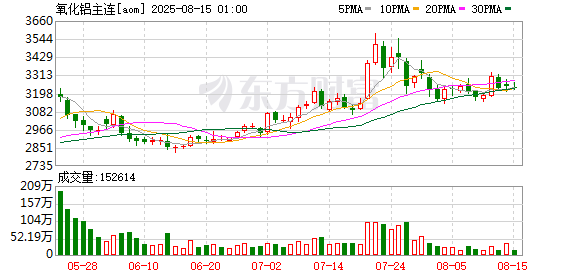
情绪退潮叠加基本面压力,氧化铝期价冲高回落
Qi Huo Ri Bao· 2025-08-15 02:53
Core Viewpoint - The recent surge in alumina futures prices was driven by news from Shanxi Province regarding adjustments in mining rights, but the market has since cooled down, leading to a decline in prices as speculative sentiment wanes [1][2]. Supply Side - Shanxi's decision aims to enhance the protection of strategic mineral resources, including bauxite, by centralizing mining rights management [1]. - China's bauxite supply has been decreasing annually due to reduced mineral resources and stricter mining controls, leading to increased imports by local alumina companies to maintain production [1][2]. - Recent elections in Guinea have led to a relaxation of aluminum ore export policies, which is expected to increase overseas ore supply [2]. - Domestic alumina production capacity is growing, but there is a regional imbalance in output, with higher production in the north compared to the south [2][3]. - As of August 7, China's alumina production capacity was 114.8 million tons, with an operating capacity of 94.4 million tons, resulting in an operating rate of 82.23% [2]. Demand Side - The demand for alumina is expected to weaken as the replenishment of raw materials and inventory reduction slows down, coupled with limited growth in demand for casting aluminum alloys [2][3]. - Inventory levels for alumina are rising, with the Shanghai Futures Exchange's alumina delivery warehouse inventory increasing from under 5,000 tons to around 40,000 tons recently [3]. Market Outlook - Analysts suggest that the fundamentals for alumina are under pressure, leading to weak price performance [3]. - The increase in registered warehouse receipts for alumina in August may alleviate previous tightness in the market, but bearish sentiment persists due to expectations of weak future prices [3][4]. - Despite the bearish outlook, factors such as the Shanxi mining rights news and stable overseas ore prices may limit the downside for alumina futures in the short term [3][4]. - The market is expected to maintain a range-bound trading pattern, fluctuating around cost levels, influenced by seasonal demand and potential supply adjustments [4].
情绪退潮叠加基本面压力 氧化铝期价冲高回落
Qi Huo Ri Bao· 2025-08-15 00:27
Group 1 - The core viewpoint of the news is that the recent fluctuations in alumina futures prices are primarily driven by market sentiment rather than fundamental supply and demand changes, following regulatory adjustments in Shanxi province [2][4] - Shanxi province has tightened the management of certain mineral resources, including bauxite, which may impact domestic supply, but analysts believe the actual effect on alumina production will be limited as companies can increase imports to meet demand [2][3] - The alumina market is experiencing regional supply-demand mismatches, with production capacity increasing in some areas while others face shortages, leading to a complex market dynamic [3][4] Group 2 - Analysts indicate that the recent increase in alumina production capacity in China has not translated into a proportional rise in output, with inventory levels rising significantly, suggesting a potential oversupply situation [3][5] - The outlook for alumina futures is cautious, with expectations of price corrections due to weakening fundamental support, although short-term factors may limit downside risks [4][5] - Long-term projections suggest that alumina capacity may face excess pressure, shifting the supply-demand balance towards a more relaxed state, which could suppress price increases [5]

累库趋势难改,期价维持弱势震荡
Wu Kuang Qi Huo· 2025-08-08 14:13
Group 1: Report Investment Rating - There is no information provided regarding the industry investment rating in the report. Group 2: Core Viewpoints - The implementation of supply - side contraction policies for alumina still needs observation. Given the low proportion of backward capacity and new production coming online this year, the over - capacity situation of alumina may be difficult to change. With the ebb of short - term commodity buying sentiment and the alleviation of the shortage of circulating spot, it is recommended to take short positions on rallies based on market sentiment. The reference operating range for the domestic main contract AO2509 is 3000 - 3400 yuan/ton, and attention should be paid to warrant registration, supply - side policies, and Guinea's ore policies [13]. Group 3: Summary by Directory 1. Monthly Assessment - **Futures Price**: As of August 8, the alumina index had risen 7.1% since June 30 to 3182 yuan/ton. In mid - and early July, the expectation of supply - side contraction policies, a strong commodity buying atmosphere, and low warrant registration volumes drove the futures price up. As sentiment faded and the spot market loosened, the price dropped due to the oversupply situation [12][23]. - **Spot Price**: In July, the "anti - involution" policy expectation led to a sharp increase in alumina spot prices. As of August 8, 2025, the spot prices in Guangxi, Guizhou, Henan, Shandong, Shanxi, and Xinjiang were 3325 yuan/ton, 3320 yuan/ton, 3225 yuan/ton, 3215 yuan/ton, 3250 yuan/ton, and 3520 yuan/ton respectively, up 155 yuan/ton, 145 yuan/ton, 135 yuan/ton, 125 yuan/ton, 165 yuan/ton, and 180 yuan/ton from early July [12][20]. - **Inventory**: As of August 8, the total social inventory of alumina had increased by 28.5 tons to 414.4 million tons. The inventory in electrolytic aluminum plants, alumina plants, in - transit inventory, and port inventory had increased by 11.8 tons, 3 tons, 10.5 tons, and 3.2 tons respectively [12][75]. - **Comprehensive Analysis**: The supply - side contraction policy implementation needs further observation. The over - capacity pattern of alumina may persist. With the ebb of short - term buying sentiment and the alleviation of spot shortages, short positions on rallies are recommended. The reference range for the domestic main contract AO2509 is 3000 - 3400 yuan/ton [13]. 2. Futures and Spot End - **Futures Price**: As of August 8, the alumina index rose 7.1% since June 30 to 3182 yuan/ton. The early - July price increase was driven by policy expectations and low warrant registration, while the subsequent decline was due to the return to the fundamental logic of oversupply [23]. - **Basis**: The basis decreased significantly this month and then gradually recovered. As of August 8, the Shandong spot price was at a premium of 45 yuan/ton over the alumina main contract price [23]. - **Monthly Spread**: The spread between the first - and third - month contracts first rose and then fell. As of August 8, it was - 12 yuan/ton [23]. 3. Raw Material End - **Bauxite Price**: Domestic bauxite prices remained flat this month. As of August 8, the CIF price of Guinea bauxite was 74 US dollars/ton, and that of Australian bauxite was 69 US dollars/ton. Due to the impact of the rainy season and previous bans on Guinea's shipments, the arrival volume of imported ores is expected to decline, and ore prices are expected to be supported in the short term [29]. - **Bauxite Production and Import**: In June 2025, China's bauxite production was 519 tons, a year - on - year increase of 4.1% and a month - on - month decrease of 3.2%. The cumulative production in the first six months was 3039 tons, a year - on - year increase of 4.29%. In June, bauxite imports were 1812 tons, a year - on - year increase of 35.86% and a month - on - month increase of 3.44%. The cumulative imports in the first six months were 10340 tons, a year - on - year increase of 33.68% [31][33]. - **Guinea Bauxite Import**: In June 2025, China imported 1332 tons of bauxite from Guinea, a year - on - year increase of 40.18% and a month - on - month increase of 0.76%. The cumulative imports in the first six months were 7967 tons, a year - on - year increase of 41.49%. Recent low shipments from Guinea may lead to a decline in imports after June, but the annual supply remains in surplus [36]. - **Bauxite Supply - Demand Balance**: Based on shipping schedules and seasonal shipments from Guinea, the bauxite supply is expected to tighten in July and experience significant inventory reduction in September and October. If the AXIS mining area does not resume production this year, China's bauxite import growth is expected to decline from 4000 tons to 2000 tons. However, due to the large surplus in the first five months and sufficient inventories in most alumina plants, the basic production of alumina enterprises is not expected to be significantly affected [37]. - **Bauxite Inventory**: As of August 1, 2025, the global bauxite floating inventory reached a new low of 1455 tons. China's bauxite port inventory was 2819 tons, and the inventory accumulation trend slowed down. With the expected decline in ore arrivals, port inventories are expected to decrease [40]. 4. Supply End - **Alumina Production**: In June 2025, alumina production was 733 tons, a year - on - year increase of 8.34% and a month - on - month increase of 3.14%. The cumulative production in the first six months was 4349 tons, a year - on - year increase of 9.01% [47]. - **Operating Capacity**: In June 2025, the operating capacity of alumina was 9000 tons, a year - on - year increase of 9.36% and a month - on - month increase of 6.38%. The recovery of smelting profits led to the resumption of previously shut - down capacity [50]. - **New Production Capacity**: In 2025, the total new alumina production capacity is expected to be 1430 tons. Some projects have been put into production and are gradually releasing output, while the fourth - quarter new production has uncertainties [51][52]. - **Smelting Profit**: Based on the August 8 spot price, the production profit in Guangxi can reach 570 yuan/ton. In Shandong, the profit using Australian and Guinea ores is 395 yuan/ton and 440 yuan/ton respectively. The profit in Shanxi and Henan using Guinea ore is 185 yuan/ton and 235 yuan/ton respectively [54]. 5. Import and Export - **Alumina Import and Export Data**: In June 2025, alumina had a net export of 6.97 tons, maintaining a net export status. The import volume increased from 6.75 tons in the previous month to 10.13 tons, and the export volume decreased from 20.78 tons to 17.1 tons. The cumulative net export in the first six months was 107.5 tons. A small net export is expected to become the norm [58]. - **Import Window**: As of August 8, the FOB price of Australian alumina rose 13 US dollars/ton to 374 US dollars/ton, and the import loss was - 72 yuan/ton. The import window remained closed [61]. 6. Demand End - **Electrolytic Aluminum Production**: In July 2025, China's electrolytic aluminum production was 377.8 tons, a year - on - year increase of 2.49% and a month - on - month increase of 3.44%. The cumulative production in the first seven months was 2560 tons, a year - on - year increase of 2.73% [66]. - **Electrolytic Aluminum Operating Capacity and Utilization Rate**: In July 2025, the operating capacity of electrolytic aluminum was 4419 tons, an increase of 16 tons from the previous month. The operating rate increased by 0.55% month - on - month to 97.24% [69]. 7. Inventory - **Alumina Social Inventory**: As of August 8, the total social inventory of alumina increased by 28.5 tons to 414.4 million tons. The inventory in electrolytic aluminum plants, alumina plants, in - transit inventory, and port inventory increased by 11.8 tons, 3 tons, 10.5 tons, and 3.2 tons respectively [75]. - **Warehouse Receipt and Delivery Inventory**: As of August 8, 2025, the alumina warehouse receipts decreased by 0.41 tons to 2.62 tons compared to early July, and the delivery inventory at the Shanghai Futures Exchange increased by 1.98 tons to 8.5 tons. As the spot market loosens, the registration volume of warehouse receipts is expected to increase [77].
氧化铝月报:矿端扰动持续,期价维持宽幅震荡-20250704
Wu Kuang Qi Huo· 2025-07-04 13:20
Report Industry Investment Rating No relevant information provided. Core Viewpoints of the Report - The short - term ore price is expected to have some support, but the over - capacity pattern of alumina is still difficult to change. The alumina futures price will still be anchored by cost, with the ore price being the core contradiction. It is expected that the CIF price of Guinean bauxite will remain in the range of $70 - 85 per ton, corresponding to a smelting cost of 2700 - 3050 yuan per ton in Shandong and 3000 - 3300 yuan per ton in Shanxi. It is recommended to combine the overall commodity market sentiment and opportunistically lay out short positions at high prices. The reference operating range of the domestic main contract AO2509 is 2800 - 3300 yuan per ton [12]. Summary by Directory Monthly Assessment - As of July 4, the alumina index increased by 1.02% to 3011 yuan per ton compared with the price on June 3. The alumina futures price gradually declined due to the non - further fermentation of the "mining ban storm" in Guinea, and then stabilized and rebounded with the improvement of the macro - sentiment. The Guinean government's announcement on July 2 may drive the futures price up, but the medium - term supply - demand surplus pattern is hard to change, and the rebound space is limited. The basis gradually declined, with the Shandong spot price at a premium of 66 yuan per ton over the main contract price. The spread between the first - and third - month contracts fluctuated and was 59 yuan per ton as of July 4 [11]. - The spot price of alumina continued to decline in June as the supply returned to a loose state with the return of previously overhauled production capacity driven by profit recovery [11]. - As of July 4, the total social inventory of alumina increased by 8800 tons to 3.882 million tons, with different changes in various types of inventory. The alumina futures warehouse receipts decreased by 105,400 tons to 21,300 tons, and the inventory in the SHFE delivery warehouse decreased by 119,700 tons to 65,000 tons [11]. Supply - side - In May 2025, the operating capacity of alumina was 84.6 million tons, a year - on - year decrease of 0.82% and a month - on - month increase of 0.12%. Inland alumina smelters faced losses, and the overhauled and reduced production capacity increased. In June, the previously overhauled capacity gradually returned due to profit improvement [12][45]. - In May 2025, the alumina production was 7.403 million tons, a year - on - year increase of 7.06% and a month - on - month increase of 2.46%. The cumulative production in the first five months was 36.66 million tons, a year - on - year increase of 10.66% [42]. Period - Spot End - Futures price: As of July 4, the alumina index increased by 1.02% to 3011 yuan per ton compared with June 3. The price declined due to the non - further fermentation of the "mining ban storm" in Guinea, then rebounded with the improvement of the macro - sentiment. The Guinean government's announcement may drive the price up, but the medium - term supply - demand surplus limits the rebound space. The basis gradually declined, with the Shandong spot price at a premium of 66 yuan per ton over the main contract price. The spread between the first - and third - month contracts fluctuated and was 59 yuan per ton as of July 4 [22]. - Spot price: With the return of previously overhauled production capacity driven by profit recovery, the alumina supply became loose again, leading to a continuous decline in the spot price in June. As of July 3, 2025, the spot prices in different regions decreased significantly compared with the beginning of June [18]. Raw Material End - Bauxite price: The domestic bauxite price remained unchanged this month. As of July 4, the CIF price of Guinean bauxite was $74 per ton, and that of Australian bauxite was $69 per ton. The short - term ore price is expected to be under pressure. The "production restriction storm" in the Guinean AXIS mining area and the rainy season may reduce the supply after July, and the CIF price of Guinean bauxite is expected to remain in the range of $70 - 80 per ton this year [26]. - Bauxite production: In May 2025, China's bauxite production was 5.366 million tons, a year - on - year increase of 9% and a month - on - month increase of 5.3%. The cumulative production in the first five months was 25.2 million tons, a year - on - year increase of 4.33% [28]. - Bauxite import: In May 2025, China imported 17.51 million tons of bauxite, a year - on - year increase of 29.3% and a month - on - month decrease of 15.32%. The cumulative import in the first five months was 85.29 million tons, a year - on - year increase of 33.23%. The import from Guinea in May was 1322 tons, a year - on - year increase of 40.47% and a month - on - month decrease of 20.97%. The cumulative import from Guinea in the first five months was 66.34 million tons, a year - on - year increase of 41.76%. The supply may tighten after July, and the inventory may decrease significantly in September and October [30][32]. - Bauxite inventory: As of July 4, 2025, the global bauxite floating inventory remained at a relatively high level in the past four years, and the port inventory in China was 27.29 million tons, with a slowing accumulation trend. In May, the total bauxite inventory in China increased by 3.01 million tons to 44.17 million tons, with inventory increases in Shanxi and Henan [36][39]. Import and Export - In May 2025, the net export of alumina was 140,300 tons, maintaining a net export status. The import volume increased from 10,700 tons in the previous month to 67,500 tons, and the export volume decreased from 262,900 tons to 207,800 tons. The cumulative net export in the first five months was 1.0053 million tons. The export window shrank in May, and the net export decreased. It is expected that the export will further decline in June [12][52]. - As of July 4, the FOB price in Australia decreased by $6 per ton to $361 per ton, and the import profit and loss was - 85 yuan per ton, indicating a closed import window [55]. Demand - side - In May 2025, China's electrolytic aluminum production was 3.75 million tons, a year - on - year increase of 2.68% and a month - on - month increase of 3.51%. The cumulative production in the first five months was 18.17 million tons, a year - on - year increase of 2.77% [59]. - In May 2025, the operating capacity of electrolytic aluminum was 44.13 million tons, an increase of 100,000 tons from the previous month. The operating rate increased by 0.26% month - on - month to 96.99% [62]. Inventory - As of July 4, the total social inventory of alumina increased by 8800 tons to 3.882 million tons, with different changes in electrolytic aluminum plant inventory, alumina plant inventory, in - transit inventory, and port inventory. The alumina futures warehouse receipts decreased by 105,400 tons to 21,300 tons, and the SHFE delivery warehouse inventory decreased by 119,700 tons to 65,000 tons [11][67][69].
突传利好氧化铝大涨 强势状态能持续多久?
Wen Hua Cai Jing· 2025-05-20 14:25
Core Viewpoint - The significant rebound in alumina prices is primarily driven by disruptions in Guinea's mining policies, particularly the revocation of mining licenses, which has notably impacted supply dynamics [2][10]. Group 1: Supply Disruptions - Guinea's mining authority issued a work stoppage order for the Axis mining area, affecting an annual capacity of approximately 40 million tons, with a 2024 production estimate of 23 million tons [3]. - The revocation of mining licenses for 46 companies in Guinea has escalated supply concerns, leading to a sharp increase in alumina futures prices [3][4]. - Guinea is the largest bauxite producer globally, with its output accounting for 69.4% of China's alumina imports, making it a critical supplier [4]. Group 2: Domestic Production and Capacity - As of May 15, the total built capacity for metallurgical-grade alumina in China is 10,922 million tons per year, with an operating capacity of 8,412 million tons per year, reflecting a decrease in the operating rate to 77.02% [6]. - The decline in domestic alumina production is attributed to significant profit drops, with average operating rates falling from 86.1% in March to 84.6% in April [6][7]. - The industry is currently experiencing low operating rates, with planned maintenance and project delays contributing to reduced supply pressure [7]. Group 3: Price Trends and Future Outlook - Short-term alumina prices are expected to remain strong due to supply disruptions and a tightening market, although medium-term oversupply risks persist [8][10]. - The anticipated addition of 1.14 million tons of new alumina capacity in China by 2025, along with 400,000 tons from overseas, may outpace demand growth, leading to potential price pressures [8]. - Key factors to monitor include the ongoing developments in Guinea's mining policies, domestic production capacity changes, and the operating rates of downstream electrolytic aluminum plants [9][10].

供应端扰动支撑盘面上涨,氧化铝要开启逆袭之路?
Wen Hua Cai Jing· 2025-05-15 12:45
Core Viewpoint - The recent supply-side adjustments and maintenance in the alumina industry have provided a boost to the market, leading to a rebound in alumina prices, with the main contract surpassing the 3000 yuan mark, reaching a one-and-a-half-month high [2][4]. Supply-Side Dynamics - The Ministry of Industry and Information Technology and other departments have issued a plan for high-quality development in the aluminum industry, which includes no new capacity for electrolytic aluminum and alumina in key pollution prevention areas. However, some companies are reportedly circumventing these regulations by launching alumina projects under the guise of "hydroxide alumina" [4]. - Several alumina companies have begun maintenance and production cuts due to increasing losses, leading to a temporary decline in alumina output and supporting price rebounds. Notable production cuts include a major alumina plant in Shanxi and several plants in Shandong and Guizhou, collectively affecting around 300,000 tons of capacity [5][6]. Inventory and Cost Trends - Recent fluctuations in production have led to a decrease in alumina inventory, with total inventory reported at 3.891 million tons, down 55,000 tons from May 1 [7]. - The cost of alumina production is expected to decline due to falling prices of imported bauxite and caustic soda. The weighted average cost of alumina production in China was reported at 3033.4 yuan per ton, down approximately 125 yuan from the previous month [9][11]. Long-Term Outlook - Despite short-term price support from production cuts, the long-term outlook suggests that alumina supply may remain in surplus due to the potential recovery of previously cut capacities and new capacity releases. The industry is projected to add 2.6 million tons of new capacity in May alone [6][11]. - The demand for alumina may face limitations due to a hard cap on electrolytic aluminum production capacity, which is set at 45.5 million tons, restricting significant increases in alumina demand [6]. Market Sentiment - The alumina market is currently experiencing a rebound due to supply-side disruptions and maintenance, but the overall supply-demand balance remains precarious, with potential for continued oversupply in the future. Market participants are advised to monitor capacity release schedules, bauxite price changes, and demand performance closely [11][12].