
水风光储一体化

Search documents
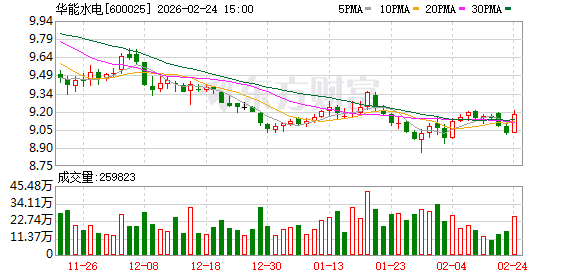
华能水电控股股东一致行动人拟以1亿元至1.5亿元增持公司股份 传递发展信心
Zheng Quan Ri Bao· 2026-02-24 13:39
Core Viewpoint - Huaneng Lancang River Hydropower Co., Ltd. plans to increase its shareholding through its controlling shareholder, China Huaneng Group, with an investment of 100 million to 150 million yuan, signaling confidence in the company's future development [2][4]. Group 1: Financial Performance - For the first three quarters of 2025, Huaneng Hydropower achieved a revenue of 20.641 billion yuan, a year-on-year increase of 6.30% [2]. - The net profit attributable to shareholders for the same period was 7.539 billion yuan, reflecting a year-on-year growth of 4.34% [2]. - The total power generation for 2025 reached 126.932 billion kWh, marking a 13.32% increase year-on-year, while the on-grid electricity volume was 125.858 billion kWh, up 13.36% year-on-year [2]. Group 2: Strategic Development - Huaneng Hydropower is transitioning into a comprehensive clean energy operator focusing on "water, wind, solar, and storage" integration, leveraging the advantages of the Lancang River basin [3]. - The company is developing a "double ten million kilowatt" clean energy base in the Lancang River basin, with a focus on the upstream development in Tibet [3]. - The RM hydropower station, currently under construction, will play a key role in the integrated scheduling of the hydropower resources in the region [3]. Group 3: Shareholder Confidence - Huaneng Hydropower has consistently provided stable returns to investors, with total dividends amounting to 22.364 billion yuan since its listing [4]. - The planned share increase by the controlling shareholder is seen as a strong support for the company's stock price and reflects high recognition of the company's intrinsic value [4].


新筑股份2026年重组转型与业绩展望
Jing Ji Guan Cha Wang· 2026-02-11 08:37
Core Viewpoint - The company is undergoing a significant asset restructuring in 2026, focusing on transforming into a clean energy generation platform by divesting its maglev and bridge component businesses and acquiring a 60% stake in Shudao Clean Energy [1][2][5] Restructuring Progress - The company announced plans to adjust its major asset restructuring scheme originally set for disclosure in June 2025, aiming to enhance asset quality further. A board and shareholder meeting will be convened to review the restructuring matters once adjustments are completed [2] Performance and Operating Conditions - The company released a performance forecast on January 30, 2026, estimating a net profit loss of 140 million to 196 million yuan for 2025, indicating a significant reduction in losses year-on-year. However, the non-recurring net profit has been in continuous loss for 14 years [3] Business Development - Post-restructuring, the company will concentrate on integrated clean energy business involving "water, wind, solar, and storage." Shudao Group is expected to empower the listed company in resource acquisition and energy integration. Future growth is anticipated to benefit from changes in the Sichuan power market and national projects like "Electricity from Xinjiang to Sichuan" [4] Future Development - The year 2026 is viewed as a critical year for the company's business transformation and development, with market attention focused on whether it can fundamentally improve by divesting loss-making businesses and injecting quality assets [5]

绿电青海 点亮中国
Xin Lang Cai Jing· 2025-12-30 19:09
Core Insights - Qinghai Province has achieved a remarkable transformation in clean energy, becoming a leader in both installed capacity and generation share of renewable energy in China [1][3] - The province's clean energy development is characterized by a unique integration of ecological protection and economic growth, showcasing a model for sustainable development [3] Group 1: Clean Energy Development - Qinghai has installed over 73 million kilowatts of clean energy capacity, accounting for 93.1% of its total installed capacity, which is 34 percentage points higher than the national average [1] - The province's renewable energy generation accounts for 90.6% of its total electricity output, leading the nation except for Tibet [1] - The installed capacity of new energy has reached 56 million kilowatts, doubling since 2020, with a generation share of 50.2% [1] Group 2: Infrastructure and Technology - The Qing-Yu ±800 kV UHVDC project has enabled the transmission of over 70 billion kilowatt-hours of clean electricity from Qinghai to central China over nearly five years [2] - Qinghai has established a robust power grid that connects with multiple regions, enhancing its electricity transmission capabilities [2] - The province is home to the first 100% clean energy traceable green data center and has seen a 40% reduction in operational costs through automation in its power stations [2] Group 3: Economic and Ecological Impact - The clean energy sector has significantly improved local livelihoods, with initiatives like the "self-generated, surplus electricity online" model increasing household incomes by over 3,000 yuan annually [3] - Qinghai's clean energy initiatives have also contributed to biodiversity conservation, with installations like the "life bird nests" supporting local wildlife [3] - The province's lithium battery industry has seen substantial growth, with lithium carbonate production reaching 134,000 tons, accounting for 19% of the national output [2]
新筑股份(002480) - 002480新筑股份投资者关系管理信息20251124
2025-11-24 10:38
Group 1: Company Overview and Restructuring - Chengdu Xinzhu Road & Bridge Machinery Co., Ltd. is undergoing a significant asset restructuring, transitioning from its current operations to focus on clean energy, specifically hydropower, wind power, and solar power [2][3] - The restructuring will result in the company exiting the magnetic levitation and bridge component sectors, with Shudao Clean Energy becoming a wholly-owned subsidiary [2] - The company aims to achieve a comprehensive transformation with a focus on clean energy generation, energy storage, and related businesses [2] Group 2: Future Goals - Short-term goal: Complete asset integration and transformation to achieve profitability in the shortest time possible [2] - Mid-term goal: Accelerate project operations and enhance asset scale and quality through the "transportation + energy" model [2] - Long-term goal: Establish a stable and sustainable profit state with a consistent dividend ratio [2] Group 3: Financial Projections and Asset Valuation - The valuation of the injected assets from Shudao Clean Energy Group is based on an asset-based approach, with a total transaction price that is less than 40% of the total asset valuation [3] - The performance commitment for the next three years pertains only to the assets valued using the income approach, which does not equate to the total expected profits of the clean energy group [3] Group 4: Asset Divestiture - Seven non-core assets have been divested to improve the overall quality of the assets injected into the listed company, with no substantial impact on the operations of Shudao Clean Energy Group [3] - The divestiture is aimed at removing underperforming or non-compliant assets [3] Group 5: Market Position and Competition - Shudao Clean Energy Group focuses on clean energy, leveraging the transportation industry advantages of Shudao Group, while Sichuan Energy Development Group operates in a broader range of industries, including energy [3] - Both companies have distinct business focuses that align with the differentiated development plans of the provincial energy industry [3] Group 6: Fundraising Plans - The company plans to issue shares to no more than 35 qualified investors to raise supporting funds, with the issuance method being through an inquiry process [3] - The timing of the fundraising will depend on the successful completion of the asset transaction [3]
长江电力(600900):三峡来水大幅转丰对业绩形成支撑
HTSC· 2025-10-31 06:54
Investment Rating - The report maintains a "Buy" rating for the company with a target price of RMB 36.55 [5]. Core Views - The significant increase in water inflow to the Three Gorges Dam has provided support for the company's performance, with expectations of a 0.34% year-on-year increase in domestic hydropower generation and a 3.62% increase in net profit for the year 2025 [1][4]. - The company has shown strong cost control, with financial expenses decreasing by 15.33% year-on-year, positively impacting profitability [3]. - The report highlights the potential for increased electricity generation from the company's hydropower stations due to improved water inflow conditions in September [2]. Financial Performance Summary - For Q3 2025, the company reported revenue of RMB 29.044 billion, a year-on-year decrease of 7.78% but a quarter-on-quarter increase of 47.56%. The net profit attributable to the parent company was RMB 15.137 billion, down 9.13% year-on-year but up 92.20% quarter-on-quarter [1]. - For the first nine months of 2025, the company achieved revenue of RMB 65.741 billion, a slight year-on-year decrease of 0.89%, and a net profit of RMB 28.193 billion, an increase of 0.60% year-on-year [1][3]. - The report projects a compound annual growth rate (CAGR) of 4.15% for net profit over the next three years [4]. Operational Insights - The report notes that the hydropower generation for Q3 2025 saw a year-on-year decline of 5.84%, but this was a significant improvement compared to the declines experienced in July and August [2]. - The company’s six hydropower stations generated a total of 2,351.26 billion kilowatt-hours in the first nine months of 2025, reflecting a year-on-year decrease of 0.29% [2]. Valuation Metrics - The report adjusts the company's earnings per share (EPS) estimates for 2025-2027 to RMB 1.38, RMB 1.43, and RMB 1.50 respectively, based on improved hydropower generation forecasts [4]. - The company is valued at a price-to-earnings (PE) ratio of 25.5x for 2026, with a target price set at RMB 36.55, reflecting a positive outlook on its operational efficiency and growth potential [4].
长江电力(600900):业绩符合预期,财务费用管控能力强
HTSC· 2025-09-01 10:56
Investment Rating - The investment rating for the company is maintained as "Buy" with a target price of RMB 32.59 [1][6][9] Core Insights - The company's performance in the first half of 2025 met expectations, with revenue of RMB 366.98 billion, a year-on-year increase of 5.34%, and a net profit attributable to the parent company of RMB 130.56 billion, up 14.86% year-on-year [6][9] - The company has strong financial expense management capabilities, with financial expenses decreasing by 13.91% year-on-year to RMB 48.63 billion, significantly enhancing profitability [8][9] - The company is committed to maintaining a dividend payout ratio of no less than 70% of the net profit attributable to the parent company during the "14th Five-Year Plan" period, ensuring stable returns for investors [6][9] Financial Performance Summary - Revenue projections for 2024 to 2027 are as follows: RMB 84,492 million (2024), RMB 81,872 million (2025E), RMB 83,382 million (2026E), and RMB 83,851 million (2027E), with a growth rate of 8.17% in 2024 and a slight decline of 3.10% in 2025 [5][9] - Net profit attributable to the parent company is projected to be RMB 32,496 million (2024), RMB 32,546 million (2025E), RMB 34,054 million (2026E), and RMB 35,688 million (2027E), with a growth rate of 19.30% in 2024 [5][9] - The company's earnings per share (EPS) is expected to be RMB 1.33 (2025E), RMB 1.39 (2026E), and RMB 1.46 (2027E) [5][9] Operational Insights - In the first half of 2025, the company's power generation increased by 5.01% year-on-year, totaling 1,266.56 billion kWh, primarily driven by a 9.01% increase in water inflow at the Wudongde Reservoir [7][9] - The company anticipates challenges in power generation growth in the third quarter of 2025 due to lower water inflow levels in July and August [7][9] Valuation Metrics - The company is currently trading at a price-to-earnings (PE) ratio of 21.15 for 2025, with a projected PE of 21.12 for 2026 and 20.18 for 2027 [5][9] - The price-to-book (PB) ratio is 3.27 for 2025, expected to decrease to 2.97 by 2027 [5][9] - The company maintains a dividend yield of approximately 3.36% for 2025 [5][9]
新筑股份(002480):蜀道集团旗下上市平台,重组聚焦清洁能源发电
Hua Yuan Zheng Quan· 2025-08-29 09:32
Investment Rating - The report assigns an "Accumulate" rating for the company, marking its first coverage [6][9]. Core Views - The company is a listed platform under Shudao Group, focusing on the clean energy generation business through asset restructuring [8][11]. - The acquisition of Shudao Clean Energy Group aims to enhance the company's focus on clean energy generation, transitioning away from traditional businesses [19][37]. - The company is expected to benefit from the resource advantages of Shudao Group, which is actively involved in the development of multiple hydropower projects and renewable energy resources [32][37]. Financial Performance and Forecast - The company’s projected revenue for 2023 is 2,509 million RMB, with a year-on-year growth rate of 52.14%. However, a decline in revenue is expected in subsequent years, with 2024 projected at 2,483 million RMB, a decrease of 1.05% [7]. - The net profit attributable to shareholders is forecasted to be -342 million RMB in 2023, worsening to -409 million RMB in 2024, before improving to -127 million RMB in 2025 [7][9]. - The earnings per share (EPS) is expected to be -0.45 RMB in 2023, improving to -0.16 RMB by 2025 [7]. Business Strategy and Development - The company plans to divest from its traditional businesses in rail transit and bridge components, focusing instead on clean energy generation [19][33]. - Shudao Clean Energy is projected to have an operational and under-construction installed capacity of 10.5 million kW by the end of 2024, with significant contributions from hydropower projects [11][37]. - The company is also exploring new models that integrate transportation and energy, as well as renewable energy and mining [11][32]. Market Position and Competitive Landscape - The company is positioned as one of the five major listed platforms under Shudao Group, which is a significant player in the transportation and energy sectors in Sichuan Province [32][33]. - The average price-to-book (P/B) ratio of comparable companies is approximately 7.5, while the company's current P/B ratio is about 5.6, indicating potential for growth post-restructuring [9][11].
2025年中国水力发电行业现状报告-嘉世咨询
Sou Hu Cai Jing· 2025-08-11 04:44
Core Insights - The Chinese hydropower industry is transitioning from scale expansion to high-quality development, playing an irreplaceable strategic role in the national energy system [1][13] - Hydropower serves as a cornerstone for energy security, a key non-fossil energy source for achieving carbon neutrality goals, and a critical tool for comprehensive river basin management [1][18][20] Industry Overview - As of early 2025, the total installed capacity of hydropower in China is expected to exceed 420 million kilowatts, with pumped storage capacity surpassing 55 million kilowatts, indicating rapid growth [1][34] - The annual hydropower generation is stable at around 1.3 trillion kilowatt-hours, although its share in total electricity generation is slightly declining [1][35][38] - The distribution of hydropower resources is uneven, with Sichuan, Yunnan, and Hubei leading in installed capacity [1][39] Industry Development Stages - The development of the hydropower industry has gone through three stages: foundational exploration, large-scale construction, and optimization for high-quality development [1][21][25] - The focus has shifted from rapid expansion to optimizing existing assets and enhancing operational efficiency through technological innovation and digital transformation [1][25][16] Market Dynamics - The market is dominated by state-owned enterprises, with specialized companies like Yangtze Power performing exceptionally well [2] - The industry faces challenges such as ecological and environmental pressures, complex resettlement issues, and seasonal fluctuations in generation [2][14] - Opportunities include the integration of hydropower with wind and solar energy, expansion of pumped storage, and the revaluation of existing assets [2][16] Industry Chain Analysis - The upstream sector is led by China Power Construction and China Energy Engineering, which dominate planning and engineering construction [1][42] - The midstream sector is characterized by manufacturers like Harbin Electric and Dongfang Electric, achieving significant domestic production of turbine generators [1][42] - The downstream sector focuses on operations led by companies like Yangtze Power, addressing power consumption issues through the "West-to-East Power Transmission" project [1][42] Future Outlook - The industry is expected to strengthen top-level planning, improve market mechanisms, and innovate ecological compensation and benefit-sharing mechanisms [2] - Companies are encouraged to undergo strategic transformations, accelerate digitalization, and prioritize ESG management [2]

万亿雅下水电工程背后,是史无前例的藏电外送“大棋局”
3 6 Ke· 2025-07-28 01:50
Core Viewpoint - The Yarlung Tsangpo River downstream hydropower project, with an investment of 1.2 trillion yuan, is expected to significantly boost the capital market and energy sector, leading to a surge in related stock prices and substantial economic growth in Tibet [1][3]. Investment Impact - The 1.2 trillion yuan investment is projected to generate a GDP increase of 2.04 trillion yuan, providing over 20 billion yuan in annual fiscal revenue for Tibet [3]. - The total installed capacity of the project is estimated to be between 60 million to 70 million kilowatts, making it the largest hydropower station globally, with an annual electricity generation of approximately 300 billion kilowatt-hours [3][5]. Energy Development Potential - The project is part of a broader initiative to develop 50 million kilowatts of solar and wind energy resources in the region, creating a comprehensive clean energy base [3][7]. - The electricity generated will primarily be transmitted to high-demand areas such as the Yangtze River Delta and the Pearl River Delta, reshaping China's energy landscape [3][8]. Clean Energy Contribution - The project will facilitate the export of 500 billion kilowatt-hours of green electricity annually, contributing significantly to China's carbon reduction goals [3][6]. - The annual electricity output is equivalent to the energy consumption of 100 million households and will account for about 3% of the national electricity generation in 2024 [3][5]. Infrastructure and Grid Development - The construction of the Yarlung Tsangpo project is accompanied by significant upgrades to the local power grid, including the establishment of high-voltage direct current (HVDC) transmission lines to facilitate electricity export [15][16]. - The project will integrate various energy sources and modern infrastructure, including 5G networks and rail extensions, to enhance energy and information connectivity [15]. Regional Energy Integration - Future plans include the establishment of a South Asia energy internet, which aims to connect China's clean energy resources with South Asian markets [10][9]. - The development of the project will require overcoming significant challenges related to inter-regional cooperation and infrastructure integration [4][17]. Challenges and Barriers - The extreme geographical conditions in Tibet pose significant challenges for the successful implementation of the electricity export plan [4]. - There are existing barriers to inter-regional electricity trade, including local protectionism and the need for cooperation between different power grid operators [18][20].
2025中国水力发电行业现状报告-嘉世咨询
Sou Hu Cai Jing· 2025-07-24 08:43
Core Insights - The hydropower industry in China plays a crucial role in energy security, achieving "dual carbon" goals, and watershed management. By early 2025, the total installed capacity of hydropower is expected to exceed 420 million kilowatts, with pumped storage capacity surpassing 55 million kilowatts, marking a shift from scale expansion to stock optimization and high-quality development [1][13][19]. Industry Overview - Hydropower is a strategic cornerstone of China's energy security, providing a stable and reliable energy source that is less susceptible to geopolitical risks compared to fossil fuels [18]. - The industry has transitioned through various development stages, from initial exploration to large-scale construction and now to stock optimization and high-quality development [23][24][27]. - The macro environment for hydropower development is shaped by political, economic, social, and technological factors, with strong government support and policy direction [29][30][35]. Industry Chain Analysis - The hydropower industry chain includes upstream planning and design, midstream equipment manufacturing, and downstream power station operation, with major players like China Power Construction and China Energy Engineering leading the market [2][45][47]. - The "West-East Power Transmission" project addresses the imbalance of resource distribution and load, although it faces challenges such as transmission costs and market reforms affecting hydropower pricing [1][3]. Market Dynamics - The market is dominated by state-owned enterprises, with local energy platforms also participating. The regional layout is concentrated in the southwest, with significant developments in the Jinsha River and Yarlung Tsangpo River basins [1][3][29]. - The installed capacity of hydropower is highly concentrated in western provinces, with Sichuan leading the nation [42][43]. Technological Advancements - China has become a global leader in high dam construction and large-scale turbine manufacturing, with widespread application of smart hydropower station technologies and cascade reservoir scheduling [1][13][35]. - The industry is increasingly focusing on digital transformation and innovative technologies to enhance operational efficiency and economic benefits [27][35]. Challenges and Opportunities - The hydropower industry faces challenges related to ecological protection and social impacts, particularly concerning environmental sustainability and the resettlement of affected populations [14][32]. - Opportunities include the integration of hydropower with wind and solar energy, accelerated development of pumped storage, and the revaluation of existing hydropower assets [16][27][28].