油转化

Search documents
中国炼化产业向高端化持续提升,成全球市场压舱石
Xin Lang Cai Jing· 2026-02-06 00:10
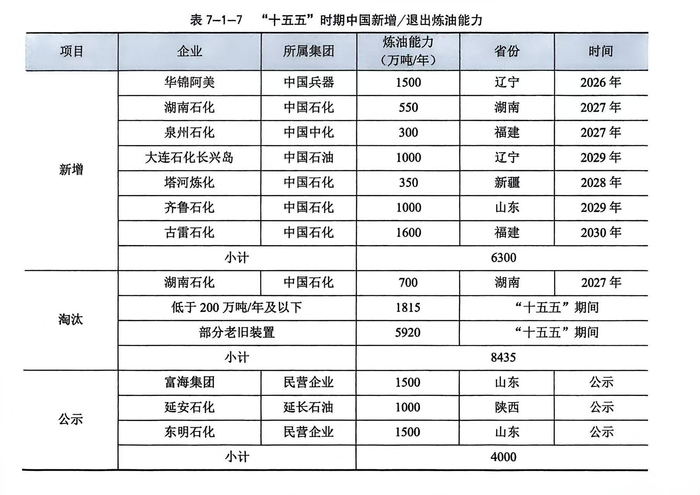
Core Viewpoint - The Chinese refining industry is undergoing significant structural adjustments driven by the "dual carbon" goals and rapid development of the new energy vehicle sector, as highlighted in the "2025 Domestic and International Oil and Gas Industry Development Report" released by the China National Petroleum Corporation Economic and Technological Research Institute [1] Group 1: Industry Structural Changes - The shift towards "oil conversion" and "oil-to-chemical" has become a key direction for structural adjustments in the Chinese refining industry [2] - By 2025, domestic refined oil production is expected to decrease from 433 million tons in 2021 to 414 million tons, a decline of 4.4%, with the refined oil yield dropping from 63% to 56% [2] - Chemical light oil production is projected to increase from 126 million tons to 184 million tons, a growth of 46.7%, with the yield rising to 25.0% [2] - The industry has eliminated or replaced 35.7 million tons/year of outdated capacity, enhancing secondary processing and deep refining capabilities, contributing to significant progress in green, low-carbon, and intelligent transformation [2] Group 2: Capacity and Market Dynamics - By 2025, China's refining capacity is expected to reach 940 million tons/year, maintaining its position as the largest globally, with a net increase of 66.3 million tons/year compared to the end of the 13th Five-Year Plan [3] - The industry concentration has improved, with major players like Sinopec, PetroChina, Sinochem, CNOOC, and private and foreign enterprises forming a competitive landscape, leading to a "four-way division" of the market by 2025 [3] - The average scale of domestic refineries is projected to reach 7.17 million tons/year by 2025, nearing the average level of 7.5 million tons/year in the United States [3] - The share of refining capacity from large-scale refineries (over 10 million tons) is expected to increase to 58.4%, up 5.7 percentage points from 2021 [3] Group 3: Future Outlook - The report anticipates that during the 15th Five-Year Plan period, the refining industry will shift from "scale-driven" to "value creation," with overall refining capacity expected to remain stable despite structural adjustments [5] - By 2030, domestic refining capacity is projected to be around 920 million tons/year, a net decrease of 20 million tons/year compared to the end of 2025 [5] - The industry will focus on "reducing oil while increasing chemicals and specialties," with a comprehensive and in-depth green low-carbon transformation and continuous enhancement of technological innovation capabilities [6]

地缘政治局势紧张抬升油价,资金抢筹布局,石油ETF(561360)近20日资金净流入超20亿元
Sou Hu Cai Jing· 2026-02-05 02:23
Group 1 - The geopolitical tensions have led to an increase in oil prices, with significant capital inflow into oil ETFs, exceeding 2 billion yuan in the last 20 days [1] - It is expected that oil prices will fluctuate between 60-80 USD per barrel by 2026, which will support the petrochemical sector's growth [1] - The "Big Three" oil companies are anticipated to maintain high capital expenditures and enhance their natural gas market expansion, facilitating long-term growth through oil price cycles [1] Group 2 - Domestic high upstream capital expenditures are expected to boost the growth of oil service companies by increasing production and reserves [1] - The refining sector is nearing the end of capacity expansion, and industry supply-demand dynamics are expected to improve under refining constraints [1] - The polyester filament sector is experiencing limited new capacity additions, leading to structural optimization, while the large refining industry is expected to see continuous improvement in supply-demand dynamics [1] Group 3 - The oil ETF (561360) tracks the oil and gas industry index (H30198), which includes listed companies involved in exploration, extraction, refining, and sales of oil and gas [1] - The index components exhibit strong cyclical characteristics and are significantly influenced by international oil price fluctuations, serving as an important indicator of the energy sector's performance [1]
石油化工行业周报第434期(20251222—20251228):25年周期景气下行龙头优势明显,26年继续看好行业龙头穿越周期-20251228
EBSCN· 2025-12-28 13:02
Investment Rating - The report maintains an "Overweight" rating for the petrochemical sector [4] Core Viewpoints - The 2025 CITIC Petrochemical Index recorded an annual increase of 15.1%, underperforming compared to the CSI 300 and Wind All A indices, with an excess return rate of -6.8% [8][11] - The "Big Three" oil companies demonstrated resilience during periods of oil price fluctuations, with their stock prices recovering in the second half of 2025 [13][21] - The refining and chemical fiber sector showed strong stock performance, with key companies benefiting from a recovery in demand and policy support [18][22] - The coal chemical industry is expected to improve profitability due to a downward trend in coal prices and accelerated industrial upgrades [23] Summary by Sections Petrochemical Sector - The CITIC Petrochemical Index's performance was significantly impacted by oil price expectations, with a notable decline in the first half of 2025 due to OPEC+ production increases [8][11] - The "Big Three" oil companies (China National Petroleum, Sinopec, and CNOOC) achieved stable performance and cash flow despite challenges, with stock price changes of +16.3%, -9.8%, and +0.7% respectively [13][21] - The refining and chemical fiber sector saw strong stock price increases, with Hengli Petrochemical, Rongsheng Petrochemical, and Dongfang Shenghong rising by 43.6%, 22.9%, and 30.6% respectively [18][19] Coal Chemical Sector - The coal market has seen a gradual easing of supply and demand, with average prices for coking coal, thermal coal, and anthracite at 1700 RMB/ton, 677 RMB/ton, and 931 RMB/ton respectively, reflecting changes of +11.1%, -11.3%, and -10.5% year-to-date [23] - The modern coal chemical industry is expected to develop positively, driven by the need for green transformation and deep clean utilization of coal resources [23] Investment Recommendations - The report suggests focusing on the "Big Three" oil companies and their subsidiaries in the oil service sector, as well as leading companies in the refining-chemical fiber and coal chemical industries [3][21]



中国石化(600028)季报点评:业绩承压 亟待“反内卷”扭转化工格局
Ge Long Hui· 2025-10-30 21:14
Core Insights - China Petroleum & Chemical Corporation (Sinopec) reported Q3 2025 earnings slightly below expectations, with operating revenue of 704.4 billion yuan, a year-on-year decrease of 10.9%, and a net profit attributable to shareholders of 8.5 billion yuan, a year-on-year decrease of 0.5% [1] Group 1: Oil and Gas Exploration - The exploration segment's profit declined year-on-year due to falling oil and gas prices, with oil equivalent production reaching 132 million barrels, an increase of 3% year-on-year. Crude oil production increased by 1% and natural gas production increased by 4%, while crude oil prices fell by 15% and natural gas prices fell by 8%, leading to a 2% increase in segment revenue but a 10% decrease in operating profit [1] Group 2: Refining and Product Supply - Refining processing volume was 66 million tons, an increase of 3.8% year-on-year, with gasoline production down by 2.8%, diesel down by 0.3%, kerosene up by 10.5%, and chemical light oil up by 7.1%. Total sales of refined oil products were 59 million tons, a decrease of 5% year-on-year, attributed to ongoing demand weakness due to electrification. However, refining profits improved year-on-year, with refining unit profit at 1 USD per barrel of oil equivalent, an improvement of 1.3 USD per barrel [1] Group 3: Chemical Sector - The chemical sector faced significant profit pressure due to the continuous release of new domestic capacity, resulting in a unit profit loss of 0.8 USD per barrel of oil equivalent, which is an increase in loss by 0.3 USD per barrel [2] Group 4: Profit Forecast and Investment Rating - The profit forecast for 2025-2027 is maintained at 43.5 billion, 53.6 billion, and 64.1 billion yuan, with corresponding price-to-earnings ratios of 15, 12, and 10 times. Assuming a dividend payout ratio of 70%, the expected dividend yield for A-shares in 2025 is 4.6%, 5.6%, and 6.7%, while for H-shares it is 6.6%, 8.2%, and 9.7%. The investment rating remains "Buy" [2]
中国石化前三季度营收与净利双降
Guo Ji Jin Rong Bao· 2025-10-30 14:39
Core Viewpoint - China Petroleum & Chemical Corporation (Sinopec) reported a decline in revenue and net profit for the first three quarters of 2025, primarily due to falling oil and gas prices [1] Financial Performance - Total revenue for the first three quarters was 2.1 trillion yuan, a year-on-year decrease of 10.7% [1] - Net profit attributable to shareholders was 29.98 billion yuan, down 32.2% year-on-year [1] - Operating cash flow net amount was 114.78 billion yuan, an increase of 13% year-on-year [1] - In Q3 alone, revenue was 704.39 billion yuan, a decline of 10.9% year-on-year, while net profit was 8.5 billion yuan, down 0.5% [1] Business Segment Performance - The chemical segment was the only loss-making sector, with an EBITDA loss of 8.22 billion yuan [2] - In exploration and development, oil and gas equivalent production reached 394.48 million barrels, a 2.2% increase year-on-year, with a profit of 38.08 billion yuan [2] - The refining segment processed 186 million tons of crude oil, producing 11 million tons of refined oil, with an EBITDA of 7 billion yuan [2] Capital Expenditure - Total capital expenditure for the first three quarters was 71.6 billion yuan, focused on capacity building and technological upgrades [3] - Capital expenditure in exploration and development was 41.6 billion yuan, while refining accounted for 10.6 billion yuan [3] - The marketing and distribution segment had a capital expenditure of 5.5 billion yuan, and the chemical segment accounted for 12.9 billion yuan [3]
中国石化(600028):业绩承压,亟待“反内卷”扭转化工格局
Tianfeng Securities· 2025-10-30 07:45
Investment Rating - The investment rating for the company is "Buy" [6] Core Views - The company's Q3 2025 performance was slightly below expectations, with revenue of 704.4 billion yuan, a year-on-year decrease of 10.9%, and a net profit attributable to shareholders of 8.5 billion yuan, down 0.5% year-on-year [1] - The exploration segment's profit declined year-on-year due to falling oil and gas prices, despite a 3% increase in oil equivalent production [2] - Refining profits improved year-on-year due to external sanctions affecting supply, with refining processing volume up 3.8% year-on-year [3] - The chemical segment faced significant profit pressure due to the continuous release of new domestic capacity, resulting in a unit profit loss of 0.8 USD per barrel of oil equivalent [4] - The company maintains profit forecasts for 2025-2027 at 43.5 billion, 53.6 billion, and 64.1 billion yuan, with corresponding PE ratios of 15, 12, and 10 times [4] Financial Data and Valuation - Revenue for 2025 is projected at 2,797.85 billion yuan, with a growth rate of -9.00% [5] - The net profit attributable to shareholders for 2025 is estimated at 43.5 billion yuan, reflecting a year-on-year decrease of 13.54% [5] - The expected dividend yield for A shares in 2025 is 4.6%, while for H shares it is 6.6% [4] - The company's current price is 5.56 yuan, with a target price not specified [6]
万华化学子公司获科威特石化战投
Zhong Guo Hua Gong Bao· 2025-09-16 02:15
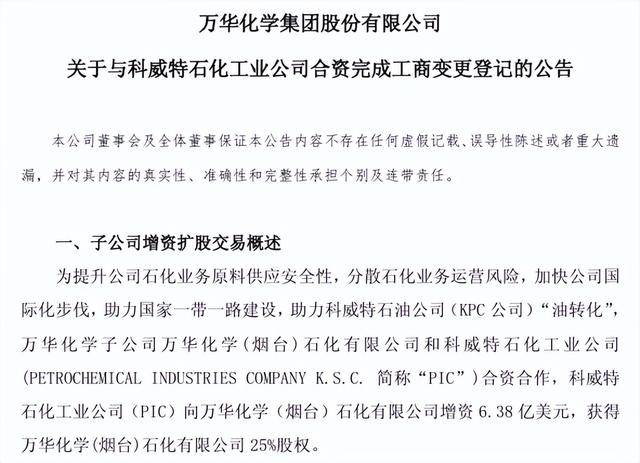
Group 1 - Wanhua Chemical Group announced that Kuwait Petrochemical Industries Company has invested $638 million in its subsidiary, Wanhua Chemical (Yantai) Petrochemical Co., acquiring a 25% stake [1] - Following the investment, Wanhua Petrochemical's registered capital increased from 2.979 billion yuan to 3.972 billion yuan, with Wanhua Chemical holding 75% and Kuwait Petrochemical holding 25% [1] - The partnership aims to enhance the security of raw material supply for Wanhua's petrochemical business, mitigate operational risks, accelerate internationalization, and support China's Belt and Road Initiative [1] Group 2 - Kuwait Petrochemical Industries Company is a subsidiary of Kuwait Petroleum Company, which is among the top ten oil producers globally, responsible for exploring, producing, and selling all hydrocarbon resources in Kuwait [2] - Kuwait Petroleum Company exports approximately 4.5 million tons of liquefied petroleum gas (LPG) annually and has an annual naphtha production of about 10 million tons, with operations across six continents [2] - Kuwait Petrochemical focuses on managing and expanding the petrochemical business of Kuwait Petroleum Company [2]

万华化学子公司获中东“巨头”科威特石化超6亿美元投资
Sou Hu Cai Jing· 2025-09-11 09:35
Core Viewpoint - Wanhua Chemical announced a joint venture with Kuwait Petrochemical Industries Company, with PIC investing $638 million for a 25% stake in Yantai Petrochemical [1][4] Group 1: Investment Details - PIC transferred $638 million to the Shandong Property Rights Trading Center on August 28, and Yantai Petrochemical completed the business registration on September 3 [4] - After the investment, Wanhua Petrochemical's registered capital increased from 2.979 billion yuan to 3.972 billion yuan [4] - Wanhua Chemical holds 75% of Yantai Petrochemical with a subscribed capital of 2.979 billion yuan, while Kuwait Petrochemical holds 25% with a subscribed capital of 993 million yuan [4] Group 2: Strategic Objectives - The collaboration aims to enhance the security of raw material supply for the company's petrochemical business, diversify operational risks, accelerate internationalization, and support the Belt and Road Initiative [4] - The partnership also aims to assist Kuwait Petroleum Company in its "oil conversion" strategy [4] Group 3: Financial Performance - In 2025, Wanhua Chemical reported total revenue of 90.901 billion yuan and a net profit attributable to shareholders of 6.123 billion yuan [4] - The polyurethane segment generated revenue of 36.888 billion yuan, a year-on-year increase of 4.04%, accounting for 40.58% of total revenue [4] - The petrochemical segment saw revenue of 34.934 billion yuan, a year-on-year decrease of 11.73%, while the fine chemicals and new materials segment achieved revenue of 15.628 billion yuan, a year-on-year increase of 20.41%, raising its share of total revenue to 17.19% [4]
投资711亿!又一化工巨头成立
DT新材料· 2025-09-06 16:04
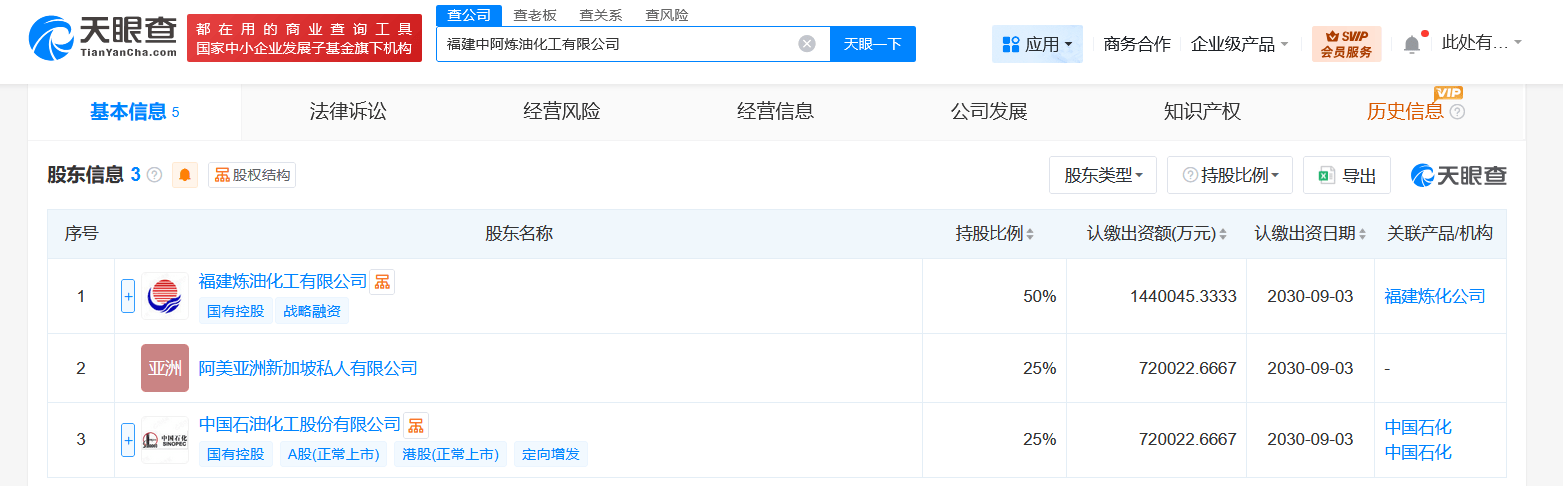
Core Viewpoint - The establishment of the joint venture company, Fujian Zhong-A Refining and Chemical Co., Ltd., marks a significant investment in the refining and chemical sector, with a total investment of 711 billion RMB, focusing on the integrated refining and chemical project in Fujian [3][4]. Group 1: Joint Venture Details - The joint venture was officially registered on September 4, with a registered capital of 28.8 billion RMB, where Fujian Refining and Chemical Co., Ltd. holds 50%, Sinopec holds 25%, and Saudi Aramco's subsidiary holds 25% [3]. - This project is the largest single investment in refining by Sinopec and the largest industrial project in Fujian province to date, representing a new model of energy cooperation between China and Saudi Arabia [3]. Group 2: Project Investment and Construction - The total investment for the project is 711 billion RMB, with plans for full production by 2030, including the construction of over 30 refining and chemical units [4]. - Key refining capacities include: 16 million tons/year of atmospheric distillation, 3.8 million tons/year of light hydrocarbon recovery, and various hydrogenation and cracking units [4]. - Chemical production will include: 1.5 million tons/year of steam cracking, 600,000 tons/year of hydrogenation of cracked gasoline, and multiple other chemical units [4]. Group 3: Saudi Aramco's Strategic Moves - Saudi Aramco's downstream president stated that this project signifies a new step in their investment in China, with plans to supply over 1 million barrels of crude oil daily to China, enhancing the "oil-to-chemicals" transition [5]. - Saudi Aramco has been actively increasing its market presence in China, with significant investments and partnerships, including a recent agreement with Rongsheng Petrochemical [5]. - The company aims to participate in various large-scale refining and chemical projects in China, indicating a strategic focus on the Chinese market [6][7].
中石化与沙特阿美携手,288亿注册资本合资公司正式成立!
Sou Hu Cai Jing· 2025-09-05 13:58
Core Viewpoint - The establishment of Fujian Sino-Arab Refining and Chemical Co., Ltd. marks a significant step in China's refining sector, with strong backing from major stakeholders including Sinopec and Saudi Aramco, aimed at enhancing cooperation and expanding overseas business opportunities [1][2]. Group 1: Company Overview - Fujian Sino-Arab Refining and Chemical Co., Ltd. was officially registered on September 4, with a registered capital of approximately 28.8 billion RMB [1]. - The company's business scope includes manufacturing petroleum products, chemical products, basic chemical raw materials, specialized chemical products, synthetic materials, as well as land pipeline transportation and general cargo storage services [1]. Group 2: Shareholder Structure - The company is jointly owned by Fujian Refining and Chemical Co., Ltd. (50% stake), Saudi Aramco Asia Singapore Private Limited (25% stake), and China Petroleum & Chemical Corporation (Sinopec) (25% stake) [3]. - This shareholder structure provides a solid foundation for the company's future development and reflects a strategic partnership among key players in the energy sector [1][3]. Group 3: Strategic Importance - The collaboration between Sinopec and Saudi Aramco is part of a broader strategy to establish a joint venture in the Gulei Port Economic Development Zone in Fujian Province, focusing on port operations, crude oil transportation, and integrated refining projects [1]. - Saudi Aramco has committed to supplying an average of 1 million barrels of crude oil per day to ensure the smooth operation of the joint venture, which significantly boosts the company's future prospects [2]. Group 4: Industry Impact - The establishment of Fujian Sino-Arab Refining and Chemical Co., Ltd. is expected to drive the synergistic development of related industries and create new opportunities and challenges in the global energy market [3].