聚氨酯

Search documents
地缘局势预期波动不改行业长期逻辑推进
Orient Securities· 2026-03-21 13:40
Investment Rating - The industry investment rating is maintained as "Positive" [5] Core Viewpoints - The geopolitical situation in the Middle East continues to impact the stability of raw material supplies, which is a primary concern for the chemical industry. Despite fluctuations in stock prices, the underlying demand for certain chemical products remains strong, particularly in sectors like polyurethane, PVC, and polyester [2][8] - The sweetener industry is showing signs of marginal improvement, with a notable increase in exports of sucralose and acesulfame K, indicating a potential recovery in demand. The domestic market for sucralose as a feed additive is also expected to expand, enhancing the industry's growth prospects [8] Summary by Relevant Sections Investment Recommendations and Targets - The report highlights several key companies across various sub-industries within the chemical sector: - MDI leader: Wanhua Chemical (600309, Buy) - PVC industry players: Zhongtai Chemical (002092, Not Rated), Xinjiang Tianye (600075, Not Rated), Chlor-alkali Chemical (600618, Not Rated), Tianyuan Co., Ltd. (002386, Not Rated) - Refining industry leaders: Sinopec (600028, Buy), Rongsheng Petrochemical (002493, Buy), Hengli Petrochemical (600346, Buy) - Agricultural chemical chain: Guoguang Co., Ltd. (002749, Buy), Xinyangfeng (000902, Buy), Shidanli (002588, Not Rated), Yuntu Holdings (002539, Not Rated), Runfeng Co., Ltd. (301035, Buy) - Phosphate chemical companies benefiting from energy storage growth: Chuanheng Co., Ltd. (002895, Not Rated), Yuntianhua (600096, Not Rated) - Oxalic acid industry: Hualu Hengsheng (600426, Buy), Huayi Group (600623, Buy), Wankai New Materials (301216, Buy) - Titanium dioxide leaders: Tianyuan Co., Ltd. (002386, Not Rated), Longbai Group (002601, Increase) - Sweetener industry: Jinhui Industrial (002597, Buy), Cooch Chemical (603968, Not Rated) [3]




建筑建材-防水涨价落实情况跟踪
2026-03-20 02:27
Summary of Conference Call on Waterproofing Industry Price Increases Industry Overview - The waterproofing industry has initiated a comprehensive price increase effective from March 15, 2026, with SBS membranes rising by 5%-6% and asphalt-based coatings increasing by over 10% to cover rising raw material costs [1][2]. Key Points and Arguments - **Cost Pressure**: Major companies have asphalt inventories that can last 2-3 months. If raw material prices remain high, a further price increase of 10%-20% may be necessary to cover costs [1][2]. - **Market Dynamics**: The industry is experiencing accelerated market clearing, with leading companies using inventory advantages to delay price increases, which may force smaller, cost-sensitive firms to lose market share or compromise on quality [1][3]. - **Channel Acceptance**: The retail market shows a high acceptance of price increases, while B2B engineering clients face internal cost control constraints, leading to slower price transmission [1][5]. - **Competitive Strategies**: Companies like Oriental Yuhong prioritize profit and cash flow, while Beixin Building Materials, backed by state-owned enterprise status, focuses on market share, intensifying competition [1][6]. - **Profit Expectations**: The initial price increase is expected to contribute only about 1% to profit margins, with future gross margin recovery heavily reliant on subsequent price increases and international oil price trends [1][9]. Additional Important Insights - **Product Price Adjustments**: As of March 15, 2026, some products, particularly those related to asphalt raw material increases, have seen price adjustments of 5%-6% for SBS membranes and 10% for asphalt coatings. Further adjustments are anticipated by late March to early April 2026 [2][3]. - **Impact on Small Enterprises**: Small companies may face significant challenges due to higher procurement costs and limited ability to lower production costs (only 4%-5% reduction possible through quality compromise) [3][4]. - **Product Categories Affected**: Asphalt-based products are most affected by rising oil prices, with traditional asphalt membranes seeing smaller increases (5%-6%) compared to coatings (12%-14%) [4]. - **Market Demand**: Overall demand in 2026 is expected to remain stable compared to 2025, with no significant changes in project initiation despite rising material costs [8][9]. - **Sales Strategy**: Different companies are adopting varied strategies; private firms prioritize cash flow while state-owned enterprises focus on market share, potentially affecting competitive dynamics [6][7]. Conclusion The waterproofing industry is navigating significant cost pressures and competitive dynamics due to rising raw material prices. Price adjustments are being implemented across various product lines, with varying acceptance levels in different market segments. The future profitability of companies in this sector will depend on their ability to manage costs and effectively implement further price increases.
直线拉升,002470尾盘涨停!化工板块,多股涨停
证券时报· 2026-03-17 09:14
Market Overview - Major stock indices in the A-share market declined, with the Shanghai Composite Index down 0.85% to 4049.91 points, and the Shenzhen Component Index down 1.87% [1] - Over 4500 stocks in the A-share market were in the red, with significant declines in the semiconductor sector, while the insurance, banking, and brokerage sectors saw gains [1][2] Financial Sector Performance - The financial sector showed resilience, with brokerage stocks like Guosen Securities rising over 9% at one point and closing nearly 5% higher [3] - The insurance and banking sectors also experienced upward movement, with New China Life Insurance rising over 5% during trading [6] Industry Insights - Analysts predict that the securities industry will continue to grow steadily and optimize its structure, driven by favorable monetary policy and improved investor confidence [5] - The banking sector is expected to undergo significant changes due to the "14th Five-Year Plan," focusing on structural optimization and long-term capital allocation [6] Chemical Sector Activity - The chemical sector saw increased activity, with stocks like Jinzhengda and Luhua Technology hitting their daily price limits [11] - The chemical industry is benefiting from rising product prices due to geopolitical tensions affecting oil and transportation costs, leading to improved supply-demand dynamics [13] Hong Kong Market Highlights - In the Hong Kong market, Yao Cai Securities surged nearly 47%, with intraday gains exceeding 80% following news of a takeover by Ant Group [8][9]


更新油气价格展望及大化工的投资建议
2026-03-17 02:07
Summary of Conference Call Records Industry Overview - The conference call discusses the chemical industry, particularly focusing on segments such as coal chemical, chlor-alkali, and fertilizers, which are experiencing sustained profitability due to high oil prices and limited industry expansion [1][2][3]. Key Points and Arguments - **High Oil Prices Impact**: High oil prices are driving profitability in coal chemical, chlor-alkali, sulfur, and fertilizer sectors, with expectations of continued upward trends in these areas [1][2]. - **Supply Constraints**: The overseas chemical supply is contracting due to high energy costs, leading to permanent closures of production capacities in Europe and Japan, while Chinese chemical companies are expected to gain market share due to lower coal and electricity costs [1][3]. - **Market Dynamics**: The MDI/TDI product price spreads are widening, indicating potential for price increases as leading companies like Wanhua Chemical and Huafeng Chemical slow down their expansion [1][3]. - **Textile Industry**: The textile supply chain, particularly PTA, polyester filament, and spandex, has a CR5 concentration of 70%-90%, indicating an optimized competitive landscape that supports price increases driven by demand [1][3]. - **Refrigerant Sector**: The refrigerant market is constrained by quota systems, but stable demand in the maintenance market supports a long-term positive supply-demand balance [1][3]. - **Upstream Benefits**: Companies involved in oil and gas extraction, as well as those using low-sensitivity processes like Baofeng Energy, are expected to benefit directly from a long-term high oil price environment around $100 per barrel [1][2][3]. Long-term Effects of High Oil Prices - **Demand Fluctuations**: High oil prices may slow the demand growth for certain optional consumer goods, impacting industries with previously excess capacity [2][3]. - **Supply-Side Reforms**: The contraction of overseas supply due to high oil prices may lead to a new round of supply-side reforms, benefiting the Chinese chemical industry in the medium to long term [3]. Investment Opportunities - **Core Companies**: The market adjustment presents new investment opportunities in leading chemical companies like Wanhua Chemical and Huafeng Chemical, which have strong competitive positions and pricing power [3][4]. - **Silicon Chemical Sector**: Companies in the silicon chemical sector are seeing improving supply-demand relationships, with potential price elasticity as global renewable energy development progresses [3][4]. - **Textile and Refrigerant Sectors**: The textile industry remains attractive due to low cost contributions to end products and a solid competitive structure, while the refrigerant sector's long-term outlook is supported by supply constraints and stable demand [4]. Structural Opportunities in the Petrochemical Industry - **Upstream Gains**: Oil and gas extraction companies, including major players like the "Big Three" oil companies, are expected to benefit from sustained high oil prices [4][5]. - **Midstream Resilience**: Companies with unique technological advantages or strong supply chain management, such as satellite chemical firms and Donghua Energy, are less affected by oil price fluctuations [4]. - **Market Reactions**: Anticipated price increases in petrochemical products in April are based on expected production halts, with futures markets already responding [4][5]. Conclusion - The current market opportunities are closely tied to geopolitical developments, and a resolution of conflicts could lead to a recovery in the sector, benefiting most companies involved [5].

迫近历史新高的化工板块,底层逻辑究竟是什么?
虎嗅APP· 2026-03-12 14:19
Core Viewpoint - The chemical industry, while complex and often overlooked, is experiencing a resurgence due to geopolitical factors, particularly rising oil prices, which have brought the sector back into focus for investors [5][6]. Group 1: Market Dynamics - The basic chemical index has shown a two-phase market performance, nearing historical highs from 2021 [8]. - The first phase began in July 2025 with the introduction of "anti-involution" policies, leading to coordinated production cuts among industry leaders, which improved supply expectations and ended a prolonged bottoming phase [9]. - The second phase, from early 2026 to the present, has been characterized by a surge in the basic chemical index, driven by heightened interest in cyclical sectors and rising international oil prices [11]. Group 2: Global Perspective on China's Chemical Industry - China's chemical industry is a global leader, with a total output value projected to reach 16 trillion yuan in 2024, accounting for 12% of the national industrial output [17]. - In 2022, China's chemical product sales accounted for 44% of the global total, with capital expenditures and R&D spending also leading globally [18]. - The industry is often misperceived as purely domestic; however, it is heavily reliant on imports for key raw materials, with over 70% dependence on imported crude oil [20]. Group 3: Competitive Advantages - China's chemical industry exhibits a dual focus on cost and technology, with a strong emphasis on bulk chemicals while catching up in fine chemicals [22]. - The country has achieved significant scale in bulk chemicals, with global production shares for products like methanol and PTA reaching 60% and 71%, respectively [30]. - In fine chemicals, while there is still a reliance on imports for high-end products, domestic companies are beginning to break the monopolies of foreign giants in certain segments [32]. Group 4: Supply-Side Dynamics - The supply side is crucial for understanding the chemical industry's pricing and profitability, with recent years seeing a shift from overcapacity to relative balance due to stricter regulations [37]. - The geopolitical situation, particularly in the Middle East, is expected to lead to a systemic clearing of global chemical capacities, benefiting Chinese companies due to their cost advantages [42][46]. - Future profitability in the chemical sector will depend on the certainty of earnings adjustments, with a focus on supply constraints rather than broad demand recovery [48].
生物基材料龙头,进军CASE领域(涂层/粘合剂/密封剂/弹性体)
DT新材料· 2026-03-01 16:05
Core Viewpoint - Avantium is advancing its biobased FDCA (2,5-furandicarboxylic acid) initiative, expanding its applications into the CASE (Coatings, Adhesives, Sealants, and Elastomers) sector, which is crucial for various industries including construction, automotive, and electronics [6][8][16]. Group 1: Avantium's Collaborations and Developments - Avantium has partnered with Will & Co, a European specialty biobased chemical distributor, to promote FDCA in the CASE sector, marking a significant expansion beyond its previous focus on packaging and textiles [6][8]. - The FDCA flagship plant, with an annual capacity of 5,000 tons, is expected to commence production by mid-2026, with over 20 pre-sale agreements totaling more than €100 million [6][8][16]. Group 2: Applications of FDCA in CASE - FDCA is being explored for its potential in polyurethane, a core material in CASE applications, due to its adjustable properties and wide-ranging uses in coatings, adhesives, sealants, and elastomers [6][8][10]. - The main research directions for furan-based compounds in polyurethane include the development of furan-based polyols, isocyanates, and chain extenders, which enhance the performance and sustainability of polyurethane products [9][10][11][14][16]. Group 3: Upcoming Events and Industry Insights - The Bio-based 2026 conference, scheduled for May 20-22 in Shanghai, will feature discussions on FDCA's industrialization progress and biobased chemicals in the CASE sector, providing a platform for industry leaders to share insights [5][16][17]. - Key industry players, including Avantium and various international companies, will participate in the conference, offering opportunities for networking and knowledge exchange [17].

Huntsman(HUN) - 2025 Q4 - Earnings Call Transcript
2026-02-18 16:02
Financial Data and Key Metrics Changes - The company converted 45% of its EBITDA to free cash flow, which is a higher percentage than many in the industry [8] - The company targeted $100 million in cost savings, achieving an annualized run rate of that amount by the end of 2025, with an expected $45 million in in-year savings for 2026 [21][22] Business Line Data and Key Metrics Changes - The aerospace business is expected to grow slightly better than the build rate, with a focus on wide-body aircraft [17][19] - The company anticipates growth in advanced materials, particularly in the Americas, driven by reindustrialization and recovery in construction [50] Market Data and Key Metrics Changes - Early signs of improved volumes and pricing in Europe were noted, although it is too early to confirm if these increases will fully materialize [9][14] - The company is seeing low inventory levels across the supply chain, which may lead to shortages if demand increases [67] Company Strategy and Development Direction - The company plans to focus on structural changes in operations to generate enough cash to cover dividends and to pursue growth through new product development and innovation [10] - There is an expectation of further opportunities for mergers, joint ventures, and industry consolidation in 2026 [9][26] Management's Comments on Operating Environment and Future Outlook - The management expressed cautious optimism about a gradual recovery in North American home building and durable goods, as well as improvements in the Chinese domestic market [8][11] - The management highlighted the need for European policymakers to take action to improve competitiveness and reduce energy costs [44][55] Other Important Information - The company is selectively using AI tools to reduce costs and expand R&D capabilities [10] - The company has made significant changes in Europe, including headcount reductions and facility closures, to address cost structures [45] Q&A Session Summary Question: What is driving the improvement in Europe? - The management noted price increases across the board and a pickup in construction and auto demand, but remains cautious due to past experiences [14][15] Question: What are the expected cost savings for 2026? - The company expects about $45 million in in-year savings for 2026, following the achievement of a $100 million annualized run rate by the end of 2025 [21][22] Question: What is the outlook for MDI margins? - The management indicated that margins could improve with increased volumes and pricing initiatives, particularly in response to rising costs [36][37] Question: How is the company addressing the potential for industry consolidation? - The management believes there will be opportunities for consolidation, particularly in chaotic market conditions, and is open to exploring strategic actions [26][90] Question: What is the outlook for polyurethanes EBITDA in Q1 2026? - The management indicated that they need to increase prices to offset rising natural gas costs, which are expected to impact EBITDA [94][96]

Huntsman(HUN) - 2025 Q4 - Earnings Call Transcript
2026-02-18 16:00
Financial Data and Key Metrics Changes - The company converted 45% of its EBITDA to free cash flow, a higher percentage than many in the industry [5] - The company targeted $100 million in cost savings, achieving an annualized run rate by the end of 2025, with an expected $45 million in-year savings for 2026 [18][19] Business Line Data and Key Metrics Changes - The aerospace business is expected to grow slightly better than the build rate, with a focus on wide-body aircraft [13][16] - The polyurethanes business is projected to face headwinds due to rising natural gas costs, with a first-quarter EBITDA range of $25 million to $40 million, down from $42 million the previous year [86][88] Market Data and Key Metrics Changes - Early signs of improved volumes and pricing in Europe were noted, with price increases announced across the board [10][11] - The company anticipates a gradual recovery in North American home building and durable goods, as well as improvements in the Chinese domestic markets [5][6] Company Strategy and Development Direction - The company plans to focus on structural changes in operations to generate enough cash to cover dividends and will pursue new product development and innovation [7][8] - There is an expectation of further opportunities for mergers, joint ventures, and industry consolidation in 2026 [6][19] Management's Comments on Operating Environment and Future Outlook - Management expressed optimism about a potential recovery in the North American construction industry and noted that the upcoming weeks would be critical for demand signals [8][56] - The company remains hopeful for European policymakers to take action to improve competitiveness, despite skepticism about the pace of change [40][41] Other Important Information - The company is selectively using AI tools to reduce costs and expand R&D capabilities [7] - The company has made significant workforce reductions and facility closures, primarily in Europe, to streamline operations [18][40] Q&A Session Summary Question: What is driving the improvement in Europe? - Management noted price increases and a pickup in construction and auto demand as key drivers [10][11] Question: What are the expected cost savings for 2026? - The company expects $45 million in in-year savings for 2026, following a targeted $100 million in overall cost savings [18][19] Question: How are MDI margins expected to play out? - Margins are expected to improve with increased volumes and pricing initiatives to offset rising costs [31][32] Question: What is the outlook for global MDI capacity growth in 2026? - The company anticipates low to mid-single-digit capacity growth in North America, with no significant adverse changes expected [68][71] Question: What is the company's stance on potential mergers or acquisitions? - Management indicated a willingness to explore both acquisitions and divestitures, depending on market conditions [50][51]
中信建投:春节后春季行情有望延续 建议持股过节
智通财经网· 2026-02-08 11:20
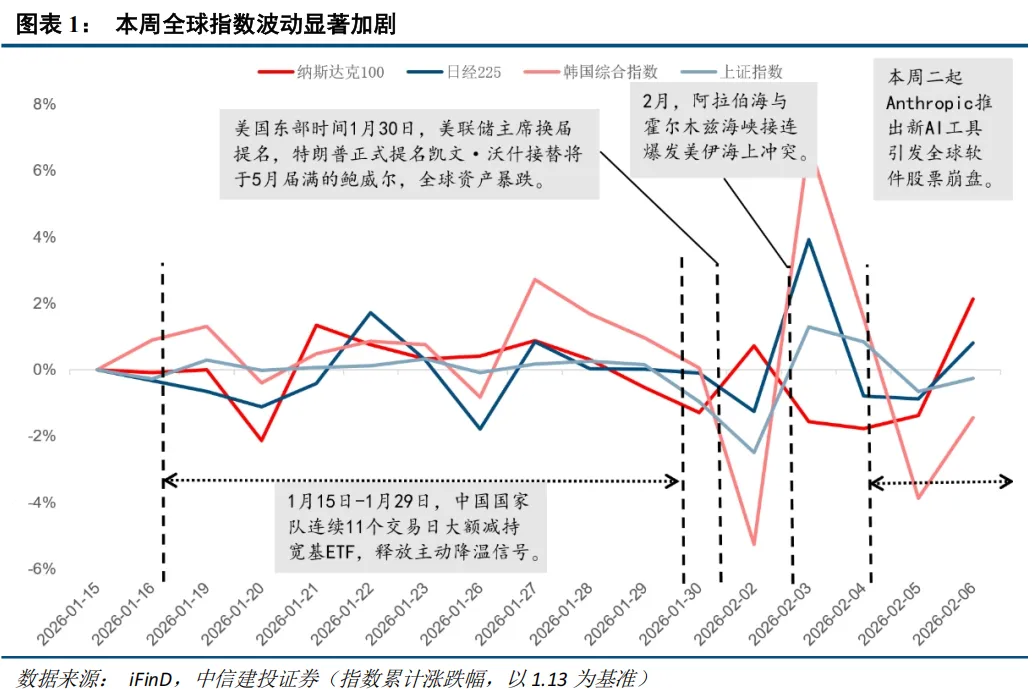
Core Viewpoint - The recent adjustment in the A-share market is primarily driven by internal factors, such as proactive cooling measures and a sell-off in broad-based ETFs, while external factors include political actions by Trump, the change in the Federal Reserve chair, geopolitical tensions in Iran, and a decline in global AI stock preferences. Despite these disturbances, the fundamental industry outlook in China remains intact, and the market sentiment has sufficiently released, suggesting a potential continuation of the spring rally after the Spring Festival [1][2][9]. Internal Factors - The proactive cooling measures by regulators have led to a sell-off in broad-based ETFs, resulting in a temporary decline in market risk appetite. Some thematic sectors have experienced speculative bubbles, prompting the China Securities Regulatory Commission to implement "counter-cyclical adjustments" [9][11]. - The adjustment is viewed as phase-specific, with the proactive cooling measures nearing completion and seasonal factors related to the Spring Festival and the Two Sessions expected to support market recovery [2][11]. External Factors - External disturbances, including Trump's political actions, the new Federal Reserve chair's policy expectations, and geopolitical tensions in Iran, have amplified the adjustment pressure. However, these factors are not expected to have a long-term impact on the A-share market due to its weak correlation with global markets [9][11][13]. - The current external disturbances do not possess the necessary conditions to transmit long-term impacts to the A-share market, as they primarily pertain to financial and political short-term disruptions rather than fundamental changes in supply chains or demand [13][15]. Market Sentiment and Liquidity - Market sentiment has sufficiently cooled, with a significant reduction in trading volume and a drop in the Shanghai Composite Index below its 20-day moving average. This indicates that the previously overheated market sentiment has been effectively resolved [18][20]. - The sell-off in broad-based ETFs has shown signs of easing since January 30, which is expected to improve the independent funding environment of the A-share market [15][18]. Industry Focus and Investment Opportunities - Key sectors to focus on include AI computing power, chemicals, electric equipment, and energy storage, with potential investment opportunities arising from upcoming policy signals from local Two Sessions and the national Two Sessions [20][28]. - The AI computing power sector is expected to see significant capital expenditure increases, with major companies like Meta, Google, Amazon, and Microsoft planning substantial investments in AI infrastructure [20][21]. - The chemical sector is experiencing a valuation recovery driven by price increases in various sub-sectors, with leading companies in PET, polyurethane, and other chemical products becoming focal points for investment [24][25]. - The energy storage industry is benefiting from both domestic and international demand, particularly from AI-driven data center projects in North America, highlighting its critical role in power solutions [28][29].

中信建投:外部冲击影响有限,围绕景气布局
Xin Lang Cai Jing· 2026-02-08 11:09
Core Viewpoint - The recent adjustment in the A-share spring market is primarily driven by internal factors, with external factors acting as catalysts. Internal factors include proactive cooling measures and a sell-off in broad-based ETFs, while external factors encompass political actions by Trump, the change in the Federal Reserve chair, geopolitical tensions in Iran, and the release of new tools by Anthropic that triggered a decline in global tech stocks. Despite these disturbances, the fundamental industrial landscape in China remains intact, and the market sentiment has sufficiently released, suggesting a potential continuation of the spring market after the Spring Festival [3][4][36]. Internal Factors - The adjustment is mainly due to the emergence of speculative bubbles in certain thematic sectors, prompting regulatory bodies to implement "counter-cyclical adjustments" [4][12][47]. - A sell-off in broad-based ETFs has led to a temporary decline in market risk appetite [4][12][47]. External Factors - External disturbances include political actions by Trump that increase policy uncertainty, the change in the Federal Reserve chair affecting global funding pricing, rising geopolitical tensions in Iran, and concerns over AI technologies replacing traditional tools, which have collectively amplified adjustment pressures [4][12][47]. - The correlation between A-shares and global markets has weakened, indicating that external shocks may not have a long-term impact on A-shares [15][50]. Market Sentiment and Performance - Market sentiment has cooled significantly, as evidenced by a decrease in trading volume and a drop in the Shanghai Composite Index below its 20-day moving average, indicating that previous over-exuberance has been adequately addressed [20][55]. - The overall liquidity environment remains stable despite fluctuations in major asset classes, with no significant cross-asset capital flow observed [41]. Industry Configuration - Future industry allocation should focus on sectors with strong growth potential, particularly AI computing power, chemicals, and energy storage, which are expected to benefit from both domestic and international demand [5][39][59]. - The AI computing power sector is supported by significant capital expenditure increases from global tech giants, with Meta planning to raise its capital expenditure to $135 billion, a potential increase of 87% [24][60]. - The chemical sector is experiencing a valuation recovery driven by price increases in various sub-sectors, with major companies like BASF announcing price hikes for TDI products, boosting market sentiment [24][61]. Thematic Investment Opportunities - The upcoming national two sessions are expected to provide policy signals that could benefit sectors such as commercial aerospace and traditional Chinese medicine, which should be monitored for potential investment opportunities [30][65]. - The energy storage industry is poised for growth due to domestic pricing mechanisms and increasing overseas demand driven by AI computing needs, with many storage companies securing orders from North American data centers [28][63].