法律风险

Search documents
AI整蛊有边界 法律红线不可越
Bei Jing Qing Nian Bao· 2026-02-24 03:55
Core Viewpoint - The integration of AI technology into festive life and social interactions is creating new forms of entertainment, but it also raises significant legal concerns regarding personal rights and the potential for misuse [1]. Group 1: AI Face Swapping - The use of AI face-swapping technology for creating humorous videos during festivals has become popular, but it infringes on individuals' portrait rights without their consent [2]. - Portrait rights are protected under the Civil Code, which grants individuals control over their image and prohibits unauthorized use [2]. - Misuse of face-swapping can lead to negative public perception and damage to reputation, constituting a violation of both portrait and reputation rights [2]. Group 2: AI Voice Mimicking - AI-generated voice mimicking can evoke laughter among friends but also poses risks to individuals' voice rights, which are now recognized as a separate personality right under the Civil Code [3][4]. - Unauthorized recording or cloning of a person's voice can lead to civil liability, especially if it results in identity confusion or association with inappropriate content [4]. Group 3: AI-Generated Misinformation - The creation and dissemination of AI-generated fake news and misinformation can severely disrupt social order and public trust [5][6]. - Such actions are often driven by a clear intent to deceive, leading to potential legal consequences under administrative and criminal laws for disturbing public order [7][8]. Group 4: AI-Driven Extortion - The malicious use of AI technology for creating fake compromising content can transform harmless entertainment into serious criminal activities, such as extortion [9]. - This form of extortion is characterized by the intent to unlawfully acquire property through threats, with AI serving as a tool to amplify the psychological pressure on victims [10]. - Legal frameworks classify such actions as extortion, with specific thresholds for criminal liability based on the amount involved and the severity of the consequences for the victim [10]. Group 5: Legal Awareness and Responsibility - The rapid development of AI technology necessitates a strong awareness of legal boundaries and respect for individual rights among users [11]. - Users are encouraged to act with caution, ensuring that their use of technology remains within the bounds of consent and legality, while also being vigilant against potential misuse [11].
自查补税超5000万元、审计师更换,信邦制药接连公告
Shang Hai Zheng Quan Bao· 2026-01-26 01:25
Group 1: Financial Impact - The company announced a tax payment and late fees totaling 50.79 million yuan, which will be recorded in the 2025 financial results, directly affecting annual profits [1] - For the first three quarters of 2025, the company reported revenue of 4.266 billion yuan, a year-on-year decrease of 6.55%, and a net profit attributable to shareholders of 152 million yuan, down 13.74% year-on-year [1] Group 2: Audit Changes - The signing auditor for the 2025 annual audit has changed from Yu Yongchun to Xu Ruixing due to the former's departure, with the project partner being Wang Xiaoming and the quality control reviewer being Huang Haiyang [2] - The company stated that the transition of audit responsibilities has been orderly and is not expected to impact the audit process [2] Group 3: Legal Risks - The company is facing legal risks as it has been prosecuted for alleged unit bribery, with the prosecution materials received from the supervisory committee [3] - The company's subsidiary, Guizhou Keke Pharmaceutical Co., Ltd., which is 99.9964% owned by the company, has been implicated in the bribery case, with its 2023 revenue at approximately 2.278 billion yuan, net profit at 94.5 million yuan, and net assets around 2.482 billion yuan [3]

宏观金融类:文字早评2026/01/13星期二-20260113
Wu Kuang Qi Huo· 2026-01-13 00:53
1. Report Industry Investment Rating No relevant content provided. 2. Core Viewpoints of the Report - For stocks, with the entry of incremental funds at the beginning of the year, the financing scale has increased significantly, and the market trading volume has rapidly expanded. In the long - term, the policy support for the capital market remains unchanged. Strategically, the idea of buying on dips is recommended [4]. - For bonds, the improvement of economic expectations may put pressure on the bond market, but the sustainability of economic recovery momentum needs to be observed. The central bank's attitude of caring for funds remains, and the bond market is expected to be volatile and weak [8]. - For precious metals, if the silver price stabilizes, it will continue a new upward trend, and the driving force for the gold price remains strong. It is recommended to pay attention to the support of gold and silver prices around the BCOM and tariff adjustment nodes and buy on dips after short - term negative factors end [10]. - For non - ferrous metals, most metal prices are expected to be volatile. For example, copper prices are expected to fluctuate and consolidate in the short term; aluminum prices are expected to remain high; zinc and lead prices are expected to fluctuate widely following the sentiment of the non - ferrous sector [13][15][18]. - For black building materials, steel prices are expected to continue to fluctuate at the bottom; iron ore prices are expected to fluctuate at a relatively high level; glass and soda ash markets are generally weak; coking coal and coke prices are expected to fluctuate in a range [32][34][37]. - For energy and chemicals, different products have different trends. For example, rubber is recommended to be treated neutrally; the valuation of heavy - quality oil products is raised; methanol has the feasibility of buying on dips; urea is recommended to take profits on rallies [55][57][59]. - For agricultural products, the short - term trend of hog prices is expected to be stable or slightly rising, and different trading strategies are recommended for different contract periods; egg prices are expected to be stable or rising, and different strategies are also recommended for different contract periods [79][80][81]. 3. Summary by Relevant Catalogs 3.1 Macro - financial 3.1.1 Stock Index - **Market Information**: China Chamber of Commerce for Import and Export of Machinery and Electronic Products promoted a "soft landing" of the EU's anti - subsidy case on electric vehicles; Lihong No.1 completed its first sub - orbital flight test; Brain - Machine Haihe Laboratory completed the first "space brain - machine interface experiment"; prices of multiple non - ferrous and precious metal futures reached new highs [2]. - **Basis Ratio of Stock Index Futures**: Different ratios are provided for IF, IC, IM, and IH contracts in different periods [3]. - **Strategy Viewpoint**: With incremental funds entering at the beginning of the year, the financing scale has increased significantly, and the market trading volume has rapidly expanded. In the long - term, the policy support for the capital market remains unchanged. Strategically, the idea of buying on dips is recommended [4]. 3.1.2 Treasury Bonds - **Market Information**: On Monday, the closing prices of TL, T, TF, and TS main contracts changed by 0.30%, 0.07%, 0.05%, and 0.00% respectively. The Canadian Prime Minister will visit China, and the National Development and Reform Commission and other departments issued relevant policies on government investment funds [5]. - **Liquidity**: The central bank conducted 861 billion yuan of 7 - day reverse repurchase operations on Monday, with a net investment of 361 billion yuan [6][7]. - **Strategy Viewpoint**: The improvement of economic expectations may put pressure on the bond market, but the sustainability of economic recovery momentum needs to be observed. The central bank's attitude of caring for funds remains, and the bond market is expected to be volatile and weak [8]. 3.1.3 Precious Metals - **Market Information**: Shanghai gold rose 1.31%, and Shanghai silver rose 7.23%. The US federal prosecutor launched a criminal investigation into Fed Chairman Powell, which impacted the Fed's independence [9]. - **Strategy Viewpoint**: If the silver price stabilizes, it will continue a new upward trend, and the driving force for the gold price remains strong. It is recommended to pay attention to the support of gold and silver prices around the BCOM and tariff adjustment nodes and buy on dips after short - term negative factors end [10]. 3.2 Non - ferrous Metals 3.2.1 Copper - **Market Information**: Silver prices were strong, and the domestic equity market strengthened, driving copper prices to rise. LME copper inventory decreased, and domestic electrolytic copper social inventory increased [12]. - **Strategy Viewpoint**: The Fed's interest - rate cut expectation has weakened, and short - term sentiment may cool down. The copper mine supply is in a tight pattern, and copper prices are expected to fluctuate and consolidate in the short term [13]. 3.2.2 Aluminum - **Market Information**: The general atmosphere of bulk commodities was strong, and aluminum prices fluctuated and rose. LME aluminum inventory decreased, and domestic aluminum ingot and aluminum rod social inventories increased [14]. - **Strategy Viewpoint**: The high - level fluctuations of precious metals and non - ferrous metals have increased, and short - term sentiment may cool down. Aluminum prices are expected to remain high [15]. 3.2.3 Zinc - **Market Information**: The Shanghai zinc index rose, and LME zinc also increased. Zinc ingot social inventory decreased slightly [16][17]. - **Strategy Viewpoint**: The zinc price has a large room for catch - up compared with copper and aluminum. It is expected to fluctuate widely following the sentiment of the non - ferrous sector [18]. 3.2.4 Lead - **Market Information**: The Shanghai lead index rose, and LME lead also increased. Lead ingot social inventory increased [19]. - **Strategy Viewpoint**: The lead price is approaching the upper edge of the long - term oscillation range, and it is expected to fluctuate widely following the sentiment of the non - ferrous sector [19]. 3.2.5 Nickel - **Market Information**: Nickel prices rebounded, and the prices of nickel ore and nickel iron also changed accordingly [20]. - **Strategy Viewpoint**: The oversupply pressure of nickel is still large, and it is expected to fluctuate widely in the short term. It is recommended to wait and see in the short term [20][21]. 3.2.6 Tin - **Market Information**: Tin prices rose significantly. The supply in Myanmar is gradually recovering, and the demand is mainly for rigid needs [22]. - **Strategy Viewpoint**: The tin market demand is weak, and the supply is expected to improve. It is recommended to wait and see. The price is expected to fluctuate following the market risk preference [22]. 3.2.7 Carbonate Lithium - **Market Information**: The spot index of carbonate lithium rose, and the futures price also increased [23]. - **Strategy Viewpoint**: The "rush to export" effect has increased the demand expectation, but the rapid rise may increase the callback risk. It is recommended to wait and see or try with a light position [23]. 3.2.8 Alumina - **Market Information**: The alumina index rose, and the inventory continued to accumulate [24]. - **Strategy Viewpoint**: The mine price is expected to decline, and the alumina market continues to face over - capacity. It is recommended to wait and see and consider shorting on rallies [25]. 3.2.9 Stainless Steel - **Market Information**: The stainless steel main contract price was stable, and the social inventory decreased [26]. - **Strategy Viewpoint**: The optimistic expectation of Indonesia's RKAB supports the price. The price is expected to remain high and volatile in the short term [27]. 3.2.10 Casting Aluminum Alloy - **Market Information**: The price of casting aluminum alloy rose, and the inventory increased slightly [28]. - **Strategy Viewpoint**: The cost is strong, and the supply is disturbed. The price is expected to remain high in the short term [29]. 3.3 Black Building Materials 3.3.1 Steel - **Market Information**: The prices of rebar and hot - rolled coil increased, and the inventory of rebar increased slightly while that of hot - rolled coil decreased slightly [31]. - **Strategy Viewpoint**: The steel price is expected to continue to fluctuate at the bottom. It is necessary to pay attention to the de - stocking of hot - rolled coil and relevant policies [32]. 3.3.2 Iron Ore - **Market Information**: The iron ore main contract price rose, and the port inventory continued to accumulate [33]. - **Strategy Viewpoint**: The overseas iron ore shipment is in the off - season, and the iron ore price is expected to fluctuate at a relatively high level. It is necessary to pay attention to the steel mill's replenishment and iron - making rhythm [34]. 3.3.3 Glass and Soda Ash - **Market Information**: The glass main contract price decreased slightly, and the inventory decreased. The soda ash main contract price increased, and the inventory increased [35][37]. - **Strategy Viewpoint**: The glass price is expected to fluctuate, and it is recommended to wait and see. The soda ash market is generally weak [36][37]. 3.3.4 Coking Coal and Coke - **Market Information**: The prices of coking coal and coke rose. The spot prices of coking coal and coke also changed [38]. - **Strategy Viewpoint**: The commodity market sentiment is positive, but the fundamental support for the price is limited. The price is expected to fluctuate in a range [40][41]. 3.3.5 Manganese Silicon and Ferrosilicon - **Market Information**: The prices of manganese silicon and ferrosilicon rose. The spot prices also changed [42]. - **Strategy Viewpoint**: The future market trend is mainly affected by the overall market sentiment and cost factors. It is recommended to pay attention to manganese ore and "dual - carbon" policies [45]. 3.3.6 Industrial Silicon and Polysilicon - **Market Information**: The price of industrial silicon rose slightly, and the price of polysilicon decreased. The inventory of industrial silicon may increase, and the supply of polysilicon may be adjusted [46][48]. - **Strategy Viewpoint**: Industrial silicon is expected to face inventory pressure, and polysilicon is expected to be weak and volatile. It is necessary to pay attention to relevant policies and production plans [47][49]. 3.4 Energy and Chemicals 3.4.1 Rubber - **Market Information**: The rubber price fluctuated and rebounded. The tire start - up rate had marginal fluctuations, and the inventory increased [51][53]. - **Strategy Viewpoint**: The overall commodity atmosphere is positive, but the rubber seasonality is weak. A neutral strategy is recommended, and short - selling can be considered if the price falls below a certain level [55]. 3.4.2 Crude Oil - **Market Information**: The main contract price of INE crude oil rose, and the inventories of refined oil products changed [56]. - **Strategy Viewpoint**: The Latin American geopolitical situation does not have enough positive impact on the overall oil price, but the valuation of heavy - quality oil products is raised [57]. 3.4.3 Methanol - **Market Information**: The regional spot prices of methanol changed, and the main contract price decreased [58]. - **Strategy Viewpoint**: The current valuation of methanol is low, and it has the feasibility of buying on dips [59]. 3.4.4 Urea - **Market Information**: The regional spot prices of urea changed slightly, and the main contract price increased [60]. - **Strategy Viewpoint**: The import window has opened, and it is recommended to take profits on rallies [62]. 3.4.5 Pure Benzene and Styrene - **Market Information**: The prices of pure benzene and styrene rose. The inventory of pure benzene increased, and the inventory of styrene decreased [63]. - **Strategy Viewpoint**: The non - integrated profit of styrene can be long - bought before the first quarter [64]. 3.4.6 PVC - **Market Information**: The PVC main contract price rose, and the inventory increased [65]. - **Strategy Viewpoint**: The domestic PVC market has a pattern of strong supply and weak demand. It is recommended to short on rallies [66]. 3.4.7 Ethylene Glycol - **Market Information**: The ethylene glycol main contract price rose, and the inventory increased [67]. - **Strategy Viewpoint**: The ethylene glycol market needs to increase production cuts to improve the supply - demand pattern. It is necessary to beware of rebound risks [68]. 3.4.8 PTA - **Market Information**: The PTA main contract price rose, and the inventory decreased [69]. - **Strategy Viewpoint**: The PTA is expected to enter the Spring Festival inventory - accumulation stage. It is recommended to pay attention to long - buying opportunities on dips [70]. 3.4.9 p - Xylene - **Market Information**: The p - xylene main contract price rose, and the inventory decreased [71][72]. - **Strategy Viewpoint**: The p - xylene load is high, and it is recommended to pay attention to long - buying opportunities following the crude oil price [73]. 3.4.10 Polyethylene (PE) - **Market Information**: The PE main contract price rose, and the inventory increased [74]. - **Strategy Viewpoint**: The PE price may be supported, and it is recommended to long - buy the LL5 - 9 spread on dips [75]. 3.4.11 Polypropylene (PP) - **Market Information**: The PP main contract price rose, and the inventory situation was complex [76]. - **Strategy Viewpoint**: The PP price may bottom out in the first quarter of next year [77]. 3.5 Agricultural Products 3.5.1 Hogs - **Market Information**: The domestic hog price was mixed, and the price may stabilize or rise slightly [79]. - **Strategy Viewpoint**: The short - term hog price may support the futures price, but in the medium - term, supply pressure exists. Different trading strategies are recommended for different contract periods [80]. 3.5.2 Eggs - **Market Information**: The national egg price mostly rose, and the price is expected to be stable or rise [81]. - **Strategy Viewpoint**: The short - term egg price may support the futures price, but in the medium - term, supply pressure exists. Different trading strategies are recommended for different contract periods [82]. 3.5.3 Soybean and Rapeseed Meal - **Market Information**: The protein meal futures price fluctuated. The import cost of soybeans may have a bottom, but the fundamental situation is weak [83][84]. - **Strategy Viewpoint**: It is recommended to wait and see in the short term due to the combination of long - and short - term factors [84]. 3.5.4 Oils and Fats - **Market Information**: The oil futures price fluctuated. The palm oil inventory in Malaysia increased, and the domestic three - major oil inventories were at a relatively high level [85][86]. - **Strategy Viewpoint**: The current fundamental situation is weak, but the long - term expectation is optimistic. The oil price may be close to the bottom [86]. 3.5.5 Sugar - **Market Information**: The Zhengzhou sugar futures price fluctuated. The spot price of sugar decreased slightly [87]. - **Strategy Viewpoint**: The international sugar price may rebound after February, and it is recommended to wait and see in the short term [89]. 3.5.6 Cotton - **Market Information**: The Zhengzhou cotton futures price decreased. The cotton supply and demand situation changed [90]. - **Strategy Viewpoint**: The cotton price may fluctuate after rising. It is recommended to wait for a callback to buy [91].
“提供身份”就能日结高薪?
Xin Lang Cai Jing· 2026-01-10 22:40
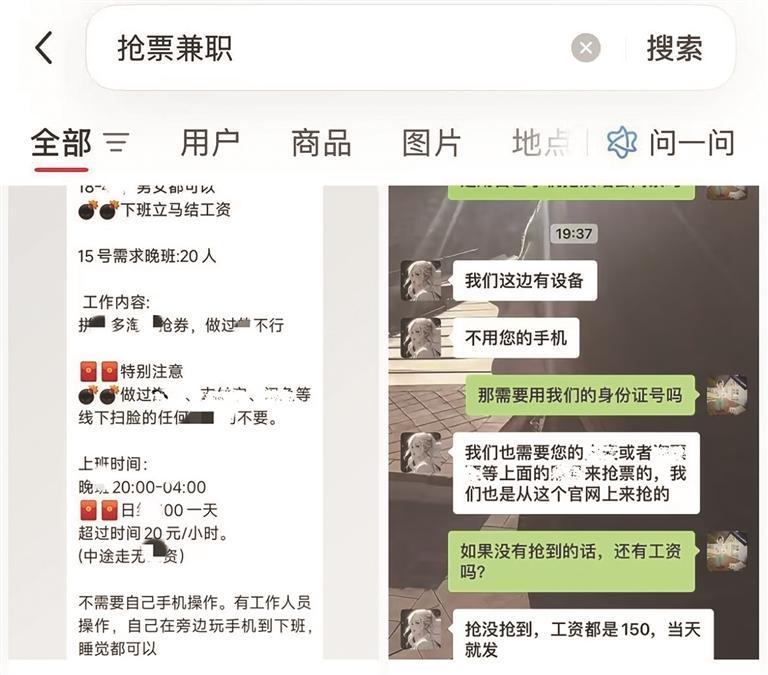
Core Viewpoint - The article investigates the rise of high-paying "part-time" job advertisements on social media, particularly those related to ticket purchasing, revealing potential risks associated with personal information and legal implications [4][11]. Group 1: Job Advertisements and Operations - Numerous high-paying part-time job postings have emerged on social media, promising easy operations and daily payments [4]. - A specific job advertisement offers a salary of 300 yuan per day for ticket purchasing, with additional pay for overtime, and claims that workers do not need to operate their own phones [5][9]. - Job seekers are required to submit personal information, including ID and bank card numbers, and must register multiple accounts on specified platforms [9][10]. Group 2: Risks and Concerns - Many job seekers express concerns about the legality and safety of these jobs, particularly regarding the use of their personal information [11]. - Legal experts warn that participating in such jobs could lead individuals to become unwitting accomplices in criminal activities, facing significant legal risks [12]. - The sharing of sensitive personal information, such as biometric data, poses severe security threats, as it can be exploited for fraudulent activities [12][13].

卢森堡首相:使用俄被冻结资产援乌存在巨大金融与法律风险
Sou Hu Cai Jing· 2025-12-18 10:30
Core Viewpoint - Luxembourg Prime Minister Frieden expressed concerns about the EU's potential use of frozen Russian assets to provide compensation loans to Ukraine, highlighting the complex financial and legal risks involved, which could impact the overall stability of the EU [2] Group 1: Financial Risks - Frieden emphasized that using Russian assets to support Ukraine could lead to "serious financial risks" [2] - He suggested that utilizing the EU budget for aid is more feasible as it would not jeopardize the stability of the Eurozone, although it requires unanimous agreement from EU member states [2] Group 2: Legal Complexity - The issuance of compensation loans backed by frozen Russian assets is described as "unprecedented" in history, with media and the public often underestimating the potential legal complexities involved [2] - Frieden pointed out that this issue is not only a concern for Belgium but is relevant to the financial stability of the entire EU, necessitating comprehensive discussions among national leaders [2] Group 3: Current Situation - Since the escalation of the Ukraine crisis in February 2022, Western countries have frozen approximately $300 billion of Russian overseas assets, with the EU freezing around €210 billion of assets from the Russian central bank [2] - About 90% of the frozen Russian assets within the EU are controlled by the European Clearing Bank based in Brussels, and the EU has announced an "indefinite freeze" on these assets, with plans to finalize specific proposals during the EU summit on the 18th and 19th [2]

X @Yuyue
Yuyue· 2025-11-30 15:59
Tax and Legal Risk Management - High net worth individuals face significant costs related to taxation and legal risks [1] - Industry suggests implementing family trusts to isolate assets from risks associated with marital changes or unforeseen liabilities, potentially preventing a 50% asset loss [1] - The sector proposes utilizing offshore structures to optimize tax strategies [1]
中企在中亚投资的法律风险及应对策略
Sou Hu Cai Jing· 2025-11-18 11:57
Core Insights - The investment attractiveness of Central Asia is increasing as the Belt and Road Initiative enters a new phase of high-quality development, with significant strategic implications for China's foreign openness [1] - However, legal risks coexist with investment opportunities, as Central Asian countries are undergoing a transformation of their legal systems, which presents challenges for foreign enterprises [1] Group 1: Market Entry and Establishment Risks - Central Asian countries primarily use a "negative list" management model to attract foreign investment, with strict regulations on foreign access to sectors related to national interests, such as mining and oil [4] - Kazakhstan retains the right to unilaterally modify or terminate contracts in certain situations, indicating significant uncertainty in market entry [4] - Uzbekistan's 2020 Investment Law allows for some legal stability for foreign investments, but exceptions related to national security and public health introduce considerable uncertainty [5] Group 2: Operational Risks - Local labor market policies in Central Asia require companies to hire local employees and provide training, with strict penalties for non-compliance [8] - Tax incentives aimed at attracting foreign investment often lack consistency and transparency, leading to potential unilateral changes by host countries [9] - Environmental regulations are becoming increasingly stringent, with significant implications for projects in sectors like mining and energy [10] Group 3: Dispute Resolution and Exit Risks - High costs and inefficiencies in local judicial systems deter foreign investors from seeking local remedies for disputes [12] - International arbitration clauses in investment agreements do not eliminate risks, as host countries may limit their applicability through domestic legislation [13][14] - Currency exchange and capital repatriation risks are present, as foreign investment laws may allow for temporary controls during economic crises [15] Group 4: Systematic Response Strategies - Companies should enhance their capacity to utilize international law, particularly bilateral investment treaties, to navigate the legal complexities in Central Asia [18] - Establishing a robust policy risk protection system through political risk insurance can mitigate systemic risks [20] - Conducting thorough due diligence before investment is crucial for identifying legal risks and ensuring compliance with local laws [21] - Developing a localized operational framework can enhance social acceptance and political legitimacy in the region [22] Group 5: Future Legal Environment Changes - The legal landscape in Central Asia is expected to evolve with improved legal coordination under the Shanghai Cooperation Organization and the implementation of economic cooperation plans [27] - Emerging sectors like digital trade and renewable energy present new opportunities but also introduce new compliance requirements [27]

黄金“代购”暴雷预警:你以为省了万元,实则踩了法律高压线!
Sou Hu Cai Jing· 2025-11-16 02:11
Core Insights - The article highlights the risks associated with a new trend in gold purchasing, where consumers use runners for "human flesh purchasing" of gold bars, claiming to save significant amounts of money, but this practice carries hidden criminal risks [1][4]. Group 1: Risks of Gold Purchasing - The low-priced gold in the Shui Bei market attracts consumers, but the reliance on runners for the entire purchasing process raises ethical concerns and risks of fraud [4][5]. - The "human goods separation" model of purchasing is identified as a typical characteristic of money laundering, which could lead to consumers facing legal consequences even if they are unaware of any wrongdoing [5][8]. Group 2: Legal and Regulatory Environment - Law enforcement agencies are monitoring gold transactions that involve separation of goods and funds, and financial institutions are conducting thorough reviews of unusual money flows [8]. - Consumers are urged to revert to legitimate channels for gold transactions, such as banks or physical stores, to protect their rights and avoid potential legal issues [8]. Group 3: Logistics and Transportation Risks - The high value and small size of gold make it a prime target for theft or substitution during transportation, with cases of undelivered or swapped items being reported [7]. - Consumers may face significant financial losses if gold is not insured during shipping, as compensation is often limited to three times the shipping cost [7].

BNP Paribas Could Face Billions in Damages After Sudan Verdict
Youtube· 2025-10-21 08:35
Core Viewpoint - BNP Paribas is facing significant stock declines due to a court ruling linking the bank to human rights abuses in Sudan, raising concerns about potential settlement payouts that could reach billions [1][3]. Group 1: Stock Performance - The stock dropped approximately 8% following a court loss in the US, where three Sudanese plaintiffs were awarded damages for BNP's alleged support of the Sudanese regime [3]. - The total verdict was $21 million, but there are over 20,000 additional plaintiffs in the US, indicating a potential for much larger financial liabilities [3][4]. Group 2: Legal Implications - The ongoing legal case presents a new risk for BNP Paribas that may not have been fully recognized previously, suggesting that the bank could face substantial costs [4]. - Lawyers for the plaintiffs have indicated that BNP Paribas should consider settling, with figures being discussed in the low billions [5]. Group 3: Market Reaction - The market appears to be reacting to worst-case scenarios due to the uncertainty surrounding the potential financial impact of the legal issues [5]. - Despite the stock's significant drop, some analysts suggest that the declines may be overdone until more clarity is provided regarding the actual risks involved [5].


宗馥莉出走后,娃哈哈下发“封杀令”逼经销商陷入两难危局
Sou Hu Cai Jing· 2025-10-21 05:12
Core Viewpoint - The resignation of Zong Fuli has triggered significant turmoil within the Wahaha market, leading to a "ban order" that has left distributors in a precarious position [1][3]. Group 1: Market Reaction - The announcement of the "ban order" has created a sense of panic among distributors, who are now facing the risk of losing their long-established partnerships with Wahaha [3]. - Distributors are caught in a dilemma between maintaining their existing channels, which provide stable revenue, and the potential opportunities presented by Zong Fuli's new brand "Wah Xiaozong" [3][4]. Group 2: Distributor Perspectives - Some distributors express a willingness to pursue "Wah Xiaozong" if it promises higher profits, while others are wary due to past grievances with Zong Fuli's management style [4]. - The relationship between distributors and Wahaha has been strained, with some feeling that Zong Fuli's actions are pushing them towards a difficult choice [4]. Group 3: Internal Family Conflict - The situation has highlighted internal conflicts within the Wahaha family, particularly regarding the trademark disputes and brand competition between Zong Fuli and her uncle Zong Ze [6]. - Legal issues have emerged, including reports of Zong Fuli's associated accounts being frozen by a Hong Kong court, complicating the brand's operational landscape [6][7]. Group 4: Historical Context - The ongoing brand conflict is reminiscent of past cases of brand internal strife, which often lead to damage to the brand's reputation and customer loyalty [7]. - Industry experts warn that continued zero-sum competition could harm the overall market ecosystem, as both parties may overlook consumer needs and market changes [7]. Group 5: Market and Consumer Role - The resolution of this conflict should be left to market dynamics and legal adjudication, as consumer preferences will ultimately determine the success of the brands involved [8]. - The importance of consumer support is emphasized, as a brand's strength lies in its ability to meet consumer demands rather than merely relying on legal agreements [8].