
牛市主线

Search documents
天风证券:低估红利继续崛起 投资主线把握三个方向
智通财经网· 2025-11-10 00:01
Core Viewpoints - The Federal Reserve has a significant probability of interest rate cuts within the year, with a 66.9% chance of a 25 basis point cut by December 2025, and a 33.1% chance of maintaining current rates [3]. Domestic Economic Indicators - In October, both export and import growth rates fell short of expectations, with exports (in USD) declining by 1.1% year-on-year, down from an 8.3% increase, while imports rose by 1.0%, down from a 7.4% increase [2]. - High-frequency indicators in transportation show a rebound in subway passenger volume [2]. - The industrial production index has shown improvement, with specific sectors like methanol, tires, and certain steel production seeing a rise, while soda ash has declined [2]. International Economic Context - Ongoing geopolitical tensions include Russia's response to potential U.S. nuclear tests and developments in the Ukraine conflict, as well as military considerations in the Middle East, such as the potential sale of F-35s to Saudi Arabia [3]. - The Federal Reserve's interest rate outlook remains a critical factor, with a notable probability of rate cuts by the end of 2025 [3]. Industry Investment Recommendations - Investment themes are categorized into three main directions: breakthroughs in Deepseek and AI technology, a "stronger gets stronger" market style during economic recovery, and the continued rise of undervalued dividends [4]. - In the early stages of a bull market, funds tend to favor a few high-growth sectors, while later stages see a focus on main themes, making it harder for new funds to achieve profits [4]. - Cyclical stocks are highlighted for their low valuations and high beta characteristics, which may attract additional capital as the economic fundamentals improve [4].

A股分析师前瞻:历史上的11月风格更偏向炒小、炒题材?
Xuan Gu Bao· 2025-11-02 13:55
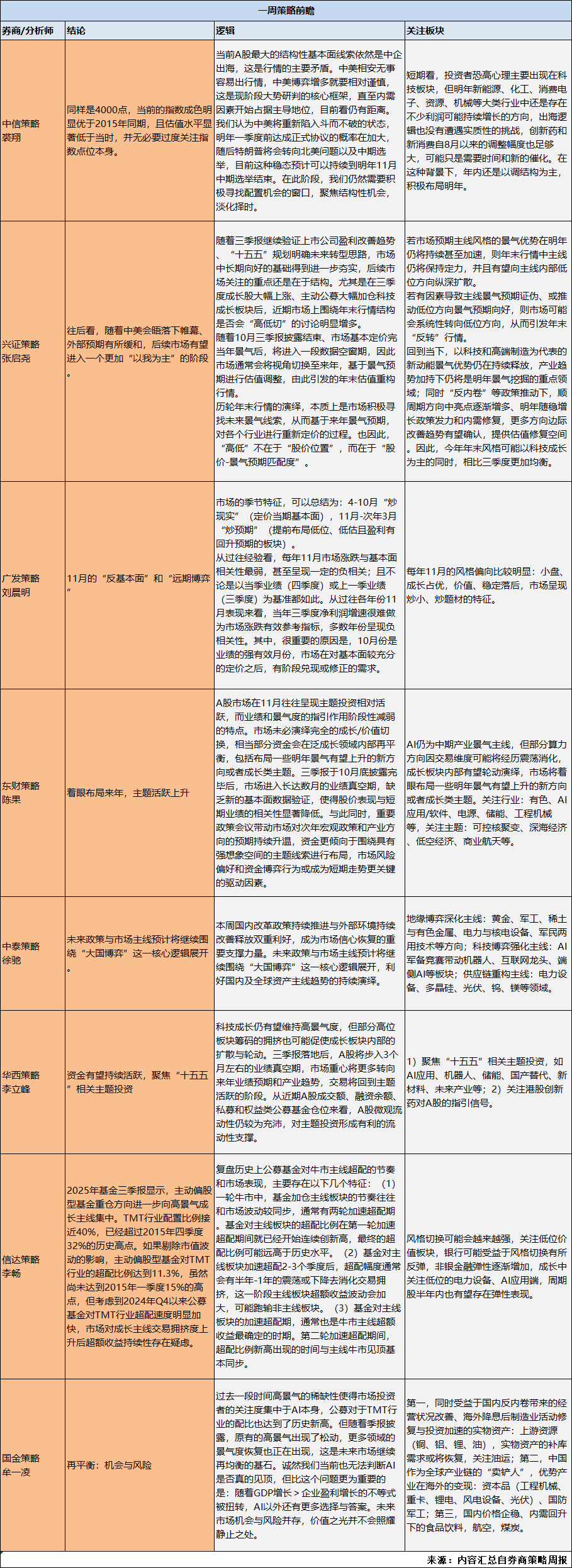
Group 1 - The core viewpoint of the articles discusses the historical market trends in November and year-end, highlighting a shift from "pricing current fundamentals" from April to October to "pricing expectations" from November to March of the following year [1][5] - Historical data indicates that the correlation between market performance in November and fundamentals is weak, often showing a negative correlation, as October is a strong earnings month leading to a need for market correction [1][5] - The market style in November tends to favor small-cap and growth stocks while value and stability lag behind, reflecting a trend of speculative investments in smaller themes [1][5] Group 2 - The year-end market performance is characterized by a search for future economic clues, leading to a revaluation of various industries based on next year's economic expectations [2][3] - The technology and high-end manufacturing sectors are expected to continue their growth momentum, becoming key areas for economic exploration in the coming year [2][3] - The "anti-involution" policies are expected to enhance cyclical sectors, with more areas showing marginal improvement trends, providing room for valuation recovery [2][3] Group 3 - The market is anticipated to enter a more balanced phase with a focus on technology growth, compared to the previous quarter [3] - The scarcity of high-growth sectors has led to increased investor focus on AI, with public funds heavily weighted towards the TMT sector, reaching historical highs [3][6] - As earnings reports conclude, the market is expected to shift focus towards next year's performance expectations and industry trends, leading to a more active thematic investment phase [5][6]

固收视角看权益系列十一:坚守牛市主线
ZHESHANG SECURITIES· 2025-10-23 05:13
Group 1: Report Industry Investment Rating - No relevant content provided Group 2: Core Views of the Report - By comparing the development paths of the past five typical bull markets and the current one, it is found that when the underlying logic of the main - line sectors in a bull market remains unchanged, the market has strong sustainability, obvious excess gains, and new opportunities are brewing during adjustments. Investors are advised to seize the adjustment window period and choose the right time to layout by judging the logical smoothness of sub - industries [1]. - Economic stimulus policies are often the starting gun for a bull market. Policy shifts catalyze investors' expectations of future liquidity easing and long - term economic improvement, leading to an initial increase in market risk appetite and valuation. Industry prosperity and corporate fundamentals determine the main line of the market, and the main - line sectors are those with the most improvement expectations and policy benefits [3][11]. - Main - line sectors usually have several common characteristics: supported by top - level policies with sustainable prosperity stories; strong capital consensus with rapid and concentrated allocation of foreign, public, and leveraged funds; strong market sustainability, with significant multiple growth in gains, outperforming the market index, and internal diffusion within the sector [3][17]. - In a bull market, there are also non - main - line sectors that rise with the market. Their rise is mainly due to the inflow of funds and the increase in overall market risk appetite, with lagging start, lower gains, and poor sustainability [18]. - In a bull market, choice is more important than timing. During the adjustment period of the main - line sectors, if the adjustment is due to external shocks without changing the long - term development trend, it may be a new layout opportunity; if it is due to the industry entering the mature stage, wait for the valuation to return to a reasonable level and find sub - sectors with moats. As long as the underlying logic of the main - line sectors remains unchanged, funds will flow back after the short - term switch [2][19]. - If the fundamental logic of the main - line sectors is shaken, it may mean the end of the market. Currently, the technology sector is the main line of the current bull market. Although affected by tariff disturbances, investors should seize the adjustment window to re - layout [20]. - The convertible bond market generally follows the equity market. It can have independent bull markets when there is a systematic inflow of convertible bond funds, such as in 2022 and from July to August 2025 [20][22]. Group 3: Summary by Relevant Catalogs 1. Past Bull Market Reviews - A - share market in the past 20 years can be divided into six typical bull markets: 2005 - 2007 (dominated by cyclical products), 2008 - 2009 (triggered by the "Four - Trillion" plan), 2013 - 2015 (driven by the mobile Internet), 2016 - 2017 (under the supply - side reform), 2019 - 2021 (led by consumption upgrade and new energy), and 2024 - present (guided by a new round of technological revolution) [9][11][12]. - During these bull markets, different main - line sectors emerged, such as cyclical products in the first round, financial and infrastructure sectors in the second round, TMT in the third round, large - cap stocks in the fourth round, and consumer and new - energy - related sectors in the fifth round. In the current sixth round, it is the new - quality productivity represented by computing power, semiconductors, and robots [12]. - The representative index gains of the six bull markets vary. For example, the WanDe QuanA index had a 583% increase in the first round (2005.07 - 2007.10), a 136% increase in the second round (2008.11 - 2009.07), etc. The main - line sectors generally had higher gains than non - main - line sectors [13][15]. 2. Current Market Situation - The technology sector is the main line of the current bull market, which has experienced different stages since September 24, 2024. Affected by tariff disturbances, market risk appetite has adjusted, and funds have flowed to defensive sectors such as dividend stocks. However, the underlying logic of the technology sector remains smooth, and investors should seize the adjustment opportunity to re - enter the market [20]. - The convertible bond market has had two independent bull markets, in 2022 and from July to August 2025, which were driven by the inflow of funds [20][22].
天风证券:赛点2.0第三阶段攻坚不易 重视恒生互联网 把投资主线降维为这三个方向
智通财经网· 2025-10-13 23:53
Core Viewpoint - The report from Tianfeng Securities emphasizes the challenges in the third phase of the "Saidian 2.0" initiative, highlighting the importance of Hang Seng Internet amidst economic recovery and market liquidity [1][7]. Industry Trends - Overall industry sentiment shows an upward trend in sectors such as electric equipment, machinery, electronics, food and beverage, light manufacturing, real estate, and retail, while sectors like oil and petrochemicals, construction materials, pharmaceuticals, textiles, automotive, public utilities, and environmental protection are experiencing a downward trend [2]. - The report predicts strong performance in specific sub-industries over the next four weeks, including automotive services, commercial vehicles, automotive parts, rail transit equipment, lighting equipment, household appliance parts, chemical pharmaceuticals, non-metallic materials, plastics, consumer electronics, chemical fibers, electronic chemicals, and motors [2]. Key Data Points - In the automotive sector, the operating rate for semi-steel tires in China is reported at 46.51%, reflecting a week-on-week decrease of 27.07 percentage points [3]. - In the machinery sector, the factory price for liquid oxygen in Shandong is reported at 270.0 CNY per ton, with a week-on-week increase of 3.85% [4]. - In the transportation sector, the weekly subway passenger volume in Beijing is 10.5665 million, showing a week-on-week increase of 52.78%, while in Suzhou, the volume is 1.896 million, reflecting a week-on-week decrease of 21.94% [4]. - In the pharmaceutical sector, the market price for domestic vitamin E (50%) is reported at 47.5 CNY per kilogram, with a week-on-week decrease of 5.94% [5]. - In the basic chemical sector, the spot price for acetic acid is 2500.0 CNY per ton, with a week-on-week increase of 1.63% [5]. - In the electronics sector, the average spot price for DRAM DDR3 (4Gb) is reported at 2.58 USD, with a week-on-week increase of 6.71% [6]. - In the electric equipment sector, the price for lithium hexafluorophosphate is reported at 67,500 CNY per ton, with a week-on-week increase of 10.66%, while the average price for lithium iron phosphate is 33,700 CNY per ton, reflecting a week-on-week decrease of 0.3% [6]. Investment Strategy - The investment focus is categorized into three main directions: 1) breakthroughs in Deepseek and leadership in open-source technology AI, 2) internal and external resonance with gradual economic recovery, favoring a "stronger gets stronger" bull market style, though cyclical stocks may perform better in the latter half, and 3) the continued rise of undervalued dividends [1][7]. - The report suggests that during the early stages of a bull market, funds tend to favor a few high-sentiment sectors, while in later stages, funds concentrate on main lines, making it harder for new funds to profit [7].