
稳民生

Search documents
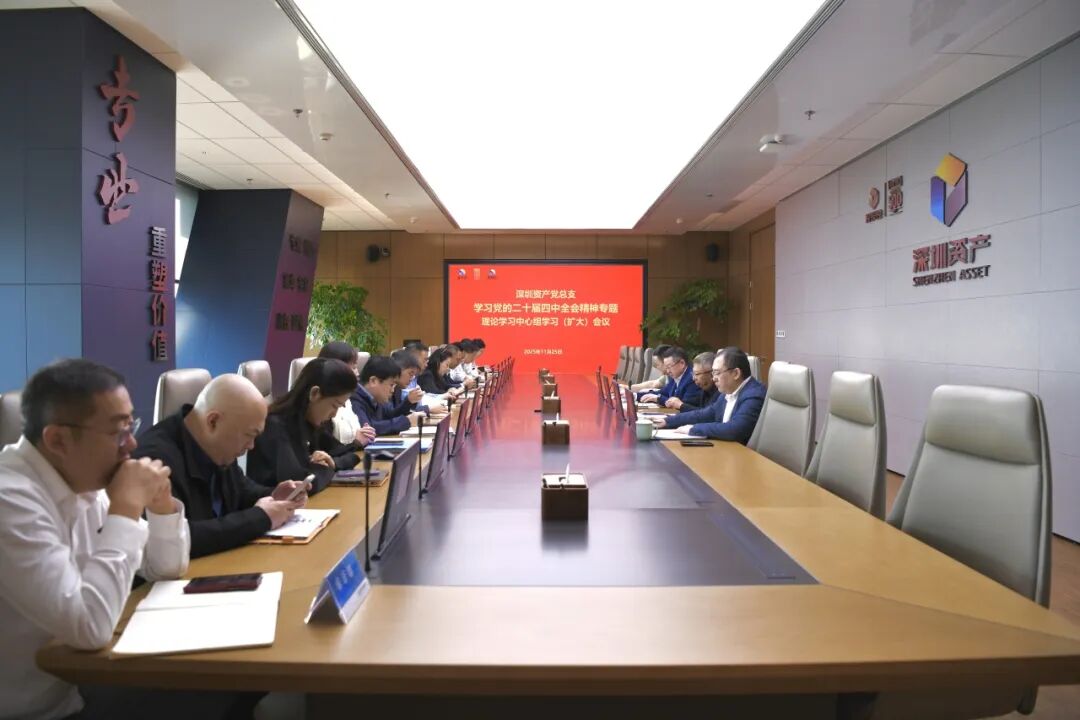
金融党建圳先行 | 深圳资产管理有限公司:党建助力金融风险化解,盘活资产彰显专业担当
Xin Lang Cai Jing· 2025-12-12 14:22
Core Viewpoint - The 20th Central Committee's Fourth Plenary Session approved the "Suggestions on Formulating the 15th Five-Year Plan for National Economic and Social Development," which sets the direction for high-quality financial development in Shenzhen [1][20]. Group 1: Political Leadership and Learning - The company prioritizes political construction, utilizing various learning methods to study Xi Jinping's latest important speeches and fostering a strong learning atmosphere through dedicated columns on their public platform [2][21]. - A structured learning matrix is established, integrating theoretical learning into daily practices, ensuring continuous engagement among party members [2][21]. Group 2: Leadership Role in Key Projects - The company plays a crucial leadership role in major project reviews and investments, ensuring alignment with national strategies and regional economic stability [5][23]. - Party members take on exemplary roles in project advancement, particularly in areas like non-performing asset management and real estate project support, contributing to high-quality economic development [5][23]. Group 3: Risk Management and Real Estate Solutions - The company actively responds to calls for real estate risk mitigation, focusing on urban renewal and policy housing, and collaborates with local governments and various departments to address challenges faced by stakeholders [9][27]. - Innovative financial solutions are implemented to restructure historical debts and attract new funding, achieving both economic and social benefits, recognized with the "2024 Best Case Award" in the national AMC industry [9][27]. Group 4: Project Revitalization and Community Support - The company engages in project revitalization efforts, employing innovative models to resolve risk conflicts, particularly in the real estate sector, and successfully isolates debt risks while achieving multi-party benefits [12][30]. - Initiatives are taken to support local governments and financial institutions, ensuring that community needs are met while promoting economic stability [12][30]. Group 5: Strategic Investment in Emerging Industries - The company embraces its political and social responsibilities by investing in emerging industries such as robotics and artificial intelligence, aligning with national strategic goals [16][34]. - Collaborative investment strategies are employed to address liquidity challenges faced by companies, enhancing the overall production capacity in Shenzhen [16][34]. Group 6: Future Directions - The company plans to continue its involvement in local financial risk management, focusing on Shenzhen's strategic emerging industries and contributing to the development of the Guangdong-Hong Kong-Macao Greater Bay Area [18][35].

国泰海通|中央经济工作会议的六个亮点
国泰海通证券研究· 2025-12-12 04:22
Core Viewpoint - The article discusses the outcomes of the Central Economic Work Conference held on December 11-12, 2025, emphasizing a moderate policy tone, a focus on internal demand, and long-term structural improvements while addressing external risks [3][4][9]. Group 1: Policy Tone and Direction - The policy tone is generally moderate, shifting from "seeking progress while maintaining stability" to "maintaining stability while seeking progress and improving quality and efficiency" [4][10]. - Fiscal policy will maintain necessary levels of deficit, debt, and expenditure, with a projected deficit rate around 4% [4][11]. - Monetary policy will continue to be moderately loose, with an emphasis on promoting reasonable price recovery [11][12]. Group 2: Internal Demand and Investment - The focus is on internal demand, with clear strategies to stabilize investment and enhance service consumption [4][11]. - Investment is expected to stop declining, with new policy financial tools being utilized to support this [4][11]. - Service consumption will be promoted through reforms aimed at increasing supply to stimulate demand [11][12]. Group 3: Risk Management and Real Estate - The emphasis on risk prevention has decreased, with ongoing policies for real estate and debt management [5][12]. - Reforms in the housing provident fund system are anticipated, including potential reductions in loan rates and adjustments in withdrawal ratios [5][12]. - The fiscal environment for 2026 is expected to remain similar to 2025, with a focus on managing debt and social spending [5][12]. Group 4: Social Stability and Employment - Maintaining social stability remains a priority, with measures in healthcare, education, and employment being highlighted [6][13]. - The economic growth target for 2026 is expected to remain stable, balancing growth with social needs [6][13]. - The article notes the importance of transitioning from traditional labor-intensive industries to ensure employment stability [6][13]. Group 5: Long-term Structural Reforms - The conference highlighted the need for long-term structural reforms to address "involution" in competition, with a focus on establishing a unified national market [5][12]. - Measures to improve the supply side are expected to contribute to a moderate recovery in the Producer Price Index (PPI) [5][12]. - The commitment to a dual carbon strategy includes accelerating the construction of a new energy system and improving disaster prevention infrastructure [6][13].

国泰海通:2026年宏观政策延续积极基调,降准降息仍可期
Sou Hu Cai Jing· 2025-12-12 03:39
Core Viewpoint - The Central Economic Work Conference held on December 10-11 outlines the economic work for 2025 and sets the direction for 2026, emphasizing the importance of expanding domestic demand in the short term and strengthening internal capabilities in the medium to long term [1] Group 1: Macroeconomic Policy - The macroeconomic policy maintains a "more proactive and effective" tone, focusing on internal conditions and medium to long-term issues, with a shift in external environment assessment from "adverse" in 2024 to neutral in 2025 [1] - It is expected that the macroeconomic policy will continue the positive tone established in 2025 into 2026 [1] Group 2: Domestic Demand and Investment - The emphasis is on domestic demand, with clear strategies for investment and service consumption, aiming to "stop the decline and stabilize investment," while maintaining a stable narrow deficit ratio [1] - The use of new policy financial tools will continue to support investment, and reforms will be implemented to promote service consumption, stimulating demand through supply [1] Group 3: Social Stability - Ensuring stable livelihoods remains a priority, with measures in healthcare, education, employment, and medical care, indicating a focus on both the quantity and quality of supply to stabilize livelihoods [1] - The economic growth target for 2026 is expected to remain relatively stable, balancing growth stability and expectations [1] Group 4: Fiscal Policy - The fiscal policy will continue to be more proactive, maintaining necessary fiscal deficits, total debt scale, and expenditure levels, with the deficit ratio expected to remain stable in 2026 [2] - There will be a focus on standardizing tax incentives and fiscal subsidy policies, aiming to address local protectionism and "involution" competition [2] Group 5: Monetary Policy - The monetary policy will continue to adopt an "appropriately loose" stance, emphasizing the flexible and efficient use of various policy tools such as reserve requirement ratio cuts and interest rate reductions [2] - The shift from "timely" to "flexible and efficient" indicates a greater focus on the effectiveness of monetary policy, with an emphasis on both short-term and long-term adjustments to address structural and deep-seated economic issues [2]

【头条评论】银行下场卖房 降风险也要防风险
Zheng Quan Shi Bao· 2025-11-17 17:12
Core Viewpoint - Banks are actively selling properties at prices significantly lower than market rates, driven by the need to manage non-performing assets and respond to economic pressures in the real estate market [1][2]. Group 1: Market Context - Recent economic downturns and deep adjustments in the real estate market have led to increased defaults on personal mortgage loans and real estate development loans, resulting in a growing scale of "foreclosure properties" and "debt settlement assets" held by banks [1]. - Traditional disposal channels for these assets have faced bottlenecks, with high rates of unsold foreclosure properties due to issues like unclear tax obligations and difficulties in clearing properties [1][3]. Group 2: Benefits of Direct Property Sales - Direct property sales by banks can significantly enhance asset disposal efficiency and accelerate capital recovery, while also reducing legal disputes through better control of the transaction process [2]. - Buyers benefit from "direct supply properties" that are generally priced 16% to 31% lower than market rates, with transparent transaction processes and access to mortgage services, addressing the challenges of full cash payments for foreclosure properties [2]. Group 3: Challenges and Risks - Banks may face challenges due to a lack of professional sales teams and market promotion experience, which could lead to inefficiencies and imbalances in cost and revenue [3]. - Potential issues with property rights and payment of property fees could result in disputes that harm the bank's reputation [3]. - The influx of low-priced properties into the market could temporarily suppress surrounding property prices, as seen in certain areas where average transaction prices have dropped [3]. Group 4: Alternative Asset Disposal Strategies - Besides direct sales, banks can utilize more mature and innovative methods for disposing of non-performing assets, such as packaging them for asset management companies (AMCs) that specialize in efficient asset disposal [4]. - Establishing "special asset divisions" or using asset securitization to attract capital market investors are also viable strategies for risk sharing and maximizing returns [4]. - For properties that are difficult to sell, converting them into long-term rental apartments or affordable rental housing aligns with policy directions and helps activate assets [4]. Group 5: Long-term Strategy - The decision for banks to sell properties directly is a tactical choice aimed at quickly mitigating risks and recovering funds, but it is essential to focus on preventing transaction disputes and reputation risks [4]. - A long-term solution involves building a multi-layered, professional, and market-oriented system for disposing of non-performing assets, with banks acting as financial providers and coordinators through collaboration with AMCs, technology companies, and local governments [4].
支持房地产市场平稳健康发展 中信银行与多家房地产企业签订战略合作协议
Xin Hua Wang· 2025-08-12 06:17
Core Viewpoint - Recently, Citic Bank signed strategic cooperation agreements with ten real estate companies, aiming to provide comprehensive financial services and support reasonable financing needs in the real estate sector [1] Group 1: Strategic Cooperation - Citic Bank has entered into "total-to-total" strategic cooperation agreements with ten real estate enterprises, including China Overseas Land & Investment, China Merchants Shekou, and Country Garden [1] - The cooperation will leverage Citic Group's resources to offer services such as real estate development loans, acquisition loans, bond underwriting and investment, and pre-sale fund supervision guarantees [1] Group 2: Policy Alignment - The signing of these agreements is seen as a step to implement the central government's policies, emphasizing that housing is for living, not speculation [1] - The parties involved aim to promote the stable and healthy development of the real estate market and protect the legitimate rights of housing consumers [1] Group 3: Economic Support - Citic Bank is actively supporting the national strategy to stabilize the economy, focusing on ensuring housing delivery and maintaining people's livelihoods [1] - The bank is committed to meeting the reasonable financing needs of real estate companies, particularly private enterprises, in line with the requirements set by the People's Bank of China and the China Banking and Insurance Regulatory Commission [1]
