农产品业

Search documents
资讯早班车-2026-02-26-20260226
Bao Cheng Qi Huo· 2026-02-26 01:30
1. Report Industry Investment Rating There is no information about report industry investment rating in the content. 2. Core Viewpoints - The overall economy shows a complex situation with different trends in various indicators. For example, GDP growth slowed down, while social financing scale increased significantly in January 2026. In the commodity market, there are changes in prices, inventories, and policies. In the financial market, there are activities in the bond, stock, and foreign exchange markets, and different institutions put forward investment suggestions [1][2][36]. 3. Summary by Directory 3.1 Macro Data - GDP growth in Q4 2025 was 4.5% year - on - year, lower than the previous quarter's 4.8% and last year's 5.4%. Manufacturing PMI in January 2026 was 49.3%, non - manufacturing PMI was 49.4%. Social financing scale in January 2026 was 7220.8 billion yuan, a significant increase from the previous month [1]. 3.2 Commodity Investment 3.2.1 Comprehensive - Agricultural Bank of China adjusted the margin ratio of Au(T + D), mAu(T + D), and Ag(T + D) contracts from 80% to 100% starting from February 26, 2026. On February 25, 32 domestic commodity varieties had positive basis, and 36 had negative basis. Some commodities' inventories increased or decreased, such as CZCE cotton and SHFE copper inventories reaching new highs [2][3]. - The CME Group had a technical glitch, interrupting trading in natural gas and metal futures for over half an hour. The UK government's sanctions on Russia included Chinese entities, and China expressed strong dissatisfaction. The US may continue the 301 investigation on China's implementation of the first - phase economic and trade agreement [4][5]. 3.2.2 Metal - The compensation plan for Guotou Silver LOF was launched, with funds from the company's own assets. Tungsten prices increased significantly, and Venezuela sold nearly 6 tons of gold in the second half of last year due to a shortage of US dollars [6][7]. - LME inventory data showed changes in copper, zinc, aluminum, etc. inventories. SPDR Gold Trust's holdings increased by 0.31%, and iShares Silver Trust's holdings decreased by 28.18 tons. Countries are hoarding metals, and the Trump administration will use AI to set reference prices for key minerals [8][9]. 3.2.3 Coal, Coke, Steel, and Minerals - Domestic stainless - steel prices rose on February 25, and Zimbabwe suspended the export of all raw ores and lithium concentrates [10]. 3.2.4 Energy and Chemicals - In 2026, China will strengthen the connectivity of oil and gas infrastructure. Russia expects the proportion of oil and gas in its budget revenue to be less than 20%. OPEC + may moderately increase production in April. Trump mentioned low gasoline prices and inflation in the US, and the US will impose anti - subsidy duties on solar - cell components from India, Indonesia, and Laos. US EIA crude inventory increased by 15.99 million barrels last week [12][13][14]. 3.2.5 Agricultural Products - ICE cocoa fell below $3000/ton, the lowest since March 2024. The US beef export volume in 2026 will decrease by 6% compared to 2025, and imports will increase by 3%. India's soybean meal exports in January increased to 132,440 tons [16][17]. 3.3 Financial News 3.3.1 Open Market - The central bank conducted 409.5 billion yuan of 7 - day reverse repurchase operations on February 25, with a net investment of 9.5 billion yuan. The central bank issued two - phase central - bank bills in Hong Kong [18]. 3.3.2 Important News - German Chancellor Friedrich Merz visited China, and China and Germany reached a series of consensuses on economic and trade cooperation. Shanghai adjusted real - estate policies. The US may continue the 301 investigation on China, and China will take necessary measures to safeguard its rights. Trump made a speech in Congress, and there were some inaccurate statements. Hong Kong's economic growth and inflation were predicted, and some policies were proposed [19][20][24]. 3.3.3 Bond Market - The inter - bank bond market adjusted, with rising yields of interest - rate bonds. Treasury - bond futures declined. Exchange - bond market showed different performances, and convertible - bond indexes had fluctuations. Interest rates in the money market had various changes, and bond - issuing and - purchasing yields were announced. European and US bond yields also changed [26][27][29]. 3.3.4 Foreign Exchange Market - After the Spring Festival, the RMB exchange rate strengthened, and the US dollar index fell. Non - US currencies mostly rose [31][32]. 3.3.5 Research Report - Xingzheng Fixed - income suggested investors to participate in long positions of T2606 and TL2606 contracts. CITIC Securities believed that the Spring Festival consumption in 2026 was in a state of differentiation, and investors should pay attention to relevant opportunities [33]. 3.3.6 Today's Reminder - On February 26, 133 bonds were listed, 117 bonds were issued, 29 bonds were paid, and 235 bonds repaid principal and interest [34]. 3.4 Stock Market - The A - share market rose on Wednesday, with cyclical resource stocks leading the gains. The Hong Kong stock market also had different performances. The A - share strong - cycle sector has been rising since January, and institutions believe it has repair potential. The Hong Kong Stock Exchange plans to consult on the "T + 1" settlement cycle and other work [36][37].
资讯早班车-2026-02-11-20260211
Bao Cheng Qi Huo· 2026-02-11 01:32
1. Report Industry Investment Rating No relevant content provided. 2. Core Viewpoints of the Report - The economy in early 2026 shows a complex situation. The GDP growth rate slows down, and the manufacturing and non - manufacturing PMIs fluctuate. The consumer price index and producer price index have different trends, and the investment and consumption data also show certain changes. In the commodity market, there are adjustments in futures contract rules and price fluctuations in various commodities. The financial market has changes in monetary policy, bond market, and exchange rate market, and the stock market shows different trends in A - shares and Hong Kong stocks [1][38][39]. 3. Summary According to the Directory 3.1 Macro Data - GDP growth rate in Q4 2025 was 4.5%, down from 4.8% in the previous quarter and 5.4% in the same period last year [1]. - In January 2026, the manufacturing PMI was 49.3%, slightly up from 49.0% in the previous month, and the non - manufacturing PMI: business activity was 49.4%, down from 50.1% in the previous month [1]. - In December 2025, social financing scale was 2207.5 billion yuan, down from 3529.9 billion yuan in the previous month and 2853.7 billion yuan in the same period last year [1]. - CPI in December 2025 was 0.8% year - on - year, up from - 0.3% in the previous month, and PPI was - 1.9% year - on - year, up from - 2.3% in the previous month [1]. 3.2 Commodity Investment Reference 3.2.1 Comprehensive - Dalian Commodity Exchange adjusted the daily price limit and trading margin levels of various futures contracts from February 12, 2026 [2]. - Bank of China adjusted the margin ratios of gold and silver deferred contracts from February 11 [2]. - On February 10, 41 domestic commodity varieties had positive basis, and 27 had negative basis [3]. - The China Futures Association drafted a management rule for stress testing of futures companies' trading and settlement systems and solicited public opinions [3]. - Heraeus Limited was approved as an overseas standard gold ingot provider by the Shanghai Gold Exchange and can trade and deliver since February 5, 2026 [4]. - Fed officials Logan and Hamark said the Fed's policy stance was close to neutral and there might be no need for further rate cuts if inflation fell and the labor market remained stable [4]. 3.2.2 Metals - On February 11, spot gold reached $5050, up 0.53% for the day, and spot silver reached $81 per ounce, up 0.81% for the day [5]. - Chow Tai Fook may adjust the price of gold products in mid - March, with an expected increase of 15% - 30% for fixed - price products [5]. - The price of indium has reached a more than ten - year high, up more than 55% since last September [5]. - In December, Codelco's copper production increased by 3.7% year - on - year to 181,400 tons, while the copper production of Collahuasi Mine decreased by 12.1% year - on - year to 36,200 tons [6]. - As of February 10, 2026, the holdings of SPDR Gold Trust decreased by 0.34 tons to 1079.32 tons [6]. - On February 9, tin and copper inventories reached new highs, while aluminum, zinc, and lead inventories decreased [6][7]. 3.2.3 Coal, Coke, Steel, and Minerals - The White House will hold a coal - related event on Wednesday [8]. - The US Trade Representative is conducting negotiations on key minerals, including with Mexico and India, and expects to finalize an agreement with Indonesia in the next few weeks. Japan and the US will discuss a project supported by a $550 - billion investment tool [8][9]. 3.2.4 Energy and Chemicals - Zhoushan was approved to carry out the mixed - export business of marine bio - fuel oil [9]. - The US Energy Information Administration predicted that US natural gas production would reach a record high in 2026, while demand would remain stable. It also provided forecasts for oil demand and prices [9][10]. 3.2.5 Agricultural Products - Beef prices showed a slight upward trend as the Spring Festival approached. Egg prices declined due to sufficient supply and weakening demand [11]. - The US Department of Agriculture's February forecast for US soybean production, ending stocks, and yield in the 2025/2026 season remained unchanged from January [12]. - Bangladesh will purchase soybeans, wheat, cotton, and corn. Brazil's February exports of soybean meal and soybeans are expected to increase [13]. - The India Cotton Association expects the cotton supply in the 2025 - 26 season to be 42.8 million bales [14]. 3.3 Financial News Compilation 3.3.1 Open Market - On February 10, the central bank conducted 311.4 billion yuan of 7 - day reverse repurchase operations, with a net injection of 205.9 billion yuan [15]. - On February 10, the Ministry of Finance and the central bank conducted a 150 - billion - yuan central treasury cash management commercial bank time - deposit auction, with an interest rate of 1.73% [15]. 3.3.2 Important News and Information - The central bank will continue to implement a moderately loose monetary policy, use policy tools flexibly, and normalize treasury bond trading operations [16]. - The 21st session of the 14th National People's Congress Standing Committee will be held from February 25 - 26, with multiple draft laws to be reviewed [17]. - The market regulatory authority approved a batch of important national standards in various fields [17]. - Five ministries jointly issued a guide for the construction of the science and technology service industry standard system [18]. - In January 2026, investment in digital economy - related fields was active, and consumption increased [18]. - Fiscal expenditure is shifting from infrastructure to "new - quality productivity" [19]. - The focus of the real estate market in 2026 is to stabilize the market, reduce inventory, strengthen housing security, and promote urban renewal [20]. - In 2025, the national social logistics volume increased by 5.1% year - on - year, with significant growth in the logistics volume of industrial robots and new - energy vehicles [20]. - Local debt resolution is in a critical stage, and some areas have completed debt - clearing tasks [20]. - Some real - estate enterprises have new financing activities, but the financing environment has only "point - like improvement" [21]. - Banks have issued a large number of large - denomination certificates of deposit, with a short - term trend and differentiated product strategies [21]. - The wealth management scale of large - scale wealth management companies declined in January 2026, but there are positive expectations for the future [22][23]. - Small and medium - sized banks have raised deposit interest rates at the beginning of the year [23]. - Tianjin's first batch of ESG - standardized bonds for financial leasing were issued [23]. - Alphabet issued a 750 - million - pound 100 - year bond, with over 7 - fold over - subscription [24]. - According to CME's "FedWatch", the probability of the Fed cutting interest rates in March is 21.6%, and the probability of maintaining the interest rate is 78.4% [24]. - Japan's national debt reached a record high at the end of 2025 [25]. - Ray Dalio warned that the US is in the "fifth stage" of the imperial cycle and recommended holding 5% - 15% of gold in the investment portfolio [26]. - There were various bond - related events, including credit rating adjustments and disciplinary actions [27]. - Overseas credit rating agencies adjusted the credit ratings of some Chinese real - estate enterprises [28]. 3.3.3 Bond Market Summary - The inter - bank bond market showed narrow fluctuations, with government bonds performing better than policy - financial bonds. The money market interest rates mostly increased [29][31]. - The exchange - traded bond market had active trading, with some bonds rising and some falling. The convertible bond index declined [29][30]. - The yields of European and US government bonds declined [33]. 3.3.4 Exchange Rate Express - The on - shore RMB against the US dollar rose 155 points to 6.9129 at the close on February 11. The RMB central parity rate against the US dollar was raised by 65 points [34]. - The US dollar index rose slightly, and most non - US currencies fell [34]. 3.3.5 Research Report Highlights - CITIC Securities believes that the liquidity of urban investment bonds will continue to differentiate, and 3 - 5 - year urban investment bonds have high cost - performance [35]. - CITIC Securities points out that the consumption during the Spring Festival and the policy from local two sessions are the focuses in Q1, and the industrial destocking speed after March and the implementation of new industrial policies are crucial for the annual economic recovery [35]. - Xingzheng Fixed - Income suggests that investors focus on the coupon strategy for Chinese - funded US - dollar bonds in 2026 and pay attention to the yields of offshore urban investment dim - sum bonds and bonds of banks and financial services sectors [36]. - Yangtze River Fixed - Income believes that the spread changes of local bonds are affected by market trading and policies, and there are differences in liquidity and trading preferences among different provinces [36]. 3.3.6 Today's Reminder - On February 11, 280 bonds were listed, 74 bonds were issued, 75 bonds were due for payment, and 89 bonds were due for principal and interest repayment [37]. 3.4 Stock Market News - On February 11, the A - share market showed narrow fluctuations, with the Shanghai Composite Index rising 0.13%, the Shenzhen Component Index rising 0.02%, and the ChiNext Index falling 0.37%. AI application stocks and some concept stocks were active, while photovoltaic and consumer stocks were weak [38]. - The Hong Kong Hang Seng Index rose 0.58%, and AI application stocks and innovative drug concept stocks rose. Southbound funds had a small net purchase, and Tencent Holdings was sold [39]. - Foreign institutions are optimistic about Chinese assets, believing that China has a complete industrial chain, strong innovation ability, and attractive valuations [39].
远东国际观察:巴西2025年贸易顺差达683亿美元 进出口额均创历史新高
Xin Lang Cai Jing· 2026-02-09 23:18
Core Insights - Brazil achieved a trade surplus of 68.3 billion USD in 2025, with total exports reaching 348.7 billion USD and imports at 280.4 billion USD [2][3] Export Performance - The growth in exports was primarily driven by the manufacturing, mining, and agricultural sectors [2][3] - Brazil's exports increased by 3.5% year-on-year, surpassing 340 billion USD, marking the highest level since records began in 1997 [3] - China accounted for 30% of Brazil's total exports, amounting to 100 billion USD, maintaining its position as Brazil's largest trading partner for 16 consecutive years [3] - Exports to the United States, Brazil's second-largest export destination, decreased by 6.6% to 37.7 billion USD due to tariff policies [3] Import Dynamics - Brazil's imports grew by 6.7% year-on-year, driven by the demand for upgraded manufacturing and mining equipment [2][3] - The import of capital goods, industrial machinery, and intermediate goods saw a significant increase, with capital goods imports rising by 23.7% [3] Future Outlook - Brazil is actively pursuing a market diversification strategy, enhancing cooperation with the EU, Mercosur, and other emerging economies, which is expected to strengthen the resilience of its economy and trade [3]
美印贸易谈判终现转机
Xin Lang Cai Jing· 2026-02-03 22:56
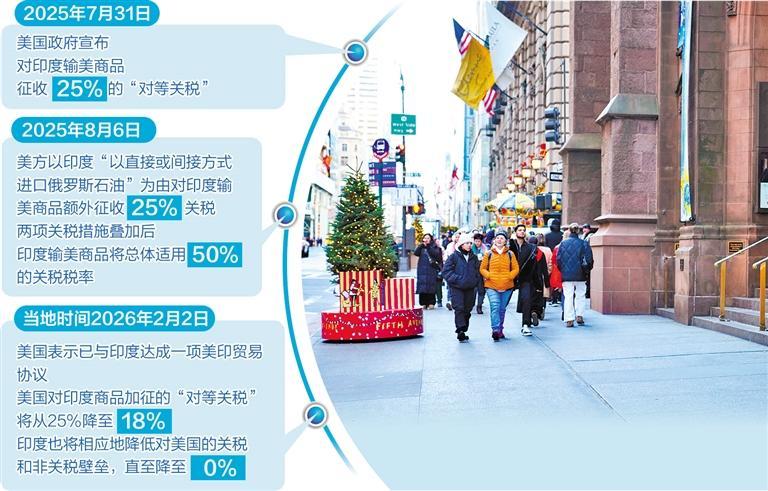
Core Viewpoint - The recent trade agreement between the United States and India marks a significant turning point in their long-standing trade negotiations, which have been fraught with tensions over tariffs and trade barriers since 2025 [3][4]. Group 1: Trade Agreement Details - The agreement includes a reduction of the "reciprocal tariff" imposed by the U.S. on Indian goods from 25% to 18%, while India will lower its tariffs and non-tariff barriers to zero [3]. - India has committed to significantly increasing its procurement of U.S. products, including over $500 billion worth of energy, technology, agricultural products, and coal [3]. Group 2: Historical Context and Negotiation Dynamics - Since 2025, U.S.-India trade talks have been overshadowed by U.S. threats to raise tariffs, leading to a breakdown in negotiations and heightened tensions [4][5]. - The U.S. initially imposed a 25% "reciprocal tariff" on Indian goods in July 2025, which was further exacerbated by additional tariffs related to India's oil imports from Russia, resulting in a total tariff rate of 50% on Indian exports to the U.S. [5][6]. Group 3: Economic Impact on India - The high tariffs have significantly impacted India's labor-intensive industries, such as textiles and jewelry, which employ millions and have faced substantial losses due to missed export opportunities [5][6]. - Indian exporters have been forced to establish subsidiaries in the U.S. to circumvent tariffs, and some have relocated production to countries with lower tax rates, such as the UAE [6]. Group 4: Future Considerations - The Indian government, under Prime Minister Modi, is under pressure to deliver economic benefits to the public ahead of the 2026 elections, necessitating a satisfactory agreement with the U.S. [7]. - Both countries must prepare for the finalization of the agreement and consider how the new trade dynamics will influence their respective economies moving forward [7].

养殖产业链日报:供需宽松-20251216
Guan Tong Qi Huo· 2025-12-16 11:17
Group 1: Report's Core View - The supply side of soybeans has significant supporting factors, but the demand side has weak recovery, with short - term prices in a volatile pattern and potential for further decline if import soybean near - month auction volume drops [1] - The selling pressure on corn prices is gradually decreasing, and after the loosening of the hoarding sentiment, the supply will increase and suppress short - term price increases, but the worst stage is over, and it's worth watching for buying opportunities around New Year's Day [1] - Egg prices are stabilizing, with short - term supply remaining loose and demand lacking highlights during the double - festival stocking period. There may be a chance of price recovery after the festival if there is over - culling, but short - term prices are expected to be volatile [2] - The pig - breeding industry has been in the capacity - reduction stage since July 2025. The supply is still loose at present, with large short - term supply pressure, but there is a possibility of price increase for far - month contracts after the Spring Festival [2] Group 2: Industry Situation Details Soybeans - On the supply side, large - scale buyers' purchase prices are rising steadily, the purchase price of China Grain Reserves Corporation provides a bottom support, farmers are reluctant to sell, and the supply of high - quality soybeans in the south is decreasing [1] - On the demand side, downstream consumption recovery is weak, the actual trading atmosphere has not improved with price trends, and enterprises in sales areas mainly replenish inventory based on rigid demand [1] Corn - The average sales progress in Northeast China is about 38% according to three - party data, with the fastest being 42% from the National Grain and Oil Information Center. Heilongjiang is at 50%, Jilin at 36%, Liaoning at 44%, and Inner Mongolia at 36% [1] Eggs - Egg spot prices are stabilizing, but the upward driving force is weakening as prices approach the cost line. Short - term supply is loose, demand during the double - festival stocking period is not prominent, and the overall number of culled chickens is still much higher than the same period in previous years [2] Pigs - Since July 2025, the pig - breeding industry has been reducing capacity. By the end of October, the national inventory of breeding sows dropped to 39.9 million, a month - on - month decline of 1.1%, and the capacity reduction accelerated in October [2] - The planned slaughter volume of large - scale enterprises in December increased by about 3.2% month - on - month, and the overall slaughter pressure is still large under the pessimistic industry expectation [2]
加央行鹰派立场成加元核心支撑
Jin Tou Wang· 2025-12-12 02:51
Core Viewpoint - The Canadian dollar (CAD) is experiencing a low-level fluctuation against the US dollar (USD), primarily due to the divergence in monetary policy between the Bank of Canada (BoC) and the Federal Reserve (Fed), alongside the resilience of the Canadian economy and support from rebounding oil prices [1][2]. Group 1: Monetary Policy and Economic Indicators - The Bank of Canada maintained its policy interest rate at 2.25% during the monetary policy meeting on December 10, indicating that the current rate is suitable for supporting structural economic transformation, marking the end of the rate-cutting cycle [1]. - Canada's GDP grew by 2.6% in Q3, significantly exceeding market expectations, and the unemployment rate fell to 6.5% in November, indicating improvements in the job market [1]. - The inflation rate in Canada was stable at 2.2% in October, remaining close to the 2% target, with core inflation between 2.5% and 3%, suggesting manageable inflationary pressures [2]. Group 2: US Monetary Policy and Market Impact - The Federal Reserve completed its third rate cut of the year on December 11, lowering the federal funds rate target range to 3.50%-3.75%, with internal dissent among officials indicating significant divisions [2]. - Fed Chairman Jerome Powell's comments on the downside risks to the US labor market have heightened expectations for further easing, contributing to a decline in the USD index below 99, which diminishes the dollar's attractiveness [2]. Group 3: Technical Analysis and Market Focus - The technical outlook for USD/CAD shows a bearish trend, with the price consistently trading below the five-day moving average and a lack of rebound momentum [3]. - Key support levels are identified at 1.3740 and 1.3680, with potential for further decline towards 1.3600 if these levels are breached [3]. - Market attention is expected to focus on statements from BoC and Fed officials, trade-related data, and international oil price movements, which are crucial for CAD as a commodity currency [3].
瑞士政府:作为回报,瑞士将降低从美国进口某些鱼类和农产品的关税。
Xin Lang Cai Jing· 2025-12-10 16:01
Group 1 - The Swiss government will lower tariffs on certain fish and agricultural products imported from the United States as a reciprocal measure [1]

美联储降息预期下降,商品有何影响
2025-11-26 14:15
Summary of Key Points from Conference Call Records Industry Overview - **Federal Reserve's Interest Rate Expectations**: The divergence in expectations regarding the Federal Reserve's interest rate cuts in December has increased, with dovish officials citing a weak labor market as support for cuts, while hawkish officials express concerns over inflation rebound, leading to increased policy uncertainty [1][3][4][5] - **Domestic Macro Economy**: The LPR remained unchanged in November, indicating that the central bank believes there is still room for monetary policy, but the marginal efficiency is declining, making further easing unlikely this year [1][7][8] Commodity Market Insights - **Black Commodities**: There is a significant divergence in the performance of black commodities. Coal and coke prices have dropped sharply, with coking coal down 9% and coke over 4%. In contrast, iron ore has shown relative strength, increasing by approximately 1.2% [1][9][12] - **Iron Ore Market**: Iron ore has performed better than other commodities recently, but with increased shipments and port arrivals, supply-demand conflicts may intensify, leading to potential price volatility in the short term [1][12] - **Precious Metals**: The precious metals market remains weak, with the gold-silver ratio hovering around 81. Factors such as internal divisions within the Federal Reserve and geopolitical tensions have limited upward momentum for gold [1][15] - **Oil Market**: The oil market is under pressure from a mid-term supply surplus, with IEA predicting continued oversupply in global oil markets this year and next, leading to a bearish outlook for oil prices [1][20] Specific Commodity Analysis - **Coking Coal and Coke**: The coking coal market is facing increased supply due to domestic production recovery and rising imports from Mongolia. The coke market is also under pressure, with limited price increases expected [1][13][14] - **Steel Market**: The rebar and hot-rolled coil markets are experiencing narrow fluctuations, with recent data showing improvements in both supply and demand, although overall market sentiment remains cautious [1][10][11] - **Nonferrous Metals**: The nonferrous metals market is generally weak, with copper prices expected to remain volatile but high. The aluminum market faces seasonal inventory increases, limiting upward price potential [1][17] - **New Energy Materials**: The polysilicon and industrial silicon markets are weak, while lithium carbonate prices have risen unexpectedly due to improved fundamentals, although risks of price declines remain [1][18][19] Additional Insights - **Market Sentiment**: The overall market sentiment is cautious due to mixed economic data and geopolitical uncertainties, impacting various commodity prices and investor strategies [1][6][17] - **Future Expectations**: The outlook for many commodities remains uncertain, with potential for volatility driven by supply-demand dynamics and macroeconomic factors [1][20][21][25]
海外高频 | 特朗普下调食品关税,高市早苗推出财政刺激草案 (申万宏观·赵伟团队)
Sou Hu Cai Jing· 2025-11-23 10:55
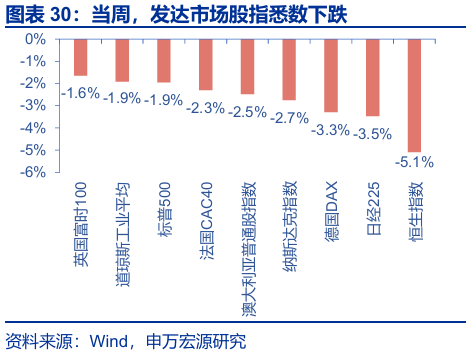
Group 1: Economic Policies and Stimulus - The U.S. announced a trade framework agreement with Argentina, Ecuador, Guatemala, and El Salvador to lower food tariffs, aiming to alleviate rising food prices due to tariffs and supply shocks [45][47] - Japan's government introduced a comprehensive economic stimulus plan worth 21.3 trillion yen, focusing on short-term subsidies, crisis management investments, and defense spending to boost GDP [64] Group 2: Market Performance - Major equity markets experienced declines, with the Hang Seng Technology Index down 7.2% and the Nasdaq down 2.7% [3][12] - The S&P 500 sectors showed mixed results, with communication services, healthcare, and consumer staples rising by 3.0%, 1.8%, and 0.8% respectively, while information technology and consumer discretionary fell by 4.7% and 3.3% [8] Group 3: Employment Data - The U.S. added 119,000 non-farm jobs in September, exceeding market expectations, but the unemployment rate rose to 4.4% [73]
15%关税!刚刚,美韩重大宣布!
券商中国· 2025-11-14 07:32
Core Viewpoint - The United States and South Korea have reached a comprehensive economic and security agreement, which includes significant investment plans from South Korea and major tariff reductions from the U.S. [2][4] Economic Agreement - South Korea will invest a total of $350 billion in the U.S., with $200 billion as cash investment and $150 billion allocated for shipbuilding projects [5] - The U.S. will reduce tariffs on South Korean automobiles, auto parts, wood, and wood products under Section 232 from 25% to 15% [5][6] - South Korea has committed to providing $33 billion in comprehensive support for U.S. troops stationed in South Korea [5] Defense Cooperation - South Korea will build nuclear-powered submarines with U.S. authorization, and plans to purchase $25 billion worth of U.S. military equipment by 2030 [4][7] - The defense spending of South Korea is set to increase to 3.5% of GDP [4] Trade Relations - South Korea will lift the import limit on 50,000 unmodified U.S. cars and work with the U.S. to address non-tariff barriers affecting food and agricultural trade [5] - The agreement aims to stabilize the foreign exchange market and prevent market instability due to the commitments made [5][6] Market Impact - The announcement led to a significant appreciation of the South Korean won, with the dollar dropping over 1% against the won [2][6] - Analysts suggest that the reduction in tariffs will alleviate downward risks for the South Korean automotive industry, which heavily relies on U.S. demand [6]