
绿色金属

Search documents
关键词 新旧背离
Qi Huo Ri Bao Wang· 2026-02-11 01:37
Group 1 - The core change in the commodity market is the divergence between "green metals" (copper, lithium, nickel) and traditional energy sources (crude oil, coal), with the former experiencing a tight balance of "rigid supply + explosive demand" and the latter facing "loose supply + slowing demand" [1] - The structural differentiation in the market is driven by global carbon neutrality goals, which have increased the demand for "green metals" while exploration and development of these resources are severely insufficient, with capacity release cycles lasting 5 to 10 years [1] - The current global macroeconomic environment resembles a recovery phase rather than an overheating phase, with commodity performance driven by demand growth from the AI technology revolution rather than traditional economic overheating [2] Group 2 - The mechanism of commodity rotation has changed significantly, with global supply chains shifting from "efficiency-first" globalization to "security-first" regionalization, where resource country policies are becoming price-dominant factors [2] - Examples include Indonesia's nickel and tin export restrictions, frequent policy adjustments in Chile's copper mines, and nationalization efforts in Bolivia and Ecuador for lithium, all of which are altering traditional supply-demand dynamics [2] - The transfer of China's processing capacity to Southeast Asia and the Middle East, along with the push for "domestic manufacturing" in the US, is creating a regional supply-demand closed loop, leading to increased price volatility and independent regional characteristics [2]
机构观点“多空对决”,会影响有色金属后续的投资逻辑吗?
Sou Hu Cai Jing· 2026-01-26 01:00
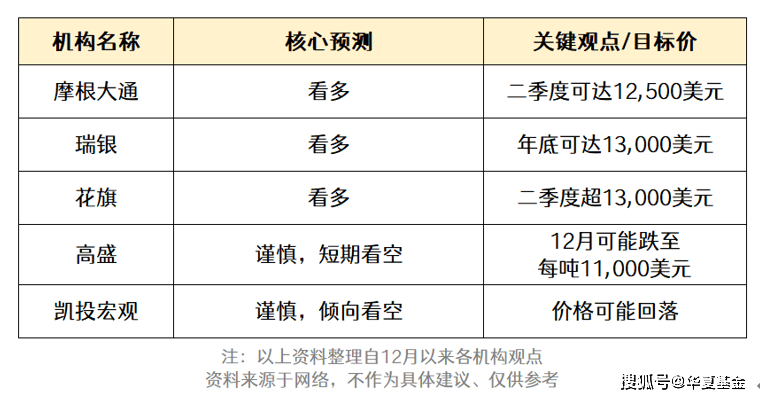
Core Viewpoint - The recent divergence in views among international investment banks regarding copper prices indicates a potential volatility in the non-ferrous metal sector, with some institutions optimistic while others express caution [1][2]. Group 1: Institutional Predictions - Morgan Stanley predicts a bullish outlook for copper, forecasting a price of $12,500 per ton by Q2 [2] - UBS shares a similar optimistic view, projecting a year-end price of $13,000 [2] - Citigroup also maintains a positive stance, expecting prices to exceed $13,000 in Q2 [2] - Conversely, Goldman Sachs advises caution, suggesting a potential drop to $11,000 per ton in December [2] - Capital Economics leans towards a bearish outlook, indicating a possible price decline [2] Group 2: Price Trends and Market Dynamics - Copper prices surged from $11,000 in early December to over $13,300, surpassing some optimistic forecasts [3] - Goldman Sachs warns that the current high prices have attracted speculative investments, which may suppress short-term actual consumption [5] - The speculative enthusiasm for copper is linked to concerns over potential tariffs following the U.S. Section 232 investigation, which led to significant imports of refined copper [6] Group 3: Long-term Demand Drivers - The fundamental narrative supporting copper prices revolves around its role as a "green metal" and "AI metal," driven by global infrastructure upgrades, electric vehicle adoption, and AI data center construction [7] - The ongoing demand for copper is expected to remain strong, as long as the underlying growth story persists [7] - The non-ferrous metal ETF funds track A-share listed companies rather than futures prices, meaning the performance of mining and refining companies will directly benefit from rising copper prices [7][8] Group 4: Investment Considerations - The non-ferrous metal ETF fund tracks a diversified index, with copper comprising 33% of the index, followed by aluminum and gold, indicating a balanced exposure to various metals [8] - Given the current global economic landscape and rising risk aversion, the non-ferrous metal ETF fund is expected to maintain a strong investment rationale throughout the year [8]

贵金属涨势无法阻挡,白银创纪录暴涨压垮金银比?
Sou Hu Cai Jing· 2026-01-21 08:11
Core Viewpoint - Precious metals have experienced a significant surge since the beginning of the year, with silver outperforming gold, reaching a historical high of over $94, and increasing more than twofold compared to the same period last year [1] Group 1: Silver and Gold Market Dynamics - The gold-silver ratio, which indicates how many ounces of silver are needed to purchase one ounce of gold, is currently around 50, suggesting that silver is in a strong position relative to gold [3] - A rising gold-silver ratio typically indicates strong market risk aversion or pessimism about economic prospects, while a declining ratio suggests increased market risk appetite and optimism about economic growth [4][5] Group 2: Factors Supporting Silver's Price Increase - The narrative of silver as a "green metal" continues, driven by long-term structural demand from sectors like photovoltaics, providing growth momentum that gold does not possess [7] - Historical data shows that the gold-silver ratio has the potential to decrease further, with extreme bull market periods seeing the ratio drop below 30, indicating room for continued compression [7] Group 3: Price Projections and Market Sentiment - In a bullish scenario, silver prices could exceed $120, but the current rapid increase may be driven by short-term speculation, which could lead to a significant correction if profit-taking occurs [9] - The influx of funds into precious metals may be weakening as investors assess the duration of supply constraints, and rising silver prices could impact its industrial applications, prompting companies to seek alternatives [9]
战略性矿产系列报告:锗:供需收敛,半导体等需求打造第二增长曲线
Minmetals Securities· 2025-08-22 07:13
Investment Rating - The report rates the bismuth industry as "Positive" [4] Core Insights - Short-term bismuth supply and demand are in a weak balance, with tight raw material supply supporting high prices, but weak exports and high inventory levels limit recovery space, leading to a potential price fluctuation in the short term. In the medium to long term, domestic environmental regulations will tighten, maintaining a tight supply of smelting raw materials, with supply growth expected to be only 2-4%. Meanwhile, demand from electronics, photovoltaic solder, and semiconductor thermoelectric materials is expected to grow at 8-10%, leading to a gradual convergence of supply surplus and a balanced state in the next 2-3 years [1][2][3]. Supply Side - China dominates global bismuth supply, accounting for 75% of the 23,940 tons produced in 2023. The expansion of production capacity is constrained by raw material shortages, with supply growth expected to be around 2-4% [2][25][26]. - The supply of refined bismuth is limited due to a continuous shortage of raw materials, particularly bismuth ore and recycling materials from lead and copper production. Current visible inventory levels are decreasing, indicating reduced inventory pressure [26][28]. Demand Side - Domestic bismuth consumption remains focused on traditional sectors, but high-tech demand from semiconductors and renewable energy is creating a second growth curve for bismuth. Overall consumption has been stable, with significant growth expected in electronics and semiconductors [2][31][34]. - China is the largest exporter of bismuth, with over 60% of bismuth metal used for export. Long-term export volumes are expected to return to normal levels, with a shift from metal bismuth to bismuth oxide exports [34]. Industry Development Trends - The bismuth industry is transitioning towards high-value-added products, with a focus on high-purity bismuth and advanced bismuth-based materials. There is a notable technological gap compared to Europe, the US, and Japan in high-end bismuth products [3][19]. - The report highlights the potential applications of bismuth in superconductors, nuclear reactor coolants, and electronic devices, indicating a strong future demand in high-tech fields [36][41][42].


