股债关系

Search documents
固收-时代-股票震荡的风会吹进债市-避风港-吗
2026-03-24 01:27
Summary of Conference Call Notes Industry Overview - The notes primarily discuss the bond market dynamics in the context of the equity market fluctuations and the impact of geopolitical events, particularly in the Middle East, on market sentiment and performance. Key Points and Arguments Changes in Stock-Bond Relationship - The relationship between stocks and bonds has undergone significant changes in 2026, necessitating a reevaluation of traditional analysis frameworks. The overlap between stock and bond investors is increasing, particularly due to the rise of "fixed income plus" products, which have seen rapid growth since the second half of 2025. This shift indicates that when "fixed income plus" funds face outflows, they may exert pressure on both stock and bond markets [2][3][4]. Bond Market Pressures - The bond market is expected to face pressure until mid-April 2026, with potential opportunities for buying in the second quarter. The anticipated selling pressure may come from the 5-10 year policy financial bonds and secondary capital bonds, which could be sold off to avoid losses in equity positions [1][2][3]. Inflation and Economic Recovery - Input inflation and endogenous economic recovery are compressing the bond market's trading window. Short-term inflation expectations are likely to rise, impacting the Producer Price Index (PPI) and Consumer Price Index (CPI), which will create pressure on the bond market. The market is expected to face upward interest rate expectations in both the short and long term [3][4]. Credit Bond ETF Market Dynamics - The credit bond ETF market has seen a significant decline in scale, with the Sci-Tech bond ETF and benchmark rate bond ETF dropping by approximately 90 billion and 27 billion respectively. This decline is attributed to a rapid growth effect at the end of 2025 and a weakening profit effect for credit bond ETFs [4][5]. Market Adjustments and Strategies - The recent adjustments in the A-share and convertible bond markets are primarily due to geopolitical tensions in the Middle East, leading to a decline in the Shanghai Composite Index by 3.38%, falling below 4,000 points. The market is expected to exhibit high volatility and structural rotation, with a focus on sectors supported by performance, such as technology and energy [6][7][8]. Investment Strategies - In the current uncertain environment, a "steady progress" investment strategy is recommended, focusing on managing positions and waiting for valuation pressures to ease. Key strategies include: - Core positions in "double low" convertible bonds with relatively low prices and premium rates. - Elastic positions in equity-type convertible bonds with compressed premium rates to capture rebounds when conditions improve. - Investment themes centered around energy transition and technology sectors that are less affected by rising oil prices [8]. Other Important Insights - The bond market's core focus has shifted from the performance of equities to whether equity movements indicate rising prices or financing demands. The negative impact of rising energy prices on the bond market is expected to be more pronounced than before [2][3]. - The market's sensitivity to geopolitical events is anticipated to decrease over time, with a return to fundamental-driven pricing logic as the Chinese economy remains relatively stable [8].
国泰海通 · 晨报260324|固收、农业、汽车
国泰海通证券研究· 2026-03-23 14:05
Fixed Income - The relationship between stocks and bonds has shown new changes since 2026, particularly due to shifts in investor structure and inflation expectations, indicating a potential for short-term co-movement under volatile conditions [2] - The expansion of fixed income + products in 2025, especially the significant increase in secondary bond funds, suggests a rising proportion of funds holding both bond and equity positions, leading to a more consistent marginal funding source for both ends [2] - In the context of strong equity markets, the pressure of "strong stocks, weak bonds" may re-emerge, particularly if the financial sector strengthens, while different themes in equity markets can have varying impacts on the bond market [3] - Geopolitical conflicts primarily influence the stock-bond relationship through rising oil prices and inflation expectations, which can weaken the stability of bonds as a safe haven [3] - Despite short-term pressures on the bond market, particularly on long-duration and highly traded varieties, the overall medium to long-term outlook remains supported by allocation forces and policy environment [4] Agriculture - The ongoing conflicts in the Middle East are expected to drive an upward trend in agricultural products, with rising energy prices enhancing the economic viability of biodiesel and increasing demand for vegetable oil raw materials [9] - Recent price increases in international soybeans, soybean meal, and soybean oil indicate a bullish outlook for grain prices, benefiting planting companies and agricultural processing firms [9] Pets - The appreciation of the RMB may impact the profitability of some companies' export businesses, but those with overseas production capacity and order growth are likely to see performance gains [10] - The domestic pet market is experiencing rapid growth, highlighted by recent large pet exhibitions in cities like Beijing and Shenzhen, indicating a robust development trend in the industry [10] Livestock - Current trends show a decline in pig prices below 10 CNY/kg, with expectations for continued price drops and rising costs due to higher prices for corn and other agricultural products, complicating the cost structure for the livestock industry [11]


固收加时代,股市震荡的风会吹进债市“避风港”吗
GUOTAI HAITONG SECURITIES· 2026-03-22 08:57
1. Report Industry Investment Rating No information provided in the report. 2. Core Viewpoints of the Report - The stock - bond relationship in 2026 shows new changes, which is still weakly correlated overall, but the situation of stock - bond co - pressure has increased. There are three new clues: the marginal change of fixed - income plus funds, the switching of equity main lines, and the disturbance of easing expectations [4][7][8]. - In the medium and long term, the bond market is still supported by allocation power and the policy environment, but in the short term, the ultra - long end and highly tradable varieties of the bond market may show positive correlation with stocks and be under pressure together with equities, and may also create "opportunities from falls" for the bond market in the medium term [4][32]. 3. Summary by Directory 2026 Stock - Bond Relationship New Trends - In 2026, the stock - bond relationship remains in a weakly correlated range, and the bond market moves along its own pricing main line. Before the Spring Festival in early 2026, the bond market was "desensitized" to the stock market. Recently, under the background of equity shocks, the stock - bond relationship shows a weak positive correlation, and the hedging property of bonds is not as stable as before [7][8]. Fixed - Income Plus Fund Structure Evolution, Equity Volatility Leading to Portfolio Rebalancing - In 2025, fixed - income plus products expanded significantly, with incremental funds mainly concentrated in secondary bond funds. The proportion of funds holding both bond positions and equity positions increased, making the marginal capital sources of stocks and bonds more consistent. Equity fluctuations can be directly transmitted to the bond market through net value retracement, redemption pressure, and rebalancing behavior [9]. - During the equity adjustment in November 2015 and February 2026, and after the outbreak of the US - Israel - Iran conflict, fixed - income plus products sold bonds. When facing redemption, the selling pressure on bonds shows the order of "high - liquidity first, low - liquidity later; trading positions first, allocation positions later" [12][13]. Under the Weak Correlation Pattern, Which Equity Signals Are More Worthy of Attention for Bond Investors - Different equity sectors have different impacts on the bond market. Since 2026, the positive correlation between growth, cyclical, and some stable - style sectors and the bond market has increased, while the financial sector shows a weak negative correlation [19]. - The relationship between sectors and the bond market depends on the trading main line. When growth is trading risk preference and equity profit - making effect, and cyclical is trading total repair and nominal growth increase, they are more negative for the bond market. When growth corresponds to structural prosperity in a low - interest - rate environment and cyclical reflects commodity, supply disturbances, and external shocks, they may be driven by the same macro main line as the bond market [22]. - Financial sector strength often means re - trading of credit expansion, policy efforts, and nominal growth repair, increasing the pressure of the traditional "strong stocks, weak bonds". If growth and cyclical sectors dominate the fluctuations, it is necessary to distinguish whether they correspond to structural prosperity in a low - interest - rate environment or re - inflation trading caused by rising commodity prices, supply disturbances, and geopolitical conflicts [27]. Re - inflation Trading: Why Is the Hedging Property of Bonds Unstable Periodically - Geopolitical conflicts affect the stock - bond relationship through oil price increases and imported inflation expectations, weakening the hedging stability of bonds from the fundamental and policy expectation levels. Once the market trades the concern about policy constraints due to imported inflation, especially when combined with month - end capital fluctuations or central bank net capital withdrawal, it is more likely to form a short - term cautious expectation of monetary policy, suppressing the bond market [28]. - The re - inflation expectation has been reflected in the data. The PPI环比 in February reached 0.4%, a four - year high, showing signs of imported inflation. The bond market is more sensitive to such shocks than before, and geopolitical conflicts may make the hedging property of bonds more unstable [28][30]. The Safe Haven May Have Ripples, but Long - Term Investors Need Not Fear Temporary Waves - In the short term, the bond market may show a certain positive correlation with stocks and needs to be vigilant against external shocks. From the end of the month to before the release of next month's PPI, the bond market may face pressure, especially high - liquidity varieties such as 30 - year treasury bonds, long - term policy financial bonds, and long - term Tier 2 capital bonds [32]. - If the subsequent adjustment leads to an increase in yields, it should be regarded as a mid - term re - layout window. After the quarter - end, if the capital situation eases, external shocks do not escalate, and re - inflation expectations do not strengthen, grid - adding strategies can be used to participate in high - liquidity varieties affected by the shock [32].
基本功 | 股市涨了,债市一定会跌吗?
中泰证券资管· 2025-08-21 11:33
Group 1 - The core idea emphasizes the importance of foundational knowledge in investment and fund selection, suggesting that solid fundamentals are crucial for successful investing [2] - The article discusses the relationship between stock and bond markets, clarifying that it is not a strict rule that when the stock market rises, the bond market must fall; both can experience simultaneous movements [3] Group 2 - The content encourages readers to engage with a dedicated section on foundational investment knowledge, indicating a resource for further learning [7]

机构称股市走牛对债市的影响预计将减弱,公司债ETF回撤稳定可控备受关注
Sou Hu Cai Jing· 2025-08-21 02:01
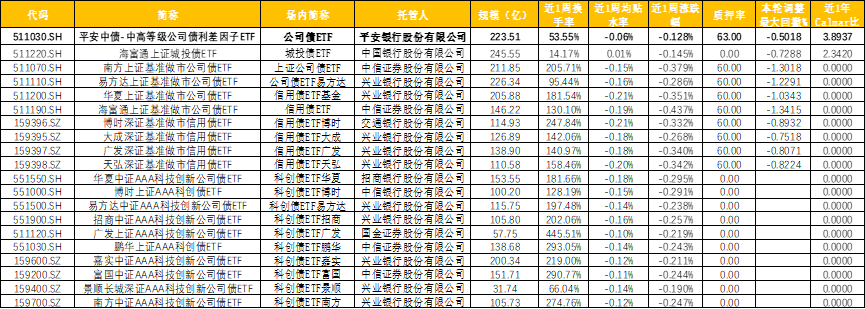
Core Viewpoint - The bond market is significantly influenced by the stock market, particularly in a stock bull market driven by funds, while an economic recovery-driven stock bull market may lead to a bond bear market [1] Group 1: Market Dynamics - The current bond fund net purchases of ultra-long-term bonds have decreased to 84.4 billion, down approximately 90 billion from its peak [1] - Since July 1, broker proprietary trading has net sold ultra-long-term bonds by nearly 120 billion [1] - The duration of both bond funds and broker proprietary trading has significantly decreased, indicating a potential future demand for extending duration [1] Group 2: Economic Indicators - The 10-year yield has reached a new high, while the overall A-share market has also hit a historical peak, although trading volume has slightly declined [1] - The future influence of the stock market on the bond market is expected to diminish as the duration of broker proprietary trading and bond funds decreases, ultimately returning to fundamentals [1] Group 3: Investment Outlook - The forecast for the second half of the year for the 10-year government bond yield is between 1.6% and 1.8%, with a bullish outlook due to factors such as central bank easing, adjustment benefits for banks, and rising economic downward pressure [1] - Investors are encouraged to value 5-year capital bonds and 30-year government bonds with yields above 2% [1] Group 4: ETF Performance - The Ping An Company Bond ETF (511030) has shown the best performance in terms of drawdown control during the current bond market adjustment, with a relatively stable net value [1] - A table of various ETFs is provided, showing their scale, recent performance, and maximum drawdown, indicating the varying performance of different bond ETFs [1]