负加工费

Search documents
有色金属行业深度研究:求“铜”存异,负加工费时代的铜冶炼企业
Lian He Zi Xin· 2025-12-17 11:10
Investment Rating - The report indicates a challenging environment for copper smelting enterprises, particularly in China, as they enter a "negative processing fee" era, which significantly impacts profitability [2][6]. Core Insights - The copper smelting industry is undergoing profound changes due to structural imbalances caused by "tight supply at the mine end" and "expansion of smelting capacity" [2]. - Leading enterprises are adapting by enhancing resource self-sufficiency, exploring the value of by-products, optimizing technology for efficiency and cost reduction, flexibly using financial tools, and promoting industry consolidation to build new competitive advantages [2]. - Long-term growth is anticipated as demand for materials from new energy and high-end manufacturing continues to rise, transitioning the copper smelting industry from a "strong cyclical attribute" to a "growth attribute" for high-quality development [2]. Summary by Sections Industry Overview - Copper is one of the earliest metals recognized and used by humans, with extensive applications due to its excellent conductivity, thermal properties, ductility, and corrosion resistance [4]. - The copper industry chain can be divided into upstream mining, midstream smelting, and downstream processing, ultimately reaching the end consumer market [4]. Current Market Dynamics - China, as the largest refined copper producer, faces a significant resource shortage, heavily relying on imported mineral resources, a situation expected to persist in the short term [6]. - In 2024, China's copper ore production is projected to decline by 11% to approximately 1.8 million tons, while refined copper production is expected to increase by over 5% to 13.64 million tons, contributing to about 50% of global output [6]. - The import volume of copper ore and concentrates is anticipated to rise to 28.11 million tons in 2024, with a self-sufficiency rate of only 13% for domestic copper concentrate [6]. Processing Fee Trends - The pricing logic for imported copper concentrates is based on the LME spot average price minus processing fees (TC/RC), which directly reflects the relationship between mines and smelters [7]. - Since the end of Q3 2023, the global copper concentrate market has experienced a structural shift, with TC/RC entering a downward trend, reaching a historical low of negative $40 per dry ton by 2025 [7][8]. - The decline in processing fees is a direct manifestation of the structural imbalance between tight raw material supply and expanded smelting capacity, severely weakening the bargaining power of Chinese copper smelting enterprises [7]. Profitability Analysis - The profitability of smelting enterprises is primarily derived from processing fees, recovery rates, and by-product sales, with processing fees historically being a crucial profit source [10]. - The report illustrates the impact of processing fee declines on profitability, showing scenarios where negative processing fees lead to significant losses for smelting enterprises [11]. - The long-term low processing fees may result in substantial losses for copper smelting enterprises, prompting potential production adjustments and accelerating industry consolidation [11]. By-Product Revenue - By-products such as sulfuric acid and precious metals significantly contribute to the profitability of copper smelting enterprises, with sulfuric acid prices remaining high and enhancing profit margins [17][19]. - The extraction of precious metals from copper anode mud has become economically valuable, with recovery rates exceeding 98% [18][19]. Technological and Cost Efficiency - Continuous technological advancements in smelting processes have positioned leading enterprises at the forefront of global standards, enhancing recovery rates and reducing costs [21][23]. - Scale production helps lower fixed costs, and effective cost control measures have been implemented by major enterprises [23]. Strategic Outlook - The report emphasizes the need for copper smelting enterprises to adapt to the negative processing fee environment by securing upstream resources, maintaining by-product profitability, and leveraging technological advancements [31]. - The strategic importance of copper is expected to grow with global energy transitions and industrial upgrades, presenting opportunities for enterprises that successfully navigate the current challenges [31].
“铜博士”创新高!矿商“狮子大开口”,供应链警报或拉响
第一财经· 2025-11-29 02:23
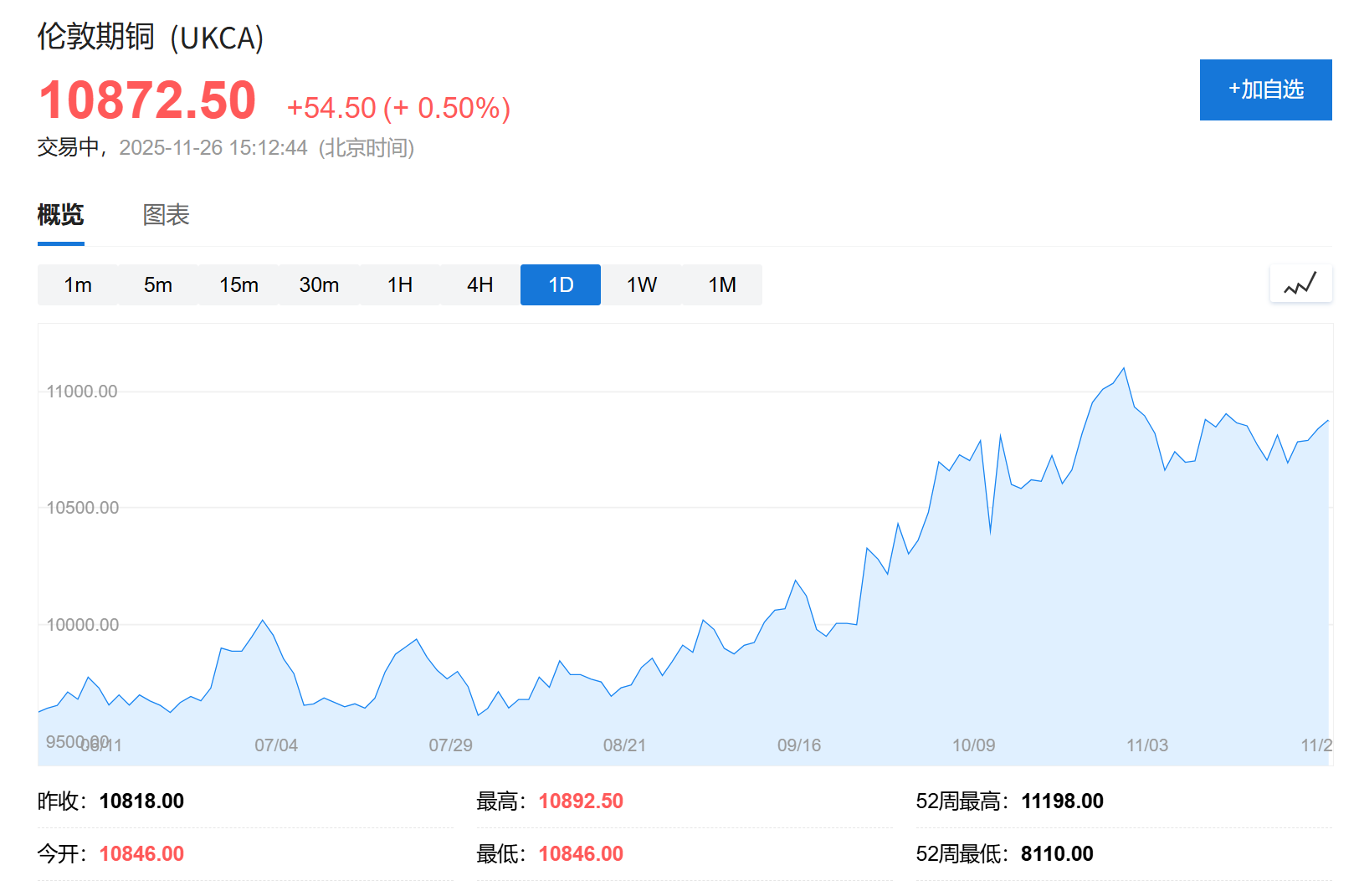
Core Viewpoint - The article highlights a significant surge in copper prices, driven by supply shortages and geopolitical factors, with expectations of continued price increases in the coming years due to structural supply constraints and rising demand [3][4][5]. Supply and Demand Dynamics - Copper futures on the London Metal Exchange (LME) rose over 4%, surpassing $11,200, marking a historical high due to supply shortages and expectations of increased demand [3][4]. - The current copper supply chain is experiencing a historic tightness, influenced by mining accidents in Indonesia and Chile, leading to a shift in pricing power back to miners [4]. - Miners are pushing for record low processing fees from smelters, with some companies like Aurubis AG refusing to accept excessively low fees, indicating a potential conflict in pricing negotiations [4][5]. Geopolitical Influences - U.S. tariffs are impacting market dynamics, with Codelco's premiums for U.S. market prices reaching historical highs, reflecting supply-demand fundamentals and additional costs [5]. - The expectation of continued refined copper flowing to the U.S. market due to tariff policies could exacerbate shortages in other regions, with predictions that U.S. copper inventories may account for 90% of global stocks [5][6]. Price Forecasts - UBS has raised its copper price forecasts for 2026, predicting prices to reach $11,500 per ton by March and $12,500 by December, driven by ongoing supply risks and declining inventories [8][9]. - The anticipated copper market deficit is expected to grow significantly, with projections of a 230,000-ton deficit in 2025 and nearly doubling to 407,000 tons in 2026 [9][10]. - Goldman Sachs projects a long-term copper price of $15,000 per ton by 2035, citing resource limitations and increasing demand in key sectors as primary drivers [10]. Demand Growth - Global copper demand is expected to maintain a growth rate of 2.8% in the coming years, supported by sectors such as electric vehicles, renewable energy, and data centers [10].


“铜博士”创新高!矿商“狮子大开口” 供应链警报或拉响
Di Yi Cai Jing· 2025-11-29 01:00
Core Viewpoint - LME copper futures surged over 4%, surpassing $11,200, reaching a historical high due to supply shortages and expectations of a weaker dollar from potential Fed rate cuts [2][3] Group 1: Supply and Demand Dynamics - The rise in futures prices reflects expectations of copper shortages, driven by supply disruptions from mining accidents in Indonesia and Chile, alongside accelerating demand growth in the coming years [3] - The current copper supply chain is experiencing a historic tightness, with miners regaining pricing power after years of expanded smelting capacity [3] - Negotiations during a recent industry conference in Shanghai were intense, with miners pressuring smelters to accept record-low processing fees [3] Group 2: Pricing and Market Impact - Codelco's pricing for the U.S. market has reached a premium of over $500 per ton, a historical high, reflecting supply-demand fundamentals and additional costs [4] - Codelco's premiums for Chinese buyers have surged to $350 per ton, significantly higher than previously agreed prices, indicating market concerns over potential copper shortages [4] - Predictions suggest that U.S. copper imports may approach record levels, with U.S. inventories potentially accounting for 90% of global copper stocks, exacerbating shortages elsewhere [5] Group 3: Future Price Expectations - UBS has raised its copper price forecasts for 2026, anticipating prices to reach $11,500 per ton by March and $13,000 by December, driven by ongoing supply risks and declining inventories [6] - The copper market is expected to face significant deficits, with projected shortfalls of 230,000 tons in 2025 and nearly 407,000 tons in 2026, much higher than previous estimates [7] - Long-term forecasts from Goldman Sachs suggest copper prices could reach $15,000 per ton by 2035 due to resource constraints and increasing demand in key sectors [7]


“铜博士”创新高!矿商“狮子大开口”,供应链警报或拉响
Di Yi Cai Jing· 2025-11-29 00:49
Core Viewpoint - The copper market is experiencing significant price increases due to supply shortages and geopolitical factors, particularly U.S. tariffs, which are impacting pricing dynamics and supply chains [1][4][5]. Group 1: Market Dynamics - LME copper futures surged over 4%, reaching a historical high of over $11,200, driven by Fed rate cut expectations and supply shortages [1]. - Mining companies are exerting pricing power, with reports indicating that miners are demanding record low processing fees from smelters, reflecting a tight supply chain [3][4]. - Codelco's pricing for the U.S. market has reached a premium of over $500 per ton, indicating heightened supply chain costs and demand concerns [4][5]. Group 2: Supply Chain Concerns - The copper supply chain is in a historically tight phase, exacerbated by mining accidents in Indonesia and Chile, leading to increased demand forecasts [3]. - The U.S. is expected to absorb a significant portion of global copper supplies, potentially holding 90% of global copper inventories by early next year, which could create shortages in other markets [5]. Group 3: Price Forecasts - UBS has raised its copper price forecasts for 2026, predicting prices to reach $11,500 per ton by March and $13,000 by December, driven by ongoing supply risks and declining inventories [6][7]. - The copper market is expected to face a significant supply gap, with UBS projecting a shortfall of 230,000 tons in 2025 and 407,000 tons in 2026, a substantial increase from previous estimates [7]. - Long-term forecasts from Goldman Sachs suggest copper prices could reach $15,000 per ton by 2035 due to resource constraints and increasing demand in key sectors [8].

铜供应“史上最紧张”!金属溢价飙至纪录,伦铜创历史新高
Hua Er Jie Jian Wen· 2025-11-28 16:26
Core Viewpoint - The global copper market is experiencing unprecedented supply chain tensions, driven by fierce negotiations between miners and smelters, tariff expectations from the U.S., and record metal premiums, leading to copper prices reaching new highs [1]. Group 1: Copper Price Surge - As of October 28, copper prices on the London Metal Exchange (LME) surged to approximately $11,210 per ton, marking a historical intraday high with a daily increase of 2.5% [1]. - If the closing price maintains a rise of around 2.2%, it is expected to set a new closing record, surpassing the previous high from a month ago [1]. Group 2: Supply Chain Tensions - The copper supply chain is under extreme pressure, with miners pushing for record low processing fees during intense negotiations with smelters at an industry conference in Shanghai [1][3]. - The annual premium for refined copper shipped to China has reached a historical high, reflecting the tight supply situation [1]. Group 3: Global Impact of Negotiations - The negotiations between miners and smelters are unusually intense, with German smelting company Aurubis AG's executives expressing readiness to reject excessively low annual processing fee benchmarks [2][3]. - The ongoing conflict over processing fees has led to a stalemate, with some participants potentially withdrawing from the established pricing system [3]. Group 4: U.S. Market Dynamics - There is an expectation that a significant amount of refined copper will flow to the U.S., with projections indicating that by Q1 2026, the U.S. could hold 90% of the global copper inventory [4]. - Codelco, the largest copper producer, has offered record premiums of $350 per ton to certain Chinese customers, significantly higher than the previously agreed $89, indicating a shift in supply dynamics [4]. Group 5: Currency Influence - The weakening of the U.S. dollar, driven by expectations of further monetary easing by the Federal Reserve, is providing additional support for copper prices [6]. - A declining dollar reduces procurement costs for overseas buyers, further bolstering metal prices amid supply disruptions and policy-driven buying [6].
"倒贴钱"加工铜精矿?中国有色金属工业协会:坚决反对行业非理性行为
Hua Er Jie Jian Wen· 2025-11-26 12:05
Core Points - The Chinese Nonferrous Metals Industry Association has publicly opposed the phenomenon of zero or negative processing fees in the copper smelting industry, calling it a "structural contradiction" that is unsustainable for the global copper industry [1][2] - China is taking measures to manage copper smelting capacity by halting approximately 2 million tons of illegal capacity to curb overexpansion, drawing lessons from the aluminum industry [2] - The processing and refining fees (TC/RC) have dropped to historical lows due to a structural imbalance between raw material shortages and excess smelting capacity, with spot processing fees even reaching negative $60 per ton [2] Industry Response - The association's vice president, Chen Xuesen, emphasized the harmful effects of negative processing fees on the global copper smelting industry and urged cooperation among relevant countries and stakeholders [1][2] - The current market conditions have led to concerns about the sustainability of the industry, with major companies like JX Advanced Metals and Glencore facing operational challenges due to low processing fees [2] - The upcoming long-term contract negotiations for 2026 are expected to address the need for a more sustainable pricing mechanism, with a cautious outlook from analysts regarding the potential for significant changes in the short term [5]

中色协明确表态反对铜冶炼行业出现的零加工费或负加工费现象
Hua Er Jie Jian Wen· 2025-11-26 08:17
Core Viewpoint - The China Nonferrous Metals Industry Association has expressed strong opposition to the phenomenon of zero or negative processing fees in the copper smelting industry, calling it an "unsustainable structural contradiction" that harms the interests of the global copper smelting sector, including China [1][2]. Industry Response - The association's vice president, Chen Xuesen, emphasized the dangers of negative processing fees, urging the global copper industry to confront this issue and promote cooperation among relevant countries and stakeholders [2]. Capacity Management - China is taking measures to manage copper smelting capacity by halting approximately 2 million tons of illegal capacity to curb excessive expansion, with these capacities either under construction or in planning stages [3]. Future Development - In the coming years, China will prioritize the development of new smelting capacity that utilizes scrap materials instead of importing copper concentrate, aiming to reduce reliance on imports and alleviate overcapacity pressures [4]. Market Dynamics - The decline in processing fees to historical lows is attributed to a structural imbalance between raw material shortages and excess smelting capacity, with spot processing fees dropping to extreme levels, raising concerns about industry sustainability [4]. - Global copper smelting companies are facing the impact of low processing fees, with companies like Japan's JX Advanced Metals announcing production cuts and Glencore's Mount Isa smelter receiving government support to maintain operations [4]. Long-term Negotiations - Analysts believe that the current pressure on processing fees is unlikely to change fundamentally in the short term, as the market awaits the upcoming 2026 long-term contract negotiations to establish a more sustainable pricing mechanism [7]. - The core issue of the negotiations will be whether the long-standing benchmark system can continue to be applicable, with expectations of further adjustments to the annual benchmark system and a shift towards more diverse and complex negotiation formats [7].