财政健康状况

Search documents
TMGM外汇平台:日本财政忧虑压过经济数据,日元承压走弱
Sou Hu Cai Jing· 2026-02-04 07:21
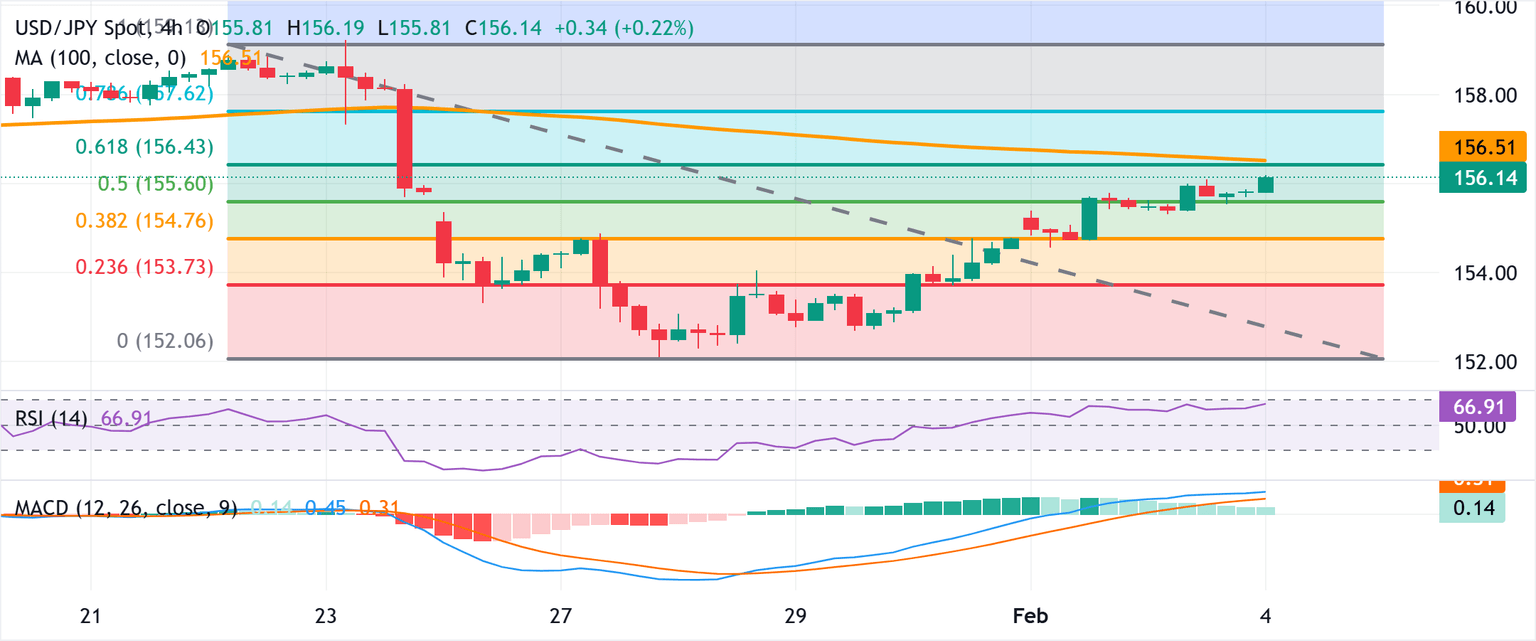
Group 1 - The Japanese yen continues to weaken against the US dollar, reaching a near two-week low, with the USD/JPY exchange rate surpassing the critical level of 156.00, influenced by multiple factors leading to a short-term tug-of-war in the market [1] - The core reason for the yen's persistent decline is centered on fiscal and political issues, with concerns over Japan's fiscal health due to expansionary spending and tax cuts initiated by the Prime Minister, exacerbating public finance pressure [1] - Despite a recovery in Japan's service sector, with the Jibun Bank services PMI rising to 53.7 in early 2026, the positive economic data has not reversed the yen's downward trend, as fiscal concerns dominate market reactions [1] Group 2 - The weak performance of the US dollar is limiting the upside potential of the USD/JPY exchange rate, as market expectations for two rate cuts by the Federal Reserve in 2026 have not attracted significant dollar buying [2] - Current market focus is on the upcoming ADP private sector employment report and ISM services PMI data, along with comments from Federal Reserve officials, which will further influence dollar demand and exchange rate movements [2] Group 3 - From a technical perspective, the short-term upward momentum of the USD/JPY has weakened, with the exchange rate breaking the 156.00 level, but the relative strength index is at 66.9, indicating it has not entered the overbought territory [4] - The MACD histogram shows a continuous contraction, indicating a slowdown in bullish momentum, with a key resistance level at 156.51 that needs to be breached to establish a short-term bullish outlook [4] - If the exchange rate fails to break through this resistance, a pullback may occur, with 157.62 identified as a significant resistance level for future upward movement [4]

市场担忧日本财政健康状况 日债价格下跌
Jin Rong Jie· 2026-01-14 01:58
Group 1 - Japanese government bond prices are declining due to ongoing market concerns about the country's fiscal health [1] - Market expectations of an upcoming early election in Japan are creating bearish trends for the yen and government bonds, while boosting the stock market [1] - Analysts suggest that if the ruling party's power is strengthened, it will lead to increased fiscal stimulus and corporate support policies, driving up long-term bond yields [1]
关键防线告急!日本国债现“崩盘”迹象,财长紧急喊话
Xin Lang Cai Jing· 2025-12-09 03:02
Core Viewpoint - Japan's government bonds are facing a sell-off due to concerns over fiscal health and expectations of interest rate hikes, with the 10-year yield reaching its highest level since 2006, around 2% [2][3][8]. Group 1: Market Monitoring and Government Response - Finance Minister Shunichi Suzuki stated that the government is closely monitoring market trends to manage government bonds effectively, avoiding comments on specific yield levels [3][8]. - The rise in yields is attributed to increasing worries about Japan's fiscal health and expectations that the Bank of Japan will continue to raise interest rates [3][10]. Group 2: Fiscal Policy and Economic Stimulus - The Japanese government has abandoned its goal of achieving a balanced annual budget after debt repayment, raising investor concerns about fiscal stability [5][10]. - Prime Minister Fumio Kishida has prepared a supplementary budget for economic stimulus, including the issuance of 11.7 trillion yen (approximately 75 billion USD) in new bonds, marking the largest spending since the easing of pandemic restrictions [6][10]. - Despite the additional spending, the government has managed to keep the total bond issuance for the fiscal year below last year's levels [6][10]. Group 3: Interest Rate Expectations - The expectation of rising interest rates has contributed to the increase in bond yields, with Bank of Japan Governor Kazuo Ueda indicating that a rate hike will be considered in the upcoming meeting [6][10]. - Traders believe there is over an 80% chance that the Bank of Japan will raise rates at the next policy meeting on December 19 [6][10]. - The Japan Business Federation's chairman described the 2% yield level as a critical milestone, urging the government to maintain market confidence in Japan's fiscal situation [6][10].
美股三大指数,全线下跌!原油跳涨
Zhong Guo Zheng Quan Bao· 2025-10-22 23:28
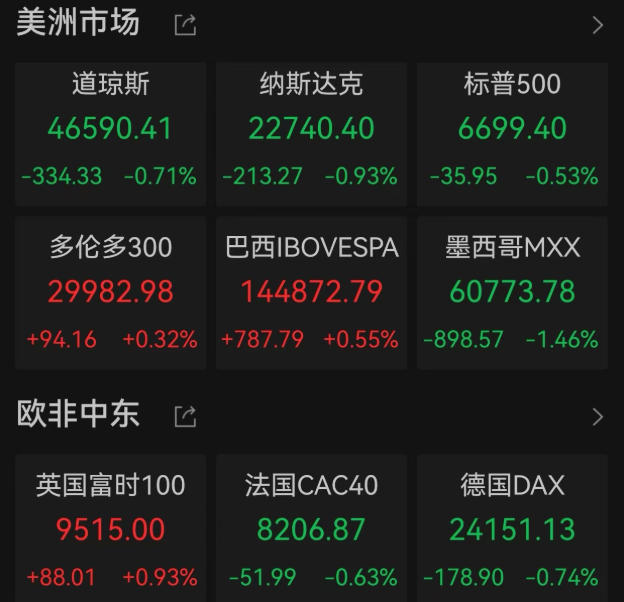
Market Overview - On October 22, US stock indices closed lower, with the Dow Jones Industrial Average dropping over 300 points, down 0.71% [2]. - The Nasdaq index fell 0.93%, and the S&P 500 index decreased by 0.53% [2]. - The US Tech Giants Index declined by 0.51%, with Amazon and Apple each falling over 1% [4]. Tesla Performance - Tesla's stock fell 0.82% and continued to decline in after-hours trading, dropping over 4% at one point [4]. - For Q3, Tesla reported revenue of $28.1 billion, exceeding the estimate of $26.36 billion, with an operating profit of $1.62 billion, slightly below the forecast of $1.65 billion [4]. - The company's gross margin for Q3 was reported at 18.0% [4]. Commodity Market - In the commodities market, international gold prices showed mixed trends, with London spot gold down 0.65% to $4,097.94 per ounce, while COMEX gold futures rose 0.18% to $4,116.60 per ounce [5]. - Oil prices surged, with Brent crude futures increasing over 4% and WTI crude futures rising more than 3% [8]. - Factors contributing to the rise in oil prices include changes in international trade dynamics, an unexpected decline in US crude oil inventories reported by the EIA, and plans by the US Energy Department to replenish the Strategic Petroleum Reserve [8]. Chinese Stocks - The Nasdaq Golden Dragon China Index fell by 0.93%, with notable declines in individual stocks such as Pony.ai dropping nearly 7% and Hesai Technology and JinkoSolar each falling over 5% [4]. European Market - European stock indices showed mixed results, with Germany's DAX down 0.74%, France's CAC40 down 0.63%, and the UK's FTSE 100 up 0.93% [4].

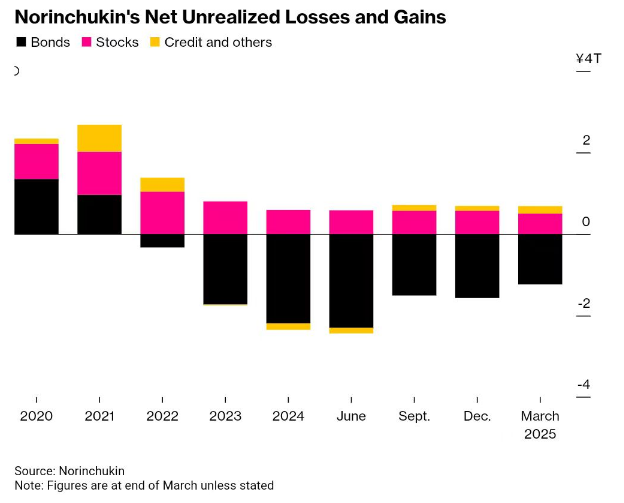
日本农林中央金库押注美债巨亏126亿美元 警示谨慎投资日本国债
Zhi Tong Cai Jing· 2025-05-22 09:36
Group 1 - Norinchukin Bank has adopted an "extremely cautious" stance towards purchasing Japanese government bonds due to significant losses from investments in US Treasuries [1][3] - The bank reported a loss of 1.8 trillion yen (approximately 12.6 billion USD) for the fiscal year ending in March, compared to a profit of 63.6 billion yen in the previous year [3] - The bank's unrealized bond losses were 1.24 trillion yen as of March 31, down from 2.2 trillion yen a year earlier [1][3] Group 2 - The new CEO Taro Kitabayashi is focused on rebuilding the bank's 40.3 trillion yen securities portfolio after the resignation of the former CEO due to the previous year's losses [3] - The bank is exploring other asset classes to include non-interest-sensitive assets in its investment portfolio, with investments in bonds, credit, and alternative assets [6] - The bank's holdings of mortgage-backed securities increased from 8.2 trillion yen to 8.3 trillion yen, accounting for 20% of its investment portfolio as of March 31 [6]