贸易投资壁垒

Search documents
瑞达期货螺纹钢产业链日报-20260326
Rui Da Qi Huo· 2026-03-26 09:17
1. Report Industry Investment Rating - Not mentioned in the report 2. Core Viewpoints of the Report - On Thursday, the RB2605 contract showed weak consolidation. The Ministry of Commerce identified that Mexico's measures of raising import tariff rates on products from non - free - trade partners like China constitute trade and investment barriers. In terms of supply and demand, the weekly output of rebar decreased, and the capacity utilization rate dropped to 43.37%. Downstream demand continued to increase, and inventory continued to decline. Overall, the apparent demand for rebar rebounded above 2.2 million tons, but due to the impact of low - price resources, it was difficult to sell at high prices. Traders resorted to bargaining and promotions to meet sales targets. Technically, the 1 - hour MACD indicator of the RB2605 contract showed that DIFF and DEA were adjusting downward. The view is for short - term trading with attention to risk control [2] 3. Summary by Relevant Catalogs 3.1 Futures Market - The closing price of the RB main contract was 3,128 yuan/ton, a decrease of 4 yuan; the position volume was 1,167,209 lots, a decrease of 40,108 lots; the net position of the top 20 in the RB contract was - 77,925 lots, a decrease of 1,639 lots; the RB5 - 10 contract spread was - 30 yuan/ton, unchanged; the RB warehouse receipt at the Shanghai Futures Exchange was 98,088 tons, an increase of 5,791 tons; the HC2605 - RB2605 contract spread was 177 yuan/ton, a decrease of 4 yuan [2] 3.2 Spot Market - The price of HRB400E 20MM in Hangzhou (theoretical weight) was 3,270 yuan/ton, unchanged; (actual weight) was 3,354 yuan/ton, unchanged; in Guangzhou (theoretical weight) was 3,450 yuan/ton, unchanged; in Tianjin (theoretical weight) was 3,200 yuan/ton, unchanged. The basis of the RB main contract was 142 yuan/ton, an increase of 4 yuan; the spot price difference between hot - rolled coil and rebar in Hangzhou was 50 yuan/ton, unchanged [2] 3.3 Upstream Situation - The price of 60.8% PB iron ore fines at Qingdao Port was 794 yuan/wet ton, a decrease of 1 yuan; the price of first - grade metallurgical coke at Tianjin Port (FOB) was 1,490 yuan/ton, unchanged; the price of 6 - 8mm scrap steel in Tangshan (tax - excluded) was 2,180 yuan/ton, unchanged; the price of Q235 billet in Hebei was 2,990 yuan/ton, unchanged. The inventory of iron ore at 45 ports was 171.0267 million tons, a decrease of 891,300 tons; the inventory of coke at sample coking plants was 523,500 tons, a decrease of 37,500 tons; the inventory of coke at sample steel mills was 6.8778 million tons, an increase of 160 tons; the inventory of billets in Tangshan was 2.3994 million tons, a decrease of 95,900 tons. The blast furnace operating rate of 247 steel mills was 79.80%, an increase of 1.44 percentage points; the blast furnace capacity utilization rate was 85.55%, an increase of 2.65 percentage points [2] 3.4 Industry Situation - The weekly output of rebar at sample steel mills was 1.9787 million tons, a decrease of 54,600 tons; the capacity utilization rate was 43.37%, a decrease of 1.20 percentage points. The inventory at sample steel mills was 2.1916 million tons, a decrease of 170,400 tons; the social inventory of rebar in 35 cities was 6.4275 million tons, a decrease of 104,600 tons. The operating rate of independent electric - arc furnace steel mills was 66.67%, an increase of 7.29 percentage points. The monthly output of domestic crude steel was 68.18 million tons, a decrease of 1.69 million tons; the monthly output of Chinese rebar was 13.75 million tons, an increase of 190,000 tons; the net export volume of steel was 747,000 tons, an increase of 18,000 tons [2] 3.5 Downstream Situation - The national real - estate climate index was 91.45, a decrease of 0.44; the cumulative year - on - year growth rate of fixed - asset investment was - 3.80%, a decrease of 5.60 percentage points; the cumulative year - on - year growth rate of real - estate development investment was - 17.20%, a decrease of 6.10 percentage points; the cumulative year - on - year growth rate of infrastructure investment was - 2.20%, a decrease of 2.20 percentage points. The cumulative value of housing construction area was 659.89 million square meters, a decrease of 124.518 million square meters; the cumulative value of new housing construction area was 58.77 million square meters, a decrease of 53.686 million square meters; the unsold area of commercial housing was 40.236 million square meters, an increase of 3.516 million square meters [2] 3.6 Industry News - On March 26, Mysteel information showed that the actual output of rebar this period was 1.9787 million tons, a decrease of 54,600 tons compared with the previous period; the mill inventory was 2.1916 million tons, a decrease of 170,400 tons; the social inventory was 6.4275 million tons, a decrease of 104,600 tons; the total inventory was 8.6191 million tons, a decrease of 275,000 tons; the apparent demand was 2.2537 million tons, an increase of 172,800 tons. According to data disclosed by Centaline Property on the 26th, since the release of the "Shanghai Seven - Point Policy" (from February 26 to March 25), the supply of new commercial housing in Shanghai was 110,900 square meters (885 units), the sales volume was 244,600 square meters (1,998 units), and the average sales price was 73,839 yuan/square meter [2]
商务部密集回应!涉及稀土出口、欧委会对多家中企发起调查
2 1 Shi Ji Jing Ji Bao Dao· 2025-12-18 12:02
Core Viewpoint - The Chinese government strongly opposes the European Commission's investigations into Chinese companies under the Foreign Subsidies Regulation (FSR), arguing that these actions create trade and investment barriers and negatively impact Chinese enterprises operating in Europe [2][3]. Group 1: Investigations and Trade Barriers - The European Commission has initiated multiple FSR investigations against Chinese companies, including CRRC Group and Tongfang Weishi, which are seen as discriminatory and excessive [2]. - The Chinese Ministry of Commerce has identified significant issues with the FSR investigations, including insufficient evidence for cases, excessive enforcement, reversed burden of proof, and lack of transparency in procedures [2]. - In 2023, the EU has launched 12 trade remedy investigations and 3 foreign subsidy investigations against China, further restricting Chinese companies' participation in public procurement and greenfield investments in EU member states [3]. Group 2: Call for Fair Trade Practices - The Chinese government urges the EU to cease its unreasonable pressure on foreign investment enterprises, including those from China, and to create a fair, just, and predictable business environment for companies operating in Europe [2][3]. - There is a call for both sides to adhere to the consensus reached during high-level meetings, opposing protectionism and maintaining an open market [3]. Group 3: Rare Earth Export Licenses - China has begun issuing longer-term rare earth export licenses to European companies, indicating a shift in policy as Chinese exporters meet the basic requirements for applying for general licenses [4][5].

商务部:强烈反对欧委会密集对中国企业发起调查
Xin Hua She· 2025-12-18 09:17
Core Viewpoint - The Chinese government strongly opposes the European Commission's recent investigations into Chinese companies under the Foreign Subsidies Regulation (FSR), citing discrimination and negative impacts on Chinese enterprises operating in Europe [1][2]. Group 1: Investigations and Responses - The European Commission has initiated multiple FSR investigations against Chinese companies, including CRRC Group and Tongfang Weishi, which China views as a clear indication of bias [1]. - The Chinese Ministry of Commerce has identified the FSR investigations as trade and investment barriers, highlighting issues such as insufficient evidence, excessive enforcement, reversed burden of proof, and lack of transparency in the investigation process [1]. - The definition of "foreign subsidies" used in these investigations is criticized for being overly broad and vague, exceeding reasonable international norms, which adversely affects Chinese companies' operations in Europe and creates uncertainty in China-EU economic cooperation [1]. Group 2: Call for Fair Treatment - The Chinese government urges the European side to cease unreasonable pressure on foreign investment enterprises, including those from China, and to use the FSR investigation tool cautiously to foster a fair and predictable business environment [2]. - There is a noted increase in trade restrictions from the EU against China, with 12 trade remedy investigations and 3 foreign subsidy investigations initiated this year, along with barriers preventing Chinese companies from participating in public procurement and greenfield investments in EU member states [2]. - The Chinese government emphasizes the importance of adhering to the consensus reached during China-EU leadership meetings to jointly oppose protectionism and maintain an open market, advocating for a fair, transparent, non-discriminatory, and predictable business environment for Chinese enterprises in Europe [2].
首次正式投入!奥前总理:中国“太重要、太庞大”
Huan Qiu Wang· 2025-11-11 23:28
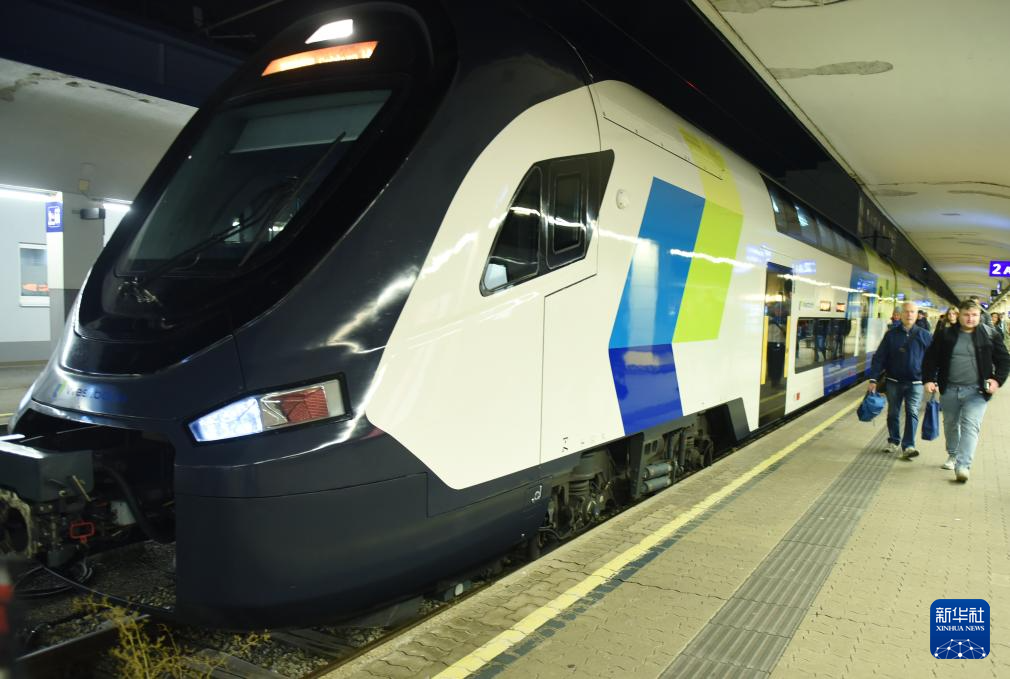
Core Points - The "Panda" train, manufactured by a Chinese company, has been officially introduced in Austria, marking the first time a Chinese-made train is used in the Austrian passenger rail system, which has garnered significant attention from European media [1][3][15] - The train is designed for the route between Vienna and Salzburg, with a maximum operational speed of 200 km/h and a capacity of 536 passengers per train [3][11] Company and Industry Insights - The "Panda" train was developed by CRRC Zhuzhou Electric Locomotive Co., tailored to the specifications of the Austrian private railway operator, Westbahn [3][11] - The decision to choose Chinese trains was influenced by the need for faster delivery times, as the previous Swiss manufacturer could not meet the expansion demands of Westbahn [3][11] - The train features components made in Austria and Switzerland, indicating a blend of Chinese manufacturing and European technology [3][11] - Former Austrian Chancellor Kern emphasized the importance of engaging with China, stating that it is "too important and too large" to be excluded from the market [4][11] - Chinese companies have been expanding into the European rail market, with previous sales to Czechia and Hungary, while focusing primarily on infrastructure projects [5][11]

管健:深度解读中国对墨西哥发起贸易投资壁垒调查
Di Yi Cai Jing· 2025-09-27 08:18
Core Viewpoint - The Chinese Ministry of Commerce has initiated an investigation into Mexico's proposed trade barriers against Chinese imports, emphasizing the need to oppose unilateralism and protectionism in the context of rising tariffs from the U.S. [1] Group 1: Investigation Background - The investigation stems from Mexico's proposal submitted to Congress on September 9, 2025, to amend the Import and Export Tariff Law, which aims to increase tariffs on 1,463 tariff items, including automobiles, textiles, and machinery, with proposed rates up to 50% for certain products [2] - The proposed measures will only affect imports from countries without free trade agreements with Mexico, excluding goods from the U.S., Canada, the EU, and Japan [2] Group 2: Impact on Trade Partners - The proposed tariff increases are expected to negatively impact trade partners, including China, as they may undermine the business environment and reduce investment confidence in Mexico [1][3] - Mexico's proposed measures align with U.S. interests, as they are perceived to address U.S. concerns about Chinese goods circumventing tariffs through Mexico [4] Group 3: Specific Trade Implications - The tariffs could affect $52 billion worth of imports, with an estimated impact of over $10 billion on Chinese goods alone, particularly in sectors where China has a competitive advantage, such as steel, textiles, and machinery [4][5] - The measures are seen as a response to U.S. pressure, highlighting the geopolitical dynamics influencing trade policies in the region [4][5]
中国五矿化工进出口商会:支持商务部就墨西哥涉华限制措施进行贸易投资壁垒调查
Zheng Quan Shi Bao Wang· 2025-09-26 05:45
Core Viewpoint - The China Minmetals Import and Export Chamber of Commerce supports the Ministry of Commerce's investigation into Mexico's trade barriers against Chinese imports, which could significantly impact Chinese industries due to increased tariffs on key imported goods [1] Group 1: Tariff Changes - On September 10, 2025, the Mexican government announced plans to raise tariffs on key imported goods from countries without trade agreements, with some tariffs reaching as high as 50% [1] - The affected goods include automobiles, textiles, clothing, plastics, steel, electrical products, aluminum, toys, furniture, footwear, leather products, paper and cardboard, motorcycles, trailers, and glass [1] Group 2: Impact on Chinese Industries - As the largest source of imports to Mexico, Chinese industries are expected to face severe impacts from the tariff increases [1] - The China Minmetals Import and Export Chamber of Commerce represents industries such as steel, aluminum, plastics, and glass, and is calling for affected parties to participate in the investigation [1] Group 3: Government Response - On September 25, the Ministry of Commerce of China announced the initiation of a trade barrier investigation in response to Mexico's restrictions [1] - The Chamber urges domestic industries and member enterprises to actively support the investigation and necessary measures to protect the legitimate rights of Chinese companies [1]
申万期货品种策略日报:国债-20250926
Shen Yin Wan Guo Qi Huo· 2025-09-26 02:03
1. Report Industry Investment Rating - No information provided in the content 2. Core View of the Report - On September 25, the central bank carried out 4835 billion yuan of 7 - day reverse repurchase operations, with a net withdrawal of 35 billion yuan; it also conducted 6000 billion yuan of 1 - year MLF operations, achieving a net MLF injection of 3000 billion yuan, which effectively alleviated the liquidity pressure. Amid the stock - bond seesaw effect, the scale of bond funds decreased slightly. The US Q2 GDP final value was significantly revised up, and the core PCE price index was also adjusted upward. The monetary market interest rates mostly rose on September 25, and US Treasury yields mostly increased. With the Fed entering the interest - rate cut cycle, the domestic central bank has more policy space, but the central bank stated that the next policy adjustment needs to wait for the unified deployment of the central government. Considering the continued strength of the equity market, it is recommended to maintain a bearish view on long - term bonds and stay on the sidelines for short - term bonds [3] 3. Summary by Relevant Catalogs Futures Market - On the previous trading day, Treasury futures prices showed mixed performance. The T2512 contract fell 0.04%, and its trading volume increased. The IRR of the CTD bonds corresponding to the main Treasury futures contracts was at a low level, with no arbitrage opportunities. The short - term market interest rates also showed mixed movements, with the SHIBOR 7 - day rate down 0.6bp, the DR007 rate up 9.09bp, and the GC007 rate up 0.3bp [2] Spot Market - On the previous trading day, the yields of key - maturity Chinese Treasury bonds showed mixed changes. The 10 - year Treasury bond yield dropped 0.94bp to 1.89%, and the spread between long - and short - term (10 - 2) Treasury bond yields was 41.54bp [2] Overseas Market - On the previous trading day, the 10 - year US Treasury bond yield rose 2bp, the 10 - year German Treasury bond yield rose 0bp, and the 10 - year Japanese Treasury bond yield rose 0.4bp [2] Macro News - On September 25, the central bank carried out 4835 billion yuan of 7 - day reverse repurchase operations, with a net withdrawal of 35 billion yuan; it also conducted 6000 billion yuan of 1 - year MLF operations, achieving a net MLF injection of 3000 billion yuan, which effectively alleviated the liquidity pressure. China submitted a position paper on the special and differential treatment issue to the WTO, and does not seek new special and differential treatment in current and future WTO negotiations. The Ministry of Commerce launched a trade and investment barrier investigation into relevant Mexican measures. As of the end of August, the scale of China's public funds exceeded 36 trillion yuan for the first time, reaching 36.25 trillion yuan, with a sharp monthly increase of 1.18 trillion yuan. The US Q2 GDP final value was significantly revised up to an annualized quarterly growth rate of 3.8%, and the core PCE price index was adjusted from 2.5% to 2.6% [3] Industry Information - On September 25, most money market interest rates rose. The weighted average interest rates of inter - bank pledged repurchase and inter - bank lending for various terms reached new highs in different periods. Most US Treasury yields increased, with the 2 - year yield rising 4.50bp, the 3 - year rising 5.08bp, the 5 - year rising 3.91bp, the 10 - year rising 1.93bp, and the 30 - year falling 0.40bp [3] Comment and Strategy - The 10 - year Treasury bond yield dropped to 1.805%. The central bank continued to inject medium - term liquidity through MLF operations. The short - end Shibor showed mixed performance, and the cross - festival funding situation tightened. Consumption and production growth rates declined in August, and the real estate market was still in the adjustment phase. The central bank adheres to an independent monetary policy and implements a moderately loose monetary policy. The Fed restarted interest - rate cuts after a 9 - month pause. With the Fed entering the interest - rate cut cycle, the domestic central bank has more policy space, but it stated that the next policy adjustment needs to wait for the unified deployment of the central government. Given the continued strength of the equity market, it is recommended to maintain a bearish view on long - term bonds and stay on the sidelines for short - term bonds [3]
中方对此坚决反对!决定启动调查
Zhong Guo Ji Jin Bao· 2025-09-25 16:26
Core Viewpoint - The Chinese Ministry of Commerce has initiated an investigation into Mexico's proposed trade barriers against Chinese products, citing concerns over unilateralism and protectionism in the context of rising tariffs from the U.S. [1][2] Group 1: Investigation Announcement - The Ministry of Commerce announced the investigation under the Trade Barrier Investigation Rules, following Mexico's proposal to increase import tariffs on products from non-free trade partners, including China [3][4] - The investigation will focus on various product categories such as automobiles, textiles, clothing, plastics, steel, home appliances, aluminum, toys, furniture, footwear, leather goods, paper, motorcycles, and glass [3][4] Group 2: Investigation Procedures - The investigation will utilize methods such as questionnaires, hearings, and on-site investigations to gather information from stakeholders [4] - Stakeholders have a period of 20 days from the announcement to submit written comments regarding the investigation [8] Group 3: Timeline and Information Access - The investigation is expected to conclude within six months from the announcement date, with a possible extension of up to three months under special circumstances [6] - Stakeholders can access public information related to the investigation through the Ministry of Commerce's website or by visiting the Trade Relief Public Information Reading Room [7]
商务部:对墨西哥相关涉华限制措施进行贸易投资壁垒调查
财联社· 2025-09-25 13:27
Core Viewpoint - The Ministry of Commerce of China has initiated an investigation into trade and investment barriers imposed by Mexico against Chinese products, particularly in response to Mexico's proposed increase in import tariffs on non-free trade partner products, which could significantly harm Chinese enterprises' trade and investment interests [1][7]. Group 1: Investigated Measures and Products - The investigation focuses on Mexico's proposed increase in import tariffs on products from China and other non-free trade partners, specifically targeting categories such as automobiles and parts, textiles, clothing, plastics, steel, home appliances, aluminum, toys, furniture, footwear, leather goods, paper and cardboard, motorcycles, and glass [1]. Group 2: Investigation Procedures - The Ministry of Commerce may utilize questionnaires, hearings, and on-site investigations to gather information from stakeholders during the investigation process [2]. Group 3: Investigation Timeline - The investigation is expected to conclude within six months from the announcement date, with a possible extension of up to three months under special circumstances [3]. Group 4: Public Information Access - Stakeholders can access public information related to the case through the Ministry of Commerce's website or by visiting the trade relief public information inquiry room [4]. Group 5: Comments on the Case - Stakeholders are invited to submit written comments regarding the case within 20 days from the announcement date [5]. Group 6: Information Submission and Handling - Stakeholders must submit comments and responses electronically via the "Trade Relief Investigation Information Platform" and provide a written version as well. If confidentiality is requested, a non-confidential summary must also be provided [6]. Group 7: Contact Information - The Ministry of Commerce has provided contact details for stakeholders to reach out regarding the investigation [7]. Group 8: Official Response - The Ministry of Commerce emphasizes the need for countries to oppose unilateralism and protectionism, asserting that Mexico's proposed tariff increases could harm not only Chinese interests but also the overall business environment in Mexico [8].