家电等

Search documents
策略简评:各行业外销收入占比跟踪
金融街证券· 2026-03-13 07:29
Group 1: Export Revenue Ratios - The electronics industry has the highest export revenue ratio at 30.68% for the period of 2024H1-2025H1[3] - The automotive industry follows with an export revenue ratio of 20.08%[3] - The home appliance industry has an export revenue ratio of 19.09%[3] - The real estate sector has the lowest export revenue ratio at 0.04%[3] - The public utilities sector has an export revenue ratio of 0.71%[3] - The non-bank financial sector has an export revenue ratio of 1.17%[3] Group 2: Industry Performance and Trends - The average export revenue ratio for the machinery equipment industry is 14.60%[3] - The average export revenue ratio for the textile and apparel industry is 10.43%[3] - The overall market environment has shown increased uncertainty due to geopolitical tensions, impacting sector performance[3] - The report indicates a negative trend in index performance across various sectors, with the electronics sector experiencing a decline of 5.07%[3]
全省近九成的省重大科技攻关项目由企业牵头承担
Da Zhong Ri Bao· 2026-02-13 01:04
Core Insights - In 2025, the province's enterprises have significantly enhanced their innovation status, with R&D investment from enterprises accounting for 88.4% of the total social R&D investment, surpassing the national average by 10.8 percentage points [1] - The number of technology-based SMEs in the province has exceeded 51,000, while high-tech enterprises have reached 35,000 [1] - The province has launched seven industry-specific technology innovation action plans, forming a "2+17" work system to cover all major industrial chains and promote deep integration of technological and industrial innovation [1] Group 1 - The province has laid out 41 major fundamental research projects and 167 major technology innovation engineering projects, along with five technology demonstration projects [1] - Significant breakthroughs include the global first complete revelation of the mechanism of a single plant cell developing into a complete plant, and the successful delivery of the world's first dedicated transport ship for new energy vehicles [1] - The province's technology innovation is driven by enterprises, with 75% of major technology attack guidelines sourced from enterprises and over 85% of major provincial technology projects led by enterprises [1] Group 2 - The "1313" four-level laboratory system has been fully established, with over 85% participation from enterprises [2] - The National Technology Innovation Center for fuel cells and high-speed trains has achieved significant results in industrial innovation platform construction [2] - The province has accelerated the transformation of scientific and technological achievements, with a technology service market system comprising 781 technology service institutions and 49,000 enterprises, facilitating over 2,000 technology transactions [2]
中三省去年GDP总值达15.4万亿,产业竞争力显著提升
第一财经· 2026-02-04 12:43
Economic Performance - The total GDP of the "Central Triangle" formed by Hunan, Hubei, and Jiangxi reached 153,989.55 billion yuan in 2025, an increase of 6,543.09 billion yuan compared to 2024 [2] - Jiangxi's GDP was 36,020.0 billion yuan with a year-on-year growth of 5.2%, while Hubei's GDP was 62,660.90 billion yuan, growing by 5.5%. Hunan's GDP surpassed 55,000 billion yuan, reaching 55,308.65 billion yuan, with a growth rate of 4.8% [2] Industrial Competitiveness - Hubei's industrial competitiveness has significantly improved, with a comprehensive technology innovation index ranking 7th nationally and 1st in Central China. The industrial contribution to economic growth reached 36.1% [4] - Hunan's advanced manufacturing industry is projected to account for 51.7% of the manufacturing value added by 2025, with high-tech manufacturing growing by 11.2%, surpassing the national average by 1.8 percentage points [4] - Jiangxi's industrial value added grew by 7.5%, with key industries like automotive manufacturing and electronics showing significant growth rates of 21.5% and 12.9%, respectively [5] Consumer Market - The total retail sales of consumer goods in the three provinces reached 62,565.91 billion yuan, with Hubei at 27,938.62 billion yuan, Hunan at 21,204.59 billion yuan, and Jiangxi at 13,422.7 billion yuan [7] - Consumption policies, such as trade-in programs, have been effective in boosting demand, with significant growth in retail sales of smart devices and home appliances across the provinces [7][8] Foreign Trade - Hubei's total import and export value reached 834.01 billion yuan, growing by 18.2%, while Hunan's reached 541.41 billion yuan, increasing by 10.8%. Jiangxi's foreign trade totaled 482.3 billion yuan, with a growth of 2.7% [10] - Jiangxi's exports of high-tech products showed strong growth, with high-end equipment and electronic components increasing by 39.7% and 43.1%, respectively [10][11] - Hunan's electric vehicle exports saw a remarkable increase, with total automotive exports exceeding 30 billion yuan for the first time, reaching 33.84 billion yuan, a growth of 26.8% [10][11]


流动性转为下行趋势
Guolian Minsheng Securities· 2026-02-01 13:34
Quantitative Models and Factor Analysis Quantitative Models and Construction Methods Model 1: ETF Hot Trend Strategy - **Model Name**: ETF Hot Trend Strategy - **Model Construction Idea**: The strategy is based on selecting ETFs with the highest and lowest prices in an upward trend and further filtering them based on the steepness of the regression coefficients of the highest and lowest prices over the past 20 days[31] - **Model Construction Process**: 1. Select ETFs where both the highest and lowest prices are in an upward trend 2. Construct support and resistance factors based on the steepness of the regression coefficients of the highest and lowest prices over the past 20 days 3. Choose the top 10 ETFs with the highest turnover rate in the past 5 days relative to the past 20 days to construct a risk parity portfolio[31] - **Model Evaluation**: The strategy achieved a return of 61.41% since 2025, with an excess return of 38.22% compared to the CSI 300 Index[31] Model 2: ETF Three-Strategy Fusion - **Model Name**: ETF Three-Strategy Fusion - **Model Construction Idea**: The strategy combines three industry rotation strategies driven by quantitative fundamentals, quality low volatility, and distressed reversal to achieve factor and style complementarity and reduce the risk of a single strategy[34] - **Model Construction Process**: 1. Construct industry rotation strategies based on quantitative fundamentals, quality low volatility, and distressed reversal 2. Combine the three strategies in equal weights to select industries from different dimensions[34] - **Model Evaluation**: The strategy achieved a cumulative return of 12.24% from April 10, 2017, to January 30, 2026, with a Sharpe ratio of 0.74[39] Model 3: All-Weather Strategy - **Model Name**: All-Weather Strategy - **Model Construction Idea**: The strategy aims to achieve stable returns by avoiding the "prediction" dilemma through diversified risk. It follows three basic principles: asset selection, risk adjustment, and structural hedging[53] - **Model Construction Process**: 1. Select assets 2. Adjust risks 3. Perform structural hedging to achieve balanced allocation and smooth out volatility[53] - **Model Evaluation**: The high-volatility version achieved an annualized return of 11.8% with an average maximum drawdown of 3.6% and a Sharpe ratio of 2.3. The low-volatility version achieved an annualized return of 8.8% with an average maximum drawdown of 2.0% and a Sharpe ratio of 3.4[61] Model Backtesting Results ETF Hot Trend Strategy - **Return**: 61.41% since 2025[31] - **Excess Return**: 38.22% compared to CSI 300 Index[31] ETF Three-Strategy Fusion - **Cumulative Return**: 12.24% from April 10, 2017, to January 30, 2026[39] - **Sharpe Ratio**: 0.74[39] All-Weather Strategy - **High-Volatility Version**: - **Annualized Return**: 11.8%[61] - **Average Maximum Drawdown**: 3.6%[61] - **Sharpe Ratio**: 2.3[61] - **Low-Volatility Version**: - **Annualized Return**: 8.8%[61] - **Average Maximum Drawdown**: 2.0%[61] - **Sharpe Ratio**: 3.4[61] Quantitative Factors and Construction Methods Factor 1: Profitability Yield Factor - **Factor Name**: Profitability Yield Factor - **Factor Construction Idea**: Measures the profitability of stocks to identify high-profitability stocks[63] - **Factor Construction Process**: Calculate the profitability yield of stocks and select those with the highest profitability yield[63] - **Factor Evaluation**: Achieved a positive return of 3.24% this week, indicating that high-profitability stocks regained market favor[63] Factor 2: Value Factor - **Factor Name**: Value Factor - **Factor Construction Idea**: Measures the value of stocks to identify high-value stocks[63] - **Factor Construction Process**: Calculate the value of stocks and select those with the highest value[63] - **Factor Evaluation**: Achieved a positive return of 2.67% this week, reflecting that high-value stocks gained market attention[63] Factor 3: Leverage Factor - **Factor Name**: Leverage Factor - **Factor Construction Idea**: Measures the leverage of stocks to identify high-leverage stocks[63] - **Factor Construction Process**: Calculate the leverage of stocks and select those with the highest leverage[63] - **Factor Evaluation**: Achieved a positive return of 1.32% this week, indicating that high-leverage stocks gained market attention[63] Factor Backtesting Results Profitability Yield Factor - **Weekly Return**: 3.24%[63] Value Factor - **Weekly Return**: 2.67%[63] Leverage Factor - **Weekly Return**: 1.32%[63]
中银量化多策略行业轮动周报–20260129-20260130
Bank of China Securities· 2026-01-30 09:03
Core Insights - The report highlights the current industry allocation of the Bank of China’s multi-strategy system, with the highest weights in basic chemicals (22.3%), telecommunications (14.0%), and building materials (11.0) [1] - The average weekly return for the CITIC primary industries was 0.4%, with a one-month average return of 6.3% [3][10] - The report indicates that the composite strategy achieved a cumulative return of 1.0% this week, outperforming the CITIC primary industry equal-weight benchmark by 0.5% [3] Industry Performance Review - The top three performing industries this week were non-ferrous metals (15.6%), petroleum and petrochemicals (7.3%), and food and beverage (4.5%) [3][10] - The bottom three performing industries were defense and military (-3.7%), automotive (-3.5%), and home appliances (-2.5%) [10] - The report provides detailed weekly and monthly performance data for each industry, indicating a mixed performance across sectors [11] Valuation Risk Warning - The report employs a valuation warning system based on the PB ratio over the past six years, identifying industries with high valuation risks [12] - Industries currently flagged for high valuation include retail, computers, non-ferrous metals, defense and military, petroleum and petrochemicals, electronics, media, machinery, steel, and composite industries, all exceeding the 95th percentile of historical PB valuations [12][13] Single Strategy Rankings and Recent Performance - The report outlines the top three industries based on the S1 high prosperity industry rotation strategy: telecommunications, basic chemicals, and coal [15] - The S2 implied sentiment momentum strategy ranks the top three industries as basic chemicals, building materials, and telecommunications [19] - The S3 macro style rotation strategy identifies the top six industries as banking, petroleum and petrochemicals, coal, home appliances, non-ferrous metals, and construction [23] Strategy Composite - The report details the composite strategy's adjustments, indicating a significant increase in positions within the TMT sector while reducing exposure to consumer and financial sectors [3] - The report emphasizes the importance of monitoring macroeconomic indicators and their correlation with industry performance to optimize investment strategies [21][22]
报告派研读:2026年消费行业深度报告
Sou Hu Cai Jing· 2026-01-30 02:36
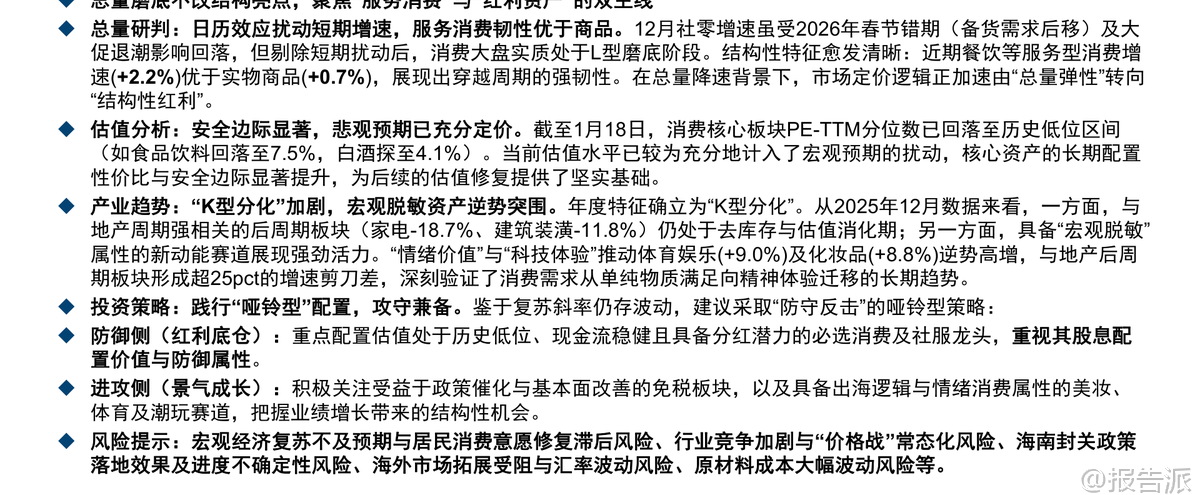
Core Insights - The Chinese consumer market is transitioning from total expansion to structural differentiation, characterized by an "L-shaped bottoming" trend as of early 2026, with retail sales growth impacted by factors like the timing of the Spring Festival and a decline in promotional activities [1] - A "K-shaped" differentiation is emerging, where resilient "extreme value-for-money" essential consumption contrasts with high-premium emotional consumption, while traditional mid-range discretionary spending faces growth challenges [1][2] - The marginal propensity to consume (MPC) is recovering slowly, reflecting a rational return in middle-class consumption decisions, with consumers being more cautious about non-essential spending but willing to pay premiums for categories that satisfy "self-pleasure" and "social" needs [1] Consumer Trends - In December 2025, restaurant revenue grew by 2.2%, significantly outpacing the 0.7% growth in retail sales, with online food products seeing a remarkable growth of 14.5%, serving as a stabilizing force for overall consumption [2] - Emotional consumption sectors, such as sports entertainment (+9.0%), cultural office supplies (+9.2%), and cosmetics (+8.8%), are experiencing robust growth, contrasting sharply with the downturn in real estate-related sectors like home appliances (-18.7%) and construction decoration (-11.8%) [2] Valuation Insights - Core consumer sectors have fallen to historical low valuations, providing a significant safety margin for investors [3] - As of January 2026, the price-to-earnings (PE) ratio for food and beverage is at 7.5%, with liquor even lower at 4.1%, indicating that pessimistic expectations are already priced in, highlighting the long-term value of core assets [4] Investment Strategy - The report suggests a "barbell" investment strategy, recommending defensive positions in essential consumption and social service leaders with low valuations and strong cash flows, such as grain and oil, traditional Chinese medicine, and gold jewelry, while also emphasizing their dividend value and defensive attributes [5] - On the offensive side, investors should capture growth sectors benefiting from policy catalysts and fundamental improvements, including the duty-free sector and emotional consumption categories like cosmetics, sports goods, and trendy toys [5] Policy Impact - The first month of the Hainan Free Trade Port's duty-free sales reached 4.86 billion yuan, a year-on-year increase of 46.8%, demonstrating the strong appeal of "zero tariffs and low tax rates" for high-end consumption [6] - China Duty Free Group holds a dominant market share of 78.7% and continues to strengthen its channel and brand barriers through acquisitions and expanding its presence in city stores [7] Emerging Markets - The pet economy is experiencing a "humanization" upgrade, and the "going out" trend in categories like home appliances is also contributing to significant incremental alpha sources [9] - The shift in pet ownership towards viewing pets as family members is driving both volume and price increases, while the home appliance sector leverages China's supply chain advantages to replicate successful "extreme value-for-money" strategies overseas [10] Market Dynamics - Overall, while the total consumption recovery is not steep, the market opportunities are shifting from a "beta market" to "structural alpha" under low valuations and clear structures [11] - Investors are encouraged to abandon linear thinking of a "full recovery" and focus on "dividend assets" and "emotional consumption" as dual main lines, employing a "barbell" strategy to seize certain opportunities amid uncertainty [12]
ETF日报|A股三大指数涨跌不一,大湾区ETF(512970)回跌0.58%
Xin Lang Cai Jing· 2026-01-29 01:55
Market Performance - As of January 28, 2026, the three major A-share indices showed mixed results, with the Shanghai Composite Index rising by 0.27% to 4151.24 points, the Shenzhen Component Index increasing by 0.09% to 14342.89 points, and the ChiNext Index declining by 0.57% to 3323.56 points [1] - The total trading volume of the two markets reached 2.97 trillion yuan, with northbound capital remaining balanced in terms of buying and selling [1] Industry Highlights - Precious metals performed exceptionally well, surging by 10.09%, followed by jewelry and oil service engineering, which rose by 8.05% and 7.46% respectively [1] ETF Insights - The Greater Bay Area ETF (512970) closed down by 0.58% at 1.55 yuan, with a trading volume of 57.92 million yuan and a turnover rate of 0.66% [1] - Over the past month, the Greater Bay Area ETF has accumulated a rise of 1.71% [2] - The index closely tracks the CSI Guangdong-Hong Kong-Macau Greater Bay Area Development Theme Index, which reflects the overall performance of listed companies benefiting from the Greater Bay Area development [2] Index Composition - As of December 31, 2025, the top ten weighted stocks in the CSI Guangdong-Hong Kong-Macau Greater Bay Area Development Theme Index accounted for 46.96% of the index, including companies like China Ping An, Luxshare Precision, and BYD [3]
“十四五”山东外贸规模年均增长9.8%,累计进出口规模16.21万亿元
Zhong Guo Fa Zhan Wang· 2026-01-21 01:25
Core Insights - During the "14th Five-Year Plan" period, Shandong Province has significantly expanded its high-level openness, achieving a cumulative import and export scale of 16.21 trillion yuan, a 70.1% increase compared to the "13th Five-Year Plan" period, contributing 10.3% to the national foreign trade growth [1] Group 1: Trade Growth and Performance - Shandong's foreign trade scale has reached new heights, with an average annual growth rate of 9.8%, surpassing 3 trillion yuan in 2022 and projected to reach 3.53 trillion yuan by 2025 [1] - The province's share of national foreign trade has increased by 1.2 percentage points to 7.7%, while its global share has risen by 0.2 percentage points to 1% [1] - Both exports and imports have maintained rapid growth, with average annual growth rates of 10.6% and 8.5% respectively, indicating balanced development [1] Group 2: Business Vitality and Structure - Shandong has optimized its business environment, leading to an increase in the number of enterprises with import and export records, expected to exceed 80,000 by 2025, an increase of 24,000 from 2020 [1] - Private enterprises have played a crucial role in stabilizing foreign trade, contributing 90.4% of the province's foreign trade growth [1] Group 3: Market Diversification and Export Structure - The "Ten Thousand Enterprises Going Global" initiative has resulted in Shandong establishing trade partnerships with over 250 countries and regions, with 80% of these partners experiencing growth in trade [2] - The province's exports have shifted towards high-quality products, with machinery and electronics exports growing at an average annual rate of 13.6%, projected to exceed 1 trillion yuan by 2025 [2] - Shandong's self-branded products have gained prominence, with their exports growing at an average annual rate of 13%, accounting for 24.3% of the province's total exports [2] Group 4: Domestic Demand and Import Trends - Shandong's economy has shown a steady recovery, with industrial added value growing rapidly and imports of key industrial commodities like metal ores and crude oil increasing significantly [3] - The import of high-tech products has also seen an average annual growth of 8.9%, with specific components like computer parts and integrated circuits growing by 31.7% and 12.3% respectively [3] - The consumer market remains stable, with annual imports of consumer goods exceeding 100 billion yuan, including high-quality fresh agricultural products [3]
A股2026年1月观点及配置建议:开年攻势,指数新高-20260104
CMS· 2026-01-04 13:01
Group 1 - The report anticipates that A-shares will continue their upward trend in January, supported by improved fundamentals due to accelerated local government special bond issuance and a recovery in government investment [2][4][12] - The earnings forecast for listed companies is expected to show a significant year-on-year increase due to a low base from the previous year, with January being a key period for earnings announcements [4][14][22] - The report highlights a focus on sectors such as commercial aerospace, AI applications, and semiconductor equipment, as well as cyclical resource sectors like industrial metals, which are expected to be the main battlegrounds in January [12][16][22] Group 2 - The liquidity environment is projected to remain stable, with net inflows of incremental funds expected, particularly from foreign and insurance capital [3][15][21] - The report emphasizes the importance of monitoring the performance of sectors with high earnings growth or improvement, particularly in TMT (Technology, Media, Telecommunications) and cyclical resource sectors [5][17][54] - The report suggests that the market is likely to experience structural inflows of funds, with a focus on large-cap growth stocks and indices such as CSI 300 and STAR Market 50 [16][18][21] Group 3 - The report indicates that January is a critical month for earnings disclosures, with potential volatility in stocks that may not meet expectations, particularly in high-growth sectors [48][51] - The analysis of historical data suggests that sectors with stable earnings, such as home appliances, automobiles, and non-bank financials, have a higher probability of achieving excess returns during this period [51][54] - The report notes that the upcoming year is significant due to the initiation of the 14th Five-Year Plan, which historically correlates with increased infrastructure investment and economic stabilization [23][26][29] Group 4 - The report discusses the global commodity market, indicating a potential upward trend in prices driven by demand recovery and policy expectations, particularly in industrial metals [30][35][36] - The analysis highlights the impact of geopolitical factors and supply chain security on commodity prices, emphasizing the importance of resource nationalism and strategic resource management [42][43][46] - The report suggests that the demand for industrial metals will be supported by new technological needs, particularly in AI and renewable energy sectors, which are expected to drive significant growth [38][40][47]
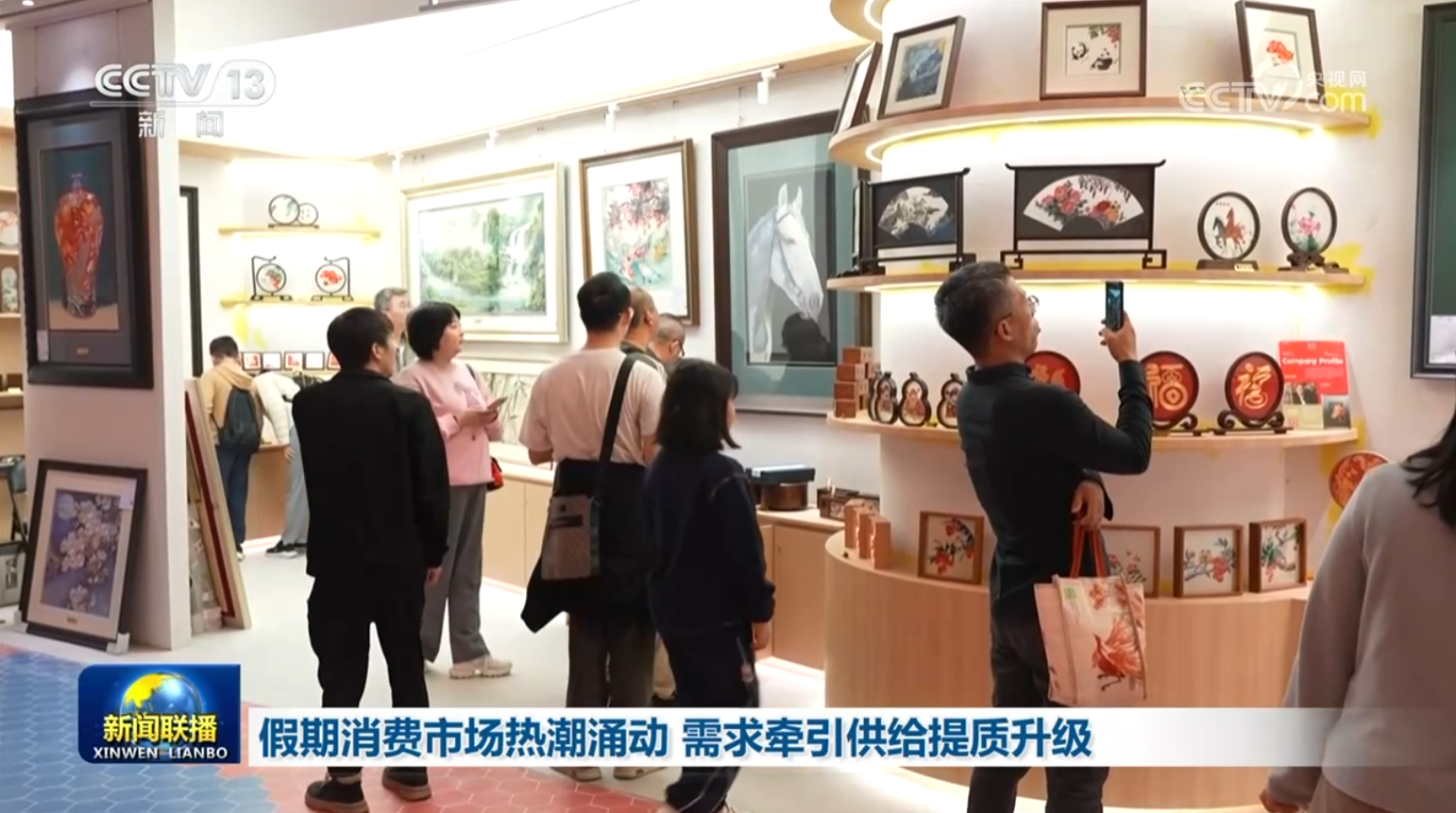
假期消费市场热潮涌动 需求牵引供给提质升级
Yang Shi Wang· 2026-01-04 12:30
Group 1 - The national consumer market is experiencing a surge in activity during the New Year holiday, with new scenarios and business formats emerging, driven by demand that enhances supply quality and market vitality [1] - Major shopping districts are launching new offerings to attract consumers, with Wuhan's first park-style complex seeing over 120,000 visitors on New Year's Day, and Shenzhen Bay New District opening with nearly 40 flagship stores, contributing to significant consumer traffic [3] - The Ministry of Commerce reported a 2.8% increase in catering consumption during the holiday, with daily foot traffic and sales in 78 key pedestrian streets and business districts rising by 5.9% and 4.9% respectively compared to New Year's Day 2025 [3] Group 2 - Cross-industry integration is accelerating the iteration of new scenarios, expanding service consumption spaces, as seen in Hunan's themed activities engaging fans and teams, and Xinjiang's immersive cultural experiences for tourists [5] - New consumer demands are leading to trends in supply, with innovations in winter sports equipment rental and real-time monitoring systems in Hebei, and the integration of robotics and AI in consumer scenarios in Jiangsu, enhancing the shopping experience [7] - Sales of smart health devices and wearable technology increased by over 20% and 15% respectively, while sales of first-class energy-efficient appliances grew by more than 10% during the holiday [7]