钢铁产能置换

Search documents
2026年钢铁行业投资策略:反内卷叠加西芒杜投产,产业链利润格局重塑
Shenwan Hongyuan Securities· 2025-11-18 12:27
Group 1 - The steel industry is expected to see improved profitability due to three main factors: declining raw material prices, supply-side adjustments, and resilient demand from manufacturing [3][5][9] - The West Simandou iron ore project is set to commence production in November 2025, significantly increasing iron ore supply and contributing to a downward trend in iron ore prices [3][71] - Government policies aimed at reducing overcapacity and promoting energy efficiency are expected to accelerate the exit of outdated production capacity, leading to a more optimized supply structure in the steel industry [3][16][10] Group 2 - Demand for steel is projected to stabilize in the construction sector, while manufacturing demand remains resilient, particularly for flat steel and special steel products [3][19][25] - The overall steel demand in China is forecasted to decline slightly, with total demand expected to be 9.05 billion tons in 2025, a decrease of 0.11% from 2024 [19][20] - The construction sector's share of steel demand is decreasing, while the manufacturing sector's share is increasing, indicating a shift in consumption patterns [3][19] Group 3 - The report highlights that the profitability of steel companies is recovering, with a stronger performance expected in flat steel compared to long steel products [3][85][82] - The average profit margin for steel companies is projected to improve as cost pressures ease, with a focus on companies with stable demand and low valuations [3][87][90] - Investment recommendations include focusing on companies like Baosteel, Nanjing Steel, and Hualing Steel, which are expected to benefit from the shift towards manufacturing [3][95][94]


2025年钢铁产能置换方案与2021年有何异同?
Changjiang Securities· 2025-10-27 04:42
Investment Rating - The investment rating for the steel industry is Neutral, maintained [8] Core Insights - The report discusses the revisions made to the "Steel Industry Capacity Replacement Implementation Measures" by the Ministry of Industry and Information Technology, comparing the 2021 version with the 2025 draft [2][4][5] - The demand for steel continues to improve, with a slight year-on-year decrease in apparent consumption of major steel products by 1.18% and a month-on-month increase of 2.57% [4] - The average daily pig iron output of sample steel enterprises has decreased slightly to 2.399 million tons, with a year-on-year decrease of 1.15% and a month-on-month increase of 1.29% in total steel production [4][5] - Total steel inventory has decreased by 1.75% week-on-week, while year-on-year it has increased by 22.16% [5] Summary by Sections Capacity Replacement Measures - The 2025 draft maintains the definition of "compliant capacity" as in 2021, but introduces stricter regulations on capacity replacement, particularly regarding "zombie capacity" [12] - New provisions allow for capacity replacement between different enterprises for two years after the implementation of the 2025 measures, after which such exchanges will be prohibited [12] - The replacement ratio for iron and steel capacity in 2025 is set at no less than 1.5:1 across provinces, expanding the scope compared to the 2021 measures [12] Market Dynamics - The report highlights the broad demand for underground pipeline networks, with an expected investment exceeding 5 trillion yuan, benefiting pipe-related companies [4] - The "anti-involution" policy is expected to boost market expectations, with increased construction intensity towards the end of the year likely to enhance demand for building materials [4] Investment Opportunities - The report identifies four main investment lines: 1. Companies benefiting from the release of new capacities in iron ore and coke, such as Nanjing Steel and Baosteel [29] 2. Companies with low market capitalization relative to their earnings, such as New Steel and Fangda Special Steel [29] 3. Mergers and acquisitions under the state-owned enterprise reform, which may enhance asset quality and valuation [31] 4. High-quality processing leaders and resource companies, particularly in the context of macroeconomic recovery expectations [31]
黑色板块日报-20251027
Shan Jin Qi Huo· 2025-10-27 03:26
Report Overview - The report is the Shan Jin Futures' daily report on the black sector, covering steel products like rebar and hot-rolled coil, as well as iron ore, with updates as of October 27, 2025 [1][2][5] 1. Report Industry Investment Rating - No investment rating for the industry is provided in the report 2. Core Viewpoints - For rebar and hot-rolled coil, the apparent demand for rebar has continued to rise but remains weaker than the same period last year, production has increased, and inventory reduction is slow. Hot-rolled coil inventory is much higher than the same period. With strong coking coal and coke prices supporting costs, but falling steel mill profits and the approaching end of the consumption peak, steel mills may cut production, leading to a potential negative feedback loop. Technically, the futures prices may have ended their downward trend. It is recommended to hold short positions lightly and take profits when prices fall [2]. - For iron ore, although the sample steel mills' molten iron production remains high, supporting demand, falling steel mill profits may lead to production cuts, suppressing raw material prices. On the supply side, global shipments are high, and rising port inventories during the peak consumption season are pressuring futures prices. Technically, the 01 contract has a slight rebound, facing resistance from the 60 - day and 10 - day moving averages. It is recommended to hold short positions and beware of the impact of a rebound in rebar prices [5] 3. Summary by Directory 3.1 Rebar and Hot - Rolled Coil - **Supply and Demand**: Rebar's apparent demand is rising but weaker than last year, production is up, and inventory reduction is slow. Hot - rolled coil inventory is much higher than the same period. Coking coal and coke prices support costs, but falling steel mill profits and the approaching end of the consumption peak may lead to production cuts [2]. - **Technical Analysis**: The futures prices of rebar and hot - rolled coil have broken through the 10 - day moving average on the daily K - line chart, indicating a possible end to the downward trend [2]. - **Operation Suggestion**: Hold short positions lightly and take profits when prices fall [2]. - **Data**: Futures and spot prices, basis, spreads, production, inventory, and other data for rebar and hot - rolled coil are provided, showing changes in prices, production, and inventory levels [3] 3.2 Iron Ore - **Supply and Demand**: High molten iron production supports demand, but falling steel mill profits may lead to production cuts, suppressing prices. Global shipments are high, and rising port inventories during the peak consumption season are pressuring prices [5]. - **Technical Analysis**: The 01 contract has a slight rebound, facing resistance from the 60 - day and 10 - day moving averages [5]. - **Operation Suggestion**: Hold short positions and beware of the impact of a rebound in rebar prices [5]. - **Data**: Futures and spot prices, basis, spreads, shipping volumes, freight rates, inventory, and other data for iron ore are provided, showing changes in prices, supply, and inventory levels [5] 3.3 Industry News - In mid - October, key steel enterprises' average daily production of crude steel decreased by 0.9% month - on - month, pig iron decreased by 1.3% month - on - month, and steel products increased by 0.8% month - on - month [7]. - The Ministry of Industry and Information Technology is soliciting opinions on the "Implementation Measures for Capacity Replacement in the Iron and Steel Industry (Draft for Comment)", with strict regulations on capacity replacement ratios and regional transfers [7]. - Some steel mills in Tangshan and Xingtai plan to raise coke prices [7]. - The total urban inventory this week is 949.87 million tons, a 1.34% decrease from last week [8]. - Shanxi is increasing coal production and supply, with a 3.7% year - on - year increase in the output of above - scale raw coal in the first three quarters, accounting for about 27.3% of the national output [8]
成材:市场环境转好,钢价存反弹
Hua Bao Qi Huo· 2025-10-27 02:49
Group 1: Investment Rating - There is no information about the industry investment rating in the provided content. Group 2: Core View - The steel price is running at a low level and there is a short - term rebound potential. The later stage should focus on macro - policies and downstream demand [3]. Group 3: Summary Based on Logical Content - After the Sino - US consultations, initial consensus has been reached, the macro - level has improved, and risk sentiment has recovered [2]. - The Ministry of Industry and Information Technology has publicly solicited opinions on the "Implementation Measures for Capacity Replacement in the Iron and Steel Industry (Draft for Comment)". It is strictly prohibited to increase the total steel production capacity in key areas, transfer steel production capacity from non - key areas to key areas, and transfer steel production capacity between different key areas. The capacity replacement ratio of ironmaking and steelmaking in each province (autonomous region, municipality) is not less than 1.5:1 [2]. - Since 12:00 on October 27, Hebei's Tangshan, Langfang, Handan, and Baoding have launched a level - II emergency response for heavy pollution weather. Some steel mills in Tangshan have received notices to extend the sintering machine production restriction time until the end of October, and blast furnaces are to be shut down by 30% according to capacity. As of October 24, the daily average hot metal output of steel mills in Tangshan was 39.69 tons. If the blast furnace is restricted by 30%, the daily average hot metal output will be affected by 9.1 tons, and a total of 40.95 tons of hot metal output will be affected in 4.5 days [2]. Group 4: Summary of Market Conditions - Last week, the finished product market fluctuated and the price rebounded slightly. The initial consensus after the Sino - US consultations improved the macro - level and increased risk sentiment. The level - II emergency response in some areas of Hebei since Monday is expected to affect the hot metal output by 40.95 tons, which will support the finished product price [2].
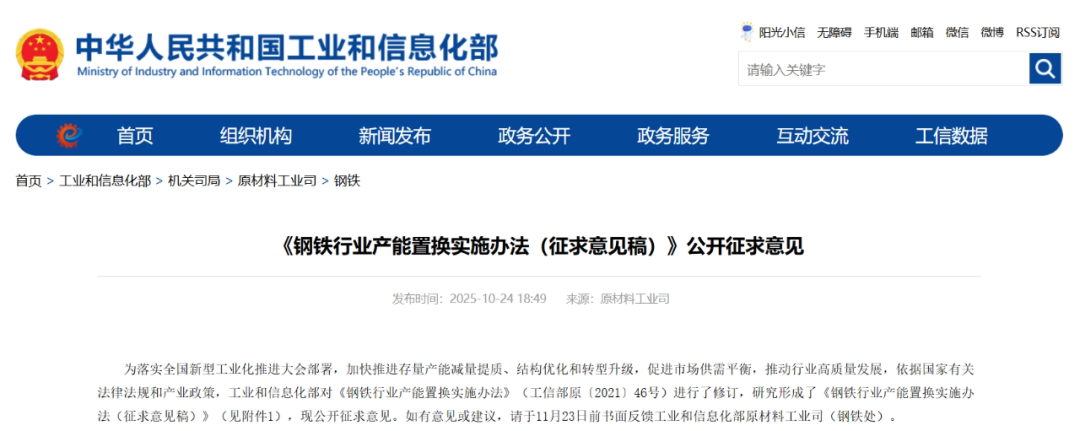
工业和信息化部:重点区域严禁新增钢铁产能总量
Xin Hua Cai Jing· 2025-10-24 14:38
Core Viewpoint - The Ministry of Industry and Information Technology has revised the "Implementation Measures for Capacity Replacement in the Steel Industry" to promote high-quality development and balance market supply and demand, with a focus on reducing and optimizing existing production capacity [1]. Group 1: Policy Changes - The revised measures prohibit the construction or expansion of steel smelting projects outside compliant parks in the Yangtze River Economic Belt [1]. - New steel production capacity is strictly forbidden in key areas, and the transfer of steel capacity from non-key areas to key areas is also prohibited [1]. - Provinces with clear steel capacity control targets are not allowed to accept steel capacity transfers from other regions [1]. Group 2: Capacity Replacement Ratios - The capacity replacement ratio for iron and steel production in all provinces (regions, municipalities) must be no less than 1.5:1 [1]. - For newly acquired compliant capacity through mergers and acquisitions after June 1, 2021, the capacity replacement ratio must be no less than 1.25:1 [1].
重点区域严禁新增钢铁产能总量!工信部征求意见
Zhong Guo Zheng Quan Bao· 2025-10-24 13:24
Core Viewpoint - The Ministry of Industry and Information Technology has revised the "Implementation Measures for Capacity Replacement in the Steel Industry" and is currently seeking public opinions on the draft [1] Group 1: Capacity Replacement Regulations - Steel companies must scientifically assess supply and demand to avoid inefficient investments and develop capacity replacement plans according to the regulations [3] - New construction or expansion of steel smelting projects is prohibited outside compliant zones in the Yangtze River Economic Belt, and no new steel capacity is allowed in key areas [3] - Six categories of capacity are not eligible for replacement, including capacities listed for reduction, those not yet operational before the announcement of replacement plans, and capacities from outdated production equipment [4][5] Group 2: Capacity Transfer and Replacement Ratios - The draft encourages cross-regional capacity replacement, with no restrictions imposed by local regions [6] - The replacement ratio for iron and steel capacity in provinces must not be less than 1.5:1, with a lower ratio of 1.25:1 applicable for newly acquired compliant capacity after June 1, 2021 [7] - Three scenarios allow for equal capacity replacement, including internal repairs of existing equipment and projects in specific regions like Qinghai and Tibet [8] Group 3: Mergers and Low-Carbon Development - The draft outlines conditions for mergers and acquisitions to qualify for replacement ratio policies, emphasizing the need for substantial changes in control and corporate structure [9][10] - It encourages high-quality utilization of scrap steel, orderly development of electric furnace steel, and the implementation of green low-carbon technology in existing steel production [10]

反内卷下,钢铁表外产能的退出路径
Changjiang Securities· 2025-09-21 23:30
Investment Rating - The industry investment rating is Neutral, maintained [9] Core Insights - The report highlights the exit paths for off-balance steel production capacity under the "anti-involution" policy, focusing on the need for stricter regulation and the removal of illegal production capacities [5][7] - Seasonal recovery in construction demand and liquidity support have contributed to a rebound in steel prices, although the demand during the "Golden September" period is not particularly strong [4][27] - The report emphasizes the importance of regulatory measures to ensure the exit of illegal and excess steel production capacities, which is crucial for improving the supply-demand balance in the steel industry [7][28] Summary by Sections Section: Current Market Conditions - Construction demand has shown seasonal recovery, with apparent consumption of five major steel products increasing by 0.34% year-on-year and 0.55% month-on-month [4] - Daily average pig iron production has risen to 2.4102 million tons, reflecting a slight increase of 0.47 tons per day [4] - Total steel inventory has increased by 0.32% month-on-month and 7.16% year-on-year [4] Section: Regulatory Environment - Recent inspections by the Central Environmental Protection Supervision Team have focused on illegal steel production capacities in several provinces, highlighting issues such as unauthorized construction and the persistence of "rebar steel" production [5][6] - The report identifies three main forms of illegal steel production: capacity replacement schemes, production under the guise of casting and forging, and the construction of illegal rebar steel [6] Section: Future Outlook - The report anticipates a clear direction for steel production regulation, emphasizing the need to eliminate illegal capacities and enforce strict compliance with production standards [7] - It suggests that the ongoing "anti-involution" policies will enhance the supply-side contraction expectations, potentially leading to significant valuation recovery for steel companies with low price-to-book ratios [27][28]
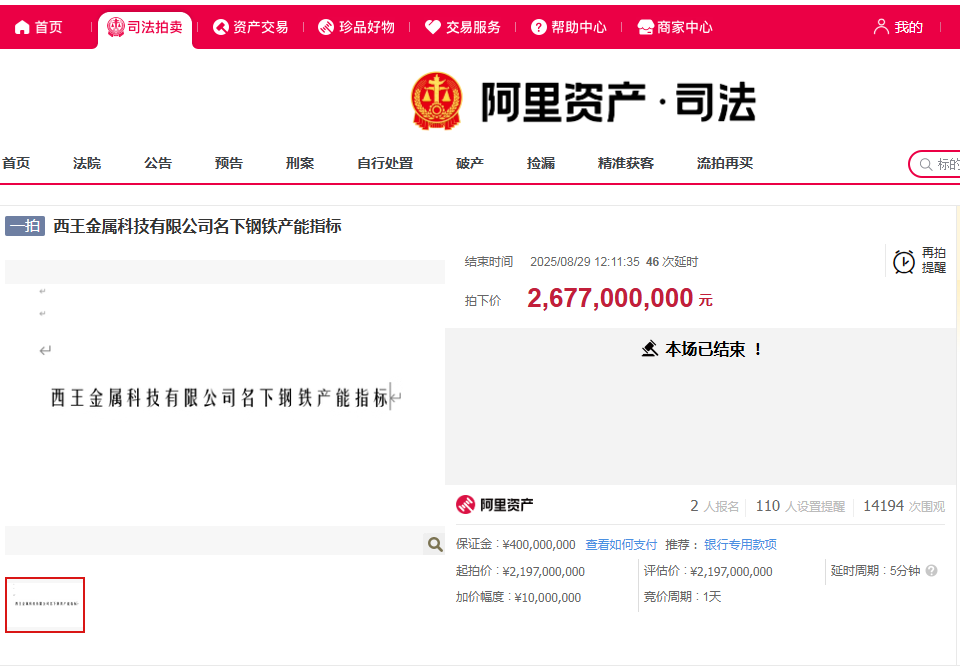
日钢铁斥资26.77亿元竞拍拿下西王466万吨钢铁产能指标
Qi Lu Wan Bao· 2025-09-01 04:05
Group 1 - Rizhao Steel Holding Group successfully auctioned steel production capacity indicators from Xiwang Metal Technology Co., Ltd. for 2.677 billion yuan, with a starting price of 2.197 billion yuan [1][3] - The auctioned capacity includes two blast furnaces and two converters, with a total iron production capacity of 236 million tons per year and a total steel production capacity of 230 million tons per year [1][3] - The auction attracted two bidders, with a deposit of 400 million yuan and a bidding increment of 10 million yuan [1][3] Group 2 - Xiwang Metal Technology Co., Ltd. was established in December 2007, with a registered capital of 27.28 million USD, and is a major private enterprise in China focusing on corn deep processing and special steel [5] - Rizhao Steel Holding Group, founded in 2003, became the first company in Rizhao to exceed 100 billion yuan in output value in 2019, and is recognized for its advanced steel production technologies [5] - The successful auction is expected to enhance Rizhao Steel's production capacity and competitiveness within the industry [5]