黄金储备重估

Search documents
黄金观点汇总分析
Sou Hu Cai Jing· 2025-12-13 10:23
Core Viewpoint - Gold prices have significantly increased since entering a bull market in 2019, rising from approximately $1,300 to $4,300 per ounce, with some experts predicting prices could reach $5,000 or even $20,000, while others have already sold at $4,500, indicating a potential price bubble that needs time to digest [1] Group 1: Market Dynamics - Economists and investment experts have expressed concerns about the sustainability of high gold prices, suggesting that the current price levels reflect already priced-in factors such as U.S. dollar depreciation, geopolitical conflicts, and central bank gold purchases [1] - The potential for a significant sell-off of gold by central banks to address fiscal deficits is highlighted, with historical precedents showing that large-scale sales can lead to prolonged bear markets for gold [3] - The role of the Chinese yuan in international reserves may increase, potentially reducing demand for gold as an alternative asset during periods of dollar depreciation [3] Group 2: Currency Impact - The appreciation of Asian currencies, particularly the Chinese yuan and Indian rupee, could suppress gold prices, as local gold prices would decrease when measured in local currencies, leading to reduced demand for gold [5] - Historical data indicates that during periods of Asian currency appreciation, retail gold purchases in Asia decline significantly, which can further weaken international gold price momentum [5] Group 3: Geopolitical and Economic Factors - In scenarios of sudden geopolitical conflicts or economic crises, gold's status as a safe-haven asset may override the negative impact of currency appreciation, leading to increased demand and higher prices [7] - The interplay of multiple global factors can influence gold prices, suggesting that unexpected strong positive factors, such as severe inflation or significant central bank gold purchases, could counteract the suppressive effects of currency appreciation [8]


中金:财政主导,重启扩表
Xin Lang Cai Jing· 2025-12-10 23:41
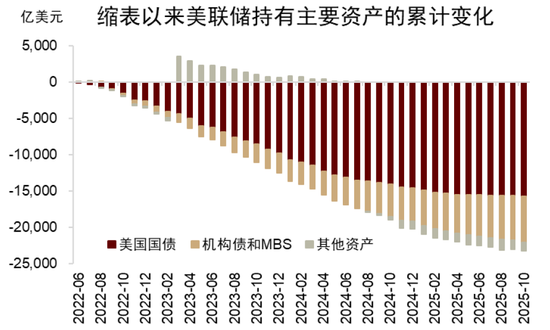
Core Viewpoint - The tightening of dollar liquidity and increasing financing pressure on U.S. financial institutions since October, with the Federal Reserve planning to end quantitative tightening (QT) by December 1, 2025, is aimed at alleviating liquidity pressures in the short-term financing market, particularly those relying on U.S. Treasuries as collateral [1][41]. Group 1: Federal Reserve Actions - The Federal Reserve will stop reducing its holdings of U.S. Treasuries while continuing to reduce MBS at a monthly cap of $35 billion, reallocating MBS proceeds into T-bills [1][41]. - There is a possibility of the Fed restarting balance sheet expansion as early as Q1 or Q3 of next year, depending on the persistence of high financing spreads in the overnight funding market [1][41]. Group 2: Market Conditions - Dollar liquidity is at a low since the pandemic, with the Fed having reduced its balance sheet by approximately $2.3 trillion since June 2022, which is about 25.9% of its assets [3][43]. - The net issuance of U.S. Treasuries from July to October reached $1.24 trillion, while the Treasury General Account (TGA) has increased to over $950 billion, exacerbating liquidity tightening [3][43]. Group 3: Financing Market Pressures - The borrowing through the discount window has been increasing, with amounts exceeding $10 billion on October 29, indicating heightened liquidity pressures in the financing market [11][53]. - The secured overnight financing (SOFR) market has seen a rise in financing amounts from $1 trillion at the end of 2022 to $3 trillion, with a significant portion borrowed by unregulated non-bank institutions [25][67]. Group 4: Fiscal and Monetary Policy Outlook - The U.S. is expected to enter a phase of fiscal and monetary dual easing, with potential new stimulus policies likely to emerge in the lead-up to the midterm elections, increasing fiscal support for economic demand [79][80]. - The revaluation of the Federal Reserve's gold reserves could provide significant fiscal revenue, potentially around $1 trillion, which would effectively inject liquidity into the market [79][80].
重估黄金储备可行吗
Sou Hu Cai Jing· 2025-11-05 10:41
Core Viewpoint - The potential revaluation of the U.S. gold reserves is being discussed, which could have significant implications for the country's fiscal policy and the value of the dollar [1][3]. Group 1: Reasons for Possible Implementation - The U.S. federal debt has exceeded $37 trillion, and revaluing gold reserves could provide nearly $1 trillion in funding without issuing new debt, which is appealing under high debt and deficit pressures [3]. - The U.S. Treasury holds approximately 8,133 tons of gold, valued at about $110 billion based on 1973 pricing, but could exceed $1 trillion if revalued at current gold prices [3]. Group 2: Reasons Against Implementation - The potential funds from revaluing gold reserves are limited compared to the overall debt, making it a less effective solution [3]. - Revaluing gold could lead to significant side effects, including synchronized easing of fiscal and monetary policies, which may exacerbate inflation risks [3]. Group 3: Market Reactions and Historical Context - The market may interpret the revaluation as a desperate measure under debt pressure, potentially undermining the international credibility of the dollar [5]. - Historical precedents, such as the UK central bank's sale of half its gold reserves from 1999 to 2002, resulted in a significant drop in gold prices, indicating potential negative impacts on gold value [7]. Group 4: Alternative Strategies - Other countries have approached gold revaluation gradually, often pairing it with fiscal tightening measures to balance policy effects [5]. - Suggestions include establishing a sovereign wealth fund with revaluation proceeds or even selling part of the gold reserves to invest in higher-yield foreign assets [5].

黄金储备估值已超万亿,美国何时“用金化债”,相当于9900亿美元的QE?
华尔街见闻· 2025-09-30 10:53
Core Viewpoint - The market speculation regarding the potential revaluation of the U.S. gold reserves has been reignited as the value of these reserves has surpassed $1 trillion for the first time, following a 45% increase in gold prices this year [1][2]. Group 1: U.S. Gold Reserves and Market Implications - The U.S. Treasury holds gold reserves directly, unlike most countries that store gold in central banks, with the Federal Reserve holding corresponding gold certificates [4]. - A revaluation of the gold reserves at current market prices could inject approximately $990 billion into the Treasury, significantly reducing the need for new debt issuance this year [5][9]. - This revaluation would directly impact the balance sheets of both the U.S. Treasury and the Federal Reserve, increasing the Treasury's assets and liabilities simultaneously [6][7]. Group 2: Economic and Policy Considerations - The process of revaluing gold reserves could resemble unconventional monetary policy tools like quantitative easing, expanding the Federal Reserve's balance sheet without traditional market operations [8][10]. - Historically, the U.S. has refrained from revaluing its gold reserves to avoid volatility in the Treasury and Federal Reserve's balance sheets and to maintain the independence of fiscal and monetary authorities [11]. - Other countries, such as Germany, Italy, and South Africa, have previously revalued their gold reserves, indicating that this action is not without precedent [12]. Group 3: Potential Risks and Market Reactions - Analysts have raised concerns that revaluing gold reserves could stimulate economic activity, trigger inflation risks, and inject excess liquidity into the banking system [13][14]. - The revaluation could also lead to increased prices for gold, Bitcoin, and other assets that may be considered for "remonetization" [15]. - The likelihood of implementation remains low unless Treasury Secretary Yellen provides credible details on how to "monetize the asset side of the U.S. balance sheet," despite rising speculation due to the unconventional approach of the Trump administration [16].

美国黄金储备价值创纪录,首次触及1万亿美元
Sou Hu Cai Jing· 2025-09-30 03:20
Core Insights - The total value of the U.S. gold reserves has surpassed $1 trillion for the first time, marking a significant milestone in the global financial landscape [3][8] - The market value of U.S. gold reserves is over 90 times its official book value, highlighting a substantial "value gap" [3][6] - The rise in gold prices is driven by multiple factors, including expectations of interest rate cuts by the Federal Reserve and increasing geopolitical tensions [5][6] Group 1: Historical Breakthrough - On September 29, 2025, the value of U.S. gold reserves reached $1 trillion as gold prices exceeded $3,824.5 per ounce [3] - The U.S. holds approximately 261.5 million ounces (about 8,133 tons) of gold, which is 2 to 4 times the reserves of Germany, Italy, and France combined [3] - The official book value of these reserves, based on a 1973 Congressional standard of $42.22 per ounce, is just over $11 billion [3] Group 2: Factors Driving Gold Prices - The expectation of continued interest rate cuts by the Federal Reserve has lowered the opportunity cost of holding gold, a non-yielding asset [5] - Geopolitical tensions and trade war concerns have led investors to seek safe-haven assets, contributing to the rise in gold prices [5] - Year-to-date, gold prices have increased by 45%, with predictions of continued upward momentum [5] Group 3: Revaluation Speculations - The significant disparity between the market value and the official book value of U.S. gold reserves has sparked discussions about potential revaluation [6] - If revalued at current market prices, the U.S. Treasury could theoretically gain about $990 billion, which could cover half of the annual budget deficit [6] - Such a revaluation could have profound implications for market liquidity and inflation risks, reflecting the cautious approach of U.S. policymakers [6] Group 4: The Mystery of Fort Knox - Fort Knox, where over half of the U.S. gold reserves are stored, has long been shrouded in mystery, with public interest in the authenticity of the reserves [7] - The gold stored at Fort Knox was transferred there in the 1930s to mitigate risks from potential military threats [7] - The high security and limited access to these storage facilities add to the intrigue surrounding U.S. gold reserves [7] Group 5: Symbolic Significance in Global Finance - The surpassing of the $1 trillion mark in U.S. gold reserves reinforces the importance of gold as a stabilizing force in the financial system [8] - In the context of a potential shift away from the dollar as the primary reserve currency, the value of gold reserves becomes increasingly significant [8] - The management of this $1 trillion "underground wealth" will be a critical factor influencing the global financial landscape [8]
创纪录涨势后,美国黄金储备价值触及1万亿美元
美股IPO· 2025-09-29 23:44
Core Viewpoint - The article discusses the significant disparity between the market value and the official book value of the U.S. gold reserves, highlighting the potential financial implications of revaluing these assets in the context of rising gold prices and government debt constraints [1][6][17]. Group 1: Gold Price Surge - The price of gold has recently surged, reaching a historic high of $3,824.5 per ounce, with a year-to-date increase of 45%, driven by investor demand for safe-haven assets amid trade tensions and geopolitical risks [3][9]. - The market value of the U.S. gold reserves has surpassed $1 trillion for the first time, reflecting the growing appeal of gold as a hedge against economic uncertainty [3][9]. Group 2: Official Valuation vs. Market Value - The U.S. Treasury's gold reserves are officially valued at approximately $110 billion, based on a fixed price of $42.22 per ounce set in 1973, creating a stark contrast with the current market value, which is over 90 times higher [6][17]. - If the gold reserves were revalued at current market prices, it could potentially release around $990 billion in funds for the U.S. Treasury, a tempting prospect given the current debt ceiling constraints [1][7][17]. Group 3: Implications of Revaluation - The potential revaluation of gold reserves raises discussions about its feasibility and the legal implications, as it could be perceived as a dual easing of fiscal and monetary policy [17][18]. - Historical precedents exist, as countries like Germany, Italy, and South Africa have revalued their gold reserves in the past, suggesting that such a move is not without precedent [18]. Group 4: Market Dynamics and Demand - The demand for gold has been bolstered by institutional and central bank purchases, indicating a "price insensitive" buying behavior among central banks [11][9]. - Speculative long positions in the gold market have increased but have not reached extreme levels, suggesting that market sentiment has not yet entered a phase of panic buying [13].