
黄金定价模型

Search documents
金元证券每日晨报-20260331
Jinyuan Securities· 2026-03-31 01:33
Market Overview - The A-share market showed mixed performance with the Shanghai Composite Index rising by 0.24% to 3923.29 points, while the Shenzhen Component Index fell by 0.25% to 13726.19 points, and the ChiNext Index decreased by 0.68% to 3273.36 points [5] - In the Asia-Pacific region, the Hong Kong Hang Seng Index dropped by 0.81% to 24750.79 points, and the Nikkei 225 Index fell by 2.79% to 51885.85 points [5] - European markets saw positive movement, with the German DAX30 Index increasing by 1.18% to 22839.56 points and the UK FTSE 100 Index rising by 1.61% to 10127.96 points [5] - The US market had a mixed outcome, with the Dow Jones Industrial Average up by 0.11% to 45216.14 points, while the S&P 500 Index fell by 0.39% to 6343.72 points [5] Key Events and Announcements - The People's Bank of China has continued to implement MLF (Medium-term Lending Facility) to stabilize the bond market [5] - Significant announcements include the approval of a new tax law by the Ministry of Finance and the launch of the "Smart Shipping 2030 Action Plan" by multiple departments [5] - Notable corporate actions include SF Holding increasing its share buyback amount to between 30 billion to 60 billion yuan and China Shipbuilding signing contracts for 10 VLCCs valued at 8 to 9 billion yuan [5] Industry Insights - The report highlights the increasing importance of gold as a monetary asset, particularly among central banks in emerging economies, which has driven gold prices [8] - A three-factor model was developed to analyze gold pricing, indicating that from 2005 to 2022, these factors explained 83% of gold price movements, with actual interest rates being a significant contributor [8] - Post-2022, the model's effectiveness changed, with central bank gold reserves becoming a critical factor influencing gold prices, improving the model's explanatory power from 43% to 88% [8]
金价走向何方-黄金研究框架与展望
2026-01-08 16:02
Summary of Key Points from the Conference Call Industry Overview - The discussion revolves around the **gold market** and its pricing dynamics, particularly in the context of changing global economic conditions and geopolitical risks. Core Insights and Arguments - **Traditional Gold Pricing Model Failure**: Post-2022, the explanatory power of U.S. real interest rates on gold prices has weakened due to high inflation potentially underestimating real rates, and structural demand from central banks has altered pricing logic [1][3] - **Central Bank Gold Purchases Reflecting Dollar Trust Crisis**: The freezing of Russian reserve assets by the U.S. and Europe has impacted the global credit system, leading to increased gold purchases as countries seek to hedge against dollar instability [1][4] - **Emerging Economies Increasing Gold Holdings**: Emerging markets are reducing dollar assets and increasing gold holdings to address uncertainties in development and security, with the People's Bank of China being a significant player in this trend from 2022 to 2024 [1][8] - **Geopolitical Risks Driving Gold Demand**: Ongoing conflicts and trade tensions have heightened gold's appeal as a safe haven, prompting central banks to shift from short-term hedging to long-term strategies [1][10] - **U.S. Policy Uncertainty Impacting Dollar Stability**: Increased political polarization in the U.S. has led to uncertainty in foreign policy, undermining the dollar's status as a global reserve currency [1][11] Additional Important Content - **Gold's Share in Central Bank Assets**: Although currently low compared to historical highs, the proportion of gold in central bank assets has been rising since 2014, indicating strong future demand [1][12] - **Future Gold Price Trends**: The supply-demand dynamics suggest that as long as strong demand from central banks persists, gold prices are likely to remain high or even increase further [1][6] - **Emerging Market Strategies**: Emerging economies are collectively increasing gold reserves as a strategy to catch up with developed economies and mitigate risks associated with the dollar [1][9] - **China's Role in Gold Price Support**: China's central bank's significant gold purchases and the allowance for insurance companies to invest in gold are expected to provide ongoing support for gold prices [2][13]
瑞银:波动性大幅走高,警惕黄金短期回调,近期是搭了“铂金、白银、钯金”的便车
Hua Er Jie Jian Wen· 2026-01-06 03:49
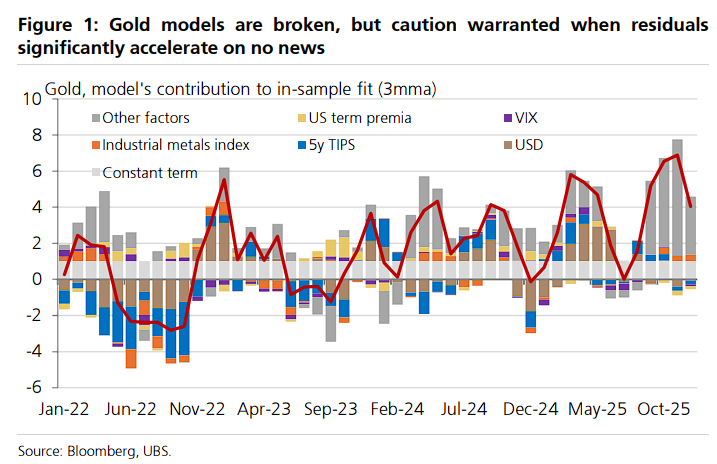
Core Viewpoint - UBS maintains a long-term bullish outlook on gold, targeting $4,750 per ounce, but raises short-term caution due to insufficient momentum in recent price increases and heightened volatility [1][20]. Group 1: Short-term Concerns - The recent surge in gold prices is attributed to the performance of silver, platinum, and palladium rather than independent bullish factors for gold itself [1][11]. - Gold's volatility has surged to levels seen at the onset of the Russia-Ukraine conflict, diminishing its appeal as a "safe haven" asset in private investment portfolios [1][6]. - The relationship between gold and real interest rates has broken down, indicating a potential for price correction in the absence of new market stimuli [1][5]. Group 2: Market Dynamics - The current gold volatility is linked to historical data suggesting that high volatility often correlates with lower future returns [6]. - The gold-silver ratio has dropped to around 65, historically indicating weaker performance for both gold and silver in the following three months [14]. - UBS highlights that when investors aggressively pursue silver, it often signals an overheated market that requires cooling [16]. Group 3: Long-term Outlook - Despite short-term risks, UBS believes conditions for a significant decline (over 20%) in gold prices are not present, as historical patterns show such declines are typically accompanied by decreased stock market volatility and rising credit spreads [17][20]. - Key support factors for gold's long-term bullish trend include central bank purchases, stable ETF inflows, and the undervaluation of gold mining stocks [20][22][27]. - Emerging market central banks, which hold only 7-11% of their reserves in gold, are expected to continue buying during price corrections, providing support for gold prices [20].


东吴证券晨会纪要-20251224
Soochow Securities· 2025-12-24 01:50
Macro Strategy - The convertible bond market in 2025 is expected to present a "dual hit" of parity and premium rates, transitioning from "equity replacement" to "debt market supplementary income" in 2026, due to high valuations and strong redemption tendencies [1][13] - The trading logic in the underlying stock market is changing, with technology growth shifting from "0-1" to "1-N," leading to a more differentiated performance in convertible bonds [1][13] - Inflation is rising, and the deep rectification of internal competition is underway, allowing convertible bonds to utilize "asymmetry" for reverse investment [1][13] Gold Market Analysis - A linear relationship between gold ETF scale and gold prices indicates that for every additional ton of investment demand, gold prices increase by $0.46/oz, with central bank purchases explaining 92.78% of the residual changes in gold prices [2][15] - The traditional pricing framework for gold has diminished, with central bank demand now playing a crucial role in driving gold prices [2][15] - The ongoing trend of central bank gold purchases is expected to provide strong support for upward movement in gold price levels [2][15] Industry Insights - Tianqi Lithium's profit forecast for 2025-2027 shows significant growth, with net profits expected to reach 12.2 billion, 64.9 billion, and 78.6 billion yuan respectively, driven by rising prices of hexafluorophosphate [9] - Sanhua Intelligent Controls has slightly exceeded market expectations for 2025, with projected net profits of 38.7 to 46.5 billion yuan, supported by stable demand in traditional refrigeration and automotive sectors [10] - Bafang Electric's performance in 2025 shows a significant recovery, with net profits expected to increase by 30.52% year-on-year, driven by the end of inventory depletion and demand recovery [11][12]


技术帖:如何量化央行购金对金价的影响?
Soochow Securities· 2025-12-22 10:33
Group 1: Key Findings on Gold Price Dynamics - The linear relationship between gold ETF demand and gold price indicates that for every 1 ton increase in investment demand, the gold price rises by $0.46/oz[1] - From 2003 to 2022, the gold ETF size explained 94.1% of gold price fluctuations, with a slope of 14.29, meaning a 1 million oz increase in gold ETF size leads to a $14.29/oz increase in gold price[1] - Since December 2022, the explanatory power of gold ETF size on gold price has dropped to 9.19%, indicating a shift in pricing dynamics due to increased central bank gold purchases[1] Group 2: Central Bank Purchases Impact - Central bank gold purchases accounted for 92.78% of the changes in the residuals between actual and implied gold ETF demand from Q3 2022 to Q3 2025[1] - As of Q3 2025, the gold ETF size was 96.65 million oz, while the implied gold ETF demand was 235.91 million oz, resulting in a residual of 139.27 million oz, closely matching the central banks' net purchases of 116.15 million oz during the same period[1] - A simplified binary model for gold price suggests it is now primarily driven by central bank demand, influenced by dollar credit, rather than solely by ETF demand[1] Group 3: Future Outlook and Risks - The ongoing trend of central bank gold purchases is expected to provide strong support for a rising gold price amid geopolitical tensions and economic isolationism[1] - Potential risks include a slowdown in central bank purchases, liquidity risks from a global financial crisis, and the impact of technological advancements in the U.S. that could challenge the long-term upward trend of gold prices[1]
【广发宏观陈礼清】宽度下降后的叙事流转:大类资产配置月度展望
郭磊宏观茶座· 2025-09-04 14:56
Core Viewpoint - The macroeconomic environment since August 2025 has been characterized by a strong performance in high-growth sectors, particularly in China's technology stocks, alongside a backdrop of rising global bond yields and shifting currency dynamics [1][3][4]. Group 1: Asset Performance - In August 2025, major asset performances ranked as follows: Sci-Tech 50 > ChiNext Index > CSI 300 > Gold > Hang Seng Tech > Dow Jones > LME Copper > European Stocks > NASDAQ > Hang Seng Index > RMB > 0 > China Bond > Nanhua Composite > USD > Crude Oil > Long VIX [1][14]. - Risk assets generally rose in August, with notable performance in Chinese assets, a concurrent appreciation of the RMB, and pressure on government bonds [2][14]. - The domestic equity market saw a broad increase, with the Wind All A Index rising by 10.9% in August, while the 10-year government bond yield increased by 13.4 basis points to 1.84% [2][27]. Group 2: Macro Trading Themes - The primary macro trading themes since August 2025 include a "high-growth narrative" led by the Sci-Tech 50 and ChiNext Index, a "rate cut trade" in the U.S. following downward revisions in employment data, and a rise in "risk aversion" reflected in increasing global bond yields [3][57]. - The U.S. employment data revision has opened a window for potential Fed rate cuts, influencing various asset classes to align with this "rate cut trade" [3][57]. Group 3: Economic Indicators - The macroeconomic indicators show that the U.S. hard data has remained stable while soft data has slightly improved since August, contrasting with Europe and Japan, where economic outlooks are mixed [4][70]. - China's economic indicators suggest a slowdown, with an estimated actual GDP growth of approximately 4.76% for August, aligning with seasonal economic characteristics [4][70]. Group 4: Real Estate Market - The real estate market in China has shown a narrowing year-on-year decline in sales, with second-hand housing performing better than new homes, indicating a trend of "price for volume" [2][42]. - The rental yield in major cities has remained above the 30-year government bond yield, although the leading margin has narrowed compared to previous periods [2][42]. Group 5: Market Volatility and Sentiment - The volatility in the market has seen a decrease in August, with the number of daily ranking changes among 19 asset classes dropping from 124 to 114 [15][62]. - The VIX index has shown signs of recovery, indicating increased market uncertainty and potential adjustments in global risk assets [15][63].

三议黄金时代行情:本质、框架与定量模型
2025-05-06 15:27
Summary of Conference Call on Gold Market Dynamics Industry Overview - The conference call focuses on the gold market, discussing its pricing mechanisms, investment demand, and the impact of central bank purchases on gold prices [1][3][11]. Core Insights and Arguments - **Gold Pricing Drivers**: The primary drivers of gold prices are investment demand and central bank purchases, with jewelry demand acting as a suppressive factor. Investors tend to buy gold when prices are rising, while central banks increase purchases at price lows and reduce them at highs [1][3]. - **Financial Product Attributes**: Gold pricing is influenced by liquidity, yield, and safety. The real yield on U.S. Treasuries is used to measure the opportunity cost of holding gold, while credit risk associated with the dollar affects its safety attribute [1][4][8]. - **Liquidity Indicators**: Dollar liquidity indicators, such as Libor, can measure the impact of liquidity on gold prices, but they are difficult to predict and only provide reference points [1][6]. - **Long-term Asset Comparison**: Gold is viewed as a long-term asset, comparable to 10-year U.S. Treasuries, with its pricing framework dependent on the real yield of Treasuries and the creditworthiness of the dollar [1][8][9]. - **Impact of Liquidity Crises**: Liquidity crises can lead to short-term adjustments in gold prices but do not alter the long-term trend. Economic crises, pandemics, or trade tensions can cause temporary market volatility [1][10]. - **Future Price Predictions**: Since October 2022, credit factors have driven gold prices up, with an estimated increase of $750 per year. If the trend of de-dollarization continues, gold prices could rise by 20% or more annually in the coming years [1][11][13]. Additional Important Points - **Gold Stocks Potential**: Gold stocks possess resource attributes and inherent growth potential. Companies like Shandong Gold, Zijin Mining, and Zhaojin Mining are highlighted for their growth prospects despite rising costs [2][14]. - **Market Outlook**: The gold market is expected to trend upward over the next 5-10 years, with increasing understanding of the dollar's credit framework leading to higher valuations for gold companies. Companies with strong resource attributes and internal growth, such as Shandong Gold and Zijin Mining, are expected to outperform gold prices [2][15].