AI与智能化

Search documents
碧桂园服务去年营收创新高,今年计划量产1万台清洁机器人
Bei Ke Cai Jing· 2026-03-28 03:25
Core Insights - The company reported a record annual revenue of 48.35 billion yuan, an increase of 4.36 billion yuan year-on-year, with a gross profit of 8.46 billion yuan and a core net profit attributable to shareholders of 2.52 billion yuan [1] - The board proposed a final dividend of 0.0462 yuan per share and a special dividend of 0.4180 yuan per share, totaling approximately 1.511 billion yuan, with an expectation of total dividends for 2026 not less than 1.5 billion yuan [1] Financial Performance - The net cash generated from operating activities was approximately 2.51 billion yuan, with total bank deposits and structured deposits at 17.93 billion yuan [2] - The net profit attributable to shareholders was impacted by non-operating factors, primarily due to amortization costs from acquisitions and impairment of goodwill and other intangible assets [2] - Excluding non-recurring gains and losses, the core net profit attributable to shareholders remained at 2.52 billion yuan, indicating strong profitability in core operations [2] Technological Advancements - The company is leveraging AI and smart technology through the PARA (People + Agents + Robots + Smart IoT) collaborative model to reshape service processes [2] - The "Zero Assistant" has been implemented as a management data assistant and intelligent partner for over 8,000 management personnel, achieving a monthly active rate of over 80% and completing over 170,000 queries [2] - The "Zero Resident" cleaning robots have been delivered at scale, with 1,053 units deployed across more than 200 projects, resulting in over 100% improvement in individual project work hours and over 60% increase in per capita work area [2] Future Plans - The management announced plans to accelerate the large-scale application of "Zero Resident" cleaning robots, aiming to produce 10,000 units within the year to enhance operational standards and efficiency [3]

碧桂园服务2025年报:收入规模创新高,财务稳健领跑行业
Xin Lang Cai Jing· 2026-03-27 11:41
Core Insights - Country Garden Services Group reported robust financial performance with record revenue of 48.35 billion yuan and a core net profit of 2.52 billion yuan, indicating strong operational cash flow and liquidity [1][5][6] - The company aims to enhance its core capabilities in property management, PARA co-living model, vertical deepening of life services, and talent development to drive sustainable growth [1][6] Financial Performance - Revenue reached a new high of 48.35 billion yuan, with a core net profit of 2.52 billion yuan and operating cash flow of approximately 2.51 billion yuan, fully covering the core net profit [1][5] - Cash reserves stood at 17.93 billion yuan, reflecting a solid financial foundation [1][5] Property Management Expansion - The managed area increased to 1.16 billion square meters, with a total of 8,268 projects across 31 provinces and regions in mainland China, as well as Hong Kong and overseas [2][6] - The company ranked first in property service satisfaction according to a recent industry survey [2][6] Market Development - The company achieved significant market expansion with an annualized revenue increase of 2.03 billion yuan from new projects, focusing on high-density cities like Hangzhou, Guangzhou, and Shenzhen [2][7] - Key projects include the Hangzhou Zhuhai Water Rhythm project and the first homeowners' committee project in Suzhou, establishing a strong market presence [7] Community Value-Added Services - Community value-added services are projected to grow by approximately 5% to 4.417 billion yuan by 2025, accounting for about 9.1% of total revenue [8] - The liquor business saw a significant revenue increase of 61.5% to 709 million yuan, with a customer repurchase rate of 61.3% [8] Technological Integration - The PARA co-living model integrates AI and smart technologies to enhance service efficiency, with over 8,000 management personnel using the "Zero Assistant" for data management [4][9] - The deployment of 1,053 cleaning robots has improved operational efficiency, with project satisfaction significantly enhanced [4][9] - The company plans to produce 10,000 cleaning robots within the year to standardize operations and improve efficiency [9]

在变局中追问奇瑞:一家中国车企如何理解“技术之治”
财富FORTUNE· 2026-03-16 13:05
Core Insights - Chery achieved significant milestones in 2025, including its IPO and a leap in the Fortune Global 500 rankings from 385th to 233rd, marking it as the fastest-rising automotive company globally [1] - The automotive industry in China is facing two major uncertainties: the technological overhaul driven by AI and smart technologies, and the reshaping of market rules due to global trade protectionism and geopolitical tensions [1] Capital Market Perspective - Becoming a public company has led to a structural shift in Chery's operational logic, with increased scrutiny from shareholders and investors regarding stock price fluctuations and profitability metrics [3] - This external pressure compels the management to reassess resource allocation and emphasizes the need to create greater social value with fewer resources [5] Technological Challenges - AI and smart technology are central themes, with Chery's chairman actively testing autonomous driving systems to ensure competitive performance against industry leaders like Tesla and Waymo [5][6] - The introduction of end-to-end models in AI presents challenges due to their unpredictable nature, prompting Chery to isolate safety-related components while allowing more aggressive iterations for non-critical features [6] Organizational Evolution - Chery is undergoing a "fission" process to enhance organizational capabilities, breaking down its innovation system into multiple specialized directions to remain agile and responsive [7] - The company has established a framework with 17 L1, 79 L2, and approximately 500 L3 directions to ensure flexibility and continuous improvement [7] Globalization Strategy - As a leader in automotive exports, Chery recognizes the unsustainability of traditional vehicle exports and aims to contribute locally in global markets, reflecting a shift in its role from an exporter to a collaborator [11] - The company emphasizes a dual trade approach, aiming to not only sell globally but also to source globally, enhancing its position in international markets [11] Response to Geopolitical Uncertainty - Chery views current geopolitical tensions as temporary waves in the globalization process and advocates for a pragmatic approach focused on self-improvement and establishing rules to mitigate irregularities in the global landscape [11][13] - The company is committed to using technology to address global challenges, aiming to leverage Chinese cultural strengths to influence the world positively [13]


坚朗五金:在智能家居、智慧社区产品中应用人脸识别、语音声控等多种功能
Sou Hu Cai Jing· 2026-01-21 13:15
Group 1 - The company is committed to improving operational quality and shareholder rights amidst current industry challenges and macroeconomic conditions [1] - The management has applied AI and smart technology in various products, including smart home and smart community solutions, featuring functionalities like facial recognition, voice control, and smart security [1] - The company is exploring opportunities for AI technology integration in both hardware and software development [1] Group 2 - The company acknowledges the importance of adapting to industry trends and is focused on creating better returns for shareholders [1] - There is an emphasis on continuous monitoring of industry dynamics and technological advancements [1]

九牧的三十而惑
Xin Lang Cai Jing· 2026-01-10 11:13
Core Viewpoint - The article discusses the challenges faced by Jomoo, a leading bathroom brand in China, as it transitions from a high-growth phase to a more mature market stage, particularly in the context of changing consumer demands and market dynamics [1][2]. Group 1: Company Performance and Market Position - Jomoo has been recognized as the top seller of smart toilets in China, achieving a market share of 23.4% across all product categories and 44.2% in the smart toilet segment [3][4]. - The company's revenue reached 12.5 billion yuan last year, benefiting from a strong distribution network and a large service team [3]. - Despite its strong market position, Jomoo faces challenges as the real estate market slows down, impacting growth opportunities [4][5]. Group 2: Transitioning Market Strategies - Jomoo must shift its focus from new home procurement to attracting customers in the existing home renovation market, which is characterized by diverse and individualized consumer needs [5][6]. - The traditional sales approach, which relied heavily on partnerships with real estate developers, is becoming less effective as consumer preferences evolve [6][7]. - The company has initiated various promotional campaigns and partnerships to enhance customer acquisition in the existing home market [6][8]. Group 3: Technological Innovation and AI Integration - Jomoo is investing in smart toilet technology, launching products that incorporate AI features, but faces challenges in achieving significant differentiation in a competitive landscape [7][9]. - The current smart toilet market is projected to decline slightly, indicating potential difficulties in driving growth through AI innovations [9][10]. - Consumer reluctance to pay a premium for smart features and competition from tech companies pose additional challenges for Jomoo's smart product offerings [9][10]. Group 4: International Expansion - Jomoo's export volume reached 1.51 million units last year, with a 10.6% increase, highlighting the importance of international markets for growth [11][12]. - The company is pursuing a global strategy that includes acquisitions and establishing design and research centers abroad, but faces challenges related to cultural differences and local market adaptation [11][12]. - While Jomoo has the foundational capabilities for globalization, it must navigate unfamiliar market dynamics to succeed internationally [12].
2025年中国电商SaaS行业背景、发展现状、市场动态及未来趋势研判:AI驱动生态升级,跨境电商引领中国电商SaaS新增长[图]
Chan Ye Xin Xi Wang· 2025-07-16 00:54
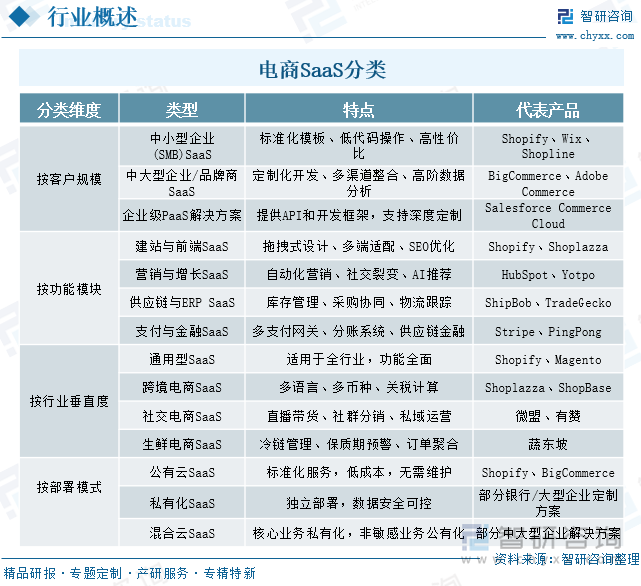
Core Insights - The Chinese e-commerce SaaS industry is experiencing rapid growth, driven by advancements in AI, cross-border e-commerce expansion, and supportive government policies [1][7][20] - The market size for e-commerce SaaS is projected to reach 143.76 billion yuan in 2024, with a compound annual growth rate (CAGR) of 34.65% from 2015 to 2024 [1][12] - Leading companies in the sector include Lingxing ERP, which holds a 26.6% market share in the cross-border e-commerce segment, and Jushuitan, which dominates the domestic small and medium-sized enterprise market [1][18] E-commerce SaaS Industry Overview - E-commerce SaaS provides cloud-based subscription solutions for online store building, operations management, marketing, and logistics, characterized by low cost and easy scalability [2][3] - The industry is evolving towards AI integration, omnichannel capabilities, and low-code solutions [2][20] Market Dynamics - The cross-border e-commerce import and export scale is expected to reach 2.63 trillion yuan in 2024, growing by 10.8% year-on-year, which will enhance the demand for e-commerce SaaS solutions [1][14][23] - The online retail sales in China reached 6.04 trillion yuan in the first five months of 2025, marking an 8.5% increase year-on-year, providing a robust market opportunity for e-commerce SaaS [1][9] Competitive Landscape - The competitive landscape is characterized by a "one strong, many strong" structure, with Lingxing ERP leading the cross-border market and Jushuitan focusing on domestic SMEs [1][18] - Companies like Weimeng and Youzan are enhancing their AI and private domain operation capabilities to strengthen their market positions [1][18] Development Trends - The industry is moving towards deeper AI integration, with applications in smart product selection, dynamic pricing, and automated customer service [20][21] - The "ERP + ecosystem" model is becoming mainstream, with leading firms integrating payment, logistics, and financial services to create a comprehensive operational framework [20][22] - Cross-border e-commerce remains a key growth driver, with policies like "bonded + ERP" improving customs efficiency by over 50% [20][23]