
AI末日论

Search documents
固收|中东变局下-债市怎么看
2026-03-11 08:12
Summary of Conference Call Notes Industry Overview - The discussion revolves around the bond market in the context of geopolitical tensions in the Middle East, particularly the impact of the ongoing conflict on oil prices and inflation, and its subsequent effects on the domestic bond market [1][2][3]. Key Points and Arguments 1. **Impact of Middle East Conflict on Oil Prices** - The conflict has led to a significant reduction in the daily shipping volume through the Strait of Hormuz, dropping from approximately 70 vessels to nearly zero [2]. - Brent crude oil prices have surged to over $90 per barrel, with a notable increase of over 50% since December 2025 [1][2]. 2. **Inflation and Bond Market Dynamics** - The supply-side shocks from rising oil prices have limited effects on the domestic bond market, as historical data suggests that such price increases do not alter the downward trend of bond yields [2]. - Demand-side inflation is identified as the core variable that could influence the bond market, contrasting with supply-side inflation which is seen as detrimental to economic growth [2]. 3. **Global Macroeconomic Narrative Shift** - The macroeconomic narrative has shifted from "AI apocalypse" to "stagflation," with the latter being more relevant to the current bond market conditions [3]. - The risk of stagnation is considered more significant than inflation risk, suggesting that a global recession could benefit the domestic bond market [3]. 4. **Central Bank Monetary Policy Stance** - The central bank is unlikely to implement significant quantitative easing, as indicated by recent statements and reports [4][5]. - However, there is an expectation of marginal improvements in liquidity through measures such as buyback operations and government bond purchases [5]. 5. **Investment Strategy Recommendations** - The current geopolitical situation presents more opportunities than risks for the bond market, suggesting a proactive investment approach [6]. - It is recommended to focus on bonds with maturities of 10 years or less, as the market structure appears healthy with low duration in rate bond funds [6]. - Attention should also be given to structural opportunities, such as the potential compression of spreads between policy bank bonds and government bonds [6]. 6. **Long-term Bond Outlook** - While short-term pressures on long-term bonds (e.g., 30-year bonds) may be significant due to inflation expectations, there is an anticipated rebound in their yields after a decline in mid-term bond yields [7]. Other Important Insights - The current market reaction to geopolitical tensions is largely emotional, potentially creating opportunities for strategic positioning rather than posing risks [2]. - The reduction in the outflow pressure on bank liabilities due to regulatory measures may further support the bond market [5]. - The expected convergence of deposit rates towards 1.5% could open up further downward potential for government bond yields [5].
无需过分担忧“AI末日论”
CAITONG SECURITIES· 2026-03-03 04:30
Group 1: AI Development Constraints - AI development is currently constrained by the exponential growth of chip production, while energy infrastructure is only expanding linearly, leading to potential shortages in high-performance AI chip deployment[3] - According to IEA estimates, data centers are projected to consume over 1700 TWh of electricity by 2035, more than three times the current consumption of less than 500 TWh, which could lead to power shortages if generation does not keep pace[7] Group 2: Employment Impact of AI - The notion that AI will lead to permanent job losses is challenged by the World Economic Forum's report, which predicts that AI will replace 92 million repetitive jobs but create 170 million new jobs by 2030, resulting in a net increase of 78 million jobs globally[15] - Historical evidence suggests that technological revolutions, such as the Industrial Revolution, have historically led to job creation despite initial fears of job loss[12] Group 3: Regulatory Framework - Contrary to the belief that governments are ignoring AI's impact, major economies have begun establishing regulatory frameworks, such as the EU's strict AI Act and China's interim measures for generative AI services[26] - The assumption of a complete regulatory void is unfounded, as proactive measures are being taken to ensure AI development is monitored and controlled[26] Group 4: Economic and Social Stability - The real challenge lies in the mismatch between labor skills and job demands during the transition period, necessitating effective systems for redistribution to mitigate economic instability[23] - Disparities in distribution of value added by AI could exacerbate economic and social instability, highlighting the need for regulatory constraints in the AI era[25]
“AI末日论”:华尔街的恐慌会成真吗?
硅谷101· 2026-02-28 07:50
华尔街吵起来了 原因是这几个字 “AI末日论” 2月末 美股软件板块持续抛售 导火索是这篇文章 《2028全球智能危机》 它的作者Citrini Research 是一个活跃在Substack上的 财经研究机构 文章强调 这不是预测 而只是一个假想场景 但这么一篇“科幻文章” 观点不算新颖 却抹去了千亿美元 为什么 时间快进到2028年6月 美国因为AI 陷入了一场经济危机 原因有四个 第一 AI生成代码的泛滥 软件公司失去护城河 收入塌陷 杠杆收购爆雷 第二 AI agent消灭中间商 机器自动比价、交易、执行 人们不再需要Visa Mastercard、DoorDash 第三 白领就业崩塌 被AI替代 找不到工作 形成恶性循环 消费下降 企业利润压缩 投资更多AI 导致更多裁员 结果就是2028年 美国的失业率超过10% 最后 金融系统传导 SaaS爆雷 今天价值2.5%万亿美元的 私募信贷市场会受到冲击 2027年底 股市暴跌57% Citrini提出 幽灵GDP(Ghost GDP) GDP在增长 实体经济却在收缩 这篇逻辑直白的科幻文章 被华尔街当真了 当然 也有很多反对者认为 “AI末日论”有逻辑 ...


研客专栏 | 2028“AI末日论”的历史反驳
对冲研投· 2026-02-26 07:52
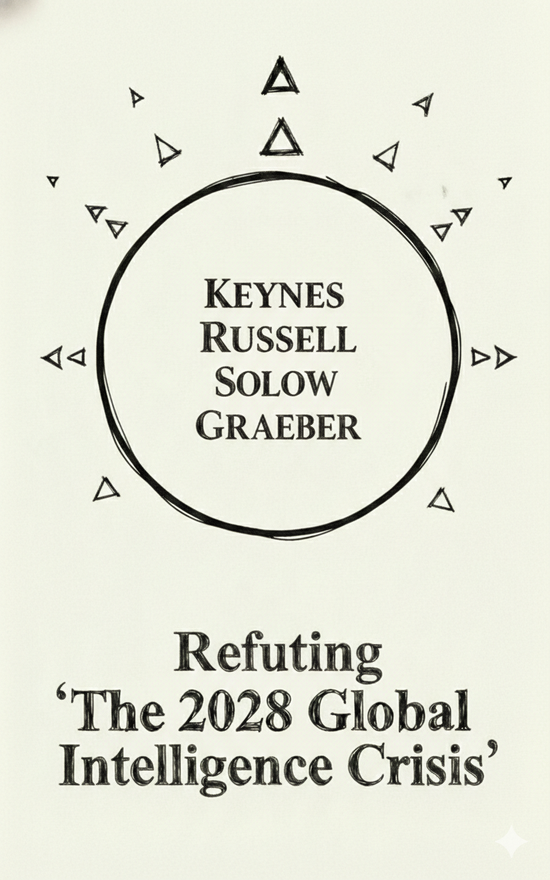
Core Viewpoint - The article argues against the pessimistic predictions of an AI-driven apocalypse in 2028, emphasizing the resilience and adaptability of human society in the face of technological change [2][3]. Group 1: Historical Perspectives on Technology and Society - John Maynard Keynes' 1930 work suggests that technological advancements could lead to a significant increase in living standards, with people working only 15 hours a week by 2030, similar to the AI apocalypse narrative [4]. - Keynes underestimated human desires, positing that as basic needs are met, new and more expensive desires will emerge, thus creating new jobs even as old ones are eliminated by AI [4][5]. - Bertrand Russell's "In Praise of Idleness" argues that technological progress should reduce necessary working hours, but in reality, it has led to job losses and overwork, contradicting the ideal of increased leisure time [6][7]. Group 2: Economic and Social Dynamics - The article highlights that the fear of job loss due to AI is often based on outdated notions of work, where losing a job equates to losing purchasing power rather than gaining leisure [7][8]. - The concept of leisure is framed as a "civilizational asset" rather than a "political liability," suggesting that technological advancements can free humans from mundane tasks, allowing for creativity and innovation [6][7]. - The article critiques the notion that AI will lead to a sudden collapse of the job market, arguing that societal structures are more resilient and capable of adapting to changes in productivity [8][9]. Group 3: The Role of AI in Future Employment - The "Solow Paradox" indicates that while technological advancements are significant, their impact on productivity and employment is gradual, countering the notion of an immediate AI-induced crisis [8][9]. - The article posits that AI's impact on employment will be less severe than macroeconomic factors and that businesses will adapt through various means, including fiscal expansion and changes in work hours [9][10]. - David Graeber's "Bullshit Jobs" suggests that many jobs created in modern capitalism lack real value, and AI could eliminate these roles without harming overall productivity, leading to a more efficient economy [10][11]. Group 4: Future Implications of AI - The emergence of AI presents an opportunity for a shift from a job-centered economy to a human-centered one, potentially leading to concepts like Universal Basic Income (UBI) [11]. - The article concludes that the predictions of an AI apocalypse are based on a fragile assumption that all jobs are essential, while in reality, many roles are unnecessary and could be replaced by AI without negative consequences [10][11]. - Ultimately, the article emphasizes that the true potential of AI will only be realized if it leads to a significant release of leisure time, comparable to the contributions of past industrial revolutions [11].

国金宏观:2028“AI末日论”的历史反驳
Xin Lang Cai Jing· 2026-02-26 02:37
Core Viewpoint - The 2028 AI apocalypse prediction is a thought experiment that underestimates human resilience and adaptability in the face of technological change [3][20][32] Group 1: Historical Perspectives on Technology and Society - John Maynard Keynes' 1930 work suggests that by 2030, living standards could increase by 4-8 times, with humans only needing to work 15 hours a week, paralleling the AI apocalypse narrative of mass unemployment [5][22] - Bertrand Russell's "In Praise of Idleness" argues that technological advancements should reduce necessary labor time, yet the reality has been increased work hours and job losses, highlighting a disconnect between theory and practice [8][26] - Robert Solow's "Solow Paradox" indicates that while technology progresses, its impact on productivity is gradual, suggesting that fears of rapid job loss due to AI may be overstated [12][28] Group 2: The Nature of Work and Value - David Graeber's "Bullshit Jobs" critiques the notion that all jobs are socially valuable, arguing that many roles exist merely to maintain stability, and AI could eliminate these without harming productivity [30][31] - The concept of leisure as a "civilizational asset" rather than a "political liability" suggests that technological progress can free humans from mundane tasks, allowing for greater creativity and innovation [8][26] - The fear of an AI-driven apocalypse stems from a lack of new value anchors, as AI challenges the traditional notion of work equating to worth, necessitating a shift towards a more human-centered approach [32][31]
2028“AI末日论”的历史反驳
SINOLINK SECURITIES· 2026-02-26 02:27
1. Report Industry Investment Rating - Not provided in the document 2. Core View of the Report - Citrini Research's 2028 AI doomsday prophecy is a perfect brainstorm, but the real - world economy is a super - chaotic system. Prophets often underestimate human beings' self - adaptive ability. There is no reason to be overly pessimistic about the AI era [2][4][15] 3. Summary by Relevant Catalogs John Keynes - "Economic Possibilities for our Grandchildren": Endless Human Desires - Keynes in 1930 predicted that by 2030, living standards would increase 4 - 8 times and humans would work 15 hours a week, similar to Citrini's AI doomsday theory. However, this view underestimates the expansion of human desires. AI may eliminate old jobs, but human desires will create new ones [6] - The AI doomsday theory assumes that humans will stop striving and enjoy leisure passively, which does not conform to social development logic. "Freedom" and "fairness" are the core drivers and ultimate goals of economic development [7][8] Bertrand Russell - "In Praise of Idleness": Leisure as a "Civilization Asset" rather than a "Political Liability" - "In Praise of Idleness" is like the origin of the 2028 AI doomsday prophecy but with a milder tone. The real - world response to technological progress is different from Russell's assumption, and the AI doomsday theory over - worries about the loss of purchasing power due to job loss [9] - Leisure is a "civilization asset" that can be transformed into creativity. The political system will take measures to hedge against high unemployment, and the AI doomsday theory ignores this spontaneous adjustment [10] - Both "In Praise of Idleness" and the AI doomsday theory have flaws, and the resilience of the social structure is stronger than expected [11] Robert Solow - "The Solow Paradox": Inertia of Production Relations - The AI doomsday theory criticizes "The Solow Paradox" and warns that the "invisibility" of technology progress may bring huge impacts. However, historical experience shows that the transformation of technology into productivity is relatively slow, and the so - called "doomsday" will be offset by the "time - lag effect" [12] - The impact of AI on employment and production relations is less significant than macro - factors and the 2020 public health event. Enterprises are complex interest - game entities, and AI may face resistance. Even if production relations change, human participation will become a scarce asset [13] David Graeber - "On the Phenomenon of Bullshit Jobs: A Work Theory": Ending Meaningless Bullshit Jobs - "On the Phenomenon of Bullshit Jobs" directly refutes the AI doomsday theory. AI can be a trigger for efficiency regression by replacing meaningless jobs, rather than a catalyst for social collapse [14] - AI provides an opportunity for re - distribution, forcing society to shift from "job - centered" to "people - centered". The so - called "doomsday" is actually the end of "bullshit jobs" and a shattering of the collective perception of "everyone must be busy" [15]
2028“AI末日论”的历史反驳(国金宏观钟天)
雪涛宏观笔记· 2026-02-26 02:13
Core Viewpoint - The 2028 AI apocalypse prediction is a thought experiment that underestimates human resilience and adaptability in the face of technological change [3][6]. Group 1: Historical Perspectives - John Maynard Keynes' 1930 work suggests that technological advancements could lead to a significant increase in living standards, with people working only 15 hours a week by 2030, similar to the AI apocalypse narrative that predicts mass unemployment due to AI [7][8]. - Bertrand Russell's "In Praise of Idleness" argues that technological progress should reduce necessary labor time, yet the reality has been increased work hours and job losses, indicating a disconnect between technological potential and societal adaptation [10][11]. - Robert Solow's "Solow Paradox" highlights that while technology progresses, its impact on productivity is gradual, suggesting that fears of rapid unemployment due to AI may be overstated [13][14]. Group 2: The Role of AI in Society - David Graeber's "Bullshit Jobs" critiques the notion that all jobs are essential, positing that AI could eliminate meaningless positions, leading to a more efficient society rather than a collapse [16][17]. - The report emphasizes that AI's role should be viewed as a catalyst for efficiency rather than a threat to societal structure, challenging the assumption that job loss equates to loss of value [16][17]. Group 3: Economic Adaptation - The article argues that human society is a complex adaptive system, capable of adjusting to technological disruptions, and that the predicted "apocalypse" may not materialize due to this inherent resilience [6][18]. - It suggests that the transition to an AI-driven economy could lead to a re-evaluation of work and value, potentially paving the way for concepts like Universal Basic Income (UBI) as society shifts from job-centric to human-centric models [17].
英伟达黄仁勋:“AI末日论”对社会毫无益处,让人们不敢投资AI
Sou Hu Cai Jing· 2026-01-10 10:31
Core Viewpoint - Nvidia's CEO Jensen Huang expressed concerns that the "AI apocalypse narrative" is negatively impacting investment in AI, deterring potential investors from entering the market [1][3]. Group 1: AI Narrative and Investment - Huang noted a "narrative war" in the AI sector, with one faction portraying a bleak outlook while another remains optimistic, suggesting that both extremes oversimplify the situation [3]. - He emphasized that the doomsday narratives propagated by respected individuals are causing significant harm, affecting people, industries, and governments [3][4]. - Huang criticized the fear surrounding AI, stating that when 90% of the information focuses on apocalyptic scenarios, it discourages investment in AI, which is essential for making the technology safer, more practical, and beneficial to society [4]. Group 2: Regulatory Perspective - Huang argued that companies should not seek increased regulation from the government, implying that some CEOs may have conflicts of interest that prevent them from advocating for the broader societal good [4]. - He previously opposed claims made by Anthropic's CEO regarding AI potentially replacing half of white-collar jobs within five years, indicating a belief in the positive potential of AI rather than a fear-based approach [4].


这些硅谷AI精英“疯了”:花光积蓄囤装备逃命,开末日狂欢派对
Hu Xiu· 2025-08-19 10:26
Core Viewpoint - The article discusses the growing anxiety among AI professionals in Silicon Valley regarding the potential existential threat posed by AI, leading to various extreme behaviors and lifestyle changes among them [1][11]. Group 1: Perspectives on AI's Threat - Anthropic's CEO estimates the probability of AI causing human extinction to be between 10% and 25% [3] - Former OpenAI CEO Emmett Shear provides a broader estimate of 5% to 50% [4] - Geoffrey Hinton warns that without regulation, the probability of AI leading to human extinction in the next 30 years is around 10% [5] Group 2: Employee Sentiments at AI Companies - Employees at Anthropic express a pervasive sense of anxiety, fearing that the AI they create could be used for destructive purposes [7] - One employee reports sleepless nights due to worries about AI, while another estimates a 20% chance of AI causing human extinction within the next decade [8] Group 3: Survival Preparations and Lifestyle Changes - Some individuals, referred to as "AI Preppers," are taking extreme measures, such as building survival shelters and spending their savings on preparations for a potential AI apocalypse [12][20] - Henry, an AI researcher, believes there is a 50% chance that AI will pose a survival threat in the coming years and is constructing a DIY biological shelter [13][15] Group 4: Business Opportunities Arising from Fear - Entrepreneurs are capitalizing on the fear of AI, with companies like Fonix selling ready-made biological shelters priced at $39,000, expected to ship in 2026 [21] - Ross Gruetzemacher is starting a consulting firm focused on helping businesses and individuals prepare for significant disruptions caused by AI and other survival risks [22] Group 5: Hedonistic Responses to AI Anxiety - Some individuals choose to embrace a hedonistic lifestyle, creating "bucket lists" and prioritizing immediate enjoyment over future planning [25][26] - Aella, a social media influencer, expresses a desire to host bizarre parties, viewing the potential AI apocalypse as a reason to live freely [26] Group 6: Shifts in Personal Values and Relationships - As AI takes over intellectual tasks, some individuals are redefining their criteria for relationships, placing greater importance on physical attractiveness and social skills [35][36] - Apoorva Srinivasan, a biomedical data scientist, has shifted her focus from intelligence to personal charm in her partner selection due to AI advancements [36] Group 7: Diverse Reactions to AI's Potential Impact - Not everyone is succumbing to extreme fears; some experts caution against the prevailing doomsday narratives, suggesting that many discussions around AI's threat may be exaggerated [44] - The article draws parallels between current AI-related anxieties and past doomsday predictions, suggesting that future reflections may find today's fears similarly unfounded [46]