
造纸等

Search documents
人民币升值受益板块2月12日跌1.61%,中国东航领跌,主力资金净流出9.16亿元
Sou Hu Cai Jing· 2026-02-12 09:16
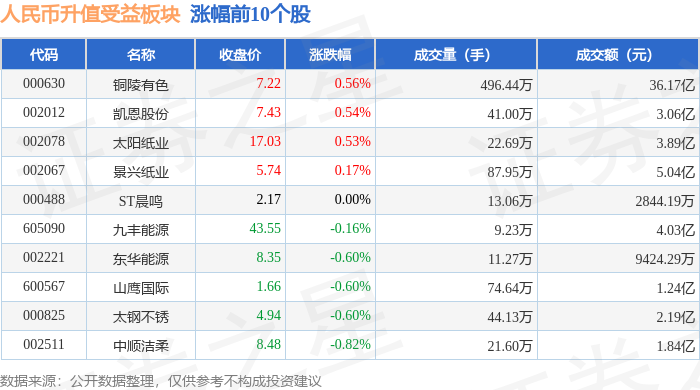
Core Viewpoint - The appreciation of the Renminbi has led to a decline of 1.61% in the benefiting sectors on the previous trading day, with China Eastern Airlines leading the drop [1]. Group 1: Market Performance - On February 12, the Shanghai Composite Index closed at 4134.02, up 0.05%, while the Shenzhen Component Index closed at 14283.0, up 0.86% [1]. - The Renminbi appreciation benefiting sector saw a net outflow of 916 million yuan from main funds, while retail investors contributed a net inflow of 713 million yuan [2]. Group 2: Individual Stock Performance - China Eastern Airlines (600115) closed at 6.00, down 3.07%, with a trading volume of 1.51 million shares and a transaction value of 9.19 million yuan [2]. - Other notable declines include China Duty Free Group (601888) down 2.92% and China Southern Airlines (600029) down 2.27% [2]. - In contrast, Tongling Nonferrous Metals (000630) saw a slight increase of 0.56%, closing at 7.22 with a transaction value of 3.617 billion yuan [1]. Group 3: Fund Flow Analysis - The main funds showed a net inflow of 86.56 million yuan for Tongling Nonferrous Metals, while retail investors had a net outflow of 33.51 million yuan [3]. - For Sun Paper (002078), main funds had a net inflow of 22.31 million yuan, while retail investors had a net outflow of 5.22 million yuan [3]. - The overall trend indicates a mixed sentiment among institutional and retail investors within the Renminbi appreciation benefiting sector [2][3].


三大环境“底牌”必须亮 ESG披露新规扭转企业“纸上谈兵”
Zhong Guo Zheng Quan Bao· 2026-02-08 22:11
Core Viewpoint - The new mandatory ESG information disclosure guidelines for A-share listed companies in China, effective from 2026, aim to enhance the quality and comparability of environmental data, addressing long-standing issues in environmental information disclosure [1][2]. Group 1: New Guidelines and Their Impact - The revised guidelines introduce three new environmental disclosure topics: pollutant emissions, energy utilization, and water resource utilization, providing a unified method for ESG reporting [2]. - Companies are expected to align their 2025 ESG disclosures with the new guidelines, aiming for full compliance with the Shenzhen Stock Exchange's requirements [1][5]. - The guidelines address the fragmentation and lack of standardization in environmental disclosures, which have historically hindered data comparability and quality [2][4]. Group 2: Industry Response and Implementation - Companies like Zijin Mining and Dufu Technology are developing systematic data collection processes to comply with the new guidelines, integrating ESG data into their daily management [5][10]. - The guidelines emphasize the need for companies to analyze the financial impacts of environmental issues on their operations, including effects on profit and cash flow [6][7]. - The guidelines allow for adjustments based on the complexity of a company's operations and data availability, promoting a more tailored approach to ESG reporting [3][8]. Group 3: Risk Management and Opportunities - The new guidelines provide a framework for companies to identify and manage environmental risks, linking ESG disclosures with internal management practices [8][9]. - Companies are recognizing green opportunities, such as recycling and energy recovery, which can enhance both environmental performance and economic benefits [9][10]. - The guidelines encourage companies to proactively manage environmental challenges, moving from compliance to strategic management [8].


三大环境“底牌”必须亮ESG披露新规扭转企业“纸上谈兵”
Zhong Guo Zheng Quan Bao· 2026-02-08 20:22
Core Viewpoint - The new mandatory ESG information disclosure guidelines for A-share listed companies in China, effective from 2026, aim to enhance the quality and comparability of environmental data, addressing long-standing issues of fragmented and qualitative disclosures [1][2]. Group 1: New Guidelines Overview - The revised guidelines introduce three new environmental disclosure topics: pollutant emissions, energy utilization, and water resource utilization, providing a unified method for ESG reporting [2]. - The guidelines aim to resolve the historical challenges of inconsistent data standards and improve the credibility of environmental disclosures by establishing clear definitions and calculation methods [2][3]. Group 2: Industry Response and Implementation - Several listed companies are preparing to align their 2025 ESG disclosures with the new guidelines, with a goal of full compliance by the end of March [1]. - Companies like Zijin Mining and Dufu Technology are developing systematic data collection processes to ensure accurate reporting, utilizing technology for real-time monitoring and data management [4][5]. Group 3: Financial Impact Analysis - The new guidelines emphasize the need for companies to analyze and disclose the financial impacts of environmental issues on their financial statements, including potential effects on cash flow and operational costs [5]. - Companies are encouraged to assess how environmental factors, such as extreme weather and resource scarcity, could affect their financial performance [5][6]. Group 4: Risk Management and Strategic Opportunities - The guidelines provide a framework for companies to identify and manage environmental risks, integrating ESG disclosures into their overall management strategies [6]. - Companies are recognizing green opportunities, such as recycling and energy efficiency projects, which can enhance both environmental performance and economic benefits [6][7]. Group 5: Challenges and Recommendations - Companies face challenges in aligning domestic regulations with international standards, particularly in data reporting and calculation methods [7]. - There is a call for regulatory bodies to offer training and support to help companies navigate the complexities of the new guidelines and improve their ESG reporting practices [7].
首个再生材料应用推广政策文件出台 2030年废钢回收利用3亿吨
Zhong Guo Jing Ying Bao· 2026-01-04 06:56
Core Viewpoint - The National Development and Reform Commission (NDRC) has issued the "Action Plan for the Promotion of Recycled Materials," marking China's first dedicated policy for promoting the application of recycled materials, focusing on key sectors such as steel, non-ferrous metals, plastics, and paper [1][2]. Group 1: Objectives and Key Tasks - The Action Plan aims to promote the application of recycled materials in industries with good development foundations and scalable application conditions, including automotive, electronics, batteries, textiles, and packaging [1]. - By 2030, the recycling system for waste will be further improved, with annual recycling volumes of scrap steel and waste paper exceeding 300 million tons and 8 million tons, respectively [1]. Group 2: Environmental Impact - The use of recycled materials is essential for practicing green development and achieving comprehensive green transformation, significantly reducing pollution and carbon emissions from resource extraction and manufacturing processes [1]. - For instance, using electric arc furnaces in the steel industry can reduce carbon emissions by approximately 1.6 tons per ton of steel produced, with reductions in waste gas, wastewater, and waste residue by 86%, 76%, and 97%, respectively [1]. Group 3: Implementation and Oversight - The NDRC will enhance coordination and tracking to ensure the effective implementation of the Action Plan, with a focus on specific plans for key industries and areas [2]. - The NDRC will also strengthen quality management of recycled materials, enforcing standards for performance, safety, and environmental protection, while cracking down on counterfeit and substandard products [2].
港股配置性价比较高
Zhong Guo Zheng Quan Bao· 2025-12-23 20:18
Group 1 - The Hong Kong stock market has experienced increased volatility in the fourth quarter, with investors speculating on the potential for a "Christmas rally" similar to the "spring market" in A-shares [1][2] - Despite the potential for a rebound narrative, the actual investment guidance may be limited, as the market is still under supply and demand pressure, and the right-side turning point remains unclear [3][4] - The Hang Seng Index and other major indices have shown signs of fluctuation, with net inflows from southbound funds exceeding 240 billion HKD in the fourth quarter, indicating a shift in market dynamics [2][3] Group 2 - The market is expected to benefit from a favorable macroeconomic environment and a potential easing of overseas liquidity, which could enhance risk appetite and stabilize the Hong Kong stock market [3][4] - Key sectors for investment include upstream resources in the power chain, travel-related stocks, and leading domestic AI companies, which are seen as having significant layout value [1][4][5] - Emerging industries such as solid-state batteries, brain-computer interfaces, and biotechnology are anticipated to gain momentum, supported by the "14th Five-Year Plan" and improving macroeconomic conditions [4][5]
午评:沪指低开高走涨0.21% 能源金属板块走强
Zhong Guo Jing Ji Wang· 2025-11-28 03:49
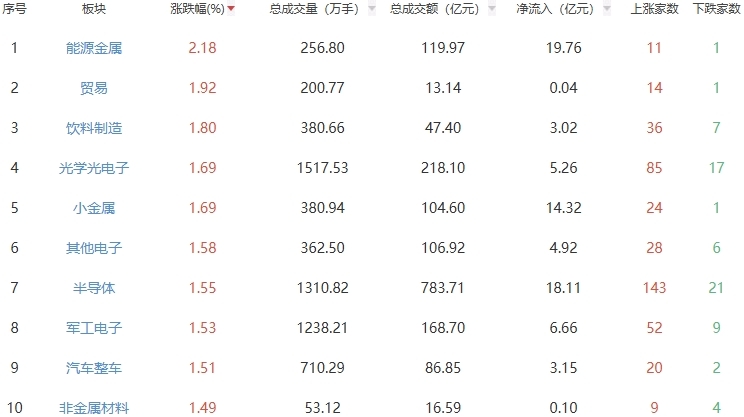
Core Viewpoint - The A-share market experienced a low opening but rebounded, with all major indices turning positive by midday, indicating a recovery trend in the market [1]. Market Performance - The Shanghai Composite Index closed at 3883.46 points, up by 0.21% - The Shenzhen Component Index closed at 12967.66 points, up by 0.72% - The ChiNext Index closed at 3052.87 points, up by 0.71% [1]. Sector Performance Top Performing Sectors - Energy Metals: Increased by 2.18%, with a total trading volume of 256.80 million hands and a net inflow of 19.76 billion - Beverage Manufacturing: Increased by 1.80%, with a total trading volume of 380.66 million hands and a net inflow of 3.02 billion - Optical Electronics: Increased by 1.69%, with a total trading volume of 1517.53 million hands and a net inflow of 5.26 billion [2]. Underperforming Sectors - Traditional Chinese Medicine: Decreased by 1.08%, with a total trading volume of 696.43 million hands and a net outflow of 13.21 billion - Paper Manufacturing: Decreased by 0.72%, with a total trading volume of 554.09 million hands and a net outflow of 2.40 billion - Internet E-commerce: Decreased by 0.61%, with a total trading volume of 169.20 million hands and a net outflow of 3.06 billion [2].
人民币汇率破7.12,央行重磅信号释放!投资者必须关注的三大受益板块
Sou Hu Cai Jing· 2025-08-30 23:57
Core Viewpoint - The offshore RMB experienced a significant rebound against the USD, rising over 340 points in one day, reaching a high of 7.1182, marking the first time since November 6, 2024, that it surpassed the 7.12 threshold. This surge reflects international confidence in China's economic resilience and is indicative of a broader global capital rebalancing trend [3][4]. Group 1: Drivers of RMB Strength - Global monetary policy shifts, particularly dovish signals from the Federal Reserve, have put pressure on the USD, benefiting the RMB. Market expectations for a 89% probability of a Fed rate cut in September have contributed to this dynamic [3][4]. - China's economic fundamentals remain robust, with a cumulative export growth rate of 6.1% from January to July, indicating strong global competitiveness. The positive shift in bank settlement for trade also supports RMB appreciation [4]. - The domestic capital market is recovering, with increased foreign capital inflows into Chinese assets. As of August 27, there was a significant net purchase of approximately 20.4 billion RMB in Hong Kong stocks, reflecting foreign investors' optimism towards the Chinese market [5][7]. Group 2: Beneficiaries of RMB Appreciation - The aviation industry stands to benefit from RMB appreciation, as it reduces the debt exchange losses associated with USD-denominated liabilities for aircraft purchases and fuel imports [8]. - Import-dependent industries, such as paper manufacturing, could see a 3% to 6% increase in gross margins due to lower procurement costs from RMB appreciation [8]. - Other sectors, including transportation, non-ferrous metals, petrochemicals, machinery, home appliances, electronics, and power equipment, may also benefit from reduced import costs and lighter foreign debt burdens [8]. Group 3: Foreign Investment Trends - International capital is increasingly focusing on Chinese stocks, with nearly 60% of sovereign wealth funds prioritizing China as an investment market. Chinese stocks have become the second-largest overseas investment destination for South Korean investors [7]. - Despite foreign capital holding only 3.4% of the total A-share market value, there remains a significant potential for increased foreign investment, indicating a strong future demand for RMB assets [7]. Group 4: Future Outlook for RMB - Market sentiment regarding the RMB's future is generally optimistic, with some institutions predicting a potential return to the "6" range if the central bank maintains a market-driven policy [9][12]. - The RMB's exchange rate is expected to fluctuate between 7.1 and 7.3 in the latter half of the year, reflecting a stable outlook amid moderate economic recovery [9][10]. - As of August 29, the RMB's midpoint against the USD reached 7.1030, the highest since November 7, 2024, indicating increased trading activity in the foreign exchange market [10].
农业品种多震荡运行
Zhong Xin Qi Huo· 2025-07-16 05:37
1. Report Industry Investment Ratings - The report does not provide an overall industry investment rating. However, it gives individual outlooks for different agricultural products, including "oscillating" for most products, "oscillating and declining" for corn and starch, and "oscillating weakly" for logs [5][6][7]. 2. Core Viewpoints of the Report - Most agricultural products are expected to oscillate in the short - term, with different influencing factors for each product. The market is affected by various factors such as weather, supply and demand, trade relations, and macro - economic conditions [5][6][7]. 3. Summaries According to Relevant Catalogs 3.1 Market Views 3.1.1 Oils and Fats - **View**: The growth of US soybeans is good, and market sentiment has weakened. - **Logic**: As of July 13, 2025, the good - to - excellent rate of US soybeans was 70%, higher than expected. The US foreign trade tension has increased, and the US dollar rose on Monday. The expected increase in US biodiesel demand for US soybean oil and the increase in the biodiesel blending ratio in Brazil are positive factors. However, the large arrival volume of imported soybeans in China and the expected increase in palm oil production in Malaysia are negative factors. - **Outlook**: The oil market is expected to continue to oscillate and differentiate in the near future [5]. 3.1.2 Protein Meals - **View**: The good - to - excellent rate of US soybeans is higher than expected, and US soybeans are weaker than Dalian soybean meal. - **Logic**: International trade tensions are high. US soybeans are growing smoothly, but the export prospects are worrying. Brazilian soybean exports are still high. In China, the supply pressure dominates the weakness of the spot market, but concerns about Sino - US trade support the futures price. - **Outlook**: The domestic double - meal futures are stronger than US soybeans, and the domestic futures market is stronger than the spot market. The basis is expected to weaken. In the short - term, it will oscillate within a range, and in the long - term, it will be bullish [6]. 3.1.3 Corn/Starch - **View**: Pay attention to the risk of a periodic rebound. - **Logic**: The supply of ports and deep - processing enterprises has decreased slightly. The futures price rebounded slightly during the day and then fell back. The cumulative auction volume of imported corn is 137 million tons, and the transaction volume is about 82 million tons. - **Outlook**: It is expected to oscillate and decline in the short - term [7]. 3.1.4 Pigs - **View**: Supply and demand are stable, and pig prices oscillate. - **Logic**: In the short - term, large pigs are still being sold off, but the average weight has bottomed out and rebounded. The planned slaughter volume of group farms in July has decreased. In the medium - term, the number of new - born piglets from January to May 2025 has increased, and the slaughter volume is expected to increase in the second half of the year. In the long - term, the production capacity is still high. - **Outlook**: The reform expectation on the supply side boosts the sentiment of pig futures. The price is expected to oscillate, but there is still supply pressure in the medium - and long - term [9]. 3.1.5 Natural Rubber - **View**: It runs oscillating and strongly. - **Logic**: It is affected by capital sentiment at night and then adjusts with the market during the day. The trading logic follows the macro - sentiment. The supply in Asian producing areas is limited due to the rainy season, and the demand from tire enterprises has recovered. - **Outlook**: It may follow the overall commodity fluctuations before the fundamental situation provides guidance [11][13]. 3.1.6 Synthetic Rubber - **View**: The futures price oscillates within a range. - **Logic**: It follows the movement of natural rubber and the overall commodity market, but the amplitude is limited. There is no obvious upward driving force, but there is support from the macro - environment and the improvement of butadiene trading. - **Outlook**: It is expected to continue to oscillate within a range, and attention should be paid to device changes [14]. 3.1.7 Cotton - **View**: Cotton prices fluctuate within a narrow range. - **Logic**: According to the USDA's static balance sheet for the 25/26 season, the global, Chinese, and US cotton markets are all loose. The expected increase in Xinjiang's cotton production and the weak demand in the off - season are negative factors. However, the low inventory before the new cotton is listed provides support. - **Outlook**: It is expected to oscillate in the short - term, with a reference range of 13,500 - 14,300 yuan/ton. There is a risk of price decline when a large amount of new cotton is listed [15]. 3.1.8 Sugar - **View**: Pay attention to import changes. - **Logic**: In the medium - and long - term, sugar prices are weak and under downward pressure due to the expected oversupply in the 25/26 season. In the short - term, the decline in Brazil's sugar production and the high sales - to - production ratio in China support the price, but the increase in Brazil's production and exports and China's imports will increase the supply pressure. - **Outlook**: In the long - term, sugar prices are expected to oscillate weakly; in the short - term, they are expected to oscillate [17]. 3.1.9 Pulp - **View**: The macro - environment dominates the trend, and pulp prices are rising within a range. - **Logic**: The futures price rises with the macro - atmosphere. The supply and demand are in a stalemate, and the upward driving force comes from the macro - environment. The low US dollar price, high overseas pulp mill inventory, and weak downstream demand limit the upward space. - **Outlook**: The pulp futures are expected to oscillate due to the warm macro - atmosphere, weak supply - demand guidance, and low absolute valuation [18]. 3.1.10 Logs - **View**: The outbound volume has declined, and the inventory has increased. - **Logic**: The new - week outbound volume of logs has decreased, and the inventory has increased. The spot price is weak due to the impact of deliverable goods. The cost of both buyers and sellers has increased during the 07 delivery. The overall demand for logs this year is stable, and the inventory - reduction rhythm is slow. - **Outlook**: It is expected to oscillate weakly around the delivery cost in the short - term [19]. 3.2 Variety Data Monitoring - The report mentions variety data monitoring for oils and fats, corn and starch, pigs, cotton and yarn, sugar, pulp, and logs, but no specific data content is provided in the given text.