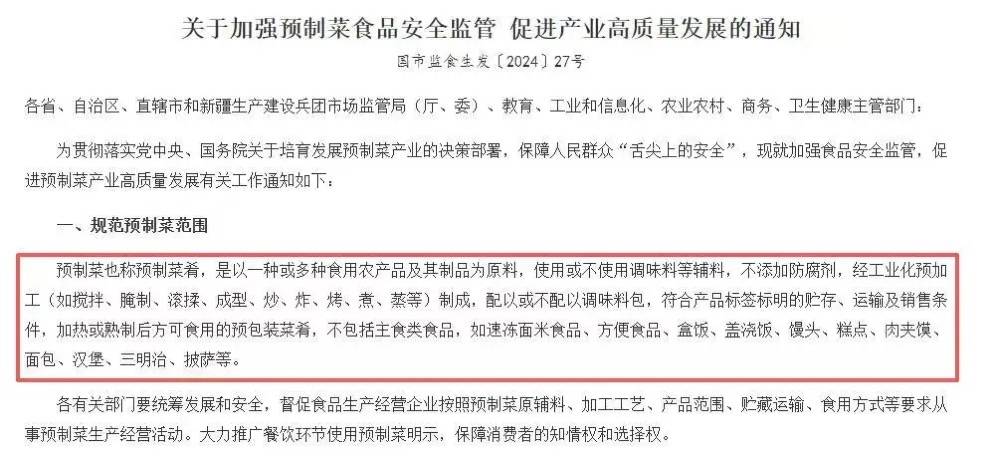
预制菜行业

Search documents
经济日报谈预制菜:只要明明白白把选择权交给消费者,就能吃个安心
Jin Rong Jie· 2026-02-11 00:07
Core Viewpoint - The national standard for pre-prepared dishes has been released for public consultation, aiming to regulate pre-prepared dishes as industrial food primarily focusing on food safety [1] Group 1: Regulatory Framework - The pre-prepared dishes standard is essentially a food safety standard, intended to ensure safe production, transportation, and storage of these products [1] - The "Central Kitchen Operation Management Specification" outlines detailed requirements for processing, packaging, and storage, including mandatory labeling of kitchen name, food name, consumption methods, production date, storage conditions, and shelf life [1] Group 2: Consumer Perception - There is a noticeable gap between the national standard and consumer perception, largely due to some restaurants misrepresenting pre-prepared dishes as freshly cooked by chefs [1] - By clearly communicating the choice to consumers, the industry can enhance trust and ensure safety in the consumption of pre-prepared dishes [1] Group 3: Industry Context - The success of global chains like McDonald's and KFC demonstrates that a robust system for managing pre-prepared food can lead to consistent quality and safety [1] - Pre-prepared dishes have already become commonplace in households, indicating a growing acceptance and demand for these products [1]
东海研究 | 晨会纪要20260209
Xin Lang Cai Jing· 2026-02-09 10:54
Group 1: Macro Background and Chemical Industry - The macroeconomic outlook for the chemical industry shows sustained improvement, with a focus on oil price variables [4][34] - The IMF projects global economic growth of 3.3% in 2026 and 3.2% in 2027, an increase of 0.2 percentage points from previous forecasts [4][34] - The chemical production index in the Asia-Pacific region saw a slight increase of 0.3%, while North America and Europe experienced a decline of 0.8% [4][34] - Since 2022, the number of chemical plant closures in Europe has surged sixfold, with a cumulative capacity loss of 37 million tons, representing about 9% of Europe's capacity [4][34] - The current chemical industry cycle is characterized by improved domestic competitiveness and stable profitability for industry leaders, despite oil prices being relatively high compared to previous cycles [4][34] Group 2: Domestic Equity Market - In the week ending February 6, 2026, the average daily trading volume in the domestic equity market was 23,880 billion yuan, down from 30,365 billion yuan [3][33] - Among the 31 primary industries, 18 saw gains while 13 experienced declines, with the food and beverage sector leading with a gain of 4.31% [3][33] - The sectors with the largest declines included non-ferrous metals (-8.51%), telecommunications (-6.95%), and electronics (-5.23%) [3][33] Group 3: Pre-prepared Food Industry Standards - The National Health Commission released a draft standard for pre-prepared foods, defining their scope, shelf life, nutritional quality, packaging, and additive use, which is significant for the industry's high-quality development [8][37] - The draft specifies that pre-prepared foods must not use preservatives and should minimize food additives, with a maximum shelf life of 12 months [9][38] - The new standards are expected to raise industry entry barriers and operational costs, leading to increased concentration in the market as smaller companies may be eliminated [9][39] - The establishment of these standards is anticipated to enhance consumer trust and expand the growth potential of pre-prepared foods in the consumer market [9][40]

外卖时代将被终结?一个全新行业正悄悄取代外卖,你准备好了吗?
Sou Hu Cai Jing· 2025-12-16 06:47
Group 1 - The takeaway industry has rapidly risen in recent years, addressing the meal needs of both the elderly and young people, with 30% of the restaurant industry's revenue coming from takeaway orders [1] - The industry has created numerous job opportunities and increased order volumes for the restaurant sector [1] Group 2 - There are significant concerns regarding food safety in the takeaway industry, as some vendors may use expired or substandard ingredients and additives, which can negatively impact health [3] - Takeaway packaging generates substantial waste, with 16 million tons of garbage produced annually in China, primarily from plastic products that take over a century to decompose [3][5] - Traffic safety issues arise as delivery personnel often violate traffic rules to meet tight delivery schedules, leading to accidents and posing risks to pedestrians [5] Group 3 - The rise of pre-prepared meals (pre-made dishes) is emerging as a challenge to the takeaway industry, with these meals offering a safer food option due to standardized production processes [7] - Pre-prepared meals save time for busy workers, allowing them to quickly prepare meals without the hassle of shopping and cooking [10] - Purchasing pre-prepared meals can be more cost-effective than ordering takeaway, as it eliminates delivery and packaging fees, while also reducing health risks associated with takeaway food [10]

预制菜为什么能占据我们的生活?
Di Yi Cai Jing· 2025-12-15 07:07
Core Viewpoint - The article discusses the shift in consumer behavior towards pre-prepared meals and takeout, highlighting the increasing reliance on convenience over traditional cooking methods due to rising costs and time constraints in modern life [12]. Group 1: Consumer Behavior - Consumers initially embraced pre-prepared meals for their convenience and cost-effectiveness compared to cooking from scratch, but this perception has changed as the quality of restaurant food has become homogenized [2][4]. - The rise of social media and food delivery platforms has altered how consumers choose restaurants, leading to a preference for familiar options that offer consistent quality, further driving the demand for pre-prepared meals [8][9]. Group 2: Restaurant Industry Dynamics - Restaurants face significant operational costs, including high rent and labor expenses, which incentivizes them to adopt pre-prepared meals to reduce food costs and labor requirements [5][6]. - The trend towards pre-prepared meals allows restaurants to maintain profitability while meeting consumer demand for quick and reliable dining options, as traditional cooking methods become less feasible [4][6]. Group 3: Economic Factors - The increasing cost of living and the need for efficiency in meal preparation have led consumers to rely more on takeout and pre-prepared meals, marking a significant shift in dining habits [12]. - The article suggests that as the costs associated with cooking at home continue to rise, the trend towards pre-prepared meals will likely intensify, reflecting broader economic pressures [12].

预制菜消费避坑指南:下单前先看投诉平台更安心
Xin Lang Cai Jing· 2025-11-26 07:01
Core Insights - The pre-prepared food market is rapidly expanding due to its convenience and time-saving features, appealing to households and young consumers [1] - Despite the growth, there are increasing consumer complaints regarding freshness, taste discrepancies, spoilage within the shelf life, and unregulated packaging information [1] Group 1: Consumer Rights and Complaint Channels - Consumers are encouraged to proactively research brands or products before making purchases, utilizing online tools to check for past complaints [2] - The official complaint platform, 12315, is recognized for its authority and ability to impose administrative penalties on businesses found violating regulations [3] - Third-party complaint platforms, such as Black Cat Complaints, have emerged as significant resources for consumers, aggregating complaints and providing a searchable database of consumer experiences [4] Group 2: Utilizing Black Cat Complaints - Black Cat Complaints serves as a pre-purchase research tool, allowing consumers to identify common issues associated with specific brands or products [5] - The platform offers a user-friendly interface for filing complaints, significantly lowering the barriers for consumers to seek redress [5] - Monthly "Red and Black Lists" published by the platform highlight companies with high complaint volumes and low resolution rates, serving as a guide for consumers [5] Group 3: Recommended Strategies for Consumers - For pre-prepared food purchases, a combination strategy is advised: use third-party platforms for background checks before buying and follow up with direct negotiation with the seller if issues arise [7] - If negotiations fail, consumers should utilize platforms like Black Cat Complaints for efficient complaint processing and simultaneously report serious issues to the 12315 platform for administrative action [7] Conclusion - In the information age, consumers are urged to leverage complaint platforms for informed decision-making, ensuring a safer and more reliable purchasing experience in the pre-prepared food sector [8]
十分钟再谈预制菜·预制菜的明天:一场关于时间、健康与情感的生活变革丨农业干部讲预制菜㉔
Nan Fang Nong Cun Bao· 2025-10-10 09:01
Core Insights - The article discusses the transformative impact of pre-prepared meals (pre-made dishes) on modern Chinese households, emphasizing the shift from traditional cooking to a focus on time, health, and emotional well-being [3][4]. Group 1: Market Demand - The consumption landscape in China is being reshaped by two significant demographics: the "post-00s" generation and the expanding "silver-haired" population [8]. - The "post-00s" generation, comprising approximately 150 million individuals, primarily purchases pre-prepared meals to save time and due to a lack of cooking skills, with over 70% citing these reasons [9][10]. - The "silver-haired" population, which has reached 280 million, faces challenges in cooking due to physical limitations, leading to a demand for convenient, nutritious meal solutions [14][15]. Group 2: Time Savings - A traditional cooking model for a family dinner takes about 1-2 hours, while the pre-prepared meal model reduces this to approximately 20-30 minutes, saving about 1 hour per meal [22][23]. - Over a year, this time savings translates to approximately 365 hours, equivalent to about 45.6 workdays, allowing families to engage in more meaningful activities [28][29]. Group 3: Industry Evolution - The evolution of the dairy industry serves as a reference for the development of pre-prepared meals, highlighting the transition from unsafe to safe consumption through technological advancements [36][42]. - The future of pre-prepared meals is expected to focus on personalized, health-oriented dietary solutions, driven by modern agriculture and food technology [43][46]. Group 4: Vision for the Future - The article envisions a future where pre-prepared meals not only address basic nutritional needs but also enhance emotional connections and cultural traditions during family gatherings [56][62]. - The integration of technology and personalization in meal preparation is anticipated to foster a deeper sense of care and connection among family members, particularly between younger and older generations [64][66].

最新!罗永浩宣布将测评在售预制菜 强调为了避嫌只做评测 不会直播带货
Hua Xia Shi Bao· 2025-09-23 07:48
Core Viewpoint - Luo Yonghao plans to test various ready-to-eat meals available in the market to identify which ones are safe for consumption, while explicitly stating he will not engage in live-streaming sales of these products [1][3]. Group 1: Company Debt and Legal Issues - Luo Yonghao clarified that he repaid all legally mandated personal debts five years ago and has since voluntarily repaid company debts that he was not legally obligated to pay [3]. - Smartisan Technology (Chengdu) Co., Ltd. has recently been listed as a dishonest executor due to failing to fulfill legal obligations, with a total execution amount of 21.4286 million yuan related to loan disputes with Suzhou Zhihui Shengwang Venture Capital [3][4]. - The company stated that the 15 million yuan borrowed from Zhihui Venture Capital is a corporate debt, not a personal one, and Luo Yonghao had previously expressed willingness to repay this debt personally, but decided to delay due to ongoing defamation from the venture capital's management [4]. Group 2: Public Perception and Controversies - Luo Yonghao faced criticism from the founder of Xibei for his comments on the use of ready-to-eat meals without consumer disclosure, leading to a lawsuit for defamation [5]. - Speculations arose regarding Luo Yonghao's whereabouts when his IP address changed to locations outside of China, but he later confirmed he was on a business trip and returned to Shanghai [5][7]. - In response to public comments, Luo Yonghao shared his dining experiences, contrasting fresh meals with ready-to-eat options, and emphasized the importance of quality in food service [7].
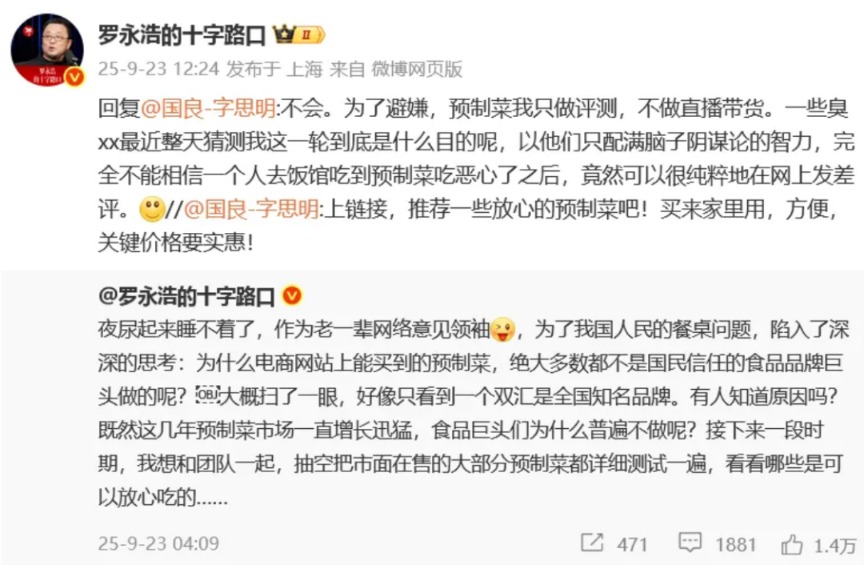
罗永浩:发问预制菜,称不转型做预制菜
Sou Hu Cai Jing· 2025-09-23 02:44
Core Insights - The article discusses the phenomenon of pre-packaged meals in the market, highlighting a lack of trust in brands that produce these products, with only a few well-known companies like Shuanghui being identified [1] Industry Summary - The pre-packaged meal market has experienced rapid growth in recent years, yet major food corporations have largely not entered this space [1] - The article indicates a potential gap in the market for trusted pre-packaged meal brands, suggesting an opportunity for new entrants or existing companies to establish credibility [1] Company Summary - Luo Yonghao, a notable figure, plans to test various pre-packaged meal products available in the market to identify safe and reliable options for consumers [1] - Despite suggestions from the public for him to transition into the pre-packaged meal business, he has stated that he will not pursue this direction [1]
从预制菜退潮,看消费者餐桌的新选择
Sou Hu Cai Jing· 2025-09-21 04:23
Core Insights - The popularity of prepared meals is declining as consumers shift towards more personalized and meaningful dining experiences, seeking fresh ingredients and home-cooked meals instead of convenience [1][3][4] Group 1: Consumer Behavior - Consumers are moving away from the convenience of prepared meals, which were once prominently displayed in stores, to more traditional cooking methods that emphasize freshness and personal touch [1][7] - The trend indicates a growing preference for cooking at home, especially among younger demographics who enjoy inviting friends over for meals and selecting seasonal ingredients [3][4] Group 2: Emotional and Social Aspects - The act of cooking and sharing meals is becoming a way to enhance emotional connections, with home-cooked dishes and accompanying beverages like Duqin wine serving as symbols of togetherness [3][4][7] - Duqin wine is increasingly seen as a complement to home-cooked meals, enhancing the dining experience and fostering a sense of community during gatherings [3][4] Group 3: Market Implications - While prepared meals may not disappear entirely, their current decline suggests a shift in consumer priorities towards the cooking process and the emotional significance of meals [7] - The market may see a rise in products that cater to this desire for personalization and emotional engagement in dining experiences, contrasting with the standardization of prepared meals [4][7]
预制菜打不败中国人的“新鲜信仰”
Hu Xiu· 2025-09-16 14:10
Core Viewpoint - The recent dispute between internet celebrity Luo Yonghao and Xibei has brought the topic of "pre-prepared dishes" into the spotlight, highlighting the negative perceptions associated with them in Chinese dining culture [1][2]. Group 1: Cultural Context of Freshness - Chinese food culture is deeply intertwined with the concept of freshness, where the time from farm to table is crucial for quality [3][5]. - Freshness is not only about time but also about taste, with specific regional preferences dictating what is considered fresh, such as live fish being killed on-site [3][4]. - The preference for fresh ingredients is evident in consumer behavior, as seen in the popularity of live poultry markets prior to health crises like SARS [3][4]. Group 2: Pre-prepared Dishes and Consumer Perception - Pre-prepared dishes are viewed as the antithesis of freshness, with consumers associating them with lower quality and safety concerns [6][7]. - The cultural resistance to pre-prepared dishes mirrors historical aversions to canned foods, with data showing significantly lower consumption rates in China compared to Western countries [6]. - The introduction of long shelf-life products raises consumer anxiety about freshness and quality, leading to skepticism about the nutritional value of such items [7][19]. Group 3: Central Kitchen Model in the Restaurant Industry - The central kitchen model has become prevalent among chain restaurants, with 68.3% of such establishments utilizing this system to streamline operations and reduce costs [10][14]. - Central kitchens allow for standardized food preparation, which can diminish the traditional role of chefs and the uniqueness of regional cuisines [11][12]. - The efficiency of central kitchens supports rapid expansion and profitability for restaurant chains, as seen in the case of Haidilao's subsidiary, which supplies ingredients to over 2,000 outlets [13]. Group 4: Market Trends and Future Outlook - The pre-prepared dish market in China is projected to grow significantly, with a market size of 419.6 billion yuan in 2022 and an expected annual growth rate of around 20% over the next few years [14][17]. - Despite the convenience offered by pre-prepared dishes, there remains a strong consumer preference for fresh, locally sourced ingredients, indicating a potential challenge for the industry [17][22]. - The need for transparency in the pre-prepared food supply chain is emphasized, as consumers seek assurance regarding the safety and quality of these products [20][21].