
算力产业

Search documents
向未来生长——台州制造的跃迁与再造
Xin Hua Wang· 2025-12-07 01:59
Core Insights - Taizhou is undergoing a transformation in its manufacturing landscape, shifting from traditional metalworking to advanced technologies such as satellite manufacturing and AI-driven computing [1][3][6] Manufacturing Transition - The city is moving from traditional manufacturing, characterized by automotive and machinery production, to new sectors like aerospace and digital technologies [3][4] - Taizhou's satellite manufacturing, exemplified by the production of "Blue Carbon No. 1," has adopted an automotive-style mass production model, reducing costs by approximately 45% and increasing annual production capacity to 500 satellites [3][4] Computing and AI Development - The establishment of the Southeast Zhejiang Intelligent Computing Center marks a strategic move to enhance local computing power, crucial for the digital economy [5][6] - The center has partnered with leading domestic AI chip companies, significantly improving the efficiency of data processing and enabling rapid deployment of new technologies [5][6] Industry Innovation - Companies like Crystal Optoelectronics and Four Brothers Rope have demonstrated significant advancements in their respective fields, achieving breakthroughs in optical technology and deep-sea cable manufacturing [7][9][10] - Crystal Optoelectronics successfully transitioned to semiconductor optical processes, while Four Brothers Rope developed high-strength cables for deep-sea applications, showcasing the potential for traditional industries to innovate [9][10] Collaborative Innovation - The establishment of mixed-ownership innovation centers, combining state-owned enterprises, private companies, and academic institutions, aims to address high-end manufacturing challenges [11][12] - This collaborative approach has led to significant advancements in high-end CNC systems, with a focus on practical solutions rather than theoretical research [11][12] Financial Support for Innovation - Taizhou's local government has implemented a robust financial ecosystem to support innovation, including industry funds and insurance products tailored for startups [14][15] - This financial backing is crucial for sustaining long-term innovation and reducing risks associated with new ventures [14][15] Conclusion - Taizhou's transformation illustrates the potential for traditional manufacturing sectors to evolve through technology and innovation, contributing to regional economic development and setting a model for other areas [15]

中国八大算力枢纽 甘肃智算占比最高
Zhong Guo Xin Wen Wang· 2025-12-06 11:03
会议披露,庆阳首创八大节点"数盾"安全标准,发布枢纽节点首个"数盾"体系规划和团体标准,启动建 设"数盾"平台和"数盾"联合实验室。 目前,当地已打通庆阳至西安、北京、南京、上海、广州、深圳的高可靠、高安全算力通道,构建起中 国首个工业互联网算力网络。(完) (文章来源:中国新闻网) "庆阳成为全国AI产业重要的绿色智算保障基地,累计对接数字企业6463户,构建了全链闭环的人工智 能产业生态。"周继军称,同时,通过引进中国通号、中航科工、中科星图等头部企业,创新研发中国 首个3D打印航空涡喷发动机,并发布中国国内领先复合翼垂直起降无人机。 今年以来,航天科技成果转化中心、陇东低空经济现代产业学院和低空经济人才培养基地在庆阳投入运 营,2025数字中国创新大赛首个低空经济赛道赛事举办,中国国内领先的"非标定制"无人机柔性制造 和"飞手"人才培训基地正加速崛起。 中新社甘肃庆阳12月6日电 (记者闫姣)2025中国算谷数字产业发展大会6日在甘肃省庆阳市举办。庆阳市 市长周继军在会上表示,庆阳已成为中国八大算力枢纽节点中算力增速最快、增量最大、智算占比最 高、消纳最充分的标杆集群,算力服务覆盖全国,辐射北美、欧洲等 ...
全线大涨,四大主线行情火爆!
天天基金网· 2025-12-05 05:31
Core Viewpoint - The article highlights a significant rise in A-shares, with over 3,500 stocks increasing in value, driven by four main sectors: computing power industry chain, electric power infrastructure industry chain, commercial aerospace, and non-ferrous metals. Notably, the stock of Moore Threads surged by 416.79%, reaching a market capitalization of 277.6 billion yuan, making it the only stock with a half-day trading volume exceeding 10 billion yuan, totaling 12.59 billion yuan [2][4]. Group 1: Computing Power Industry Chain - The computing power industry chain saw notable gains, particularly in sectors like optical modules and copper cables, with stocks such as Zhishang Technology and Dongtian Micro experiencing significant increases [6]. - Key stocks in this sector included Zhishang Technology, which reached a 20% increase, and Changguang Huaxin, also hitting a 20% increase, with respective market capitalizations of 6.65 billion yuan and 22.7 billion yuan [7]. - Marvell's acquisition of Celestial AI for $3.25 billion, including $1 billion in cash and $2.25 billion in stock, highlights the growing importance of photonic technology in addressing data transmission bottlenecks in data centers [8][9]. Group 2: Commercial Aerospace - The commercial aerospace sector experienced a strong rally, with stocks like Hongxiang Co., Changguang Huaxin, and Chaojie Co. hitting the daily limit of 20% [12]. - The successful launch of the Zhuque-3 rocket and the upcoming 2025 Satellite Internet Industry Ecosystem Conference in Shanghai indicate a growing focus on commercial aerospace advancements [14][15]. - The number of commercial aerospace companies in China has surpassed 600, with significant projects expected to commence during the 14th Five-Year Plan period, including manned lunar missions and satellite internet construction [15].



福建发力构建“一核两区多点” 算力网络协同发展布局
Shang Hai Zheng Quan Bao· 2025-12-02 18:09
在基础设施建设方面,《措施》还提出,鼓励福州(含平潭)、泉州、厦门等地规划建设城市算力网, 推进"福州—深圳短路径光缆"项目建设。升级扩容"福淡""厦金"海底光缆,依托区域性国际关口局探索 算力"出海"专网服务。 作为数字经济大省,福建近年来数字经济规模持续高速增长。福建省发展改革委党组成员、省数据管理 局局长郭文忠曾透露,福建全省数字经济规模从2020年的2.03万亿元跃升至2024年的3.2万亿元,年均增 速超12%。 国研新经济研究院创始院长朱克力分析称,《措施》的出台对行业影响深远:从基础设施层面看,将推 动算力资源布局优化;从技术发展角度,鼓励新技术研发部署,将加速行业技术迭代,提升整体技术水 平;在应用场景方面,聚焦政务、医疗等重点行业开展算力应用创新,能拓展算力应用边界,催生新业 态新模式。 福建上市公司积极布局算力业务。弘信电子2025年前三季度算力及相关业务收入占主营业务收入比例达 40.53%。弘信电子董事长李强表示,《措施》的出台将给本地企业发展带来利好,下一步公司非常有 意愿参与支持西部及宁夏算力建设。鸿博股份AI算力业务占比超75%,相关人士称将借助政策机遇拓展 福建本地市场。此外还 ...





2分钟,涨停!一则消息,引爆市场!
券商中国· 2025-12-02 08:07
Core Viewpoint - The article discusses the recent policy support for the computing power industry in Fujian Province, aiming to enhance the development of computing infrastructure and promote the integration of digital and physical economies [4][5]. Group 1: Policy Measures - Fujian Province aims to achieve a public computing power scale of over 12 EFLOPS by the end of 2027 and plans to construct several medium-sized computing infrastructure projects [4][5]. - The measures include improving computing network transmission efficiency and advancing the construction of the "Fuzhou-Shenzhen Short Path Optical Cable" project [8]. - The initiative encourages the establishment of a unified computing resource public service platform to facilitate resource allocation and sharing across the province [6]. Group 2: Infrastructure Development - The plan includes the construction of high-performance data centers in key areas, with a focus on energy efficiency, aiming for a Power Usage Effectiveness (PUE) of below 1.25 and an overall rack utilization rate of no less than 65% [5]. - The development strategy emphasizes a collaborative layout of "one core, two zones, and multiple points" for integrated computing network development [5]. - The article highlights the need for strict compliance with national layout requirements for data centers, focusing on the aggregation of computing resources at national hub nodes [5]. Group 3: Technological Advancements - The measures promote the deployment of edge computing nodes in key areas and encourage the collaboration between cloud computing and edge computing [8]. - By 2027, the plan aims to deploy at least 50 edge nodes and create no fewer than five typical cases [8]. - The article mentions the importance of advancing storage technologies and optimizing data management to enhance efficiency and security [9]. Group 4: Market Opportunities - The computing power infrastructure market is viewed as a rapidly expanding sector, with significant growth potential as demand for computing resources continues to rise [10]. - Companies with comprehensive AI stack capabilities are expected to benefit from the increasing demand for computing power solutions [10]. - The article suggests focusing on investment opportunities in the supply chain of optical interconnects and related technologies as the market evolves [10].

今年前九个月,山东智能算力产业规模超七百亿元
Da Zhong Ri Bao· 2025-12-01 00:59
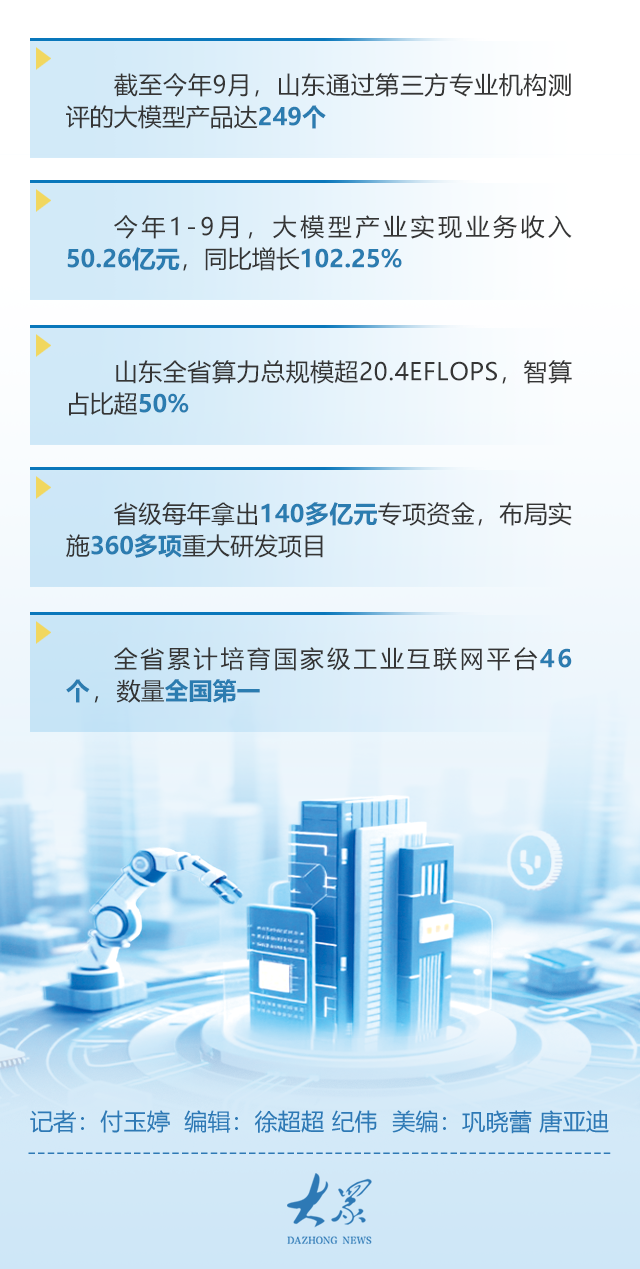
Core Insights - The intelligent computing industry in Shandong has exceeded 700 billion yuan in scale in the first nine months of this year, indicating significant growth and investment in this sector [1][5][6] - The emergence of large models in various industries, such as oil and gas, is enhancing operational efficiency and decision-making capabilities, particularly in the context of carbon capture and utilization [2][3] - The establishment of intelligent computing centers is crucial for meeting the growing demand for computational power across multiple sectors, including petrochemicals, biomedicine, and education [2][3][5] Industry Developments - As of September, Shandong has evaluated 249 large model products across various fields, with the large model industry achieving a business revenue of 5.026 billion yuan, reflecting a year-on-year growth of 102.25% [3][6] - The intelligent computing centers are designed to provide diverse computational capabilities, including general, intelligent, and high-performance computing, to support various applications [4][5] - The province has established 22 provincial-level intelligent computing cloud service centers, with a total computing power exceeding 20.4 EFLOPS, and the intelligent computing sector accounts for over 50% of this capacity [5][6] Technological Innovations - The construction of intelligent computing centers is being approached with a modular and prefabricated strategy, allowing for rapid assembly and deployment [4] - The collaboration between traditional and digital enterprises is fostering technological advancements, as seen in the partnership between Inspur and Shandong Tianrui Heavy Industry [4] - The integration of AI in various applications is accelerating the development and deployment of large model products, significantly reducing the time required for research and development tasks [6]
像“搭积木”一样建设算力中心,前9个月山东智能算力产业规模超700亿元
Da Zhong Ri Bao· 2025-11-30 22:51
Group 1 - The core industry of Dongying is petrochemicals, and the emergence of large models with rich professional knowledge is enhancing the intelligence and confidence in "black gold" development [1] - The oil identification model developed by Shengruan Technology has been included in the provincial "model coupon" award list, helping more companies build oil and gas-specific large models through a technical system of "pre-trained large model + industry knowledge base + intelligent application" [1] - The CCUS (Carbon Capture, Utilization, and Storage) industry in Dongying is leveraging artificial intelligence to accelerate the development of new efficient capture materials, reducing traditional selection cycles from years to days [1] Group 2 - As of September, Shandong has evaluated 249 large model products through third-party professional institutions, achieving a business revenue of 5.026 billion yuan in the large model industry, a year-on-year increase of 102.25% [2][6] - The transition from "manufacturing" to "intelligent manufacturing" is supported by the rapid deployment of intelligent computing centers, which facilitate data circulation and enhance the accessibility of artificial intelligence [2] - The demand for intelligent computing centers is increasing as local governments aim to accelerate construction, transforming traditional buildings into intelligent computing centers to meet challenges such as rapid delivery and flexible expansion [2] Group 3 - The construction of intelligent computing centers is being driven by prefabrication, modularization, and greening, allowing for a 90% prefabrication rate and flexible combinations of modular functional boxes [3] - The Dongying computing center is built on cloud computing technology, providing a unified platform for general, intelligent, and high-performance computing to meet various usage scenarios [3] - A joint venture between Inspur and Shandong Tianrui Heavy Industry aims to innovate and optimize technology, with related achievements recognized as "internationally advanced" by Shandong Province [3] Group 4 - The Inspur intelligent computing center project covers eight major hub nodes in the country, with a cumulative computing power scale of approximately 10 EFLOPS [4] - Shandong has established 22 provincial intelligent computing cloud service centers with over 100 PFLOPS of computing power, contributing to a total computing power scale exceeding 20.4 EFLOPS in the province [4] - The intelligent computing industry in Shandong, including AI servers and intelligent computing cloud services, has surpassed 70 billion yuan in scale from January to September [4][5] Group 5 - The time required for research and development tasks has been significantly reduced, accelerating the launch of large model products across various application scenarios [5] - Shandong is focusing on vertical large model tracks, enhancing the comprehensive supply capacity of infrastructure, and deepening the application of artificial intelligence, with related industries accounting for about 9% of the national total [5][6] - The provincial government allocates over 14 billion yuan annually for major research and development projects, implementing more than 360 initiatives [6][7]

四中全会精神解读·市场最前沿 | 织起全国一张网,看算力普惠按下“加速键”
Xin Hua She· 2025-11-30 09:39
"目前,平台已连接30多家超算、智算中心,提供近70种规格的国产超智融合算力,上架超7200个应用 商城商品,服务80多万用户。未来希望让算力如水电一样联网、便宜、好用。"国家高性能计算机工程 技术研究中心副主任曹振南说。 "十四五"以来,《深入实施"东数西算"工程加快构建全国一体化算力网的实施意见》《算力基础设施高 质量发展行动计划》《算力互联互通行动计划》等一系列政策部署相继出台,算力"全国一张网"加速织 就。 山东汇聚融合全省16地市及周边省份算力资源,入网算力中心资源利用率平均提升40%,赋能1000多个 应用场景;贵州创新发放"算力券",为企业提供多样化激励,降低用户用算成本;江苏打造智算算力网 AI开发平台,统筹纳管异构异属异域的智算资源,实现全局能用、好用…… 新华社北京11月30日电(新华社记者温竞华、周圆)在湖南汇视威智能科技有限公司,"95后"创业者顾 善植正带领团队加班加点,迭代升级自主研发的"橘洲"大模型。依托国家超算互联网的强大算力支持, 该大模型高效完成了4000万张图片的训练,性能快速提升。 "我们是年轻的AI初创公司,最缺但也最用不起的就是算力。现在有高性价比的国产算力'撑腰' ...

麦子智云(庆阳)万P绿色智算中心项目签约启动
Sou Hu Cai Jing· 2025-11-29 10:31
Core Insights - The strategic cooperation framework agreement and project entry agreement between Gansu Province's Qingyang City and Hangzhou Maizi Zhiyun Technology Co., Ltd. marks a significant investment of 20 billion yuan for the "Qingyang Maizi Zhiyun WanP Green Intelligent Computing Center" project, which will enhance the rapid construction of the "East Data West Computing" initiative and promote high-quality development of the digital economy [1][2] Group 1 - Qingyang is transitioning from an "energy city" to a "computing power city," aiming to build the "China Computing Valley" as one of the eight national integrated computing power network hubs [1] - The project will cover an area of 300 acres and utilize advanced green energy-saving technologies, leveraging Qingyang's abundant wind and solar power resources [1] - The center will deploy a total of 200,000 servers and achieve a core computing power scale of 100,000 P, forming a comprehensive computing power hub that includes intelligent computing, general computing, supercomputing, and storage [1] Group 2 - The successful signing of the project is a key layout for Qingyang to solidify its computing power foundation and build a trillion-level digital economy industrial chain [2] - The collaboration represents Maizi Zhiyun's strategic choice to respond to the national "East Data West Computing" strategy and leverage technological capital advantages [2] - Future initiatives will focus on upgrading computing power infrastructure, cultivating AI industry ecosystems, and innovating digital services, with applications in various advanced fields such as energy exploration, green agriculture, and autonomous driving [2]
沈阳算力规模已达1830P
Liao Ning Ri Bao· 2025-11-28 01:09
Group 1 - The core viewpoint is that computing power has become a new key productivity in the digital economy, with Shenyang City establishing five computing power centers, achieving a total computing power scale of 1830P [1] - Computing power is defined as the amount of computational tasks a computer system can complete in a unit of time, measured in P (petaflops), where 1P is approximately equal to 10 million trillion calculations per second [1] - The Shenyang government is actively promoting the construction of a smart and comprehensive data infrastructure, integrating into the national "East Data West Computing" project [1] Group 2 - Shenyang has launched a trusted data space, becoming the first in Northeast China to enhance data flow efficiency by 40% through a multi-party collaboration mechanism [2] - The city aims to increase its intelligent computing power to 3000P by 2027 and develop 20 general and industry-specific large models to support various sectors [2] - The demand for computing power is expected to grow significantly as local enterprises transition to cloud-based data utilization [2]