交换芯片

Search documents
光最好的时代-寻找斜率最高的方向
2026-03-30 05:15
Summary of Key Points from Conference Call Records Industry Overview - The optical communication industry is experiencing strong growth, driven by significant investments in AI infrastructure by major cloud service providers (CSPs) in North America, with a notable increase in the value share of optical interconnects from approximately 3% in the traditional cloud era to nearly 5% in the AI era, and potentially reaching 10% in the future, outpacing overall capital expenditure growth [2][2][2] Market Dynamics - The optical chip market is witnessing two main trends: 1. Price increases for low-speed optical chips due to prioritization of higher-value products, leading to reduced supply of lower-value items [3][3][3] 2. High-power light sources for CPO applications are being actively tested by multiple companies, indicating a future increase in value [3][3][3] - The optical fiber market is transitioning from a cyclical to a growth phase, with rising long-term contract prices in North America and successful cost pass-through to downstream customers, enhancing profit margins for some manufacturers [3][3][3] DCI Market Insights - The DCI market is thriving, with significant demand for coherent optical modules and related components, necessitating substantial production expansions among industry players [4][4][4] - North American DCI equipment vendors are consolidating, as seen with Nokia's acquisition of Infinera, to enhance competitiveness [4][4][4] Company Performance Highlights - Changfei Fiber's overseas revenue share has risen to nearly 40%, with significant contributions from cable products, indicating a strong international presence [5][5][5] - Bochuang Technology's revenue from its largest customer doubled year-on-year, reflecting robust demand growth [5][5][5] - Yuanjie Technology has diversified its customer base, reducing reliance on a single major client, while Huagong Technology is expanding production capacity in response to strong order forecasts [6][6][6] OCS Market Developments - The OCS market is seeing optimistic projections, with Lumentum forecasting OCS-related revenue to exceed $1 billion by 2027, and Coherent doubling its market space prediction to $4 billion [7][8][8] - The OCP's OCS project group has made significant strides in standardization and commercialization, enhancing product interoperability and reducing deployment costs [9][10][10] Supply Chain and Material Insights - The supply of indium phosphide substrates is tight due to long expansion cycles and export licensing issues, leading to anticipated price increases starting in 2026, which will benefit related manufacturers' profit margins [13][13][13] - The domestic switching chip market is expected to grow significantly due to AI applications, with increased penetration of domestic products in internet companies' solutions [14][14][14] Conclusion - The optical communication industry is positioned for substantial growth driven by AI infrastructure investments, with key players adapting to market demands and technological advancements. The ongoing trends in pricing, supply chain dynamics, and company performances indicate a robust outlook for the sector in the coming years.
从整机厂看交换芯片26年大产业趋势
2026-03-26 13:20
Summary of Conference Call Notes Industry Overview - The conference call discusses the evolution of the "super node" architecture driven by the demand for computational power in AI model training, particularly focusing on the deployment plans of major companies like Alibaba, Tencent, and ByteDance for 2026 and 2027 [1][2][4]. Key Points and Arguments Super Node Architecture - The "super node" solution is designed to meet the increasing computational demands of large AI models, moving beyond traditional server configurations [2][8]. - NVIDIA and Google have pioneered the concept of interconnecting multiple GPUs, leading to the "super node" architecture that integrates entire cabinets as computing nodes [2]. Deployment Plans - **Alibaba**: Plans to deploy 1,800 to 2,000 units of the "Pan Jiu 128" super node, which consists of 128 GPUs and 16 51.2T switching chips [4][7]. - **Tencent**: Plans to deploy 2,300 to 2,400 units of the "ETH-64" super node, featuring 64 GPUs and 10 to 12 51.2T switching chips [4][7]. - **ByteDance**: Plans to deploy 1,800 units of the "Dayu" super node, which includes 72 GPUs and 12 51.2T switching chips [4][7]. Chip Development and Supply Chain - The domestic 51.2T switching chip development is on track, with expected delivery for validation around May 2026 [5][10]. - In the interim, a combination of two 25.6T chips will be used to achieve equivalent performance until the 51.2T chips are available [5][9]. - Alibaba has placed an order for approximately 30,000 units of the 25.6T chips, with an estimated total order value of around 1 billion yuan [18]. Market Dynamics - The market for switching chips is expected to grow significantly, driven by the doubling of GPU counts in cabinets and a projected 30% to 40% increase in total cabinet numbers by 2027 [19][20]. - The supply chain is benefiting from the demand for concentrated power systems, liquid cooling solutions, and high-speed copper cables [1][2]. Competitive Landscape - **Merger of Technologies**: The competition in the 51.2T switching chip market is primarily between companies like MerriTech and ZTE, with MerriTech currently leading in development speed [10][21]. - The long delivery times for Broadcom's chips (over 52 weeks) are accelerating the shift towards domestic alternatives [16]. Future Projections - The expected transition to single 51.2T chips in 2027 will maintain the value per unit while increasing overall demand due to higher GPU counts and cabinet growth [20]. - The anticipated market entry of 102.4T switching chips is projected for late 2026, with domestic solutions being developed to meet this demand [19]. Additional Important Insights - The "super node" architecture is expected to significantly impact various segments of the supply chain, including power systems, cooling solutions, and interconnect technologies [2][3]. - The integration of GPUs and switching chips in the super node architecture will require a reevaluation of existing supply chains and procurement strategies among major internet companies [22].

交换芯片系列专家会
2026-03-16 02:20
Summary of Conference Call on Exchange Chip Market Industry Overview - The conference call discusses the exchange chip market, specifically focusing on Scale-up and Scale-out segments, with projections for 2026 and 2027 demand growth. [1][2] Key Points and Arguments Market Demand Projections - **Scale-up Market**: Demand is expected to grow from over 100,000 units in 2026 to over 200,000 units in 2027, driven by major cloud service providers (CSPs) like Alibaba, ByteDance, and Tencent. [1][2] - **Scale-out Market**: Anticipated growth from 260,000 units in 2026 to 300,000-400,000 units in 2027, with a significant increase in demand for high-bandwidth networking solutions. [1][2] Market Share and Competition - **Shengke Communication**: Expected to dominate the Scale-up market with over 90% share in 2026 and maintain at least 20% in the Scale-out market due to its first-mover advantage with 25.6T chips. [1][2] - **Competitive Landscape**: Shengke is positioned favorably as an independent supplier, with higher priority for integration with downstream manufacturers compared to self-research firms like ZTE Microelectronics. [1][2] Pricing and Revenue Estimates - **25.6T Chip Pricing**: Estimated at approximately 15,000 to 16,000 RMB, with potential orders in the Scale-out market reaching close to 1 billion RMB if Shengke achieves a shipment of 50,000-60,000 units. [4] - **Total Revenue Potential**: If Shengke successfully ships 100,000 units in the Scale-up market, total order value could exceed 2 billion RMB. [4] Policy and Market Drivers - **2028 Full Localization Policy**: Aiming for 100% domestic replacement in key sectors, with exchange chips being a priority. This policy is expected to drive significant demand from state-owned enterprises and telecom operators. [5][7] - **Market Growth from Localization**: The policy is projected to increase the domestic market share significantly, with a conservative estimate of 20% market share for Shengke, potentially higher depending on customer adoption rates. [5][6] Long-term Market Dynamics - **Independent Chip Manufacturers vs. Integrated Firms**: Shengke is expected to have a larger market share growth potential compared to integrated firms like ZTE, as independent suppliers are preferred by other manufacturers to avoid competition. [6] - **Future Market Trends**: The demand for high-end chips (25.6T and above) is expected to grow significantly, with annual demand in key sectors projected to reach tens of thousands of units. [7] Major CSPs and Their Plans - **CSP Deployment Plans**: Major players like Alibaba, ByteDance, and Tencent are planning significant deployments of supercomputing nodes, with combined demand exceeding 100,000 chips in 2026. [12][14] - **Specific Deployment Estimates**: For 2027, Alibaba plans to deploy 1,200 supercomputing nodes, leading to a demand of approximately 70,000 chips, while ByteDance and Baidu also have substantial deployment plans. [14] Emerging Competitors - **New Entrants**: Companies like Yunhe Zhinet and Yutai Micro are entering the market, with varying degrees of readiness and technological capabilities. [17][19] - **Challenges for New Players**: New entrants face significant challenges in technology development and market penetration, particularly in the competitive landscape dominated by established firms. [17][18] Additional Important Insights - **GPU and Chip Ratio**: The typical ratio of GPUs to exchange chips is around 2:1, but this may evolve based on network architecture and density. [9] - **Technological Evolution**: The market is witnessing a shift towards higher-speed chips, with 51.2T chips expected to dominate by 2027, reflecting advancements in supercomputing technology. [10][11] This summary encapsulates the key insights and projections from the conference call regarding the exchange chip market, highlighting growth opportunities, competitive dynamics, and the impact of policy changes on market demand.
博通电话会全文&详解:2027年AI芯片营收将破1000亿美元,AI不会颠覆基础设施软件!
美股IPO· 2026-03-05 04:40
Core Viewpoint - Broadcom expects AI chip revenue to exceed $100 billion by 2027, driven by strong demand from strategic customers and a robust supply chain strategy [1][4][18] Group 1: AI Chip Revenue and Customer Base - Broadcom anticipates that AI chip revenue will surpass $100 billion by 2027, with a projected installed capacity of nearly 10 gigawatts [5][18] - The company has identified six long-term strategic customers, including Google, Meta, OpenAI, and Anthropic, who are developing custom AI chips [5][18] - The demand for custom chips is expected to grow as clients develop dedicated chips for model training and inference, indicating a long-term expansion rather than a one-time replacement of GPUs [9][35] Group 2: Network Infrastructure Growth - Network revenue is projected to grow significantly, with expectations that it will account for 33% to 40% of AI revenue in the coming quarters [10][30] - Broadcom's Tomahawk 6 switch, with a throughput of 100 Tbps, is experiencing high demand, and the company plans to launch the next-generation Tomahawk 7 in 2027 [10][30] - The company emphasizes the advantages of using direct attach copper cables for low latency and cost efficiency in data center environments [10][30] Group 3: Supply Chain and Production Capacity - Broadcom has secured critical component capacity through 2028, positioning itself as one of the first companies to lock in such long-term supply agreements [11][17] - The company has a strong inventory position, with $3 billion in inventory at the end of the first quarter, reflecting its anticipation of accelerating AI semiconductor demand [11][20] Group 4: Software Business Resilience - Broadcom's infrastructure software, particularly VMware, is expected to benefit from the growth of AI, with a 13% year-over-year revenue increase in the first quarter [12][18] - The company asserts that its infrastructure software will not be displaced by AI but will instead see increased demand as AI applications grow [12][18]



盛科通信:深度受益国产算力发展,交换芯片进展加速-20260303
Huachuang Securities· 2026-03-03 07:20
Investment Rating - The report maintains a "Recommendation" rating for the company, indicating an expectation to outperform the benchmark index by 10%-20% over the next six months [1][7]. Core Insights - The company is expected to benefit significantly from the development of domestic computing power, with accelerated progress in switching chips. The projected revenue for 2025 is CNY 1.151 billion, representing a year-on-year increase of 6.35% [1][7]. - The net profit attributable to the parent company is forecasted to be a loss of CNY 150 million, which is an increase in loss of CNY 82 million compared to the previous year [1][7]. - The company is positioned as a leading player in the domestic commercial switching chip market, with its Arctic series performance comparable to overseas products. It is expected to grow rapidly due to increased demand from data centers driven by the AI wave and the trend of domestic production [7]. Financial Summary - The total revenue for 2025 is estimated at CNY 1,151 million, with a year-on-year growth rate of 6.4% projected for 2026 and 26.3% for 2027 [3][8]. - The net profit attributable to the parent company is expected to improve to CNY 530 million in 2026 and CNY 2.02 billion in 2027, following a loss of CNY 150 million in 2025 [3][8]. - The company's earnings per share (EPS) is projected to be CNY -0.37 in 2025, turning positive at CNY 0.13 in 2026 and CNY 0.49 in 2027 [3][8]. - The company’s total assets are projected to be CNY 2.738 billion in 2025, with a slight increase to CNY 3.518 billion by 2027 [8].
盛科通信(688702):深度受益国产算力发展,交换芯片进展加速
Huachuang Securities· 2026-03-03 06:56
Investment Rating - The report maintains a "Recommendation" rating for the company, indicating an expectation to outperform the benchmark index by 10%-20% over the next six months [1][7][14]. Core Insights - The company is expected to benefit significantly from the development of domestic computing power, with accelerated progress in switching chips. The projected revenue for 2025 is 1.151 billion yuan, reflecting a year-on-year increase of 6.35% [1][7]. - The net profit attributable to the parent company is forecasted to be -150 million yuan for 2025, which is a deterioration of 82 million yuan compared to the previous year [1][7]. - The company is positioned as a leading player in the domestic commercial switching chip market, with its Arctic series performance comparable to overseas products. It is anticipated to grow rapidly due to increased demand from data centers driven by the AI wave and the trend of domestic production [7][8]. Financial Summary - **Revenue Projections**: - 2025E: 1,151 million yuan (up 6.35% YoY) - 2026E: 1,833 million yuan (up 59.3% YoY) - 2027E: 2,315 million yuan (up 26.3% YoY) [3][8] - **Net Profit Projections**: - 2025E: -150 million yuan (YoY decline of 119.5%) - 2026E: 53 million yuan (YoY increase of 135.6%) - 2027E: 202 million yuan (YoY increase of 277.8%) [3][8] - **Earnings Per Share (EPS)**: - 2025E: -0.37 yuan - 2026E: 0.13 yuan - 2027E: 0.49 yuan [3][8] - **Valuation Ratios**: - Price-to-Earnings (P/E) ratio for 2025E: -539 - Price-to-Book (P/B) ratio for 2025E: 37.0 [3][8] Market Position - The company is recognized as a core enterprise in China's switching chip sector, with expectations of deep benefits from the growth in domestic computing power demand. The report highlights the increasing capabilities of domestic models and their significant share in the market [7][8].
AI互连芯片“小巨人”启动IPO
是说芯语· 2026-02-14 01:35
Core Viewpoint - The article highlights the growth and potential of Shenzhen Nanfeng Microelectronics Co., Ltd., emphasizing its strong R&D capabilities, extensive product offerings, and strategic positioning in the semiconductor industry, particularly in the field of network interconnection chips. Group 1: Company Overview - Shenzhen Nanfeng Microelectronics was established on November 13, 2015, with a registered capital of 41.407 million yuan [2] - The company is headquartered in Shenzhen and focuses on the design, production, and sales of Ethernet data exchange, smart network cards, PHY, and PCIe Switch chips and modules [1][2] - The controlling shareholder is Zeng Yu, who directly holds 17.82% of the shares and has significant influence over the company through various partnerships, controlling a total of 48.92% of voting rights [2][6] Group 2: Market Position and Development - Nanfeng Microelectronics has established a nationwide presence with R&D and sales centers in major cities, including Shenzhen, Beijing, Shanghai, Chengdu, and Changzhou, creating a comprehensive service network [3] - The company has a strong talent pool, with nearly 400 employees, of which over 85% are in R&D, supporting its innovation capabilities [3] - The company has received multiple industry recognitions, including being named a "Little Giant" enterprise by the Ministry of Industry and Information Technology in July 2024, and recognized as a "Gazelle Enterprise" and "Potential Unicorn Enterprise" in Shenzhen in July 2025 [4] Group 3: Product and Technology - Nanfeng Microelectronics has launched numerous core products, including switching chips, PHY chips, network card chips, and PCIe Switch chips, while also developing high-end interconnection chips to meet AI demands [4] - The company has seen steady growth in product shipments, with over 5 million LAN-Switch network switching chips, over 1 million mid-range switching chips, and over 400,000 high-end switching chips shipped annually [4] - Its products are widely used in critical sectors such as telecommunications, energy, transportation, and commercial markets, gaining recognition from leading domestic ICT and cloud service providers [4] Group 4: Financial and Investment - Nanfeng Microelectronics has completed multiple rounds of financing, attracting investments from notable institutions, with a C+ round investment from Hengdian Capital in December 2025 aimed at AI interconnection chip development [6] - The company is focused on strengthening its R&D and market expansion as it progresses towards an IPO, aiming to enhance the development of domestic network interconnection chips [6]
国金证券:2026年AI算力需求有望持续强劲 看好AI覆铜板/PCB及核心算力硬件、半导体设备等
智通财经网· 2026-01-04 23:41
Group 1 - The core viewpoint is that the capital expenditure of the four major cloud service providers in North America (Microsoft, Google, Meta, Amazon) continues to grow, with a positive outlook for future capital spending, indicating sustainability and potential for further increases [1] - Nvidia's AI server cabinet is expected to see significant growth by 2026, with a surge in token numbers and a forecasted explosive growth in ASIC quantities, leading to optimism for AI copper-clad laminates/PCBs and core computing hardware [1][2] - The demand for AI copper-clad laminates/PCBs and core computing hardware is expected to continue increasing in both volume and price, driven by rapid growth in Nvidia GPUs and explosive growth in Google and Amazon ASICs [2] Group 2 - The semiconductor equipment industry is viewed positively due to the expansion cycle of storage and the acceleration of self-sufficiency, with significant opportunities for domestic replacements [3] - The domestic cloud service providers still have room for increased capital expenditure, with Tencent, Alibaba, and Baidu reporting varying year-on-year changes in capital spending, indicating a strong future investment in AI infrastructure [3] - Apple's AI strategy focuses on hardware, prioritizing edge computing and strong privacy protection, with expectations for breakthroughs in AI/AR glasses technology and sales [4]

交换机行业深度报告:AI大模型快速发展助力交换机市场扩张
Huafu Securities· 2025-12-23 07:31
Investment Rating - The industry investment rating is "Outperform" (maintained) [1] Core Insights - The rapid development of AI large models is driving the expansion of the switch market, with increasing demands for ultra-large-scale networking, high bandwidth, low latency, high stability, and automated network deployment [2][3] - The global switch market is projected to reach USD 43.89 billion in 2025, while the Chinese switch market is expected to grow to approximately CNY 44.48 billion in the same year, indicating significant growth potential [2][28] - The demand for switches is evolving towards white-box solutions, market expansion, and Optical Circuit Switching (OCS) technology, which enhances flexibility and reduces deployment costs [3][46] Summary by Sections AI Large Models Driving Data Center Expansion - AI large models are becoming the new engine of artificial intelligence, significantly impacting various fields and driving the digital economy [8][12] - The global data center market is expected to grow to USD 96.8 billion by 2025, with China's market projected to reach CNY 318 billion [22] Switch Demand Upgrade - The switch market is experiencing a shift towards white-box switches, which offer flexibility and cost advantages through decoupled hardware and software [43][44] - OCS technology is emerging as a key player, providing ultra-high bandwidth and compatibility for future network demands [46][47] Switch Chip Demand Upgrade - The demand for high-bandwidth switch chips is increasing, with 100G and above Ethernet switch chips expected to dominate the market by 2025 [50][54] - The production of switch chips is facing challenges due to the industry's shift towards advanced packaging technologies to overcome physical limitations [59][66] Related Companies - Companies to watch include Shengke Communication, ZTE, Ruijie Networks, and Unisplendour, which are positioned to benefit from the growing demand in the switch market [4][76]
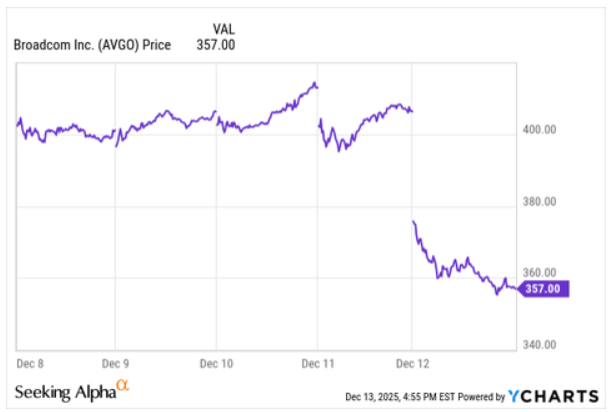
两日失血17%,博通(AVGO.US)的暴跌是陷阱还是馅饼?
智通财经网· 2025-12-16 07:16
Core Viewpoint - Broadcom's stock experienced a significant decline, with a drop of 11.43% on Friday and an additional 6% on Monday, raising questions about the reasonableness of the sell-off despite strong financial performance [1][4]. Financial Performance - For Q4 of FY 2025, Broadcom reported revenues of $18 billion, a year-over-year increase of 28%, and a diluted earnings per share (EPS) of $1.74, up 93% from the previous year [4][5]. - Semiconductor solutions generated $11.07 billion in revenue, accounting for 61% of total revenue and growing 35% year-over-year, while infrastructure software contributed $6.94 billion, representing 39% of total revenue with a 19% increase [5][7]. - Free cash flow for the quarter reached $7.5 billion, representing 41.4% of revenue and a 36% increase compared to the previous year [7][8]. Cash Flow and Shareholder Returns - For FY 2025, Broadcom's total free cash flow was $26.91 billion, a 39% increase from FY 2024, with a free cash flow margin of 42.1% [8][9]. - The company announced a 10% increase in dividends for Q1 FY 2026, reducing long-term debt by $4.3 billion, and extending its stock buyback program with a remaining balance of $7.5 billion [9][10]. AI Orders and Market Position - Broadcom secured a $11 billion order from Anthropic, expected to be delivered by the end of 2026, and reported a backlog of over $73 billion in AI-related orders, which is anticipated to be fulfilled within the next 18 months [10][11]. - The CEO emphasized that the $73 billion backlog represents the minimum expected revenue from AI over the next six quarters, with additional orders likely to increase this figure [11][12]. Analyst Misinterpretations - Analysts misread the significance of the $73 billion backlog, failing to understand the CEO's conservative guidance style and comparing Broadcom unfavorably to Oracle, which is deemed inappropriate given Broadcom's strong cash flow and debt reduction [12][15]. - The market's reaction to the backlog was seen as overly emotional, with the CEO indicating that the order flow is expected to accelerate, contradicting the negative sentiment [12][23]. Valuation and Market Outlook - Despite the recent stock decline, Broadcom's valuation remains high, with a trailing P/E ratio of 30.8, reflecting the market's willingness to pay a premium for high-quality growth companies [17][20]. - Analysts have raised Broadcom's fair value estimate from $365 to $480, highlighting the company's strong revenue growth and potential for continued performance in the AI sector [21][20].