软件

Search documents
4100点!上证指数罕见16连阳,机会在哪儿?
Sou Hu Cai Jing· 2026-01-10 11:50
Group 1 - The Shanghai Composite Index closed at 4120.43 points, marking a 16-day consecutive rise and reaching a new high not seen in over 10 years [4][6] - Nearly 4000 stocks rose, with 113 stocks hitting the daily limit, and total trading volume exceeded 30 trillion yuan [6][8] - The AI application sector experienced significant growth, leading the market, particularly in cultural media and internet industries, which saw over 5% gains [5][6] Group 2 - The market is transitioning from a phase driven by liquidity expectations to one supported by profit recovery and valuation alignment, although comprehensive profit improvement is still in its early verification stage [7] - The "spring rally" is attributed to improved liquidity conditions, with significant capital inflows from insurance and pension funds, supporting valuation recovery [8][9] - Analysts expect a balanced market structure in 2026, with a focus on sectors like AI applications, commercial aerospace, semiconductor equipment, and new energy, driven by the "14th Five-Year Plan" priorities [9]

ETF龙虎榜 | ETF 逼近涨停!
Zhong Guo Zheng Quan Bao· 2026-01-09 15:44
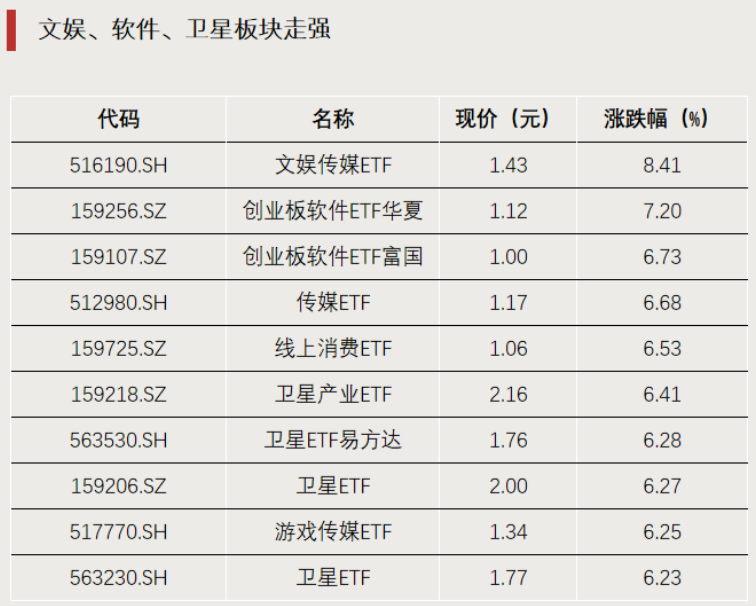
Market Performance - On January 9, the Shanghai Composite Index surpassed 4100 points, with strong performances in sectors such as cultural media, aerospace, and software, leading to significant gains in related ETFs [1][4] - The Entertainment Media ETF (516190) led the market with a closing increase of over 8%, reaching a peak intraday gain of 9.85% [1][4] ETF Fund Flows - From January 5 to January 8, the metal sector attracted significant capital, with the highest net inflows recorded in color metal-themed ETFs [2][10] - The top two ETFs by net inflow during this period were the Color Metal ETF (512400) with a net inflow of 30.47 billion and the Color Metal ETF Fund (516650) with 24.85 billion [10] Sector Highlights - The satellite and aerospace sectors also showed strong performance, with multiple satellite-themed ETFs gaining over 20% in the last five trading days [4][7] - The Aerospace ETF (561660) and other related ETFs recorded gains exceeding 17% over the same period [7] Future Outlook - The commercial aerospace industry is expected to accelerate in 2026, with numerous catalysts anticipated, suggesting that the sector's performance may exceed expectations [6][12] - Investment opportunities are seen in the rocket and satellite manufacturing and launch sectors, as well as ground terminal and operational services, which have a larger market potential [12]
环旭电子:拟以3000万元认购私募基金份额 投资于AI为核心的新一代信息技术产业
Zheng Quan Shi Bao Wang· 2026-01-09 09:29
Core Viewpoint - The company, Huanxu Electronics, announced its investment in a partnership focused on AI and emerging technologies, indicating a strategic move towards high-growth sectors [1] Investment Details - Huanxu Electronics will invest 30 million yuan as a limited partner in the Tianjin Haihe Yaozhong Equity Investment Partnership [1] - The target fundraising scale for the fund is set at 1 billion yuan, with a potential maximum of 1.5 billion yuan, and the initial fundraising amount is 613 million yuan [1] Investment Focus - The partnership aims to invest primarily in AI-centric new-generation information technology industries, including but not limited to semiconductors, foundational software, AI inference-related fields, AI data application industries, new foundational materials, and high-end manufacturing sectors with large-scale applications in robotics [1] - The investment strategy will focus on early to growth-stage projects, with a portion allocated to mature projects [1]

软件ETF(515230)收涨超3.6%,技术突破与政策支持成行业焦点
Mei Ri Jing Ji Xin Wen· 2026-01-09 09:25
Group 1 - The software ETF (515230) rose over 3.6%, driven by technological breakthroughs and policy support in the industry [1] - China has included brain-computer interfaces (BCI) in its future industry plans, with a "two-step" development goal for the next five years outlined by seven departments by 2025 [1] - The U.S. brain initiative has entered its 2.0 phase, providing a stable development environment for the industry globally [1] Group 2 - Two major breakthroughs in BCI technology are highlighted: interactive brain perception technology for smooth interaction and sensory brain control technology shifting from open-loop stimulation to closed-loop control [1] - The medical field remains the primary downstream application of BCI, accounting for over 50% of its usage [1] - The global BCI industry is expected to reach a scale of $7.63 billion by 2029, with a compound annual growth rate (CAGR) of approximately 13% from 2023 to 2029 [1] Group 3 - The software index (H30202) tracked by the software ETF primarily selects securities from companies engaged in software development, sales, and related services in the Shanghai and Shenzhen markets [1] - The index constituents are characterized by high growth potential and technological leadership, with a focus on the information technology sector and a growth-oriented investment style [1]
软件业务收入同比增长13.3%
Ren Min Ri Bao Hai Wai Ban· 2026-01-09 08:28
Core Insights - The software business revenue in China reached 1,397.77 billion yuan in the first 11 months of 2025, representing a year-on-year growth of 13.3% [2] - The total profit of the software industry amounted to 169.54 billion yuan, with a year-on-year increase of 6.6% [2] - Software exports were valued at 56.89 billion USD, showing a year-on-year growth of 8.1%, maintaining positive growth for nine consecutive months [2] Revenue Breakdown - Software product revenue was 295.09 billion yuan, reflecting a year-on-year growth of 11.4%, accounting for 21.1% of the total industry revenue [2] - Basic software product revenue reached 18.01 billion yuan, with a year-on-year increase of 12.9% [2] - Industrial software product revenue was 29.51 billion yuan, growing by 10.2% year-on-year [2] Information Technology Services - Revenue from information technology services was 961.04 billion yuan, with a year-on-year growth of 14.6%, making up 68.8% of the total industry revenue [2] - Cloud computing and big data services generated 146.58 billion yuan, reflecting a year-on-year growth of 12.8%, accounting for 15.3% of information technology service revenue [2] - Integrated circuit design revenue was 40.28 billion yuan, with a year-on-year increase of 16.5% [2] - E-commerce platform technology service revenue reached 129.44 billion yuan, growing by 12.5% year-on-year [2] Other Revenue Segments - Revenue from information security products and services was 20.01 billion yuan, showing a year-on-year growth of 6.9% [2] - Revenue from embedded system software was 121.62 billion yuan, with a year-on-year increase of 9.3% [2]
动画制作和建模游戏有哪些 热门动画制作和建模游戏排行榜前十
Xin Lang Cai Jing· 2026-01-09 06:54
Core Insights - The article highlights the intersection of animation and gaming art, showcasing a ranking of popular animation production and modeling games that inspire both professional developers and enthusiasts [1][8]. Group 1: Game Highlights - **PIXELS**: A new pixel battle game allowing players to compete on a large canvas with global participants, featuring simple gameplay and various weapons and items to enhance player strength [1][8]. - **Wallpaper Live PRO**: A powerful desktop wallpaper software offering rich video resources and a smooth playback experience, allowing users to set dynamic wallpapers without performance issues [1][8]. - **REQUIEM MEMORY**: A horror adventure game where players act as investigators exploring a forgotten island, characterized by stunning visuals and a gripping storyline [2][9]. - **Ancient Architecture Simulator**: A single-player game focused on building and exploring ancient Chinese architecture, providing an immersive experience to learn about historical structures [2][9]. - **Game Creation Creative Gears**: A cross-platform 2D independent game development software that enables users to create games without programming, suitable for both beginners and professionals [4][11]. - **Map Treasure Hunt**: A treasure-hunting game where players search for hidden items on various maps, featuring puzzles and cooperative online gameplay [4][11]. - **Smokeys Rescue Team**: A cat rescue and adoption simulator where players care for abandoned cats and find them new homes, emphasizing a warm and fulfilling gameplay experience [5][12]. Group 2: Software Features - The digital watermark processing tool offers professional-grade capabilities for watermark handling, supporting various file formats and ensuring efficient and stable performance [3][10]. - **HandsON**: A virtual reality software that allows users to interact with a surreal environment through hand and dance movements, providing an immersive experience [3][10]. - A 3D puzzle game that challenges players to build their houses by collecting and placing items, enhancing spatial awareness and logical thinking, with a multiplayer cooperative mode [3][10].
华泰证券:继续布局春季行情,成长和周期均衡配置
Xin Lang Cai Jing· 2026-01-09 00:07
Core Viewpoint - The report from Huatai Securities indicates that the industry prosperity index shows initial signs of a turning point in December, corroborated by an unexpected rebound in PMI [1] Sector Summaries - **Upstream Resources and Public Industries**: Significant improvement in the last three months, particularly in sectors such as non-ferrous metals, coal, certain chemical products, paper, and ordinary steel driven by price increases [1] - **TMT (Technology, Media, and Telecommunications)**: Accelerated progress in AI applications, leading to improved conditions in gaming and software, with a positive trend in computing power storage and passive components [1] - **Capital Goods and Intermediate Products**: Improvement noted in sectors like new energy, automation equipment, and engineering machinery, with export orders potentially being advanced due to the later timing of the 2026 Spring Festival [1] - **Consumer Goods**: Recovery observed in dairy products, beer, and livestock sectors [1] - **Infrastructure Chain**: The construction PMI rose above the threshold in December, indicating a recovery in the construction industry [1] - **Independent Prosperity Cycle**: Notable performance in sectors such as military electronics [1] Investment Recommendations - The report suggests continuing to position for the spring market with a balanced allocation between growth and cyclical sectors, recommending a focus on non-ferrous metals, chemicals, military, storage, gaming, new energy (batteries/wind power), and pharmaceuticals at a monthly level [1] - Additionally, short-term thematic investments are favored, with a focus on humanoid robots, brain-machine interfaces, and domestic computing power, considering trading congestion [1]

Haveli拟收购合同软件公司Sirion
Xin Lang Cai Jing· 2026-01-08 14:09
Core Viewpoint - Haveli Investment Group has reached an agreement to acquire a majority stake in Sirion, a contract software company specializing in AI-driven contract drafting, storage, and management services [1][2]. Group 1: Acquisition Details - Haveli will acquire a controlling stake in Sirion, with insider information suggesting the stake could be as high as 90%, valuing Sirion at approximately $1 billion [1][2]. - The specific percentage of the stake and transaction valuation have not been disclosed by the companies [2]. Group 2: Strategic Implications - This investment is expected to accelerate Sirion's product innovation and enhance its global business expansion [1][3]. - Haveli's Managing Director, Sumit Pandey, stated that AI is increasingly becoming a core element of business operations, presenting growth opportunities for companies that integrate AI deeply into their processes [3]. Group 3: Company Performance and Future Plans - Sirion has achieved an average annual revenue growth of 40% over the past five years and has recently become profitable [3]. - Following the acquisition, Sirion may consider acquiring other companies within the same industry [3]. - Sirion, founded in India, has established 10 branches in countries including the USA, Canada, UK, France, Germany, India, South Africa, and Singapore [3].
AI投资引燃融资热潮,全球可转债发行规模创24年新高
Hua Er Jie Jian Wen· 2026-01-08 13:06
Core Insights - The artificial intelligence (AI) boom is rapidly reshaping the global financing market, leading companies to raise significant funds through convertible bonds, with global issuance expected to reach approximately $166.5 billion by 2025, marking a 24-year high since 2001 and nearing historical records [1] - The surge in financing is driven by substantial investments in AI infrastructure and related technologies, with companies like Alibaba, Lumentum Holdings, and Super Micro utilizing convertible bonds to fund their AI-related bets [1] - Convertible bonds, which combine features of debt and equity, are projected to outperform large-cap stocks and traditional bonds in 2025 after years of low returns [1] Group 1: AI-Driven Financing - AI-related companies are becoming increasingly dominant in the convertible bond market, contributing significantly to issuance volumes and investment returns, with approximately 40% of last year's benchmark convertible bond index returns driven by AI-related firms [3] - Companies such as Lumentum, Super Micro, and CoreWeave have raised billions through convertible bonds, while even cryptocurrency miners like Bitfarms Ltd. are turning to this financing method to support their transition to AI and high-performance computing [3] Group 2: Refinancing Demand and Mature Companies - The pressure from maturing debt is another key factor driving market recovery, with about a quarter of outstanding convertible bonds set to mature in the next two years, sustaining market activity [4] - In a high-interest rate environment, mature companies are reassessing the attractiveness of convertible bonds, which allow borrowing at lower interest costs despite potential equity dilution, as seen with European firms like Lufthansa and Ferrovial SE entering the market [4] Group 3: Rise and Resilience of the Asian Market - While North America remains the dominant player in the convertible bond market, the Asian market has played a crucial role in recent recovery, with Alibaba raising $3.2 billion and other insurance giants like Pacific and Ping An raising $2 billion and $1.5 billion respectively [5] - The Asian market is expected to provide more opportunities in 2026 as stock markets stabilize and interest rates level off, with convertible bonds becoming a mainstream financing tool in the region [5] - Despite concerns about the sustainability of AI spending, the convertible bond asset class has shown resilience against market volatility, with Bloomberg data indicating that the Bloomberg Global Convertible Bond Index's decline was less than that of the MSCI World Index during last year's market fluctuations [5]
紧抓稀缺性
Hua Xia Shi Bao· 2026-01-08 10:32
Core Viewpoint - Scarcity is defined as the limitation in obtaining resources needed by people, with a focus on time as a crucial factor in both enhancing and destroying scarcity [2][4]. Group 1: Definition of Scarcity - Scarcity in investment refers to a situation where demand for a product remains stable or grows while supply cannot keep pace, often due to a lack of adequate substitutes [2][3][4]. - The definition emphasizes limited supply and the absence of sufficient substitutes [2]. Group 2: Types of Scarcity - Geographic scarcity occurs when a product is unique to a specific location, making it irreplaceable, such as Moutai liquor, which can only be produced in Maotai Town, Guizhou [4]. - Technological scarcity is characterized by monopolistic advantages, as seen with companies like NVIDIA, which have maintained a strong market position through innovation [5][6]. - Non-renewable scarcity refers to resources that are inherently limited and diminish with use, such as indium, which has a very low natural reserve [11]. Group 3: Impact of Time on Scarcity - Scarcity is not constant and can be altered by supply factors; for example, cocoa has seen increasing scarcity due to rising demand and limited production areas [13][14]. - The cocoa market is particularly sensitive to environmental conditions, which can drastically affect supply and prices [14][15]. Group 4: Market Dynamics and Investment Implications - The investment value of certain products can fluctuate significantly over time, influenced by market conditions and consumer behavior [4][17]. - Companies must adapt to changing market dynamics, especially during periods of consumer downgrading, to maintain their competitive edge [17].