
建材

Search documents
光大证券晨会速递-20251029
EBSCN· 2025-10-29 01:47
Group 1: Industry Research - The core view is that the basic chemical industry is expected to experience a recovery in profitability due to macroeconomic improvements and supply-side policy advancements, with a focus on sectors like phosphate chemicals, potash fertilizers, and pesticides [1] - New materials driven by AI and robotics are anticipated to maintain strong growth momentum, suggesting investment in leading companies with strong cost control and complete industrial chains [1] - Recommendations include focusing on leading enterprises in semiconductor materials, OLED materials, PEEK, and AI materials that possess technological barriers and customer validation advantages [1] Group 2: Company Research - Nanjing Bank reported a revenue of 41.9 billion with an 8.8% year-on-year growth and a net profit of 18 billion, reflecting strong performance and resilience [2] - Ningbo Bank's revenue and net profit growth rates were 8.3% and 8.4% respectively, indicating a stable expansion despite external economic challenges [3] - Wuxi Bank achieved a revenue of 3.77 billion with a 3.9% year-on-year increase, and a net profit of 1.83 billion, showcasing steady growth in non-interest income [4] - China Ping An's net profit increased by 11.5% year-on-year, with new business value growing by 46.2%, indicating a positive outlook for future growth [5] - New Yangfeng's new fertilizer products showed strong growth, with net profit forecasts for 2025-2027 at 1.686, 1.890, and 2.148 billion respectively [7] - Wanhua Chemical's net profit forecasts for 2025-2027 are 12.8, 16.0, and 18.9 billion, supported by steady production and sales growth in polyurethane and new materials [8] - Jianghua Micro's revenue reached 910 million with a 10.92% year-on-year increase, although net profit decreased by 8.66% due to price declines [9] - Runfeng's net profit forecasts for 2025-2027 are 1.141, 1.338, and 1.626 billion, reflecting a positive outlook in the agricultural chemical sector [10] - Shanghai Petrochemical's net profit forecasts for 2025-2027 were adjusted downwards due to declining refining product sales, but future growth is expected from new material projects [11] - Jiuli Special Materials, a leader in industrial stainless steel pipes, maintains net profit forecasts of 1.624, 1.876, and 2.160 billion for 2025-2027 [12] - Hualing Steel's net profit forecasts for 2025-2027 are 4.012, 4.373, and 4.760 billion, indicating a focus on high-end product structure [13] - Shengxin Lithium's net profit forecasts for 2025-2027 are -0.5, 0.17, and 0.37 billion, with improvements expected from lithium price increases [14] - Puyang Refractories reported a revenue of 4.18 billion with a 4.3% year-on-year increase, but net profit decreased by 22.8% [15] - Kingsoft Office's revenue grew by 25% year-on-year, with net profit increasing by 35%, indicating strong performance driven by AI [16] - Nobon Co. achieved a revenue of 2.02 billion with a 29.7% year-on-year increase, and net profit growth of 38.3% [17] - Betain's revenue decreased by 13.8% year-on-year, with a net profit decline of 34.5%, leading to a downward revision of profit forecasts [18] - Furuida's revenue decreased by 7.3% year-on-year, with a net profit decline of 17.2%, but future growth is expected from brand performance [19] - Baoxin Bird's revenue decreased by 1.6% year-on-year, with a significant drop in net profit, leading to a downward revision of profit forecasts [20] - Weikang Medical's revenue increased by 30.1% year-on-year, with net profit growth of 32.4%, indicating strong performance across sectors [21] - Nanwei Medical's net profit forecasts for 2025-2027 are 0.652, 0.765, and 0.927 billion, reflecting a clear growth path [22] - Songcheng Performing Arts reported a revenue decline of 8.98% year-on-year, with a net profit decrease of 25.22%, leading to a downward revision of profit forecasts [23] - Xueda Education's revenue increased by 11.2% year-on-year, but net profit dropped significantly due to cost pressures [24] - Qianwei Central Kitchen's revenue reached 1.378 billion with a 1% year-on-year growth, but net profit declined by 34.06% [25] - Qingdao Beer reported a revenue of 8.88 billion with a slight decline, but net profit increased by 1.6%, indicating stable profitability [26] - Bairun Co. achieved a revenue increase of 3% year-on-year, but net profit declined due to increased investment costs [27] - Gujia Home's revenue forecasts for 2025-2027 are 2.04, 2.27, and 2.54 billion, reflecting strong growth momentum [28] - Sun Paper's net profit forecasts for 2025-2027 are 3.28, 3.84, and 4.58 billion, indicating long-term growth potential [29]
重庆阔清建材有限公司成立 注册资本50万人民币
Sou Hu Cai Jing· 2025-10-28 21:50
Core Points - Chongqing Kuoqing Building Materials Co., Ltd. has been established with a registered capital of 500,000 RMB [1] - The legal representative of the company is Tang Sheng [1] - The company’s business scope includes construction engineering contracting, design, residential interior decoration, and construction labor subcontracting [1] Business Scope - Licensed projects include construction engineering contracting and design, residential interior decoration, and construction labor subcontracting [1] - General projects encompass sales of building materials, construction decoration materials, rental of construction machinery and equipment, and sales of various electrical and mechanical equipment [1] - Additional services offered include engineering management, earthwork construction, metal door and window engineering, and maintenance of electronic and mechanical equipment [1]
海螺新材(000619.SZ):前三季度净亏损3834.82万元
Ge Long Hui A P P· 2025-10-28 15:42
Core Viewpoint - The company reported a decline in revenue and a net loss for the first three quarters of 2025 compared to the previous year [1] Financial Performance - The company achieved an operating revenue of 3.655 billion yuan, representing a year-on-year decrease of 10.57% [1] - The net profit attributable to shareholders of the listed company was a loss of 38.3482 million yuan [1] - The net profit attributable to shareholders after deducting non-recurring gains and losses was a loss of 53.4979 million yuan [1] - The basic earnings per share were -0.0869 yuan [1]

策略日报:关前蓄势-20251028
Tai Ping Yang Zheng Quan· 2025-10-28 15:24
Group 1: Macro Economic Overview - The report indicates that the 30-year government bonds are expected to stabilize and rebound within one quarter, but will continue to decline in the long term, targeting the low point from September 30, 2024 [3][17]. - The A-share market has seen the Shanghai Composite Index reach 4000 points for the first time in ten years, providing a solid foundation for future highs, with any pullback seen as a buying opportunity [4][19]. - The technology sector has shown significant gains, with many leading tech stocks reaching new highs, while sectors like coal, banking, and military remain undervalued, suggesting a strategy of buying in less popular areas [4][19]. Group 2: Stock Market Insights - The report highlights that the military equipment sector has led the market with gains exceeding 2%, while precious metals have underperformed [4][19]. - The technology sector's absorption rate remains high, above 35%, indicating limited room for a pullback, and suggests that lower volatility sectors may yield better returns in the fourth quarter [4][19]. - The report advises against chasing high-volatility tech stocks at elevated levels and recommends focusing on traditional sectors for potential excess returns [4][19]. Group 3: Foreign Market Analysis - The U.S. stock market is expected to perform strongly due to anticipated agreements on trade at the APEC meeting and positive earnings reports, although it may experience low volatility leading up to key meetings [5][24]. - The report notes that the U.S. dollar is likely to maintain its strength, with the euro expected to weaken against the dollar, while the Chinese yuan is projected to remain stable against the dollar [6][28]. - The report emphasizes that the market's perception of the U.S. economy may shift positively in the fourth quarter, correcting overly pessimistic expectations [7][28]. Group 4: Commodity Market Trends - The report indicates a slight decline in the Wenhua Commodity Index, with steel and construction materials leading gains, while precious metals are advised to be approached with caution due to recent volatility [8][32]. - Oil prices have surged due to sanctions on Russian oil, although the overall trend remains weak, suggesting a potential for stabilization in the short term [8][32]. - The report highlights that various commodities, including copper, aluminum, and lithium carbonate, are showing strength, with several domestic products indicating signs of recovery [8][32]. Group 5: Policy and Regulatory Developments - The report outlines key domestic policies, including the release of the 15th Five-Year Plan, which aims to improve income distribution and increase the proportion of labor income in national income [9][35]. - The report also mentions the 11th batch of national drug procurement, which includes 55 commonly used drugs, aiming to stabilize clinical needs and ensure quality [9][35]. - The 28th China-ASEAN Leaders' Meeting is noted, emphasizing cooperation and unity as essential for mutual benefits [9][36].
工业富联订单做不完,A股谁能拿下外溢订单?| 1028 张博划重点
Hu Xiu· 2025-10-28 15:03
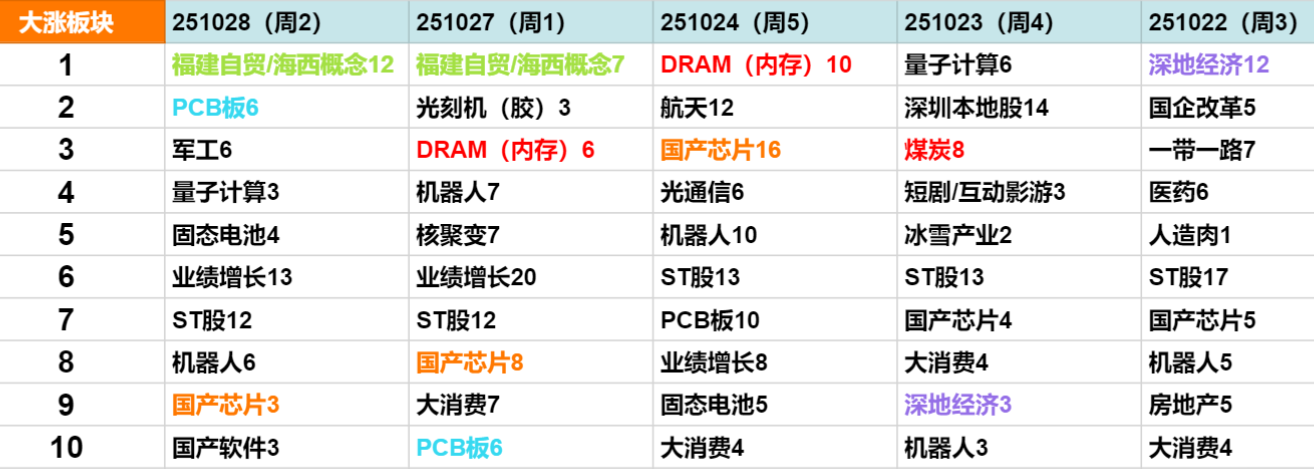
Market Performance - The Shanghai Composite Index broke the 4000-point mark, reaching a ten-year high on October 28, with a peak increase of over 1% before retreating [1] - The total trading volume in the Shanghai and Shenzhen markets was 2.15 trillion yuan, a decrease of 192.3 billion yuan compared to the previous trading day [1] - By the end of the trading session, the Shanghai Composite Index fell by 0.22%, the Shenzhen Component Index decreased by 0.44%, and the ChiNext Index dropped by 0.15% [1] Sector Performance - The top-performing sectors included Fujian Free Trade Zone/Haixi concept, PCB boards, and solid-state batteries, with notable increases in their respective stocks [2] - The DRAM (memory) sector showed significant activity, reflecting ongoing trends in semiconductor demand [2] - Other sectors such as quantum computing and robotics also demonstrated growth, indicating a diverse range of investment opportunities [2]


超100亿元!A股“红包雨”来了
证券时报· 2025-10-28 15:01
Core Viewpoint - The focus on cash dividends among listed companies has significantly increased as the third quarter earnings reports are being disclosed, indicating a trend towards more frequent and stable cash returns to investors [1][2][8]. Group 1: Dividend Announcements - As of October 27, 95 A-share listed companies have announced third-quarter dividend plans, with a total proposed payout of 10.87 billion yuan [2]. - In the first half of the year, 837 companies announced cash dividend plans totaling over 659.48 billion yuan, while 13 companies announced dividends during the first quarter, amounting to 5.87 billion yuan [2][8]. - Notable companies like HSBC, China Evergrande, and Huaxin Cement have also announced their third-quarter dividend plans in the Hong Kong market [6]. Group 2: Company Performance and Dividends - HSBC reported a revenue of 17.788 billion USD for the third quarter of 2025, a year-on-year increase of 5%, but its profit attributable to shareholders decreased by 20.56% [4]. - Despite the profit decline, HSBC's stock price rose over 4% due to its stable dividend policy, announcing a dividend of 0.1 USD per share for the third quarter [4]. - Huaxin Cement achieved a revenue of 8.986 billion yuan in the third quarter, a year-on-year growth of 5.95%, and a net profit of 900 million yuan, up 120.73% [5]. Group 3: Market Trends and Investor Behavior - The trend of high-frequency dividends reflects a maturation of the market, driven by both policy and market mechanisms, with an increasing number of companies adopting a "multiple dividends per year" strategy [8][9]. - The rise in long-term funds, such as insurance capital, in both A-share and Hong Kong markets is leading to a greater focus on companies with high dividend payouts [10][11]. - The regulatory environment is also tightening, with new policies encouraging companies to maintain stable and predictable dividend distributions, which may impact their financing capabilities if they fail to meet these standards [9][12].

北新建材(000786):计提影响业绩 静待提价效果显现
Xin Lang Cai Jing· 2025-10-28 12:34
Core Viewpoint - The company reported a decline in revenue and net profit for the first three quarters of 2025, primarily due to decreased demand for gypsum boards and increased costs associated with raw materials [1][2]. Financial Performance - Revenue for the first three quarters of 2025 was 19.905 billion yuan, a decrease of 2.25% year-on-year; net profit attributable to shareholders was 2.586 billion yuan, down 17.77% [1]. - In Q3 2025, revenue was 6.347 billion yuan, a decline of 6.20%; net profit attributable to shareholders was 657 million yuan, down 29.47% [1]. - The gross margin for Q3 was 27.79%, a decrease of 2.28 percentage points, mainly due to a 7.4% year-on-year increase in the price of recycled paper [1]. Cost and Expense Analysis - The expense ratio for the first three quarters was 14.27%, an increase of 0.86 percentage points; the sales, management, and R&D expense ratios were 5.57%, 4.48%, and 4.10%, respectively, with year-on-year increases of 0.61, 0.42, and 0.01 percentage points [1]. - Asset and credit impairment loss ratio was 0.36%, up 0.28 percentage points, indicating an increase in bad debt provisions [1]. Cash Flow and Collection Efficiency - The net cash flow from operating activities for the first three quarters was 1.539 billion yuan, a decrease of 43.13% year-on-year, primarily due to a high base effect from the previous year [1]. - The cash collection ratio was 82.8%, down 3.4 percentage points; the cash payment ratio was 85.7%, down 2.6 percentage points [1]. Market Outlook and Strategic Initiatives - The gypsum board industry continues to face pressure, with a decline in domestic demand and intensified competition; the company is adjusting its strategies and increasing the development of high-value-added products [2]. - The company announced a price increase for its products effective October 20, which is expected to improve profitability in Q4 [2]. - The company is expanding its overseas presence in Southeast Asia, Africa, and Central Asia, and is pursuing a 100% acquisition of an overseas building materials company, which is expected to have a positive impact on its international development [2]. Investment Forecast - The company forecasts net profits attributable to shareholders for 2025-2027 to be 3.398 billion, 3.946 billion, and 4.584 billion yuan, reflecting year-on-year changes of -6.82%, 16.12%, and 16.15% respectively; EPS is projected to be 2.00, 2.32, and 2.70 yuan [2]. - The closing price on October 27 corresponds to a PE ratio of 11.83x, 10.19x, and 8.77x for 2025-2027 [2].

海螺新材:10月28日召开董事会会议
Mei Ri Jing Ji Xin Wen· 2025-10-28 12:19
Group 1 - The core point of the article is that Conch New Materials (SZ 000619) announced the convening of its 23rd meeting of the 10th board of directors on October 28, 2025, to discuss the proposal for the third extraordinary shareholders' meeting of 2025 [1] - For the first half of 2025, the revenue composition of Conch New Materials is as follows: construction materials account for 82.57%, environmental new materials account for 9.88%, and other industries and services account for 7.54% [1] - As of the time of reporting, Conch New Materials has a market capitalization of 2.8 billion yuan [1] Group 2 - The A-share market has surpassed 4000 points, marking a significant resurgence after a decade of stagnation, with technology leading the market and a new "slow bull" pattern emerging [1]
海螺新材:2025年前三季度净利润约-3835万元
Mei Ri Jing Ji Xin Wen· 2025-10-28 12:19
Group 1 - The core viewpoint of the article highlights that Conch New Materials (SZ 000619) reported a decline in revenue and a net loss for the third quarter of 2025 [1] - The company's revenue for the first three quarters of 2025 was approximately 3.655 billion yuan, representing a year-on-year decrease of 10.57% [1] - The net profit attributable to shareholders of the listed company was a loss of approximately 38.35 million yuan, with basic earnings per share showing a loss of 0.0869 yuan [1] Group 2 - As of the report, Conch New Materials has a market capitalization of 2.8 billion yuan [2]
金隅冀东:10月28日召开董事会会议
Mei Ri Jing Ji Xin Wen· 2025-10-28 11:37
Group 1 - The company Jinju Jidong (SZ 000401) held its 21st meeting of the 10th board of directors on October 28, 2025, where it reviewed the proposal for electing the vice chairman of the board [1] - For the first half of 2025, the company's revenue composition was 100% from the building materials sector [1] - As of the report date, Jinju Jidong's market capitalization was 13.3 billion yuan [1] Group 2 - The A-share market has surpassed 4000 points, marking a significant resurgence after a decade of stagnation, with technology leading the market's transformation [1] - A new "slow bull" market pattern is emerging, indicating a shift in market dynamics [1]
