电子制造

Search documents
宜安科技:目前公司生产的主要产品有折叠屏手机铰链结构件等
Zheng Quan Ri Bao Wang· 2025-11-27 07:12
Core Viewpoint - Yian Technology (300328) announced on November 27 that it is focusing on the development and application of amorphous alloys, which possess unique properties and advantages over traditional materials [1] Group 1: Amorphous Alloys - Amorphous alloys are characterized by a non-crystalline state, differing from the periodic and symmetrical atomic arrangement of conventional metals [1] - The long-range disorder structure of amorphous alloys provides exceptional properties such as high strength, high hardness, high smoothness, corrosion resistance, and wear resistance [1] - Amorphous alloys exhibit superior bending strength, tensile strength, and elastic deformation compared to commonly used materials [1] Group 2: Processing Advantages - The processing methods for amorphous alloys are more efficient than traditional methods, allowing for faster production, fewer post-processing steps, and high precision in mold forming [1] - Amorphous alloys can be produced in bulk, enhancing manufacturing capabilities [1] Group 3: Environmental Impact - The production process of amorphous alloys involves non-toxic raw materials and products, resulting in minimal environmental impact [1] - In an increasingly stringent environmental policy landscape, amorphous alloys offer significant production advantages [1] Group 4: Product Applications - The main products produced by the company include structural components for foldable screen smartphones, wearable devices, door locks, medical equipment, and sports equipment [1] - The company is committed to deepening its existing product areas while continuously exploring the feasibility of applications in other fields [1]

19.36元至75元!万亿巨头工业富联大幅提升回购价上限
Nan Fang Du Shi Bao· 2025-11-27 06:56
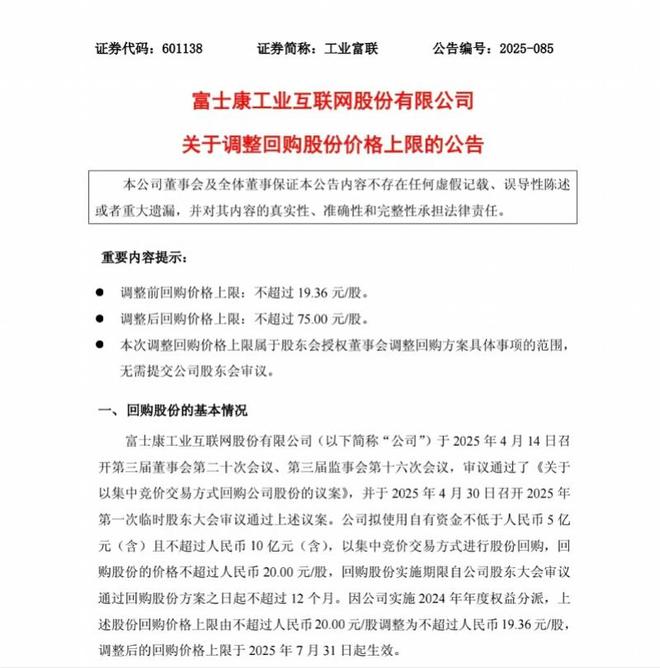
Core Viewpoint - The company has adjusted its share repurchase plan, raising the maximum repurchase price from 19.36 CNY to 75 CNY per share, an increase of 287.4% [1][3]. Group 1: Share Repurchase Plan - The company initially announced a plan to repurchase shares using self-owned funds between 5 billion CNY and 10 billion CNY, with a maximum repurchase price of 20.00 CNY per share [1]. - The maximum repurchase price was later adjusted to 19.36 CNY due to the company's 2024 annual equity distribution [1]. - As of now, the company has repurchased approximately 7.6974 million shares, with a total expenditure of about 1.47 billion CNY [1]. Group 2: Stock Performance - The company's stock price has shown strong performance, reaching 61.66 CNY per share as of November 27, with a market capitalization of 1.224966 trillion CNY [4]. - The stock price has increased over 200% from the initial repurchase price limit of 19.36 CNY [4]. - However, the stock experienced significant volatility, with a nearly 30% decline since reaching a historical high at the end of October [4]. Group 3: Financial Performance - For the first three quarters of the year, the company reported a revenue of 603.931 billion CNY, a year-on-year increase of 38.4%, and a net profit attributable to shareholders of 22.487 billion CNY, up 48.52% year-on-year [4]. - The third quarter alone saw record revenue of 243.172 billion CNY and net profit of 10.373 billion CNY [4]. Group 4: Cash Flow Situation - The company's cash flow situation is under short-term pressure, with a net cash flow from operating activities of -4.14 billion CNY for the first three quarters, a significant decline due to large-scale inventory buildup to meet strong demand in the AI server market [5].


领益智造递表港交所 股价涨2倍后又跌26%去年净利降
Zhong Guo Jing Ji Wang· 2025-11-27 06:49
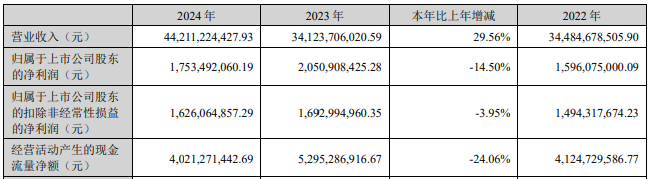
| | 2024年 | 2023 年 | 本年比上年增减 | 2022年 | | --- | --- | --- | --- | --- | | 营业收入(元) | 44,211,224,427.93 | 34,123,706,020.59 | 29.56% | 34.484.678,505.90 | | 归属于上市公司股东 的净利润(元) | 1,753,492,060.19 | 2,050,908,425.28 | -14.50% | 1.596.075.000.09 | | 归属于上市公司股东 的扣除非经常性损益 | 1,626,064,857.29 | 1.692.994.960.35 | -3.95% | 1.494.317.674.23 | | 的净利润(元) | | | | | | 经营活动产生的现金 | 4,021,271,442.69 | 5.295.286.916.67 | -24.06% | 4.124.729.586.77 | | 流量净额(元) | | | | | 前三季度,领益智造实现营业收入375.90亿元,同比增长19.25%;归属于上市公司股东的净利润19.41亿元, 同比增 ...

春秋电子(603890):收购ASETEK布局液冷赛道 协同效应开启新成长极
Xin Lang Cai Jing· 2025-11-27 06:26
Core Viewpoint - The company announced a voluntary cash offer to acquire all shares of Asetek A/S to enhance synergies between different business segments [1] Group 1: Synergy and Strategic Complementarity - The acquisition is expected to create significant synergies, achieving a "1+1>2" effect, as the company is a leading provider of notebook structural components with integrated services from precision mold design to manufacturing [2] - Both companies have overlapping customer bases, allowing for rapid expansion of product offerings and market share, which will enhance overall profitability [2] - The company will leverage its strengths in precision manufacturing and supply chain management to internalize Asetek's production processes, effectively reducing manufacturing costs and accelerating capacity expansion [2] Group 2: Strategic Transformation and New Growth Areas - The acquisition will facilitate a strategic transformation from electronic manufacturing to an "electronic + liquid cooling solutions" model, integrating Asetek's core liquid cooling technology [3] - Asetek has over 20 years of experience in the liquid cooling sector and has previously collaborated with major companies in developing data center liquid cooling products, which may be revived post-acquisition [3] Group 3: Financial Projections and Investment Recommendations - The company is projected to achieve revenues of 4.629 billion, 5.639 billion, and 6.767 billion yuan from 2025 to 2027, with year-on-year growth rates of 17.4%, 21.8%, and 20.0% respectively [4] - Expected net profits for the same period are 334 million, 460 million, and 605 million yuan, with growth rates of 58.2%, 37.7%, and 31.4% respectively, leading to a strong investment recommendation [4]

FIT HON TENG(06088)资讯系统遭入侵 目前营运全面恢复 无重大财务影响
智通财经网· 2025-11-27 04:42
Core Viewpoint - FIT HON TENG (06088) reported a cybersecurity incident where the group's information system was breached, but the financial impact on the company is deemed minimal [1] Group 1 - The company discovered that its servers were attacked earlier this month [1] - Following the incident, the company activated its emergency response and recovery mechanisms [1] - The company's operations have fully recovered from the incident [1]
湖南证监局常态化走访 助推上市公司高质量发展
Zheng Quan Shi Bao Wang· 2025-11-27 04:29
Group 1 - The Hunan Securities Regulatory Bureau is implementing a regular visit program to listed companies to address their development challenges and enhance their quality and investment value [1][2] - As of mid-November, 106 listed companies have been visited, achieving a coverage rate of 73%, fostering a supportive environment for high-quality development [1] - 28 major index constituent companies have established market value management systems, and 86 companies have implemented annual cash dividends totaling 20.2 billion yuan, with 26 companies announcing mid-term dividend plans totaling 6.889 billion yuan, a year-on-year increase of 161.34% [2] Group 2 - The focus is on promoting compliant and efficient mergers and acquisitions (M&A) to help traditional industry companies address development difficulties and transition needs [3] - Since 2025, 49 M&A transactions have been completed in the region, including one major asset restructuring, with six companies having announced major asset restructuring plans [3] - The company Youa Co., Ltd. is transitioning from traditional retail to a dual business model of "retail + semiconductor" through strategic acquisitions [3] Group 3 - A dual leadership mechanism has been established to address risks in listed companies, emphasizing the responsibility of local governments and controlling shareholders in risk mitigation [4] - Since the beginning of the year, one company has begun to mitigate risks by divesting overseas loss-making assets, while two companies have removed other risk warnings [4] - The government has developed a risk disposal plan for Hengli Industrial to ensure a smooth delisting process [4] Group 4 - The Hunan Securities Regulatory Bureau is actively addressing specific challenges faced by listed companies in advantageous industries, particularly in technology and consumer sectors [5] - Coordination efforts have led to the financing of approximately 6 billion yuan for three technology companies through green channels for refinancing [5] - The bureau is advocating for consumer companies to correct "involution" competition behaviors and is facilitating loan replacements for companies facing financial difficulties [5] Group 5 - The bureau is collecting and reporting common issues and policy suggestions for companies significantly impacted by tariff policies, particularly those with high foreign trade exposure [6] - Efforts have been made to resolve historical issues, including the recovery of 3.46 million shares and 1.4 billion yuan in long-standing fiscal returns for companies [6] - The bureau aims to enhance service levels and regulatory support to improve the quality of listed companies [6]


嘉利国际绩后涨超6% 中期净利1.02亿港元 公司成功获纳入英伟达伺服器供应商名单
Zhi Tong Cai Jing· 2025-11-27 03:05
Core Viewpoint - 嘉利国际's stock rose over 6% following the release of its financial results, indicating positive market reaction despite a slight decline in net profit [1] Financial Performance - Revenue for the six months ending September 30, 2025, was HKD 1.609 billion, representing a year-on-year increase of 5.4% [1] - Net profit was HKD 102 million, showing a slight decrease of 0.1% compared to the previous year [1] - Basic earnings per share were HKD 0.05, with an interim dividend proposed at HKD 0.015 per share [1] Market Position and Developments - 嘉利国际 is one of the earliest entrants in the server market, leveraging over 40 years of experience in metal and plastic engineering [1] - The company has become a preferred partner for several international server brands due to its strong engineering R&D capabilities and mature mold manufacturing strength [1] - 嘉利国际 has been included in Nvidia's list of server chassis and cabinet component suppliers, successfully delivering multiple prototype products to support Nvidia's AI server platform and data center deployment [1] - The company has commenced deliveries of its application-specific integrated circuit (ASIC) related server products, marking a significant milestone in entering the core supply chain for AI servers and laying the groundwork for future order growth [1]
环旭电子股价涨6.05%,南方基金旗下1只基金位居十大流通股东,持有956.74万股浮盈赚取1253.33万元
Xin Lang Cai Jing· 2025-11-27 02:18
截至发稿,罗文杰累计任职时间12年223天,现任基金资产总规模1704.45亿元,任职期间最佳基金回报 145.85%, 任职期间最差基金回报-47.6%。 数据显示,南方基金旗下1只基金位居环旭电子十大流通股东。南方中证500ETF(510500)三季度减持 20.91万股,持有股数956.74万股,占流通股的比例为0.43%。根据测算,今日浮盈赚取约1253.33万元。 南方中证500ETF(510500)成立日期2013年2月6日,最新规模1400.98亿。今年以来收益23.54%,同类 排名1967/4206;近一年收益24.27%,同类排名1955/4006;成立以来收益134.4%。 南方中证500ETF(510500)基金经理为罗文杰。 11月27日,环旭电子涨6.05%,截至发稿,报22.98元/股,成交2.03亿元,换手率0.41%,总市值505.78 亿元。 资料显示,环旭电子股份有限公司位于上海市浦东新区盛夏路169号B栋5楼,成立日期2003年1月2日, 上市日期2012年2月20日,公司主营业务涉及 为国内外的品牌厂商提供通讯类、电脑及存储类、消费电 子类、工业类及其他类(以车用电子 ...

长盈精密股价涨5.15%,山证资管旗下1只基金重仓,持有2.3万股浮盈赚取4.49万元
Xin Lang Cai Jing· 2025-11-27 02:06
Core Viewpoint - Changying Precision has seen a significant stock price increase of 20.13% over the past five days, closing at 39.85 CNY per share with a market capitalization of 54.231 billion CNY [1] Company Overview - Changying Precision Technology Co., Ltd. was established on July 17, 2001, and listed on September 2, 2010. The company is located in Bao'an District, Shenzhen, Guangdong Province [1] - The main business includes the development, production, and sales of electronic connectors, precision small parts for smart electronic products, connectors and modules for new energy vehicles, precision structural parts and modules for consumer electronics, and industrial internet robotics [1] - Revenue composition: 41.16% from consumer electronics precision structural parts and modules, 34.04% from new energy product components and connectors, 20.28% from electronic connectors and smart electronic products, 4.07% from other sources, and 0.44% from robotics and intelligent equipment [1] Fund Holdings - Shan Zheng Asset Management has a fund that heavily invests in Changying Precision. The Shan Zheng Asset Management Reform Selected Mixed Fund (005226) held 23,000 shares in the third quarter, accounting for 3.39% of the fund's net value, ranking as the tenth largest holding [2] - The fund has generated a floating profit of approximately 44,900 CNY today and 146,000 CNY during the five-day increase [2] - The fund was established on January 12, 2018, with a current scale of 28.3104 million CNY and has achieved a year-to-date return of 12.37% [2] Fund Manager Profile - The fund manager of Shan Zheng Asset Management Reform Selected Mixed Fund (005226) is Du Gu Nan Xun, who has been in the position for 9 years and 237 days [3] - The total asset size of the fund is 185 million CNY, with the best return during the manager's tenure being 47.28% and the worst being -7.03% [3]

工业富联提升回购价格上限每股从19.36元提高至75元
Zheng Quan Shi Bao Wang· 2025-11-27 00:57
Core Viewpoint - Industrial Fulian (601138) has adjusted its share repurchase plan, increasing the maximum repurchase price from 19.36 yuan per share to 75 yuan per share, representing a significant increase of 287% [1] Summary by Sections Share Repurchase Plan - As of now, Industrial Fulian has spent 147 million yuan to repurchase 7.6974 million shares [1] - The stock price on November 26 closed at 58.93 yuan, reflecting a 4.10% increase [1] - The adjustment in the repurchase price is based on the company's confidence in its future stable development and recognition of its value, ensuring the smooth implementation of the repurchase plan [1] Historical Context - Since its listing, Industrial Fulian has consistently returned value to shareholders through share repurchases and substantial dividends [1] - Over the past three years, the company has repurchased shares totaling nearly 1.7 billion yuan [1] - The introduction of a cancellation-based repurchase plan of 200-300 million yuan in July 2024 has garnered market attention, as it is believed to reduce total share capital, thereby increasing earnings per share and shareholder equity [1] Dividend Distribution - The cash dividend proposal for the first half of 2025, amounting to 6.55 billion yuan, has been approved by the shareholders' meeting [1] - To date, Industrial Fulian has completed seven cash dividend distributions, totaling 56.54 billion yuan, maintaining its position as the top dividend payer in the A-share electronic industry for many years [1]