军工

Search documents
11月17日主题复盘 | 福建板块强势依旧,锂电板块也持续活跃,AI应用迎资金关注
Xuan Gu Bao· 2025-11-17 08:30
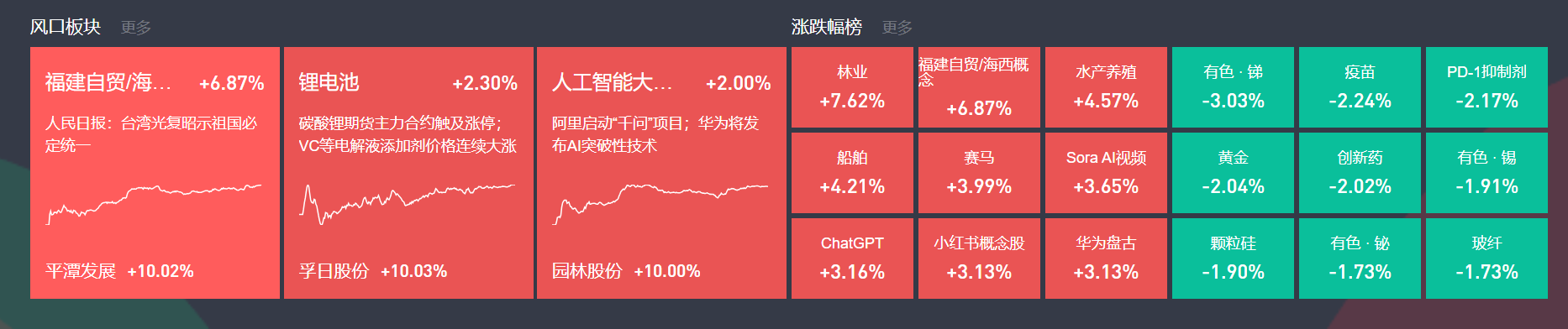
Market Overview - The market experienced fluctuations with all three major indices slightly declining. Local stocks in Fujian surged, with over 20 stocks hitting the daily limit. The lithium battery sector showed strength, with companies like Zhongmin Resources and Rongjie Co. reaching their limits. AI application stocks were active, with companies such as 360 and Xuan Ya International also hitting their limits. The military industry saw a midday rally, while pharmaceutical stocks collectively adjusted, with Shuoshi Bio dropping over 10%. The total trading volume for the day was 1.93 trillion [1]. Hot Topics Fujian Free Trade Zone - The Fujian Free Trade Zone sector continued to explode, with Pingtan Development hitting the daily limit, Sanmu Group achieving its seventh consecutive limit-up, and Jiuzhou Wang and Haixia Innovation also reaching their limits [4]. Lithium Battery Sector - The lithium battery concept remained active, with companies like Fuzhi Co. achieving eight consecutive limit-ups. The futures price of lithium carbonate hit the daily limit. At the 10th International Summit on Power Battery Applications (CBIS2025), the chairman of Ganfeng Lithium predicted that if the demand for lithium carbonate exceeds 30% to 40% in 2026, prices could break through 150,000 to 200,000 yuan per ton due to supply-demand imbalances [6]. AI Large Models - The AI application sector performed well again, with stocks like Huasheng Tiancai, Inspur Software, and Xuan Ya International hitting their limits. Huawei is set to release a breakthrough technology in AI on November 21, which could significantly enhance the utilization rate of computing resources. Additionally, Alibaba announced its "Qianwen" project, aiming to penetrate the AI to C market by integrating various life scenarios into the app [9][12].

指数又跌了,形势不妙!题材热度降温,还有哪些投资机会?
Sou Hu Cai Jing· 2025-11-17 08:20
Group 1: Macroeconomic Insights - The key to macroeconomic clues in 2025 is "the lifeblood of currency," with micro liquidity remaining abundant, leading to an expected bullish stock market amid a slow recovery in fundamentals, drawing parallels to bull markets in 1999, 2014, and 2019 [1] - The asset allocation strategy suggests focusing on three main lines: technology growth sectors (TMT/mechanical/military), sectors expected to improve due to "anti-involution" (new energy/building materials/traditional cycles), and consumer sectors benefiting from policy support and currently low valuations [1] Group 2: Industry Trends - In the context of traditional e-commerce reaching a peak in traffic dividends and high customer acquisition costs, short dramas have emerged as a new entry point for user attention, becoming a focal point in the "Double 11" e-commerce promotion [3] - The price of lithium carbonate has been rising due to unexpected demand and accelerated inventory depletion, with futures contracts increasing from 72,000 yuan/ton to 82,280 yuan/ton since mid-October [3] - The white liquor sector has underperformed significantly, with the CITIC liquor index down 4.6% year-to-date as of October 31, 2025, lagging behind major indices by 22.5 and 30.9 percentage points [5] - The beer industry is expected to maintain stable revenue and profit in 2026, with a focus on companies with strong channel management and product momentum [5] Group 3: Market Performance - The short-term market trend is strong, with no significant increase in incremental capital entering the market, indicating a positive market sentiment [7] - The Shanghai Composite Index has shown a pattern of upward oscillation since late August, with a critical support level at 3,900 points [9] - The financing and securities market has seen increased activity, with margin trading balances reaching new highs, leading to a 54.52% year-on-year increase in net interest income for listed brokerages in the third quarter [9]

国防军工指数走低,板块行情回调
Guotou Securities· 2025-11-17 08:04
Investment Rating - The industry investment rating is "Leading the Market - A" and the rating is maintained [6]. Core Viewpoints - The defense and military industry indices have declined, indicating a market correction. The China Securities Military Industry Index fell by 2.02%, the China Defense Index by 1.86%, and the Shenwan Defense and Military Industry Index by 2.15% during the week from November 7 to November 14, 2025. In comparison, the Shanghai Composite Index decreased by 0.18%, the CSI 300 Index by 1.08%, and the ChiNext Index by 3.01% [1][15]. - The Shenwan Defense and Military Industry Index ranked 27th out of 31 in terms of performance among primary industries during the same period [1][18]. Summary by Sections 1. Defense and Military Market Review - The China Securities Military Industry Index closed at 11,962.63 points, down 2.02% [1][15]. - The Shenwan Defense and Military Industry Index closed at 1,671.60 points, down 2.15% [1][15]. - The index underperformed compared to the Shanghai Composite Index and the CSI 300 Index but outperformed the ChiNext Index [1][15]. 2. Individual Stock Performance - Top performing stocks included Tian'ao Electronics (+12.63%), Shanghai Huguang (+12.35%), and Aerospace Development (+8.54%) [2][19]. - The worst performing stocks included *ST Wanfang (-19.65%), Triangle Defense (-12.22%), and Aerospace Technology (-11.83%) [2][19]. 3. Key Company Announcements - Newray Energy announced a plan to reduce its shareholding by up to 3,500,000 shares [3][21]. - Aerospace and Aerospace will hold a quarterly performance briefing on November 18, 2025 [3][21]. - China Shipbuilding announced a quarterly performance briefing scheduled for November 17, 2025 [3][21]. 4. Industry News - The U.S. Department of Defense announced plans to simplify the weapon procurement process to address global threats [11][23]. - Saab and Embraer completed aerial refueling certification flights for the Gripen E fighter and KC-390 tanker in Brazil [11][23]. - The Ministry of Industry and Information Technology released a draft for the "Medium and Long-term Technology Development Plan for the Defense Industry (2026-2035)" [11][23]. 5. Investment Recommendations - Focus on the upcoming markets for gas turbines and international subcontracting businesses, highlighting companies like Triangle Defense and Wanze Shares [11][23]. - Emphasize new-generation high-end equipment sectors, including companies like AVIC Shenyang Aircraft and AVIC Chengdu Aircraft [11][23]. - Highlight opportunities in ammunition and unmanned equipment sectors [11][23].

沸腾!董事长一句话,集体涨停!
中国基金报· 2025-11-17 08:02
Core Viewpoint - The article highlights the significant surge in lithium mining stocks following a sharp increase in lithium carbonate futures prices, indicating a bullish sentiment in the market for lithium-related companies [2][4][5]. Lithium Market Dynamics - On November 17, lithium carbonate futures reached a limit-up price of 95,200 yuan/ton, marking a 9% increase and the highest level since July 2024 [4]. - The chairman of Ganfeng Lithium, Li Liangbin, projected that global lithium carbonate demand will rise to 1.55 million tons in 2025, up from an earlier estimate of 1.45 million tons, with a supply capacity of over 1.7 million tons, indicating a surplus of around 200,000 tons [7]. - Li also forecasted a 30% increase in demand for lithium carbonate in 2026, potentially reaching 1.9 million tons, with supply growth of approximately 250,000 tons, suggesting a balance in supply and demand and potential price increases [7]. Stock Performance - Several lithium mining stocks experienced significant gains, with multiple companies hitting their daily price limits. For instance, Yahua Group and Zhongmin Resources both saw a 10% increase, while Tianqi Lithium and Ganfeng Lithium rose by 9.87% and 7.48%, respectively [6][5]. - The overall A-share market showed volatility, with the Shanghai Composite Index down by 0.46% and a total of 2,584 stocks rising, while 2,726 stocks fell [9]. Other Market Trends - Local stocks in Fujian province also saw a notable rise, with over 20 stocks hitting their daily limits, including Haixia Innovation and Pingtan Development, both increasing by 20% [11]. - The AI application sector showed active performance, with companies like 360 and Xuanyuan International reaching their daily limits [13]. - The military industry sector experienced a midday surge, with stocks such as Jianglong Shipbuilding and Aerospace Development also hitting their limits [14]. Sector Adjustments - The pharmaceutical sector faced a collective downturn, with companies like Shuoshi Biology dropping over 10% [16].





A股收评:三大指数集体下跌,沪指跌0.41%创业板指跌0.2%北证50涨0.81%,锂矿概念、福建板块走高!逾2700股下跌,成交1.93万亿缩量501亿
Ge Long Hui· 2025-11-17 07:57
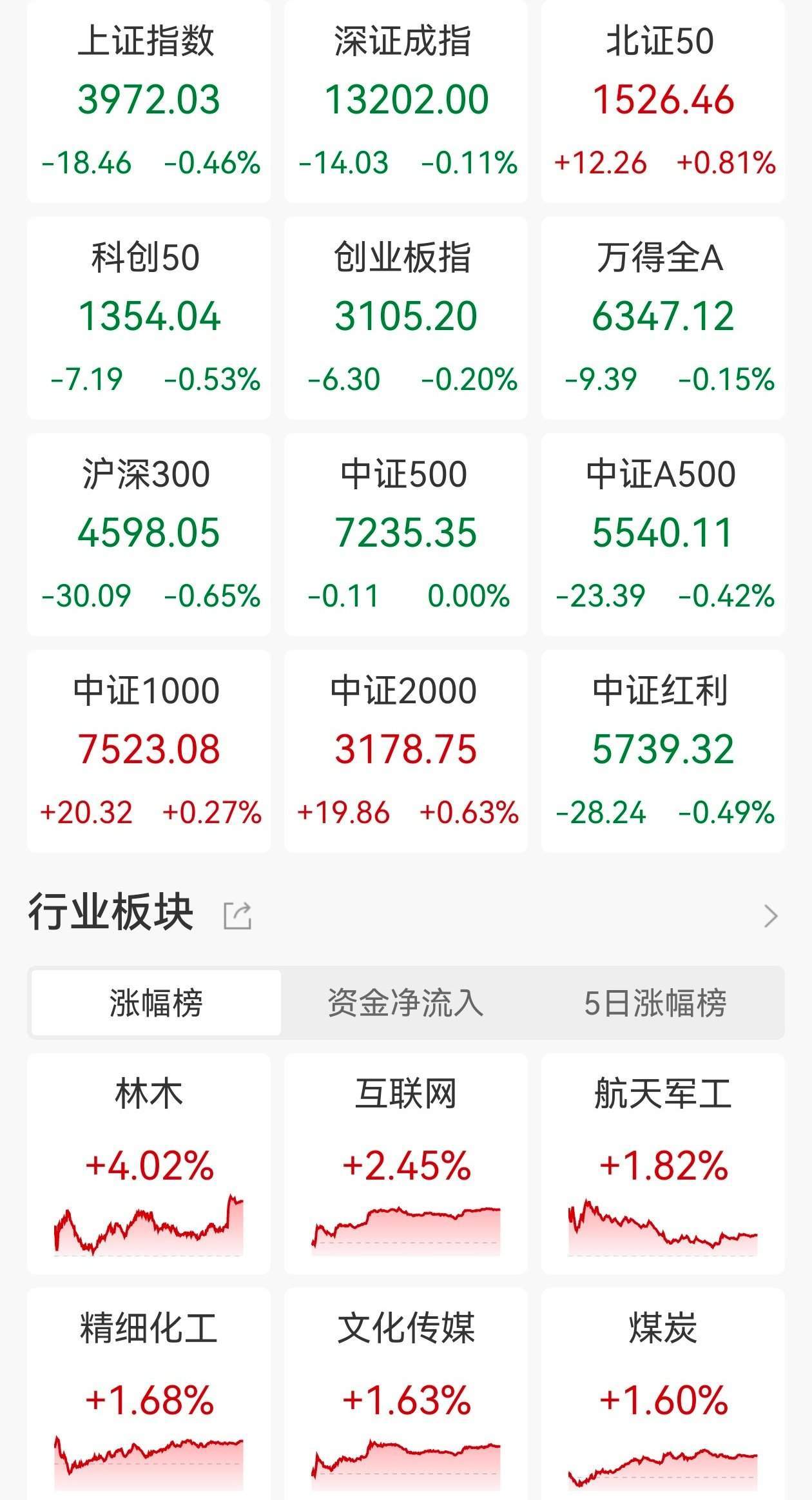
Market Overview - Major A-share indices collectively declined, with the Shanghai Composite Index down 0.46% closing at 3972 points, and the Shenzhen Component Index down 0.11% [1] - Total market turnover was 1.93 trillion yuan, a decrease of 501 billion yuan compared to the previous trading day, with over 2700 stocks declining [1] Index Performance - Shanghai Composite Index: 3972.03, down 18.46 points (-0.46%) [2] - Shenzhen Component Index: 13202.00, down 14.03 points (-0.11%) [2] - ChiNext Index: 1526.46, down 12.26 points (+0.81%) [2] - Other indices such as the CSI 300 and CSI 500 also showed declines [2] Sector Performance - Lithium carbonate futures hit the daily limit, with lithium mining concepts continuing to surge, leading to stocks like Shengxin Lithium Energy and Yahua Group reaching the daily limit [3] - The military and shipbuilding sectors saw gains, with Jianglong Shipbuilding hitting a 20% limit up [3] - The AI application concept was active, with stocks like Xuanya International reaching the daily limit [3] - Conversely, the pharmaceutical sector experienced a broad decline, with stocks like Shuyou Pingmin dropping over 6% and Kexing Pharmaceutical nearly 8% [3] - Other sectors such as precious metals, cultivated diamonds, photovoltaic equipment, and medical devices also faced significant declines [3]

超60亿元资金抢筹!三重逻辑共振,这一赛道迎来价值重估
Zheng Quan Shi Bao Wang· 2025-11-17 07:53
Core Viewpoint - The military industry is positioned as a high-potential investment sector driven by national security needs, military trade exports, and technological innovation through civil-military integration [1][3][4] Industry Dynamics - The military industry is experiencing a positive trend characterized by "economic recovery, value reassessment, and event-driven catalysts" [3] - The defense industry reported a revenue growth of 6.7% year-on-year in the first three quarters, reversing a decline of 0.57% in the first half of the year [3] - The net profit attributable to shareholders improved from -8.59% in the first half to 0.02% in the third quarter, indicating a recovery in industry performance [3] Investment Opportunities - The military trade export structure has shifted from reliance on imports to high-value exports, with a significant decrease in import share from 4.3% in 2015 to 0.2% in 2024 [4] - The 2025 defense budget is projected at 1.78 trillion yuan, with a consistent growth rate of 7.2%, indicating a stable growth foundation for defense investments [3] Valuation Insights - The current price-to-earnings ratio (TTM) for the military industry is approximately 85.77, significantly higher than the overall market average of 22.59 [5][6] - The valuation premium in the military sector is attributed to high barriers to entry and the long-term investment required for core technology development [6] Investment Tools - The military industry presents complexities and information asymmetries, making it challenging for ordinary investors to participate directly [8] - The military leader ETF (code: 512710) offers a transparent and accessible investment vehicle, tracking the military leader index that focuses on leading companies across the military supply chain [8][9] Market Sentiment - As of October 30, the military leader ETF has seen a net inflow of 6.413 billion yuan this year, with a total scale of 13.735 billion yuan, reflecting strong market recognition [2][10] - The investment in the military sector is viewed as a long-term confidence in national technological strength and security, aligning with national strategies [10]
超60亿元资金抢筹!三重逻辑共振,这一赛道迎来价值重估
券商中国· 2025-11-17 07:43
Core Viewpoint - The military industry is positioned as a high-potential investment sector, driven by national security needs, military trade exports, and technological innovation through military-civilian integration, highlighting its long-term investment value as the country transitions from the "14th Five-Year Plan" to the "15th Five-Year Plan" [1] Group 1: Industry Dynamics - The military industry is experiencing a positive trend characterized by "economic recovery, value reassessment, and event-driven catalysts" [4] - The defense and military sector's revenue for the first three quarters showed a year-on-year growth of 6.7%, reversing a decline of 0.57% in the first half of the year [4] - The 2025 national defense budget is projected at 1.78 trillion yuan, with a consistent growth rate of 7.2%, indicating a stable foundation for continued investment [4] Group 2: Military Trade and Technological Integration - Military trade exports are a key variable for value reassessment, with China's military trade export structure shifting towards high-value areas such as drones and stealth fighters [5] - The integration of military and civilian technologies is creating new growth paths, with military high-tech accelerating its transition into civilian sectors like commercial aerospace and logistics [5] Group 3: Valuation and Market Perception - The current price-to-earnings ratio (TTM) for the A-share military industry is approximately 85.77, significantly higher than the overall market average of 22.59, raising concerns about overvaluation [7] - The valuation of military enterprises should consider their strategic importance, technological barriers, and profit certainty, rather than relying solely on traditional metrics [7] - The global military industry valuation logic is being restructured, with a shift from traditional manufacturing to technology-driven platforms, emphasizing long-term growth potential [8] Group 4: Investment Strategies for Ordinary Investors - The military industry presents significant complexity and information asymmetry, making direct investment challenging for ordinary investors [11] - The military leader ETF (code: 512710) offers a transparent and accessible investment tool, tracking the military leader index that focuses on leading enterprises across the military supply chain [11][13] - The military leader index includes key players from all segments of the military industry, providing a diversified investment approach that mitigates individual stock risks [12][13]

军工股大涨,江龙船艇等多股20cm涨停,锂电概念集体狂飙
21世纪经济报道· 2025-11-17 07:37
Market Overview - The A-share market experienced weak fluctuations on November 17, with the Shanghai Composite Index down 0.46%, the Shenzhen Component Index down 0.11%, and the ChiNext Index down 0.2%. The total market turnover was 1.93 trillion yuan, with 100 stocks hitting the daily limit [1]. Sector Performance - Energy metals, military industry, and AI applications sectors saw significant gains, while precious metals and pharmaceuticals sectors faced declines. The defense and military sector surged, with stocks like Jianglong Shipbuilding hitting the daily limit, and companies like Morningstar Aviation and Tianhe Defense rising over 10% [2]. Lithium Battery Sector - The lithium battery sector experienced a strong rally, with stocks such as Shengxin Lithium Energy and Rongjie Co. hitting the daily limit. Tianqi Lithium rose over 9%, Yongxing Materials over 8%, and Ganfeng Lithium over 7%, indicating a broad upward trend in the sector [4]. Lithium Carbonate Futures - On November 17, lithium carbonate futures surged over 7%, with the main contract breaking the 94,000 yuan/ton mark, reaching a high of 94,760 yuan/ton, marking a new high in over a year. Since June, the main contract has seen a price increase of over 56% [5]. Supply and Demand Dynamics - According to industry analysis, the price fluctuations of lithium carbonate exhibit clear phase characteristics, driven initially by "anti-involution" sentiments, followed by supply contractions due to some mines halting production, and recently supported by unexpectedly strong downstream demand [6]. Future Demand Projections - At the 10th International Summit on Power Battery Applications (CBIS2025), Ganfeng Lithium's chairman predicted a 30% increase in lithium carbonate demand by 2026, reaching 1.9 million tons, while supply capacity is expected to grow by 250,000 tons. If demand growth exceeds 30%, prices could potentially break 150,000 yuan/ton or even 200,000 yuan/ton in the short term [7]. Precious Metals Market - International gold prices saw a significant decline, with spot gold and COMEX gold dropping to around 4,050 USD/ounce. Despite this, domestic gold jewelry prices remained stable, with brands like Chow Tai Fook and Chow Sang Sang maintaining prices above 1,300 yuan/gram as of November 17 [7].




A股收评:沪指跌0.46%,锂矿板块全天强势
2 1 Shi Ji Jing Ji Bao Dao· 2025-11-17 07:32
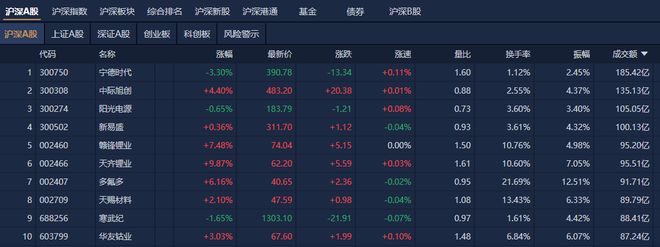
Market Overview - The market showed weakness with the Shanghai Composite Index opening lower and closing down by 0.46%, while the Shenzhen Component Index fell by 0.11% and the ChiNext Index decreased by 0.2% [1] - The total trading volume in the Shanghai and Shenzhen markets was 1.91 trillion yuan, a decrease of 47.3 billion yuan compared to the previous trading day [4] Sector Performance - The lithium mining sector remained strong, with major stocks like Dazhong Mining achieving three consecutive daily limits and over ten stocks hitting the daily limit [1] - The AI application concept saw rapid growth, with stocks such as 360, Inspur Software, and Xuan Ya International reaching their daily limits [2] - The military industry sector was active, highlighted by Aerospace Development achieving two consecutive daily limits [3] - Conversely, the pharmaceutical sector experienced a collective decline, with stocks like Shutai Shen and Jimin Health suffering significant drops [4] Notable Stocks - Ningde Times had the highest trading volume of over 18.5 billion yuan, while stocks like Zhongji Xuchuang, Yangguang Electric, and Xinye Sheng all exceeded 10 billion yuan in trading volume [4] - Specific stock performances included: - Ningde Times: down 3.30% [5] - Zhongji Xuchuang: up 4.40% [5] - Yangguang Electric: down 0.65% [5] - Tianqi Dingshi: up 9.87% [5] - Ganlong Jianye: up 7.48% [5]
A股再现百股涨停
财联社· 2025-11-17 07:14
下载财联社APP获取更多资讯 准确 快速 权威 专业 7x24h电报 头条新闻 VIP资讯 实时盯盘 今日A股市场弱势震荡,沪指低开低走,深成指、创业板指尾盘跌幅有所收窄。沪深两市成交额1.91万亿,较上一个交易日缩量473亿。 盘面上,热点快速轮动, 全市场100只个股涨停。锂电池产业链集体爆发, 大中矿业3连板,丰元股份等10余股涨停。 福建板块延续强势 ,厦工股 份10天5板,平潭发展、龙洲股份3连板。AI应用概念快速走强,三六零、浪潮软件、宣亚国际等多股涨停。军工板块表现活跃,航天发展2连板。下 跌方面,医药概念集体下挫,舒泰神、济民健康等大跌。 板块方面,能源金属、军工、AI应用等板块涨幅居前,贵金属、医药等板块跌幅居前。 截至收盘,沪指跌0.46%,深成指跌0.11%,创业板指跌0.2%。 ...