
汽车制造业

Search documents
东风汽车申请电机绕组接线结构相关专利,减少绝缘材料用量
Jin Rong Jie· 2025-11-18 05:57
Group 1 - Dongfeng Motor Group Co., Ltd. has applied for a patent titled "Winding Connection Structure of Motor, On-board Motor, and Electric Vehicle," with publication number CN120979052A, and the application date is August 2025 [1] - The patent provides a winding connection structure for motors that reduces the voltage difference between adjacent winding sections, thereby decreasing the amount of insulation material required and lowering the height of the stator slots, which enhances motor performance [1] Group 2 - Dongfeng Motor Group Co., Ltd. was established in 2001 and is located in Wuhan, primarily engaged in the automotive manufacturing industry [2] - The company has a registered capital of 858,937,000 RMB and has made investments in 45 enterprises, participated in 5,000 bidding projects, and holds 5,000 patent records [2]

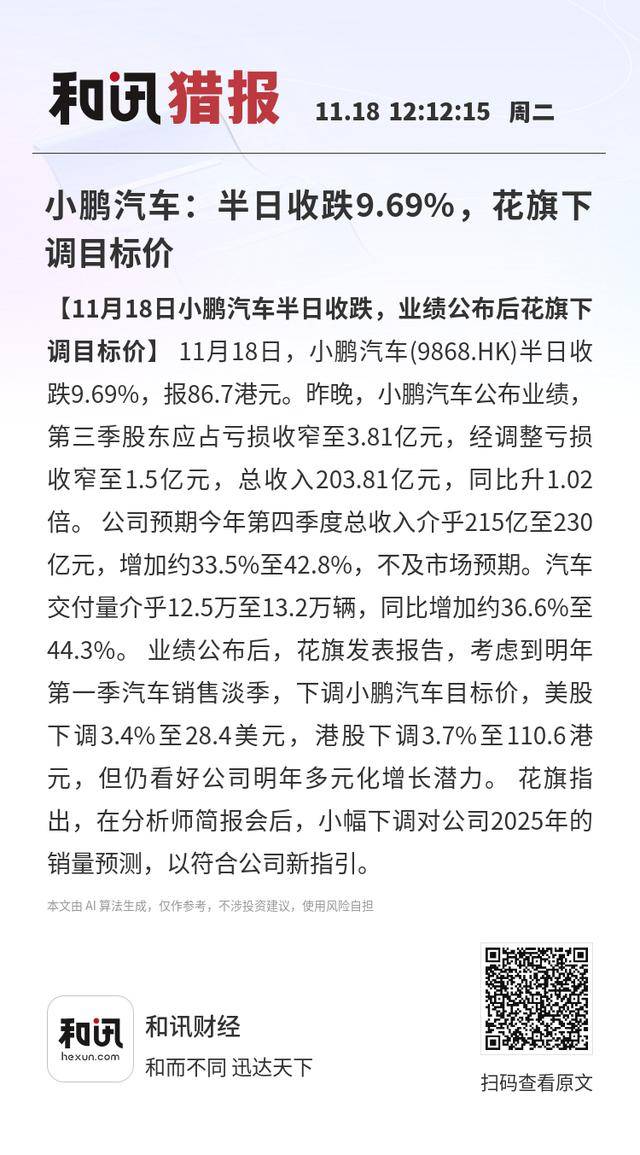
小鹏汽车:半日收跌9.69%,花旗下调目标价
Sou Hu Cai Jing· 2025-11-18 04:40
Group 1 - The core viewpoint of the article highlights that XPeng Motors reported a narrower loss in Q3, but its revenue guidance for Q4 fell short of market expectations, leading to a decline in stock price [1] - XPeng Motors' Q3 net loss attributable to shareholders narrowed to 381 million yuan, with adjusted losses at 150 million yuan, while total revenue reached 20.381 billion yuan, a year-on-year increase of 102% [1] - The company expects Q4 total revenue to be between 21.5 billion and 23 billion yuan, representing an increase of approximately 33.5% to 42.8% year-on-year, which is below market expectations [1] Group 2 - Vehicle delivery volume is projected to be between 125,000 and 132,000 units, reflecting a year-on-year increase of approximately 36.6% to 44.3% [1] - Following the earnings announcement, Citigroup downgraded XPeng Motors' target price, reducing it by 3.4% to $28.4 for US shares and by 3.7% to HK$110.6 for Hong Kong shares, while maintaining a positive outlook on the company's diversification growth potential for next year [1] - Citigroup also slightly lowered its sales forecast for the company in 2025 to align with the new guidance provided by XPeng Motors [1]

赛力斯入选福布斯中国创新力企业50强 智能安全彰显硬核领先实力
Jing Ji Guan Cha Wang· 2025-11-18 03:35
Core Insights - Forbes China has recognized Seres Group as one of the "Top 50 Innovative Enterprises of 2025," highlighting its continuous innovation in the smart electric vehicle sector [1][4] - Seres focuses on core technologies in electrification and intelligence, establishing a technological moat with platforms like Seres Cube Technology, Super Range Extender, and Super Factory [1] - The company emphasizes safety as a luxury, leading the industry with its advanced intelligent safety system [1] Innovation and Technology - Seres has developed an intelligent safety system that covers over 190 safety scenarios, including remote driving, parking, and accident management, with more than 340 safety features [3] - The system has reportedly prevented over 2 million potential collisions for users [3] - Key innovations include a 720° safety protection framework and the world's largest aluminum alloy integrated die-cast rear body [3] Future Directions - The recognition from Forbes is seen as a validation of Seres' technological capabilities [4] - The company plans to continue investing in intelligent safety technology, aiming to enhance user safety and collaborate with industry partners for improved travel experiences [4]


江淮汽车申请智能速度辅助系统仿真测试方法专利,显著降低测试成本与复杂度
Jin Rong Jie· 2025-11-18 02:39
Group 1 - The core viewpoint of the news is that Anhui Jianghuai Automobile Group Co., Ltd. has applied for a patent for an "Intelligent Speed Assistance System Simulation Testing Method," which aims to reduce testing costs and complexity while ensuring accuracy and repeatability in testing [1] Group 2 - Anhui Jianghuai Automobile Group Co., Ltd. was established in 1999 and is located in Hefei City, primarily engaged in the automotive manufacturing industry [2] - The company has a registered capital of 218,400.9791 million RMB and has invested in 47 enterprises, participated in 5,000 bidding projects, and holds 946 trademark records and 5,000 patent records [2]

建设工业集团(云南)申请转向器壳体气密性检测用工装专利,满足汽车转向器壳体气密性快速无损检测
Jin Rong Jie· 2025-11-18 01:26
Core Viewpoint - The article discusses the patent application by Construction Industry Group (Yunnan) Co., Ltd. for a device used in testing the airtightness of steering gear housings, indicating the company's ongoing innovation efforts in the automotive manufacturing sector [1]. Company Overview - Construction Industry Group (Yunnan) Co., Ltd. was established in 1997 and is located in Kunming City, primarily engaged in the automotive manufacturing industry [1]. - The company has a registered capital of 1,033.040407 million RMB [1]. - It has made investments in 4 external enterprises and participated in 947 bidding projects [1]. - The company holds 35 trademark registrations and 116 patent registrations, along with 17 administrative licenses [1]. Patent Details - The patent titled "A Tool for Testing the Airtightness of Steering Gear Housing" was applied for with publication number CN120970937A, with an application date of September 2025 [1]. - The patent includes a design featuring a base plate with a right sealing assembly, which consists of a first support frame, a first mounting plate, a right sealing plate, and various locking components [1].

吉利汽车(00175): 25Q3 业绩点评:业绩符合预期,单车盈利向上
SINOLINK SECURITIES· 2025-11-18 01:03
Investment Rating - The report maintains a "Buy" rating for the company, indicating an expected price increase of over 15% in the next 6-12 months [10]. Core Insights - The company's Q3 performance is robust, with new car sales reaching 761,000 units, representing a year-on-year increase of 42.5% and a quarter-on-quarter increase of 8.1%. Total revenue for Q3 is 89.19 billion yuan, up 47.7% year-on-year and 14.7% quarter-on-quarter [1]. - The company has shown a strong ability to improve its product mix, driven by the growth in the new energy vehicle segment and a recovery in exports. However, the gross margin has slightly declined due to the increased proportion of new energy vehicles, which typically have lower margins compared to traditional fuel vehicles [2]. - The company is expected to maintain strong operational performance in Q4, with continued growth in the new energy segment and stable performance in traditional business lines [2][3]. Summary by Sections Financial Performance - In Q3, the company achieved a gross margin of 16.6%, with a year-on-year increase of 1.0 percentage points. The actual net profit attributable to the parent company for Q2 was 3.96 billion yuan, reflecting a year-on-year increase of 61.3% [1]. - For the first three quarters of 2025, the company sold 2.169 million new cars, a year-on-year increase of 45.6%, with total revenue of 239.48 billion yuan, up 26.4% year-on-year [1]. Cost and Expenses - The company’s sales, administrative, and R&D expense ratios for Q2 were 6.0%, 1.5%, and 4.9%, respectively, showing a slight decrease from the previous quarter [1]. - The report highlights that the company has maintained a stable expense structure, with expense ratios decreasing quarter-on-quarter [2]. Future Outlook - The company is expected to continue its upward trajectory, with new models like the Zeekr 9X and Galaxy M9 set to enhance the product lineup and improve profitability [2][4]. - The report projects net profits for 2025, 2026, and 2027 to be 16.6 billion, 19.68 billion, and 24 billion yuan, respectively, corresponding to PE ratios of 10.45, 8.81, and 7.24 [4].

富乐稳得工业(苏州)有限公司成立 注册资本5000万人民币
Sou Hu Cai Jing· 2025-11-18 00:54
天眼查App显示,近日,富乐稳得工业(苏州)有限公司成立,法定代表人为吴晓岗,注册资本5000万 人民币,经营范围为一般项目:工业自动控制系统装置制造;密封件制造;密封件销售;高性能密封材 料销售;紧固件制造;紧固件销售;通用零部件制造;通用设备制造(不含特种设备制造);汽车零部 件及配件制造;汽车零配件批发;汽车零配件零售;金属表面处理及热处理加工;喷涂加工;机械设备 销售;化工产品销售(不含许可类化工产品);专用化学产品销售(不含危险化学品);货物进出口; 技术进出口;技术服务、技术开发、技术咨询、技术交流、技术转让、技术推广;新材料技术推广服务 (除依法须经批准的项目外,凭营业执照依法自主开展经营活动)。 ...
哈尔滨东安汽车动力股份有限公司关于召开2025年第三季度业绩说明会的公告
Shang Hai Zheng Quan Bao· 2025-11-17 19:28
Core Viewpoint - The company, Harbin Dong'an Automotive Power Co., Ltd., is set to hold an investor briefing on November 25, 2025, to discuss its Q3 2025 performance and financial results, allowing for interactive communication with investors [2][3][8]. Group 1: Meeting Details - The investor briefing will take place on November 25, 2025, from 15:00 to 16:00 [2][5]. - The meeting will be held at the Shanghai Stock Exchange Roadshow Center and will be conducted in an online interactive format [2][4]. - Investors can submit questions from November 18 to November 24, 2025, through the Roadshow Center website or via the company's email [2][4][6]. Group 2: Company Information - The company has released its Q3 2025 report on October 28, 2025, and aims to provide a comprehensive understanding of its operational results and financial status during the briefing [2][8]. - Key personnel involved in the meeting include Chairman Chen Libao, CFO Wang Xiangkun, and Secretary of the Board Wang Jianghua [4].

赛力斯(601127):赛力斯2025Q3业绩点评:Q3业绩略低预期,全球战略加速
Changjiang Securities· 2025-11-17 14:43
Investment Rating - The report maintains a "Buy" rating for the company [2][7]. Core Insights - The company reported a revenue of 1105.34 billion yuan and a net profit attributable to shareholders of 53.12 billion yuan for the first three quarters of 2025, representing a year-on-year growth of 31.56%. The Q3 performance was slightly below expectations, with profitability under pressure [2][4]. - The company is expected to achieve net profits of 88.41 billion yuan, 128.21 billion yuan, and 143.09 billion yuan for the years 2025, 2026, and 2027, respectively. The current market capitalization corresponds to PE ratios of 26.64, 18.37, and 16.46 for the same years [2][4]. Summary by Sections Q3 Performance - In Q3, the company achieved a revenue of 481.33 billion yuan, with year-on-year and quarter-on-quarter growth of 15.8% and 11.3%, respectively. The sales volume of the Wanjie model improved significantly, contributing to core revenue elasticity, with total sales of 123,900 units in Q3, reflecting a year-on-year increase of 25.1% [10]. - The net profit attributable to shareholders for Q3 was 23.71 billion yuan, with a slight decrease of 1.7% quarter-on-quarter but an increase of 8.1% year-on-year. The gross margin was 29.9%, up 4.4 percentage points year-on-year [10]. Strategic Developments - The company is enhancing its domestic sales and international expansion strategies, with a focus on launching new models and increasing market penetration. The recent launch of the new M7 model has seen strong initial demand, with over 40,000 orders within 24 hours [10]. - The company plans to utilize 20% of its IPO financing for new model development and 10% for enhancing overseas model adaptation and marketing channels, targeting markets in the Middle East and Europe [10]. Future Outlook - The company is expected to continue its growth trajectory, with a focus on diversifying its product matrix and exploring new business avenues, including robotics, which is seen as a new growth driver [10].
广汽集团:今年1月-9月份研发费用为10.05亿元
Zheng Quan Ri Bao Wang· 2025-11-17 14:15
证券日报网讯广汽集团(601238)11月17日在互动平台回答投资者提问时表示,根据上市公司企业会计 准则,研发投入包括费用化支出和资本化支出两部分,其中资本化支出不计入当期损益,不直接影响当 年利润。公司2025年研发投入(包括费用化支出及资本化支出)预计突破100亿元,其中今年1月-9月份研 发费用(即费用化支出)为10.05亿元,已计入当期损益。当前公司财务结构良好,第三季度末公司资产负 债率为45.3%,整体负债率在整车行业中处于较低水平,现金与现金等价物余额为325亿元,具有充足 的资金储备和较强的融资能力。公司正推进三年"番禺行动",展开自主品牌一体化变革,降本增效已取 得一定成效,将在财务上逐步体现,同时自主品牌盈利状况也将逐步改善,实现健康、可持续发展。 ...
