
智能手机

Search documents
豆包“撞墙”微信:所有AI手机厂商都将面临的生态战争正式引燃
3 6 Ke· 2025-12-04 02:21
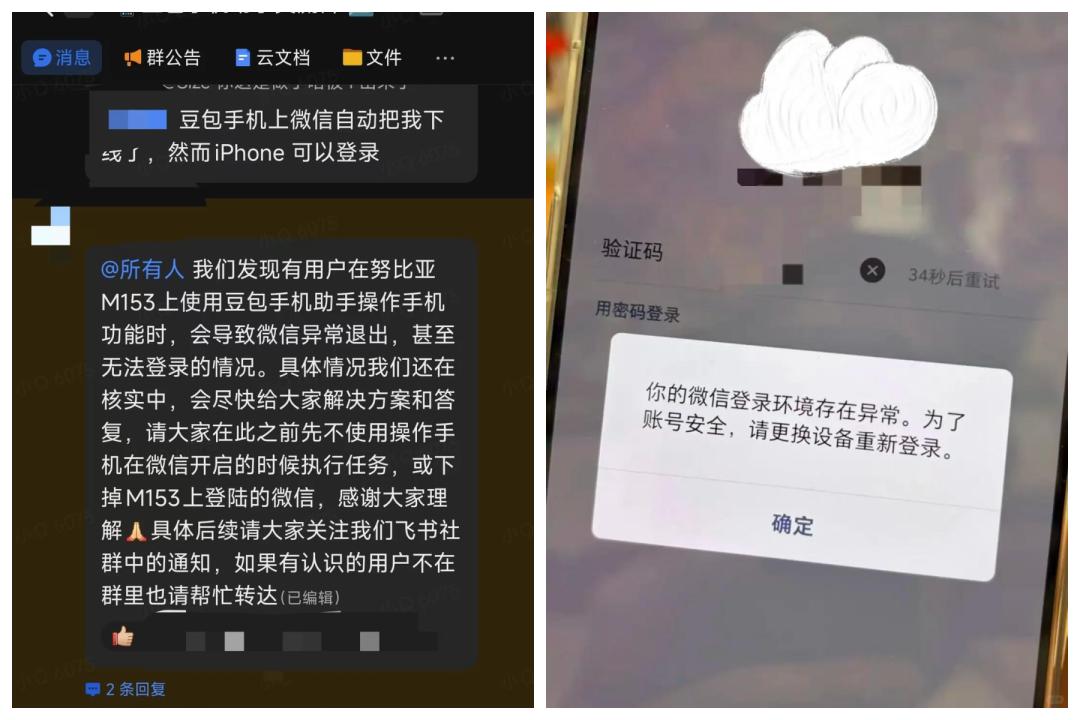
豆包助手在微信上的短暂尝试如闪电般照亮了行业深水区的暗礁。这部售价3499元却溢价千元的手机,成为了一个时代的测试机,测试技术的 边界,也测试商业的容忍度。 3日多位努比亚M153用户发现,当他们使用豆包手机助手操作涉及微信的任务时,微信会异常退出甚至无法登录。 微信方面回应称"可能是触发了安全风控",而豆包则宣布其操作手机功能"目前不再支持操作微信"。 这场短暂而激烈的交锋,表面上是一场技术兼容性问题,实则揭开了AI手机时代生态控制权的边界之争。 Part.1 权限的诱惑与代价 豆包手机助手之所以能够实现"全网比价并下单"的炫酷演示,核心在于它获得了INJECT_EVENTS这一系统级权限。 这一权限允许应用模拟用户的点击、滑动等操作,在多应用间自动跳转,但在安卓生态中历来被视为"高危操作"。它打破了应用之间的沙盒隔离原则,使 得一个应用可以操纵其他应用。 虽然小米小爱、荣耀Yoyo等手机厂商的原生助手也拥有类似权限,但它们的使用范围通常被严格限制在自家生态内。 豆包的不同之处在于,它试图用这一权限调度整个移动互联网生态,包括微信这样的国民级应用。 冲突由此爆发,即豆包凭什么有权限重新划定边界? Part. ...

多方抗议下,印度宣布撤销智能手机预装网络安全应用的命令
Xin Lang Cai Jing· 2025-12-04 01:48
Core Viewpoint - The Indian government has revoked a mandate requiring smartphone manufacturers to pre-install a national cybersecurity app, "Sanchar Saathi," on new devices, following strong opposition from privacy advocates and global tech companies [1][6]. Group 1: Government Decision - The Indian government initially notified companies like Apple, Samsung, and Xiaomi on November 28, requiring them to pre-install the app within 90 days, which was intended to combat online fraud [1][6]. - The Ministry of Communications announced on Wednesday that the government decided not to enforce the pre-installation requirement for smartphone manufacturers [3][7]. Group 2: Controversy and Opposition - The mandate faced significant backlash, with opposition leader Mallikarjun Kharge describing it as "near dictatorial," raising concerns about privacy invasion and surveillance [3][7]. - Reports indicated that Apple and Samsung planned to disregard the directive due to the controversy surrounding it [3][7]. Group 3: App Usage and Popularity - The government stated that the app is designed solely to help citizens protect themselves from online threats, and users can uninstall it at any time [5][9]. - As of now, "Sanchar Saathi" has been downloaded by 140 million users, providing information on 2,000 fraud incidents daily, with a rapid increase in user registrations, including 600,000 in just one day [5][9].

Counterpoint:Q3全球折叠屏智能手机出货量同比增长14% 创季度历史新高
Zhi Tong Cai Jing· 2025-12-04 01:28
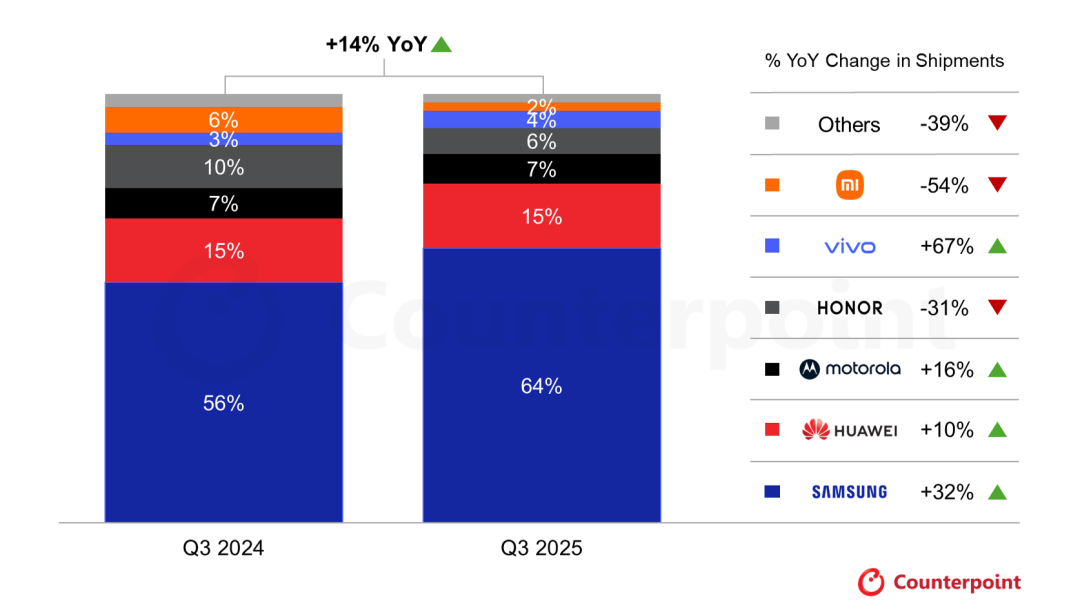
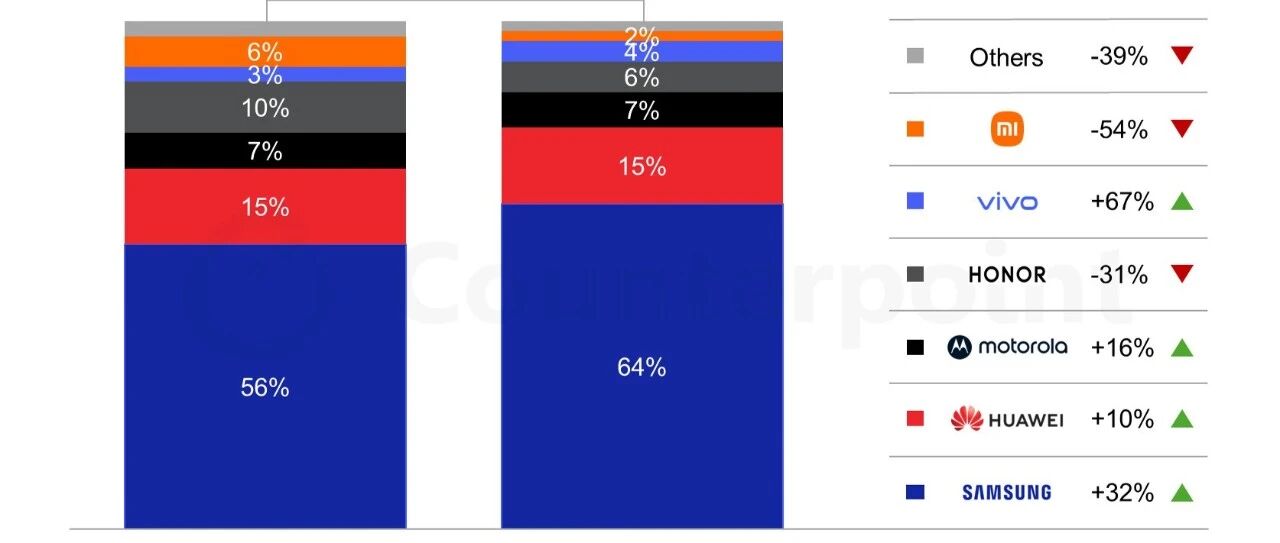
Group 1 - The global foldable smartphone shipment is expected to grow by 14% year-on-year in Q3 2025, reaching a historical high for the category, with foldable devices now accounting for 2.5% of global smartphone shipments [1] - The market expansion is driven by the Samsung Galaxy Z Fold7 and Huawei Mate series, with book-style models leading the growth, while clamshell models also perform well due to Samsung's refreshed product line and the strong performance of the Motorola Razr60 series [1] - Samsung's Galaxy Z series, particularly the Z Fold7, has significantly enhanced its appeal in the high-end market due to its thinner body, lighter weight, more durable hinge, and less visible crease, contributing to unexpected growth [1] Group 2 - The foldable smartphone market is projected to close 2025 with a stable growth rate of around 16% year-on-year, driven by high-end users' preference for larger screens and improved durability [4] - The market is expected to enter a significant expansion phase in 2026, with key drivers including enhanced durability, thinner and lighter designs, optimized hinge and panel structures, and richer AI-driven software experiences [4] - Apple is anticipated to enter the foldable market in the second half of 2026, leveraging its large iPhone user base to drive a new round of high-end product upgrades [4] Group 3 - The competition landscape is expected to change significantly with Apple's entry into the foldable market, prompting existing manufacturers to accelerate their technological advancements and product differentiation strategies [4] - A notable trend is the gradual move away from traditional book-style designs in foldable smartphones, with Huawei's early multi-fold solutions demonstrating engineering feasibility and Samsung's new tri-fold product marking a shift from concept to practical testing [4][5] - Samsung's first tri-fold model will have limited shipments, focusing on validating durability, hinge structure, and software optimization before larger-scale commercialization [5]

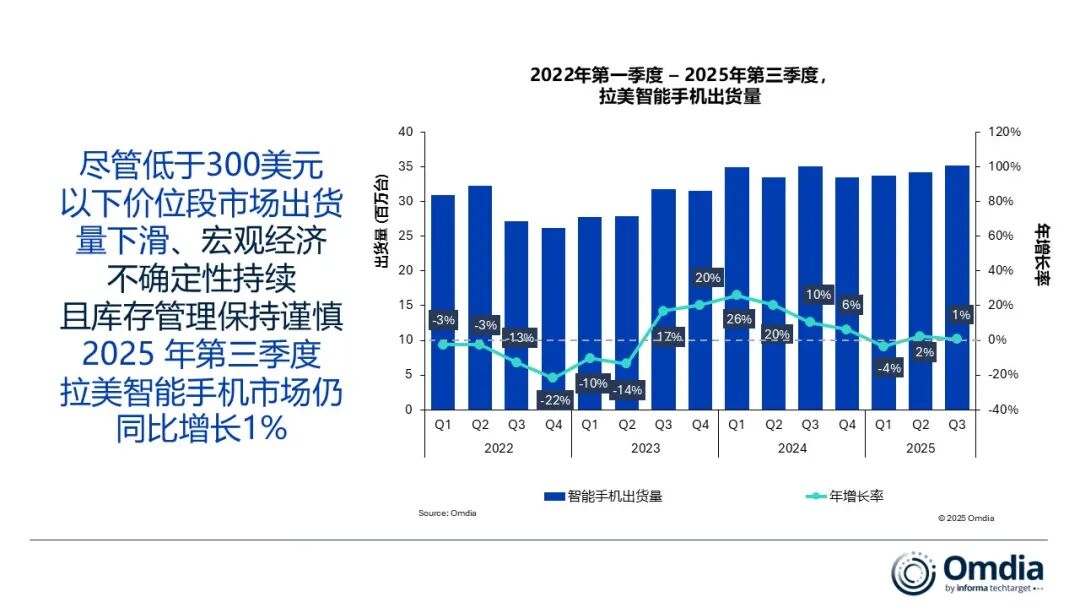
Omdia:第三季度拉美地区智能手机市场同比增长1% 出货量达到3520万部
Zhi Tong Cai Jing· 2025-12-04 01:21
Core Insights - The Latin American smartphone market is projected to grow by 1% year-on-year in Q3 2025, reaching a shipment volume of 35.2 million units, marking the highest quarterly shipment level since Q4 2015 [1][9] - Despite economic uncertainties, careful inventory management and moderate consumer demand have contributed to resilient shipment performance among major manufacturers [1] Market Performance - Samsung leads the market with 11.6 million units shipped, capturing 33% market share, driven by strong performance of its low-end A series, which accounts for 68% of its total shipments [2][9] - Xiaomi follows in second place with 6.3 million units (18% share), while Motorola ranks third but has seen a decline of 11% year-on-year [2][9] - Honor has achieved a new shipment high of 2.9 million units, marking a 75% increase year-on-year, while Transsion has experienced a 19% decline [2][9] Regional Insights - The recovery in the region is attributed to growth in key markets such as Brazil and Central America, with Brazil holding a 29% share and a shipment volume of 10.3 million units, reflecting a 5% year-on-year increase [4] - In contrast, Mexico, the second-largest market, saw a shipment volume of 7.4 million units (21% share), down 11% year-on-year, marking the fourth consecutive quarter of decline [4] - Emerging brands like realme, OPPO, and Honor are strengthening their market positions through local manufacturing and partnerships with carriers and retailers [4] Price Segment Analysis - The segment of smartphones priced below $300, which accounts for 71% of total shipments, has declined by 2%, primarily due to ongoing inventory pressures and stagnant consumer demand [5][6] - Conversely, the high-end segment (above $500) has seen a robust growth of 20% year-on-year, leading to an 8% increase in average selling price (ASP) in Q3 2025 [6][8] - This structural shift indicates increased competition in the high-price segment traditionally dominated by Apple and Samsung, with brands like OPPO, Xiaomi, and Honor intensifying their investments [6][8] Future Outlook - Omdia forecasts that the Latin American smartphone market will remain stable in 2025, with an estimated annual shipment volume of approximately 137 million units, although pressures for 2026 are beginning to emerge [8] - Rising costs for memory and storage may lead to price increases for entry-level devices, potentially hindering market growth [8] - Manufacturers and retailers will need to adopt strategies such as subsidies, margin management, bundled sales, and flexible financing options to mitigate the impact on consumers [8]


全球折叠屏智能手机出货量在 2025 年 Q3 创历史新高,为 2026 年爆发式增长奠定基础
Counterpoint Research· 2025-12-04 01:03
Core Insights - The global foldable smartphone shipment volume reached a record high in Q3 2025, with a year-on-year growth of 14%, driven primarily by the strong performance of Samsung's Galaxy Z7 series [4][5]. Market Performance - In Q3 2025, foldable smartphones accounted for 2.5% of global smartphone shipments, indicating a growing acceptance in the high-end market [5]. - The book-style foldable models led market expansion, supported by the launch of Samsung's Galaxy Z Fold7 and Huawei's Mate series [5]. - The clamshell foldable models also performed well, benefiting from Samsung's refreshed product line and the strong showing of Motorola's Razr 60 series [5]. Future Projections - The foldable smartphone market is expected to close 2025 with a year-on-year growth of around 16%, maintaining a stable growth trajectory [8]. - By 2026, the market is anticipated to enter a significant expansion phase, driven by improvements in durability, thinner and lighter designs, and enhanced AI-driven software experiences [8]. - Apple is expected to enter the foldable market in the second half of 2026, potentially triggering a new upgrade cycle among high-end users [8][9]. Competitive Landscape - The competition in the foldable smartphone market is set to intensify with Apple's entry, prompting existing manufacturers to accelerate their technological advancements and product differentiation strategies [8][10]. - Samsung's recent launch of the Galaxy Z TriFold is a strategic pilot aimed at solidifying its technological leadership before broader commercialization [9][10].
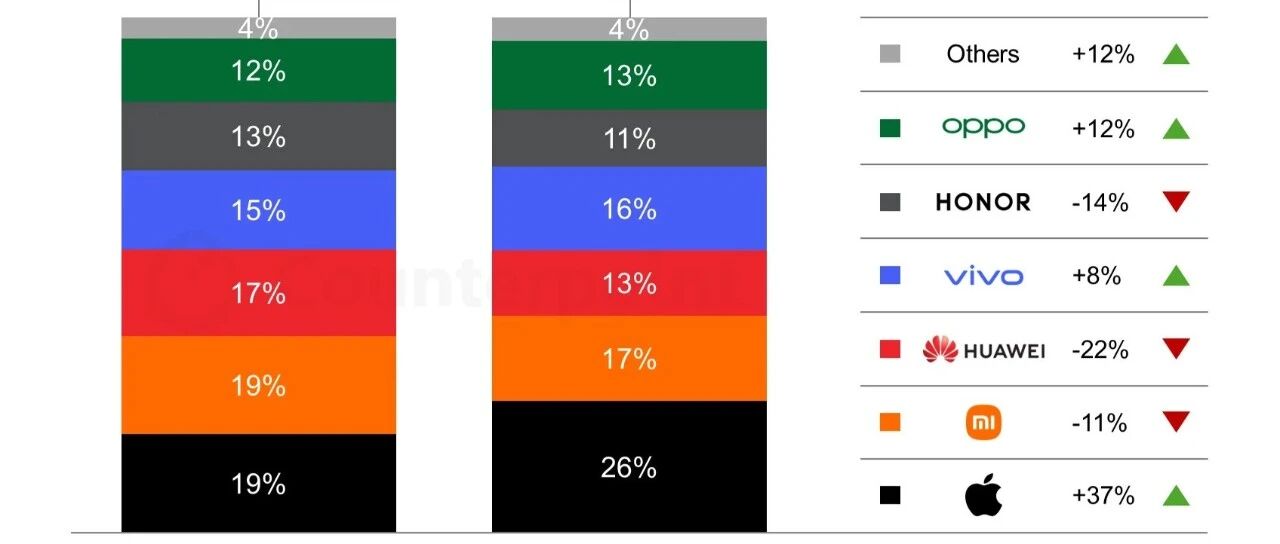
苹果推动中国双 11 期间智能手机销量同比增长 3%
Counterpoint Research· 2025-12-04 01:03
Core Insights - The article highlights that the smartphone sales in China during the Double 11 shopping festival saw a year-on-year increase of 3%, primarily driven by strong demand for the Apple iPhone 17 series [4][5][7]. Smartphone Market Performance - The iPhone 17 series, particularly the base model, has shown remarkable performance with sales more than doubling year-on-year, while the Pro and Pro Max models also experienced mid to high double-digit growth [5][8]. - Excluding Apple, the overall smartphone market in China declined by 5% year-on-year, indicating a more cautious consumer environment and weak momentum at the start of Q4 [7][8]. - Huawei faced the largest decline among major smartphone brands due to the delayed launch of its flagship Mate 80 series, which missed the Double 11 sales period [7][8]. - Xiaomi's sales dropped by 11% year-on-year, attributed to the early release of the Xiaomi 17 series, which shifted the sales peak forward by a month [7][8]. Strategic Shifts in the Industry - Major smartphone brands are shifting their focus towards newly launched high-end models, which has further suppressed overall sales [8]. - The early launch of the Xiaomi 17 series and the strong performance of the previous generation Xiaomi 15 series during the Double 11 period highlight the impact of product timing on sales performance [8].
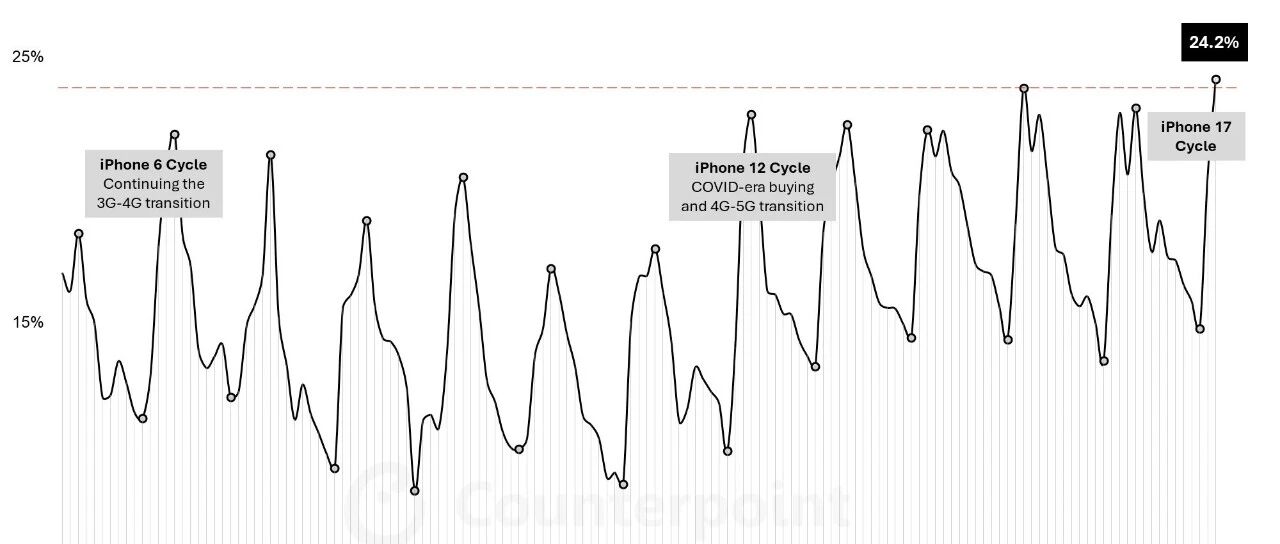
苹果单月市场份额创历史新高
Counterpoint Research· 2025-12-04 01:03
Core Insights - Apple achieved a record global smartphone market share of 24.2% in October 2025, marking a historic high for a single month [4][5] - The success of the iPhone 17 series, driven by a significant upgrade cycle in major markets like the US, China, and Western Europe, was a key factor in Apple's growth [5][9] - The iPhone 17 series outperformed the previous iPhone 16 series in sales, particularly in China, where the growth rate reached 47% year-on-year [6][8] Market Performance - In October, Apple's smartphone shipments increased by 12% year-on-year, with the iPhone 17 series being the main contributor to this growth [5][9] - The basic model of the iPhone 17 showed the highest year-on-year growth among new models, benefiting from its competitive pricing and features similar to the Pro models [6][9] - The iPhone 17 series' strong sales were supported by external factors such as a concentrated upgrade cycle post-pandemic and promotional events like the Mid-Autumn Festival and early Double 11 sales [8][10] Future Outlook - Counterpoint Research anticipates that Apple will maintain high growth through Q4 2025, potentially achieving record shipment volumes and becoming the world's leading smartphone brand for the first time since 2011 [9][10] - The ongoing success of the iPhone 17 series, combined with holiday promotions, is expected to further boost Apple's Q4 and annual shipment figures [10]
Omdia:2025年第三季度,拉美智能手机市场同比增1%,创2015年以来单季出货量最高水平
Canalys· 2025-12-04 01:01
Core Insights - The Latin American smartphone market is projected to grow by 1% year-on-year in Q3 2025, reaching a shipment volume of 35.2 million units, the highest quarterly shipment level since Q4 2015 [2] - Major manufacturers have shown resilience in shipment volumes due to cautious inventory management and moderate consumer demand despite economic uncertainties [2] Market Performance - Samsung leads the market with 11.6 million units shipped, capturing 33% market share, with its low-end A series models accounting for 68% of its total shipments [2] - Xiaomi follows in second place with 6.3 million units (18% share), while Motorola ranks third but has seen a decline for six consecutive quarters, with a year-on-year drop of 11% [2] - Honor ranks fourth, achieving a new shipment high of 2.9 million units for the third consecutive quarter, driven by growth in the Caribbean, Colombia, and Ecuador, which now account for over 40% of its total shipments [2] Regional Insights - The recovery in the region is attributed to growth in key markets like Brazil and Central America, with Brazil holding a 29% share and a shipment volume of 10.3 million units (5% year-on-year growth) [4] - In contrast, Mexico, the second-largest market, saw a shipment volume of 7.4 million units (21% share), down 11% year-on-year, marking the fourth consecutive quarter of decline [4] - The demand for low-end devices remains strong in Brazil and other markets, while Colombia and Chile show signs of recovery due to improved economic conditions [4] Price Segment Analysis - Despite overall market growth, the segment below $300, which accounts for 71% of total shipments, declined by 2% due to ongoing inventory pressures and stagnant consumer demand [5] - This decline is offset by a robust 20% year-on-year growth in the high-end segment (above $500), leading to an 8% increase in average selling price (ASP) in Q3 2025 [6] - Brands like OPPO, Xiaomi, Honor, vivo, and realme are intensifying their efforts to solidify their positions in this high-margin segment [6] Strategic Insights - The increase in high-end market shipments reflects manufacturers' efforts to maintain market share and enhance brand positioning amid saturation in the low-end market [8] - Companies are focusing on improving ASP, enhancing ecosystem profitability, and strengthening customer loyalty as key strategies for sustained financial health [8] - Omdia forecasts that the Latin American smartphone market will remain stable in 2025, with an estimated annual shipment volume of approximately 137 million units, although pressures for 2026 are emerging due to rising costs of memory and storage [8]




8点1氪:12306回应“取消靠窗选座”;张雪峰回应被点名“使用污言秽语”;马航MH370客机残骸搜寻将重启
3 6 Ke· 2025-12-04 00:12
Group 1 - Industrial and Commercial Bank of China (ICBC) has raised the minimum deposit for its 3-year large-denomination certificates of deposit to 1 million yuan, with an annual interest rate of 1.55% [5] - Wanda Group has made its first buyback of a Wanda Plaza after selling over 40 plazas, indicating a strategic shift in its asset management [5] - The storage industry is experiencing significant price increases, leading to predictions of rising prices for smartphones and computers, with manufacturers caught off guard [4] Group 2 - Dell founder Michael Dell and his wife have donated $6.25 billion to establish investment accounts for American children, aiming to provide a financial foundation for 25 million children [8] - The French fashion brand Etam has announced the closure of its online stores in China, indicating a potential exit from the market due to business adjustments [7] - Huawei has regained the top position in China's tablet market with a 31% market share, while Apple's iPad has seen a significant decline in market share to 23% [7]
财信证券晨会纪要-20251204
Caixin Securities· 2025-12-03 23:35
Financial Insights - The bond market overview indicates a slight increase in yields, with the 1-year government bond yield rising by 0.35 basis points to 1.41% and the 10-year yield increasing by 0.77 basis points to 1.85% [15] - The People's Bank of China conducted a 7-day reverse repurchase operation amounting to 793 billion yuan, with a fixed interest rate of 1.40% [21] Industry Dynamics - In Q3 2025, the online sales revenue of headphones and earphones in China increased by 9.8% year-on-year, reaching 7.84 billion yuan, despite a 6.4% decline in sales volume [27] - From January to October 2025, China's exports of construction machinery and parts totaled 48.57 billion USD, marking a 12% year-on-year increase, with significant growth in excavator exports to Europe and North America [29] - Global shipments of foldable smartphones reached a record high in Q3 2025, growing by 14% year-on-year, driven by the popularity of high-end models [31] Company Updates - Baijun Medical's ePTFE pericardial membrane product has received regulatory approval, with plans for global market sales following FDA registration [33] - Renfu Pharmaceutical has withdrawn its registration application for a recombinant plasmid liver cell growth factor injection, which was intended for treating severe limb ischemia [35] - Hualing Steel has repurchased a total of 43.48 million shares, representing approximately 0.63% of its total share capital, as part of its share buyback program [37]