
可穿戴设备

Search documents
全球腕带设备新格局:小米超越苹果跃居第一 华为全球第三、国内第一
Zhong Guo Jing Ying Bao· 2025-06-18 12:54
Core Insights - The global wearable wristband device market is projected to grow by 13% year-on-year in Q1 2025, reaching a shipment volume of 46.6 million units [2][3] - Xiaomi has surpassed Apple to become the global leader in wearable wristband shipments, with a 44% increase to 8.7 million units, while Apple Watch shipments grew by 5% to 7.6 million units, placing Apple in second [2][4] - Huawei maintains its position as the third-largest player globally, with a 36% increase in shipments to 7.1 million units, benefiting from its expanding ecosystem [4][5] Market Dynamics - The growth in the wearable wristband market is attributed to a low base from the previous year and a rebound in market demand, with all major product categories (basic bands, basic watches, and smartwatches) experiencing growth [2][3] - Xiaomi's rapid growth is driven by the success of its Redmi Band 5 and a strategic focus on R&D and mid-to-high-end market segments [3][5] - Apple is expected to refresh its product lineup in the latter half of 2025 to regain momentum, leveraging its established health-centric ecosystem [4] Competitive Landscape - In the domestic market, Huawei leads with a 36% market share, followed by Xiaomi, XTC, Apple, and Honor [5] - Samsung and Garmin rank fourth and fifth globally, with Samsung showing a significant 74% year-on-year increase in shipments [5] - The rise of domestic brands is attributed to improved user experience and cost advantages from supply chain efficiencies [5] Future Trends - The integration of AI technology into wearable devices is anticipated to drive future growth, with companies exploring health monitoring and fitness tracking capabilities [6][7] - The wearable device market is expected to cater to more niche demands, with a projected shipment volume of 193 million units in 2024, reflecting a 4% year-on-year growth [7][8] - China remains the largest market for wearable wristband devices, accounting for 30% of global shipments, bolstered by government subsidies and product upgrades [7][8]


Canalys:2025年第一季度全球可穿戴腕带设备市场同比增长13%
Zhi Tong Cai Jing· 2025-06-18 02:17
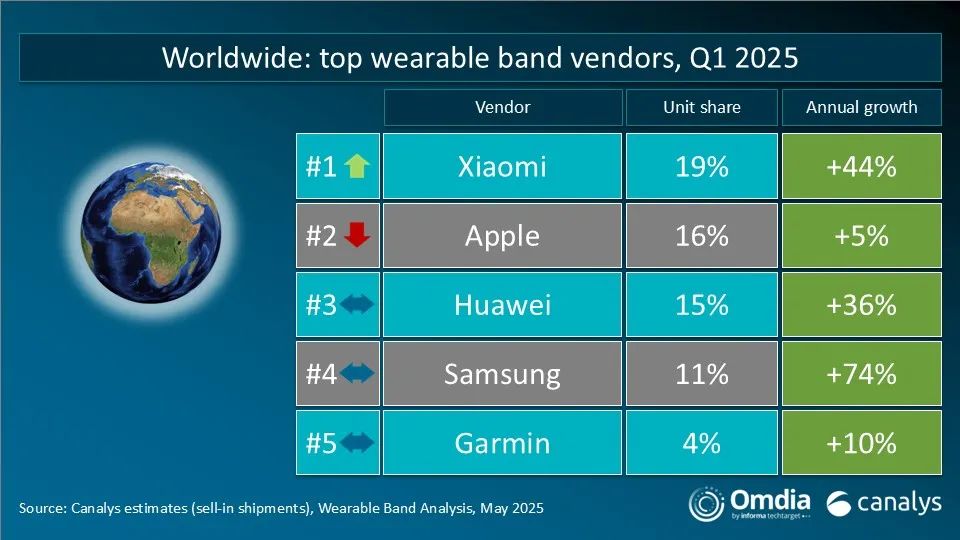
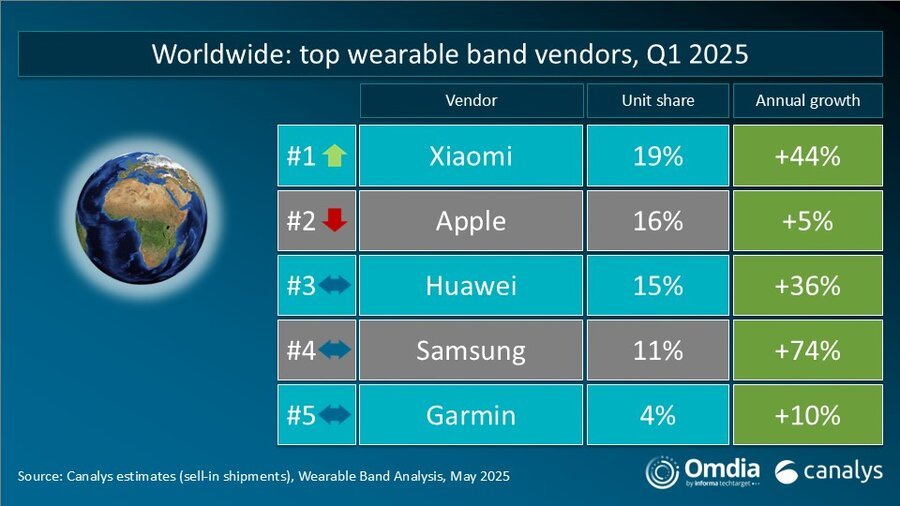
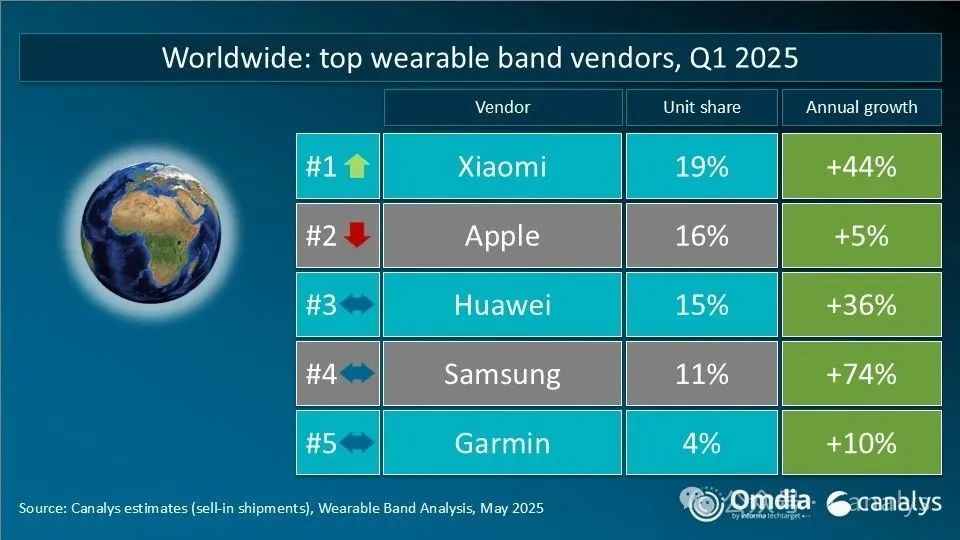
Core Insights - The global wearable band device market is projected to grow by 13% year-on-year in Q1 2025, reaching a shipment volume of 46.6 million units, driven by a low base from the previous year and a rebound in market demand [1] - Xiaomi regained the top position globally with a 44% increase in shipments to 8.7 million units, primarily due to the strong sales of the Redmi Band 5 [1] - Apple ranked second with a 5% increase in Apple Watch shipments, reaching 7.6 million units, while Huawei maintained third place with a 36% growth to 7.1 million units [1][2] Global Market Overview - The top five wearable band vendors worldwide in Q1 2025 are: 1. Xiaomi: 19% market share, +44% growth 2. Apple: 16% market share, +5% growth 3. Huawei: 15% market share, +36% growth 4. Samsung: 11% market share, +74% growth 5. Garmin: 4% market share, +10% growth [3] Regional Insights - In Africa, Transsion led with a 48% market share and a remarkable 217% growth, while Samsung followed with 31% and 258% growth [4] - In the APAC region (excluding Greater China), Noise held the top position with 15% market share but saw an 18% decline, while Samsung experienced a 121% growth [5] - In Latin America, Xiaomi dominated with a 38% share and 62% growth, followed by Samsung with 19% and 67% growth [6] Specific Market Performance - In Mainland China, Huawei led with a 36% market share and 25% growth, while Xiaomi followed closely with 32% and 94% growth [7] - In the United States, Apple maintained a strong lead with 49% market share and 6% growth, while Samsung captured 13% with a 31% increase [8] - In India, Noise led with 27% market share but faced an 18% decline, while Apple had a modest 1% share with a 32% growth [9] - In Germany, Apple held the top position with 29% market share and 10% growth, while Huawei experienced a significant 298% growth despite a smaller share [10]


研判2025!中国可穿戴腕带设备行业产业链、相关政策及出货量分析:全球可穿戴腕带设备市场出货量增长13%,生态驱动转型加速[图]
Chan Ye Xin Xi Wang· 2025-06-15 02:56
Core Insights - The global wearable wristband device industry is experiencing rapid growth and transformation, with Q1 2025 shipments reaching 47 million units, a 13% year-on-year increase, driven by low base effects and recovering market demand [1][14] - Major product categories, including basic bands, basic watches, and smartwatches, have all seen significant growth, becoming key drivers of market expansion [1][14] - The market is shifting from a "hardware-driven" model to an "ecosystem-driven" model, with manufacturers accelerating the development of platforms and services to enhance user retention and sustainable revenue [1][14] Industry Overview - Wearable wristband devices are portable electronic devices worn on the wrist, integrating sensors, chips, and smart algorithms for health monitoring, activity tracking, and information interaction [2] - The industry has evolved through four main stages: the nascent phase (2000-2014), rapid growth phase (2015-2018), innovation upgrade phase (2019-2023), and stable development phase (2024-present) [5][6][7] Current Industry Status - In Q1 2025, Xiaomi regained the top position in global shipments with 8.7 million units, a 44% increase, primarily due to the popularity of the Redmi Band 5 [16][21] - Apple ranked second with 7.6 million units shipped, a 5% increase, while Huawei maintained third place with 7.1 million units, a 36% increase [16][18] - Samsung's shipments surged by 74% to 4.9 million units, leveraging a dual-track strategy to expand its user base in emerging markets while maintaining a premium position in developed markets [16] Industry Development Trends - The industry is witnessing a technological convergence that drives product evolution towards "unobtrusive, proactive, and specialized" devices [23] - Wearable devices are increasingly penetrating vertical markets such as healthcare, industrial safety, and elder care, with specific requirements for reliability and compliance [25] - Chinese manufacturers are building competitive advantages through "hardware + software + services" ecosystems, while facing intensified global competition from established players like Apple and Samsung [26]
多元供给激发消费潜力 5月份武汉CPI同比上涨0.6%
Chang Jiang Ri Bao· 2025-06-13 00:48
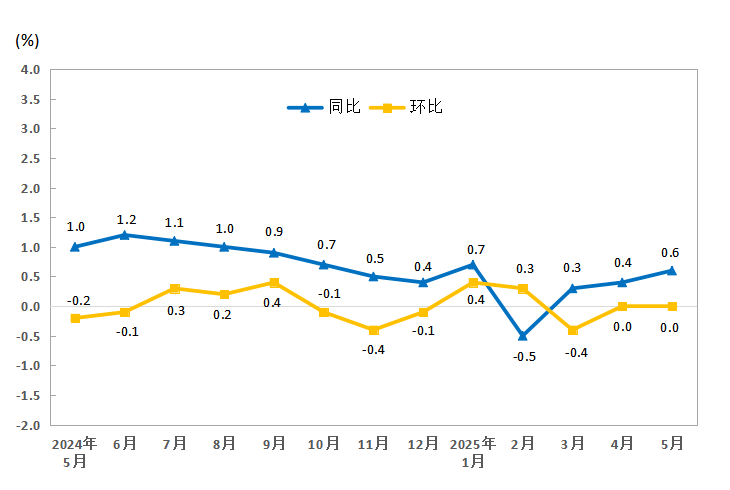
Core Viewpoint - In May, the Consumer Price Index (CPI) in Wuhan increased by 0.6% year-on-year, with the growth rate expanding by 0.2 percentage points compared to the previous month. The core CPI, excluding food and energy, rose by 1.2% year-on-year [1]. Group 1: CPI Trends and Influences - The consumption potential was stimulated by the "old-for-new" policy for consumer goods, contributing to a steady increase in CPI over three consecutive months from March to May. This was supported by holiday factors and various consumption-boosting policies [2]. - In May, prices for eight major categories of goods and services showed "seven increases and one decrease." Notably, prices for other goods and services rose by 6.9%, clothing by 3.5%, and education, culture, and entertainment by 2.4%. Conversely, transportation and communication prices fell by 3.7% [2][4]. Group 2: Service Consumption and Price Dynamics - Service consumption emerged as a key driver for the CPI increase, with service prices rising by 1.1% year-on-year, an increase of 0.2 percentage points from the previous month. Specific services such as education, culture, and tourism saw price increases of 3.5%, 2.0%, and 0.2%, respectively [6]. - The rise in service prices reflects a booming cultural and tourism market in Wuhan, driven by events like the "Summer Gathering" consumption promotion activities and an influx of tourists during the May Day holiday [6]. - Expectations for continued price increases in services are supported by upcoming high school and college entrance exams, increased summer travel demand, and ongoing promotional activities like the 618 e-commerce shopping festival [6].
IDC:2025年一季度全球腕戴设备市场同比增长10.5%
news flash· 2025-06-11 02:25
Core Insights - The global wearable device market is projected to ship 45.57 million units in Q1 2025, reflecting a year-on-year growth of 10.5% [1] - The Chinese market shows significant growth, with shipments reaching 17.62 million units, a year-on-year increase of 37.6% [1] Market Breakdown - The wearable device market includes smartwatches and fitness bands, with global smartwatch shipments expected to reach 34.81 million units in Q1 2025, marking a 4.8% year-on-year growth [1] - In China, smartwatch shipments are anticipated to be 11.4 million units, representing a year-on-year growth of 25.3% [1] - The fitness band market is expected to see global shipments of 10.76 million units in Q1 2025, showing a robust year-on-year growth of 34.0% [1] - China's fitness band market is projected to ship 6.21 million units, with a remarkable year-on-year growth of 67.9% [1]
高合汽车将获10亿美元重组资金及三年海外大额订单承诺;董明珠回应孟羽童是否会重回格力;字节致合作方:对腐败贿赂“零容忍”丨邦早报
创业邦· 2025-05-24 00:57
Group 1 - EV Electra plans to invest $1 billion in the restructuring of Chinese electric vehicle company HiPhi, with a commitment for at least 100,000 vehicles or $3 billion in overseas orders over the next three years [3] - ByteDance emphasizes a "zero tolerance" policy towards corruption and bribery, warning partners that any violations will result in being blacklisted from future collaborations [3] - Analyst Ming-Chi Kuo states that Apple would rather absorb a 25% import tariff than move production to the U.S., citing the high costs associated with establishing domestic manufacturing [5] Group 2 - Red Star Macalline's new chairman, Li Yupeng, expresses confidence in the company's future despite recent challenges, stating that the team is motivated to achieve significant growth [8] - Gree Electric's chairman, Dong Mingzhu, hints at the possibility of Meng Yutong returning to the company after her studies abroad, despite company policies against re-hiring former employees [8] - Xiaomi's CEO Lei Jun discusses the design philosophy of the new Xiaomi YU7, emphasizing its intuitive features and long-lasting design [11] Group 3 - The stock of Seres, a new energy vehicle company, surged amid rumors of a humanoid robot prototype being showcased on June 16, although the company has not confirmed these claims [13] - Tesla releases a video demonstrating its humanoid robot's capabilities, including household tasks and learning from online videos [13] - Yushutech announces a robot combat live broadcast event scheduled for May 25, showcasing advancements in robotics and AI [13] Group 4 - Miniso reports a 19% year-on-year revenue increase in Q1 2025, with overseas revenue growing by 30% and overseas stores exceeding 3,200 [17] - Faraday Future officially takes over a factory and operations center in Ras Al Khaimah, UAE, to support the production of its FF and FX models [17] - OpenAI's acquisition of AI startup io for nearly $6.5 billion is expected to lead to the production of new AI hardware by 2027 [17] Group 5 - Nissan anticipates an additional $418 million in restructuring costs due to a planned workforce reduction of 20,000 employees [19] - OnlyFans is reportedly in talks for a sale, with an estimated valuation of $8 billion [19] - Mirxes successfully lists on the Hong Kong Stock Exchange, focusing on miRNA technology for disease diagnostics [19] Group 6 - BMW announces the start of road testing for the first BMW i7 model equipped with solid-state batteries, marking a significant step in battery technology [20] - DeepBlue launches the S09, a family-oriented SUV featuring Huawei's HarmonyOS and advanced driver assistance technologies, with prices starting at 239,900 yuan [22] - Sensor Tower reports that Tencent's "Honor of Kings" topped the global mobile game revenue chart in April 2025, reflecting a strong performance in the gaming sector [24]





第一季度可穿戴市场需求回升 AI赋能有望加速市场发展
Zheng Quan Ri Bao· 2025-05-23 15:42
Core Insights - The wearable device market experienced rapid growth in Q1 2025, with a year-on-year increase of 13%, reaching a shipment volume of 46.6 million units [1] - The market is transitioning from a "hardware-driven" model to an "ecosystem-driven" model, with manufacturers focusing on platform and service development to enhance user retention and sustainable revenue [2] Market Demand Release - The growth in Q1 2025 was driven by a low base from the previous year and a rebound in market demand, with all major product categories (basic bands, basic watches, and smartwatches) showing growth [2] - The top five brands by shipment volume were Xiaomi, Apple, Huawei, Samsung, and Garmin [2] - The true wireless stereo (TWS) earphone market also saw a strong rebound, with a year-on-year growth of 18%, reaching 78 million units, marking the highest growth rate since 2021 [2] AI Empowerment Acceleration - The integration of AI with wearable devices is expected to drive future industry growth, with several companies accelerating their related initiatives [4] - Hengxuan Technology reported a revenue of 999.5 million yuan in Q1 2025, a 52.25% increase, attributed to the continuous growth of the smart wearable market [4] - Shanghai Longqi Technology expanded its product matrix by successfully developing AI eyewear accessories in collaboration with leading global internet clients [4] - Analysts predict that advancements in AI technology, particularly in healthcare functions like blood glucose measurement, will convert into market momentum, driving global shipment growth [4] TWS Earphone Market Dynamics - The TWS earphone market is experiencing a replacement cycle, with a significant number of users expected to upgrade their devices by 2025 [3] - Factors such as new product launches from leading brands, government subsidies, and the rise of open-ear designs are stimulating market growth [3] - The application of AI features in TWS earphones, such as generative AI and adaptive noise cancellation, is anticipated to accelerate, driving product differentiation strategies among manufacturers [5]
2025年Q1全球可穿戴设备市场增长13%,生态与服务成竞争关键
Huan Qiu Wang· 2025-05-23 06:46
Group 1: Market Overview - The global wearable band device market is projected to grow by 13% year-on-year in Q1 2025, reaching a shipment volume of 46.6 million units, driven by a low base from the previous year and a rebound in market demand [1] - All three major product categories—basic bands, basic watches, and smartwatches—experienced growth, serving as the main drivers of market expansion [1] Group 2: Vendor Performance - Xiaomi emerged as the top vendor in wearable device shipments for the first time since Q2 2021, capturing a 19% market share with a 44% annual growth rate, attributed to its diverse product lineup and improved integration through HyperOS [2] - Apple holds a 16% market share with a 5% annual growth, while Huawei follows closely with a 15% share and a 36% growth rate [2] - Samsung achieved an 11% market share with a remarkable 74% annual growth, indicating strong performance in the wearable segment [2] - Garmin, with a 4% market share, reported a 10% annual growth [2] Group 3: Industry Trends - The wearable device market is shifting from a hardware-driven model to an ecosystem-driven approach, as companies focus on developing platforms and services to enhance recurring revenue and user retention [2] - In China, Xiaomi is leveraging its extensive product range and HyperOS to deepen device integration and user engagement, while Huawei is building a closed-loop health ecosystem through its Huawei Health app [2] - Globally, lightweight device-centric brands like Oura and Whoop are prioritizing service development and subscription models to enhance user value [2] Group 4: Consumer Preferences - Price, battery life, and health tracking are identified as the top three features consumers consider when purchasing wearable devices [3] - As market education improves and hardware penetration reaches a certain level, software and ecosystem integration are expected to provide greater added value, allowing manufacturers to showcase their strengths [3]
Canalys:一季度全球可穿戴腕带设备市场出货量达4660万台 同比增长13%
智通财经网· 2025-05-23 05:54
Core Insights - The global wearable band market is projected to grow by 13% year-on-year in Q1 2025, reaching a shipment volume of 46.6 million units, driven by a low base from the previous year and a rebound in market demand [1][8] - Major product categories, including basic bands, basic watches, and smartwatches, have all seen growth, contributing significantly to market expansion [1] Company Performance - Xiaomi regained the top position in the wearable band market with a 44% increase in shipments to 8.7 million units, benefiting from the popularity of the Redmi Band 5 and a strong product portfolio [2][3] - Apple ranked second with a 5% increase in Apple Watch shipments, reaching 7.6 million units, and is expected to revitalize growth with new product updates in the second half of 2025 [3] - Huawei maintained third place with a 36% increase in shipments to 7.1 million units, supported by the performance of its GT and Fit series and the global promotion of the Huawei Health App [3] - Samsung experienced a significant 74% increase in shipments to 4.9 million units, leveraging a dual-track strategy to expand its user base in emerging markets while maintaining a premium position in developed markets [3] - Garmin ranked fifth with a 10% increase in shipments to 1.8 million units, focusing on a differentiated product mix and the new Connect+ platform to enhance customer retention [3] Market Trends - The wearable band market is transitioning from a hardware-driven model to an ecosystem-driven model, with companies focusing on platform and service development to enhance user retention and drive sustainable revenue [4] - Health monitoring and fitness guidance are becoming core application scenarios, making seamless device connectivity and subscription-based services crucial for increasing user engagement and driving revenue growth [7] - Consumer preferences are shifting towards price, battery life, and health monitoring as the top factors influencing purchasing decisions, highlighting the need for manufacturers to balance innovative features with core selling points [5]
机构:Q1全球可穿戴腕带设备市场同比增长13% 出货量达4660万台
news flash· 2025-05-23 05:18
Core Insights - The global wearable wristband device market experienced a year-on-year growth of 13% in Q1 2025, with a total shipment of 46.6 million units [1] Market Performance - The growth is attributed to a low base from the previous year and a rebound in market demand, leading to accelerated overall growth [1] - Three main product categories—basic bands, basic watches, and smartwatches—have all shown growth, serving as the primary drivers of market expansion [1]