
保险

Search documents
行业轮动ETF策略周报-20260224
金融街证券· 2026-02-24 12:53
Core Insights - The report emphasizes the construction of a strategy portfolio based on industry and thematic ETFs, leveraging insights from previous strategy reports on industry rotation and ETF market overview [2]. Strategy Update - The strategy portfolio includes various ETFs with specific holdings and weightings, such as: - Wine ETF with a market value of 184.16 billion, holding a significant position in the liquor industry (84.84%) [3]. - Real Estate ETF valued at 6.61 billion, fully invested in real estate development (100%) [3]. - Tourism ETF at 88.57 billion, primarily focused on the aviation and airport sector (33.21%) [3]. - New additions include Agriculture and Fishery ETF and Grain ETF, with respective holdings in aquaculture (46.89%) and planting (49.63%) [3]. - The strategy's performance for the period from February 9 to February 13, 2026, showed a cumulative net return of approximately -0.38%, underperforming the CSI 300 ETF by about -0.85% [3]. Performance Tracking - Since October 14, 2024, the strategy has achieved a cumulative return of approximately 37.93%, outperforming the CSI 300 ETF by about 14.43% [3][4]. - The report includes a performance chart illustrating the cumulative return of the industry rotation ETF strategy since its inception [4]. Weekly Holdings and Performance - The report details the weekly performance of various ETFs, indicating that the strategy will continue to hold Wine, Real Estate, Tourism, and Traditional Chinese Medicine ETFs while adding Agriculture and Grain ETFs [11]. - The average return of the ETF portfolio for the week was -0.38%, with a notable underperformance compared to the CSI 300 ETF [11].
中国平安谢永林:精准服务广东制造业向“新”提质
Nan Fang Du Shi Bao· 2026-02-24 12:23
Core Viewpoint - The Guangdong High-Quality Development Conference emphasizes the theme of "coordinated development of manufacturing and service industries," showcasing the role of comprehensive financial services in supporting the province's modernization goals [1] Group 1: Financial Services Contributions - Ping An Insurance plans to provide risk coverage exceeding 2.48 trillion yuan for 65,000 manufacturing clients in Guangdong by 2025, including over 10,000 technology companies [2] - Ping An Bank issued loans totaling 584.9 billion yuan in Guangdong last year, with 63.7 billion yuan allocated to technology loans [2] - Ping An Life has invested a cumulative 250 billion yuan in Guangdong's real economy and established a 10 billion yuan industry fund targeting the Greater Bay Area's "20+8" industrial clusters [2] Group 2: Innovations in Financial Solutions - Ping An Insurance is a member of the Greater Bay Area Low Altitude Economy Industry Alliance, planning to insure over 30,000 industrial drones by 2025, providing risk coverage exceeding 13 billion yuan [2] - The company has launched the first comprehensive financial solution for embodied intelligent robots, addressing the needs of this emerging sector [2] - Ping An Insurance has served over 15,000 technology enterprises in Guangdong, providing risk coverage exceeding 1.96 trillion yuan and paying out over 610 million yuan in claims [3]

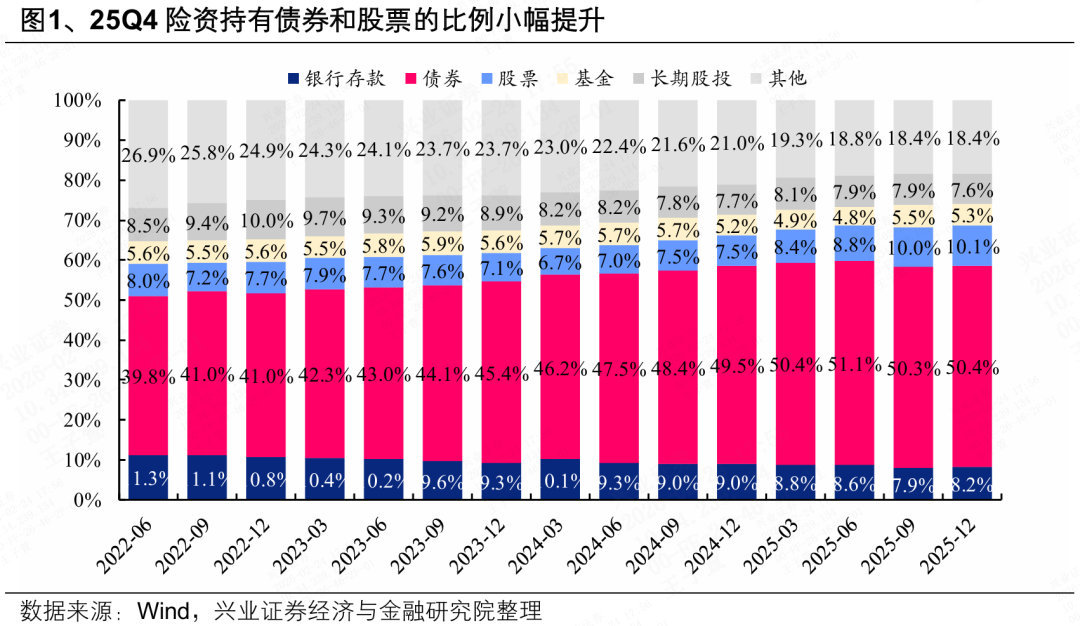
兴业证券:险资连续七个季度增配股票
智通财经网· 2026-02-24 12:22
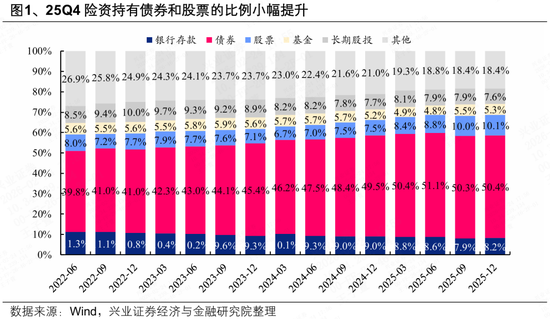
Core Viewpoint - Insurance funds have shown a continuous trend of increasing equity asset allocation, with a slight increase in stock holdings in Q4 2025, although the pace of increase has slowed compared to previous quarters [1][10]. Group 1: Stock Holdings - In Q4 2025, insurance funds have increased their stock holdings for the seventh consecutive quarter, with a slight rise of 0.1 percentage points to 10.1% [1][10]. - The estimated scale of stock accumulation by insurance funds in Q4 2025 reached 70.6 billion yuan, indicating a sustained trend of equity asset allocation [1][10]. - Despite the increase, the allocation ratio and accumulation scale for stocks have slowed down compared to the previous three quarters due to the already high historical levels of equity asset allocation [1][10]. Group 2: Asset Allocation - The proportion of insurance funds holding bonds and stocks has slightly increased in Q4 2025, with changes of +0.3 percentage points for deposits, +0.1 percentage points for bonds, and +0.1 percentage points for stocks [2]. - Conversely, the proportion of funds and long-term equity holdings has decreased, with changes of -0.2 percentage points for funds and -0.3 percentage points for long-term equity [2]. - The proportion of equity assets (stocks + funds) held by insurance funds has slightly decreased from 15.49% in Q3 2025 to 15.38% in Q4 2025, primarily due to a decline in fund holdings [4]. Group 3: Future Outlook - Insurance funds are expected to continue increasing their equity asset allocation trend into 2026, supported by policy backing and liability-driven factors, potentially becoming a major incremental force in the market [14]. - It is predicted that insurance funds will bring approximately 1.2 trillion yuan in incremental funds to the market in 2026, based on an estimated 30% of new premiums [14]. - The first quarter is anticipated to be a significant time window for insurance funds to allocate equity assets, as historically, 41% of new premiums have concentrated in this period [14].


中国人保:近年来公司坚持“长期投资、价值投资、审慎投资”理念,实现了较好的投资收益
Zheng Quan Ri Bao Wang· 2026-02-24 12:10
Core Viewpoint - The company emphasizes its commitment to "long-term investment, value investment, and prudent investment" principles, which have led to favorable investment returns [1] Group 1: Investment Strategy - The company plans to continue implementing national policies regarding long-term capital entering the market [1] - There will be an optimization of asset allocation structure with an increased focus on equity market investments [1] Group 2: Focus Areas - The company will concentrate on blue-chip stocks that demonstrate long-term stable growth [1] - There is an intention to explore high-quality sectors with significant growth potential, such as technological innovation and consumption upgrades [1] Group 3: Research and Development - The company aims to enhance its investment research capabilities to support the long-term stable development of the capital market while striving to stabilize investment returns [1]
春节文旅消费创新高,复星主业基本盘稳固马年展现强劲增长势头
Feng Huang Wang Cai Jing· 2026-02-24 11:53
Core Viewpoint - Fosun International has continued its strong growth momentum in 2026, driven by the commercialization of innovative results and deepening global operations, achieving breakthroughs in sectors such as cultural tourism, consumer goods, and innovative pharmaceuticals [1][2]. Group 1: Cultural Tourism and Consumer Growth - During the Spring Festival, Fosun's cultural tourism sector showed robust growth, with Shanghai Yuyuan Mall receiving nearly 1.2 million visitors, a year-on-year increase of over 20% [1] - Club Med's five domestic resorts achieved an average occupancy rate of 90% during the core holiday period [1] - Atlantis Sanya reported a total revenue of 124 million yuan during the Spring Festival holiday, marking a 20% year-on-year increase and setting a historical record for the holiday [1] Group 2: Innovative Pharmaceuticals - Fosun's innovative pharmaceutical sector has seen significant developments, with its subsidiary, Fuhong Hanlin, receiving clinical trial approvals for HLX15-SC from both the Chinese National Medical Products Administration and the FDA [2] - HLX15, a biosimilar to Daratumumab, has a projected global sales potential of approximately 12.88 billion yuan in 2024 [2] - Fosun's innovative drug revenue exceeded 6.7 billion yuan in the first three quarters of 2025, reflecting an 18.09% year-on-year growth [3] Group 3: Strategic Collaborations and Future Growth - Fosun's subsidiary, Yaoyou Pharmaceutical, signed a global exclusive licensing agreement with Pfizer for the oral small molecule GLP-1 drug YP05002, with potential total payments exceeding 2 billion USD [4] - A strategic partnership with Clavis Bio aims to develop innovative therapies, with potential payments up to 7.25 billion USD [4] - The innovative drug sector is expected to enhance Fosun's long-term valuation elasticity, as the company enters a period of concentrated harvest of innovative drug research and commercial growth [5] Group 4: Globalization and Financial Performance - Fosun's overseas revenue reached 53% in the first half of 2025, marking a historical high [6] - The pharmaceutical sector's overseas revenue grew by 184%, surpassing 10 billion yuan, showcasing the company's global capabilities [7] - The company has successfully divested non-core assets, raising significant funds to support its focus on core businesses, with total debt to total capital ratio at 53% as of mid-2025 [8][9]


兴证策略张启尧团队:险资连续七个季度增配股票
Xin Lang Cai Jing· 2026-02-24 11:40
Core Insights - The insurance capital's allocation towards bonds and stocks has slightly increased in Q4 2025, while the proportion of funds and long-term equity holdings has decreased [1][14] - The proportion of equity assets (stocks + funds) held by insurance capital has slightly declined due to a reduction in fund holdings, indicating a shift from outsourced investments to direct investments [3][15] Group 1: Asset Allocation Trends - In Q4 2025, the proportion of insurance capital held in deposits, bonds, and stocks increased by 0.3 percentage points, 0.1 percentage points, and 0.1 percentage points respectively, while fund and long-term equity holdings decreased by 0.2 percentage points and 0.3 percentage points [1][14] - The proportion of equity assets held by insurance capital decreased from 15.49% in Q3 2025 to 15.38% in Q4 2025, with stock holdings increasing steadily while fund holdings decreased [3][15] Group 2: Stock Investment Dynamics - Insurance capital has increased its stock holdings for seven consecutive quarters, with a slight increase of 0.1 percentage points to 10.1% in Q4 2025, reflecting a sustained trend towards equity asset allocation, with an estimated increase in scale of 706 billion [6][18] - Despite the continuous increase in stock allocation, the pace of accumulation has slowed compared to the previous three quarters, as the proportion of insurance equity asset allocation is already at a historically high level [6][18] Group 3: Future Projections - Insurance capital is expected to continue increasing its allocation to equity assets in 2026, driven by policy support and liability-side factors, potentially contributing approximately 1.2 trillion in new funds to the market [9][21] - The first quarter is anticipated to be a significant time window for insurance capital to allocate equity assets, as historically, 41% of new premiums have concentrated in this period [9][21]
险资权益投资进入加速期,去年股票、基金投资余额大增1.6万亿元
Xin Lang Cai Jing· 2026-02-24 11:17
Core Viewpoint - The pace of insurance capital allocation in the capital market has significantly accelerated, with a notable increase in equity asset allocation driven by both yield pressure and policy guidance [1][10][12]. Group 1: Insurance Capital Allocation Trends - By the end of 2025, the balance of insurance capital utilization is expected to reach approximately 38.5 trillion yuan, a year-on-year increase of 15.7%, marking a high growth rate in recent years [1][8]. - The combined balance of investments in stocks and securities investment funds is about 5.7 trillion yuan, an increase of approximately 1.6 trillion yuan year-on-year, with a growth rate close to 40% [1][8]. - The weight of equity assets in the insurance capital allocation system is continuously increasing, with stock investments around 3.7 trillion yuan, accounting for nearly 10% of total capital utilization [1][8]. Group 2: Factors Driving Changes in Allocation - The traditional dominance of bond assets, which currently account for over half of total investment assets, is facing challenges due to declining interest rates and compressed returns on fixed-income assets [12][13]. - Policy improvements in regulations regarding equity investments have provided greater allocation space for insurance capital, reducing the impact of short-term market fluctuations on institutional investment behavior [12][13]. - The recovery of the capital market in 2025, with significant increases in major stock indices, has enhanced the willingness to allocate to equity assets [12][13]. Group 3: Market Impact and Future Outlook - The current trend of insurance capital entering the market reflects a shift towards long-term investment characteristics, favoring high-dividend, low-volatility, and stable cash flow assets [14]. - The continuous influx of insurance capital is expected to enhance market liquidity and stability, guiding a transition from a "policy-driven" market to a "market-driven" one [14]. - Forecasts indicate that new equity investments from insurance capital in 2026 are likely to remain in the trillion-yuan range, with estimates from various securities firms suggesting additions between 0.9 trillion and 1.18 trillion yuan [15].

吉林:支持保险机构面向文化单位开展与知识产权影视作品等相关的保险业务
Bei Jing Shang Bao· 2026-02-24 11:15
Core Viewpoint - The Jilin Financial Regulatory Bureau, in collaboration with multiple departments, has developed measures to promote high-quality cultural development by encouraging banks to explore the use of intangible assets for pledge loan services and supporting insurance institutions in providing services related to intellectual property in the cultural sector [1] Group 1: Financial Services Innovation - Banks are encouraged to utilize intangible assets such as copyrights, patents, and trademarks for pledge loan services [1] - Insurance institutions are supported in offering services related to intellectual property, including film works, performing arts, and cultural heritage [1] - The initiative aims to innovate financial products and services to enhance the quality of financial support for cultural development [1]
非银金融行业周报(2026年第六期):关注券商并购重组主线行业迎来估值业绩双修复-20260224
AVIC Securities· 2026-02-24 11:04
Investment Rating - The industry investment rating is "Overweight," indicating that the growth level of the industry is expected to exceed that of the CSI 300 index over the next six months [3][44]. Core Insights - The report highlights that the securities sector is entering a golden window for dual recovery in valuation and performance, driven by ongoing mergers and acquisitions, regulatory clarity, and a shift towards quality improvement in the industry [2][6]. - The report notes that the current PB valuation for the brokerage sector stands at 1.34 times, which is considered low historically, suggesting potential for recovery [2]. - The insurance sector is experiencing a rebound in profitability, with significant growth in net profits driven by improved investment returns and cost reductions in commissions [8][9]. Summary by Sections Securities - The securities sector saw a decline of 1.19% in the week from February 9 to February 13, 2026, underperforming the CSI 300 index by 1.55 percentage points [1]. - Southwest Securities announced a 6 billion yuan private placement plan, marking it as the first major issuance following new refinancing measures [2]. - The report emphasizes that the integration process within the industry is accelerating, with a focus on differentiated development for smaller brokerages to break through market challenges [2][6]. Insurance - The insurance sector experienced a decline of 2.48% during the same week, underperforming the CSI 300 index by 2.85 percentage points [7]. - The overall insurance industry showed signs of recovery in profitability, with significant net profit increases reported by major players, such as Taikang Life, which achieved a net profit of 27.16 billion yuan [8]. - The report indicates that the insurance sector's future performance will depend on the conditions of the bond, equity, and real estate markets [9].





每日报告精选(2026-02-13 09:00——2026-02-24 15:00)
GUOTAI HAITONG SECURITIES· 2026-02-24 10:30
Group 1: Macroeconomic Insights - In 2023, the market discussed a peak of 16 trillion yuan in "excess savings," with approximately 76-77 trillion yuan of residential time deposits maturing in 2026, indicating a historical peak[5] - The maturing deposits in the first quarter of 2026 are expected to reach 32-34 trillion yuan, highlighting a significant seasonal pattern[6] - The actual pressure from maturing deposits is limited, with a year-on-year increase of 9.6-10.8 trillion yuan in 2026, corresponding to a growth rate of 14.4%-16.3%, which is lower than the 17.7% growth rate in 2025[6] Group 2: Interest Rate and Asset Allocation - Approximately 25 trillion yuan of high-interest deposits are set to mature, with 32% of the total maturing deposits being two years or older, indicating a core pressure for renewal[6] - The renewal rate for deposits in 2025 remained close to 90%, suggesting that low interest rates do not automatically trigger a shift in risk appetite among residents[7] - The anticipated migration of deposits to other assets is expected to occur slowly and in a dispersed manner, with a potential 10% outflow rate from the 77 trillion yuan in time deposits being a marginal pricing variable for equity and bond markets[7] Group 3: Trade and Tariff Impacts - As of November 2025, the effective tariff rate in the U.S. reached 9.8%, the highest since 1946, with China facing the highest actual tariff rate of 30.9%[9] - The actual tariff increases have significantly impacted trade dynamics, with China and India experiencing the largest increases in effective tariffs compared to 2024, at 20.2 and 17.3 percentage points respectively[10] - Despite tariff pressures, China's export position remains robust, maintaining the largest share of global exports, while the U.S. has shifted its import structure towards North America and Europe[11] Group 4: Economic Recovery and Consumer Behavior - The Chinese economy is shifting focus towards domestic demand as a long-term strategy, with consumer spending projected to account for 56.6% of GDP by 2024, still below developed economies[39] - Consumer confidence is stabilizing, with improvements in disposable income growth and a reduction in the crowding-out effect of precautionary savings on consumption[40] - The recovery in domestic demand is supported by a reasonable rise in prices, which is expected to stimulate consumption and improve corporate profitability[40]