
装备制造业

Search documents
勇担民族复兴的时代大任
Shan Xi Ri Bao· 2025-07-09 00:04
Group 1 - Xi Jinping emphasized the importance of balancing development and safety in the transformation of resource-based economies, urging for a new chapter in modernization in Shaanxi [1][2] - The need for traditional manufacturing to innovate and adapt to market demands was highlighted, with a focus on enhancing technological advancements to revitalize traditional industries, particularly in the automotive sector [2] - The automotive industry, represented by companies like Shaanxi Fast Auto Drive Group, is encouraged to accelerate technological innovation and develop high-end products to gain trust in both domestic and international markets [2] Group 2 - The education sector, particularly in oil and gas engineering, is directed to cultivate innovative talents that meet the needs of modern energy industries, aligning with national energy strategies [2] - Institutions like Xi'an Petroleum University are urged to strengthen research capabilities and establish national-level research platforms to enhance technological innovation in the oil and gas sector [2]
外贸稳量提质向“新”行
Zhong Guo Zheng Quan Bao· 2025-07-08 20:49
Core Viewpoint - China's foreign trade demonstrates resilience and stability in the first half of the year, driven by proactive responses from export enterprises to global market demands and supportive policies [1][2]. Group 1: Trade Performance - In the first five months, China's total goods trade value reached 17.94 trillion yuan, reflecting a year-on-year growth of 2.5% [1]. - Export orders for certain companies, such as a toy manufacturer, increased by 10% year-on-year, attributed to adjustments in product structure and faster updates [1][2]. Group 2: New Product Development - Many foreign trade enterprises are enhancing product competitiveness through innovation, with some companies reporting continuous growth in export orders due to new product launches [2]. - The equipment manufacturing sector contributed significantly to export growth, with a contribution rate of 73% in the first five months, peaking at 76.9% in May [3]. Group 3: Future Outlook - Despite facing complex external challenges, many foreign trade enterprises remain optimistic about export growth in the second half of the year, with some companies already having orders lined up into the next year [4]. - Analysts predict that foreign trade will continue to grow steadily, supported by robust demand in overseas markets and the development of new business models such as cross-border e-commerce and digital trade [5].
智库要论 | 赵忠秀:“十五五”产业链供应链发展:在开放与创新中筑牢安全韧性
Sou Hu Cai Jing· 2025-07-07 00:44
Group 1: Industry Resilience and Trade Dynamics - The adjustment of foreign trade structure highlights the stability of China's industrial chain, with equipment manufacturing exports reaching 6.22 trillion yuan, accounting for 58.3% of total exports in the first five months of 2025 [3][19] - Emerging products such as industrial robots and electric vehicles are leading growth, reflecting an increase in the "new" and "green" content of foreign trade [3][19] - Trade cooperation with countries along the Belt and Road is deepening, with trade volume surpassing 50% for the first time in 2024 [3][19] Group 2: Foreign Investment Trends - Foreign investment is increasingly directed towards technology-intensive industries, indicating an upgrade in supply chain cooperation [4][19] - In the first five months of 2025, actual foreign investment in China reached 358.19 billion yuan, with high-tech industries attracting 109.04 billion yuan [4][19] - Notable growth in foreign investment includes a 146% increase in e-commerce services and a 74.9% increase in aerospace manufacturing [4][19] Group 3: Digital Transformation and Economic Integration - The digital economy's core industries accounted for 10% of GDP in 2024, achieving the target set in the 14th Five-Year Plan one year ahead of schedule [5][19] - Digital technologies are increasingly integrated into various sectors, enhancing supply chain responsiveness and market competitiveness [5][19] - Knowledge-intensive services now represent 38.5% of total service exports, indicating strong growth potential [5][19] Group 4: Institutional Opening and Global Value Chains - The removal of all foreign investment restrictions in the manufacturing sector demonstrates China's commitment to investment liberalization [7][19] - By 2024, actual foreign investment in the manufacturing sector exceeded 220 billion yuan, with high-tech manufacturing accounting for 11.7% [7][19] - The expansion of service sector openness has been significant, with 50.2% of foreign investment in services concentrated in 11 cities [7][19] Group 5: Innovation and Strategic Industry Development - Enterprises are increasingly recognized as the main drivers of innovation, with over 75% of R&D investment coming from them [10][19] - Central enterprises are forming innovation alliances in strategic emerging industries, focusing on overcoming key technological challenges [11][19] - The establishment of 178 national high-tech zones is fostering the growth of high-tech enterprises and new industries [11][19] Group 6: Internal and External Trade Integration - The construction of a unified national market is progressing, facilitating smooth resource flow and breaking down local protectionism [12][19] - The establishment of overseas economic and trade cooperation zones is enhancing international capacity cooperation [12][19] - These efforts are significantly improving the resilience and risk resistance of China's industrial and supply chains [12][19] Group 7: Comprehensive Support System for Supply Chain Security - The integration of reforms, opening up, and innovation is essential for enhancing the security and resilience of China's industrial chain [14][19] - Expanding cooperation with emerging markets and enhancing international collaboration through the Belt and Road Initiative is a priority [14][19] - The promotion of a unified national market and the reduction of internal trade barriers are crucial for stimulating domestic market vitality [15][19]

6月份PMI继续回升,景气水平保持扩张
Zhong Guo Chan Ye Jing Ji Xin Xi Wang· 2025-07-03 23:52
Core Insights - In June, China's manufacturing PMI rose to 49.7%, indicating a recovery in manufacturing demand and overall economic resilience, supported by effective economic policies [1][2] - The non-manufacturing business activity index stood at 50.5%, while the comprehensive PMI output index reached 50.7%, both showing improvements compared to the previous month [1] Manufacturing Sector - The manufacturing PMI indicates that 11 out of 21 surveyed industries are in the expansion zone, an increase of 4 from the previous month, suggesting an overall improvement in manufacturing sentiment [2] - The production index and new orders index were at 51.0% and 50.2%, respectively, both showing month-on-month increases, reflecting accelerated production activities and improved market demand [2] - Large enterprises reported a PMI of 51.2%, up 0.5 percentage points, while medium-sized enterprises saw a PMI of 48.6%, up 1.1 percentage points, indicating a positive trend in business sentiment [2] Non-Manufacturing Sector - The construction business activity index rose to 52.8%, up 1.8 percentage points, driven by a significant recovery in civil engineering projects, which indicates a faster pace of infrastructure construction [4] - The service sector business activity index slightly decreased to 50.1%, attributed to the fading effects of holiday consumption, particularly in retail, transportation, and hospitality [4] Future Outlook - The service and construction sectors maintain optimistic business activity expectations, with indices at 56.0% and 53.9%, respectively, indicating a positive outlook for industry development [4] - Analysts expect that with continued policy support and potential new measures, the manufacturing PMI is likely to improve further in the second half of the year [5]
新旧动能接续塑造发展新优势
Jing Ji Ri Bao· 2025-07-03 22:07
Core Viewpoint - China's economy is undergoing a critical phase of transformation, with new momentum industries enhancing resilience against external risks through technological innovation and market demand [1][4]. Group 1: Manufacturing Sector Performance - In June, the manufacturing PMI rose for two consecutive months, with equipment manufacturing and high-tech manufacturing showing stable expansion [1]. - The added value of equipment manufacturing accounted for 36.7% of the total industrial output in May, maintaining above 30% for 27 months [2]. - High-tech manufacturing's added value grew by 8.6% year-on-year, contributing 1.4 percentage points to overall industrial growth [2]. Group 2: Profitability and Growth Expectations - From January to May, profits in the equipment manufacturing sector increased by 7.2%, contributing 2.4 percentage points to overall industrial profits [2]. - The PMI for equipment manufacturing and high-tech manufacturing in June was 51.4% and 50.9%, respectively, indicating continued expansion [2]. Group 3: Innovation and Policy Support - The development of new momentum industries is driven by the integration of technological and industrial innovation, with breakthroughs in key technologies in fields like 5G and artificial intelligence [3]. - Macro policies, including large-scale equipment upgrades and consumption incentives, have effectively released domestic demand and promoted industrial upgrades [3]. Group 4: Regional Development and Industry Integration - New momentum industries are creating new growth points and enhancing local economic vitality, with regions like Anhui showing significant growth in equipment manufacturing [3]. - The integration of high-tech and equipment manufacturing is fostering new business models, particularly in sectors like smart connected vehicles and high-end medical equipment [3]. Group 5: Challenges and Strategic Focus - Despite progress, some industries face challenges such as key technology bottlenecks and supply chain disruptions, necessitating sustained innovation investment and ecosystem improvement [4]. - The recovery in manufacturing is also a result of collaborative recovery across various sectors, highlighting the importance of maintaining connections between new and traditional industries [5].
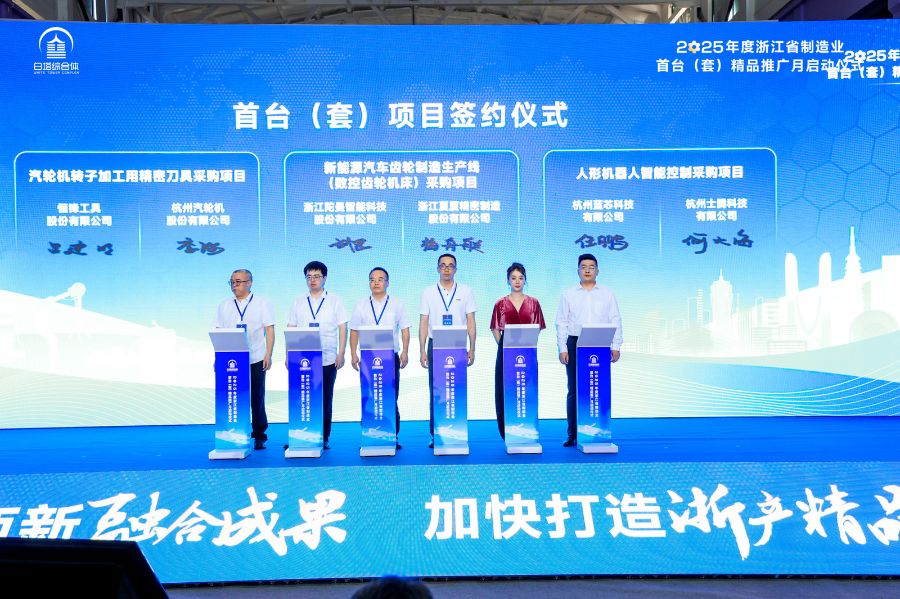
浙江启动制造业首台(套)精品推广月 加速创新成果转化
Zhong Guo Xin Wen Wang· 2025-07-03 15:57
Group 1 - The Zhejiang province has launched a promotional month for its first sets of high-quality manufacturing products, aiming to enhance the application and accelerate the transformation of innovative achievements into new productive forces [1] - As of now, Zhejiang has cultivated a total of 2,969 first sets of products, including 2,353 equipment, 253 materials, and 363 software [1] - In 2024, Zhejiang will recognize 476 new first sets of products, marking the highest number in history, with 63% of these products reaching international advanced or leading levels [1][2] Group 2 - The new generation of information technology equipment recognized in 2024 has seen a significant year-on-year increase of 68.4%, indicating a strong momentum in the high-end development of Zhejiang's equipment manufacturing industry [2] - A strategic cooperation was established between the Equipment Industry Development Center of the Ministry of Industry and Information Technology and Zhejiang's Economic and Information Technology Department to promote the application of first sets of products in more production scenarios [2] - Zhejiang has implemented a series of supportive policies across various areas, including insurance compensation, application rewards, procurement support, and talent assurance, to empower the promotion and application of innovative achievements [3]
从0到1!浙江近3000项硬核装备获官方认证背书
2 1 Shi Ji Jing Ji Bao Dao· 2025-07-03 12:16
Core Viewpoint - The integration of technological innovation and industrial innovation is exemplified by the promotion of the first set of products in Zhejiang Province, aiming to accelerate the transformation of innovative achievements into new productive forces [1][3]. Group 1: Definition and Current Status - The concept of "first set" includes first equipment, first batch materials, and first version software as defined in the 14th Five-Year Plan [3]. - As of now, Zhejiang Province has cultivated a total of 2,969 first set products, including 2,353 equipment, 253 materials, and 363 software [3]. - In 2024, 63% of the newly recognized first set products in Zhejiang are expected to reach international advanced and leading levels, with a 68.4% increase in new products in the new generation information technology equipment sector [3]. Group 2: Policy and Market Positioning - The policy issued in 2024 aims to enhance the insurance compensation for first set major technical equipment and first batch new materials, emphasizing the importance of achieving significant technological breakthroughs and possessing independent intellectual property rights [4]. - The first set products are crucial for China to seize technological high ground and market initiative, particularly in the power industry, where the development of large-scale equipment is essential for clean and low-carbon transformation [5]. Group 3: Case Studies and Innovations - Zhejiang Feida Environmental Technology Co., Ltd. developed a "1350MW-level ultra-large electrostatic precipitator," recognized as an international first set equipment, which supports the transition to larger and more energy-efficient coal-fired power units [5][7]. - Ningbo Huayi Ningchuang Intelligent Technology Co., Ltd. has developed a domestically produced single-cell metabolite analysis mass spectrometer, filling a technological gap in the high-end equipment sector [9]. Group 4: Government Support and Future Initiatives - The Zhejiang government has initiated a project for engineering breakthroughs in first set products, allowing companies to register and enter a system for project tracking and support [12]. - Key areas for the engineering project include intelligent equipment, energy-saving and new energy vehicles, advanced environmental protection equipment, and high-end medical equipment [13]. - Since 2015, the insurance compensation mechanism for first set major technical equipment has provided nearly 1 trillion yuan in risk protection for various major technical equipment and key new materials [13][14]. Group 5: Financial Incentives - In 2024, Zhejiang will offer financial rewards for recognized first set equipment, with 2 million yuan for international first set equipment, 1 million yuan for domestic first set equipment, and 500,000 yuan for provincial first set equipment [14].
★由降转增!一季度规模以上工业企业利润同比增长0.8%
Shang Hai Zheng Quan Bao· 2025-07-03 01:56
Group 1 - In the first quarter, the total profit of industrial enterprises above designated size reached 1509.36 billion yuan, reversing a decline of 3.3% from the previous year to a growth of 0.8% [1] - The profit growth was driven by the continuous release of the "two new" policy effects, rapid profit growth in equipment manufacturing and high-tech manufacturing, and an acceleration in enterprise revenue growth [1][2] - In March, the profit growth of industrial enterprises turned from a decline of 0.3% in January-February to an increase of 2.6% [1] Group 2 - Nearly 60% of industries saw profit growth in the first quarter, with manufacturing showing significant improvement; 24 out of 41 major industrial categories experienced either accelerated profit growth or reduced declines, resulting in a recovery rate of 58.5% [2] - Manufacturing profits increased by 7.6% year-on-year, accelerating by 2.8 percentage points compared to January-February [2] - Equipment manufacturing profits grew by 6.4% year-on-year, contributing 2 percentage points to the overall profit growth of industrial enterprises [2] Group 3 - The "two new" policy continued to show positive effects on industry profits, with specialized equipment and general equipment industries seeing year-on-year profit growth of 14.2% and 9.5%, respectively [3] - The effects of the consumption upgrade policy were evident, with profits in wearable smart device manufacturing, electric vehicle manufacturing, and kitchen appliance manufacturing increasing by 78.8%, 65.8%, and 21.7% year-on-year, respectively [3] - Overall, industrial enterprises' profits showed a sustained recovery trend in the first quarter, supported by macroeconomic policies and a favorable external environment [3]
★四月规模以上工业企业利润增速加快
Zheng Quan Shi Bao· 2025-07-03 01:56
Group 1 - The total profit of industrial enterprises above designated size in China reached 21,170.2 billion yuan from January to April, with a year-on-year growth of 1.4%, and a 3.0% increase in April alone [1] - In the first four months, 23 out of 41 major industrial sectors saw profit growth year-on-year, indicating a stable recovery in industrial profits [1] - The profit growth rate for the equipment manufacturing and high-tech manufacturing sectors accelerated, with respective year-on-year increases of 11.2% and 9.0% [1] Group 2 - The recovery in industrial enterprise profits is attributed to effective policies and industrial upgrades, with high-tech and high-value-added industries becoming new growth drivers [2] - Significant profit growth was observed in sectors related to "Artificial Intelligence+" initiatives, with semiconductor device manufacturing profits increasing by 105.1%, and profits in smart vehicle equipment and unmanned aerial vehicle manufacturing rising by 177.4% and 167.9% respectively [2] - Emphasis is placed on continuing the integration of technological innovation and industrial innovation, optimizing industrial structure, and accelerating the transformation and upgrading of traditional industries [2]
★多项先行指标向好 经济运行有望延续平稳态势
Zhong Guo Zheng Quan Bao· 2025-07-03 01:56
Group 1 - In May, China's manufacturing Purchasing Managers' Index (PMI) rose by 0.5 percentage points to 49.5%, indicating an improvement in manufacturing sentiment [1] - The increase in manufacturing PMI is attributed to the sustained implementation of growth-stabilizing policies, including monetary measures such as interest rate cuts [1][2] - The production index in May was 50.7%, up 0.9 percentage points, indicating accelerated manufacturing activity, while the new orders index rose to 49.8%, up 0.6 percentage points [1] Group 2 - High-tech manufacturing PMI stood at 50.9%, remaining in the expansion zone for four consecutive months, while equipment manufacturing and consumer goods PMIs were 51.2% and 50.2%, respectively, both showing improvement [2] - The production expectation index for manufacturing enterprises was 52.5%, up 0.4 percentage points, reflecting stable confidence in market development [2] - New export orders and import indices were 47.5% and 47.1%, respectively, both showing increases of 2.8 and 3.7 percentage points compared to the previous month [2] Group 3 - From May 19 to May 25, monitored ports completed a cargo throughput of 27,134.8 million tons, a 2.8% increase, and a container throughput of 656.4 thousand TEUs, up 3.63% [3] - The rebound in export container freight indices and sustained high levels of port cargo throughput suggest a potential for continued export growth in May [3] - Analysts expect exports to maintain resilience in the second quarter, with high growth rates anticipated [3] Group 4 - The current international environment remains complex, necessitating continued efforts in stabilizing growth policies to solidify the economic recovery [3] - There is a call for increased government investment in public goods to boost market demand and corporate orders, which would support production and employment [3] - New incremental policies are expected to be introduced to further support economic stability and high-quality development [4]