
纺织服装

Search documents
鲁泰A(000726):非经损益带动业绩高增,全年确定性较强
Changjiang Securities· 2025-09-04 23:30
Investment Rating - The investment rating for the company is "Buy" and is maintained [7]. Core Views - In the first half of 2025, the company achieved a revenue of 2.83 billion yuan, a slight decrease of 0.1% year-on-year, while the net profit attributable to shareholders reached 360 million yuan, reflecting a significant increase of 112.4% year-on-year. The non-recurring net profit was 230 million yuan, down 14.5% year-on-year. In Q2, the revenue was 1.37 billion yuan, down 5.1% year-on-year, with a net profit of 210 million yuan, up 109.1% year-on-year, and a non-recurring net profit of 140 million yuan, down 3.0% year-on-year. The company plans to distribute cash dividends of 80 million yuan, with a payout ratio of 23% [2][5]. Summary by Sections Financial Performance - The company reported a revenue of 2.83 billion yuan in H1 2025, with a net profit of 360 million yuan, marking a year-on-year increase of 112.4%. The non-recurring net profit was 230 million yuan, down 14.5% year-on-year. In Q2, revenue was 1.37 billion yuan, a decrease of 5.1% year-on-year, while net profit was 210 million yuan, an increase of 109.1% year-on-year [2][5]. Business Segments - The fabric and clothing business saw revenues of 1.85 billion yuan and 770 million yuan respectively, with the fabric business declining by 7.8% and the clothing business increasing by 24.8%. The fabric business faced revenue pressure due to tariff impacts, while the clothing business benefited from increased market expansion and order growth [10]. Cost Management and Profitability - Effective cost control measures led to a decrease in research and financial expense ratios in Q2 2025, contributing to a non-recurring net profit margin increase of 0.2 percentage points to 10.0%. The fair value change income increased by 130 million yuan, significantly boosting net profit [10]. Future Outlook - The company is expected to return to stable growth as uncertainties related to tariffs diminish. The leadership position in the industry and ongoing capacity expansion in Vietnam are anticipated to drive future growth. The projected net profits for 2025-2027 are 620 million yuan, 690 million yuan, and 740 million yuan respectively, with a corresponding PE ratio of 9, 8, and 8 times [10].

产业提能升级
Jing Ji Ri Bao· 2025-09-04 22:04
Core Insights - The article highlights the rapid development of the Haishu District in Ningbo, Zhejiang Province, focusing on the integration of technological and industrial innovation to build a modern industrial system and create a vibrant innovation ecosystem [1] Group 1: Technological Advancements - The Zhejiang Humanoid Robot Innovation Center has achieved full-scale production of the "Navigator 2" robot, which boasts an AI computing power of 275 trillion operations per second and an operational arm precision of 0.1 mm, applicable in various sectors including research, education, smart retail, and intelligent manufacturing [1] - The first national textile and apparel data circulation platform has been launched in Haishu, empowering over 200 small and medium-sized enterprises in the textile and apparel industry [1] Group 2: Investment and Project Planning - Haishu District has planned 336 major projects for the year, with an annual investment target of 35.45 billion yuan, aiming to attract 55 projects with investments exceeding 100 million yuan, and achieving an over 80% on-the-ground rate for signed projects [1] - Local government officials, including the district's party secretary, are actively collaborating with industry experts and local entrepreneurs to create a better environment for innovative productivity development, resulting in six detailed research reports for government reference [1]
晚间公告丨9月4日这些公告有看头
第一财经· 2025-09-04 14:18
Major Events - China Shipbuilding announced that it plans to absorb and merge with China Heavy Industry, with the latter's A-share stock set to be delisted on September 5, 2025. After the delisting, the stock value will not be reflected in investors' accounts until the conversion to China Shipbuilding A-shares is completed [4] - Anzheng Fashion's stock has experienced three consecutive trading days of limit-up prices, indicating potential irrational speculation in the market. No significant media reports or market rumors have been found that could impact the stock price [5] - Zhonghuan Hailu has terminated its plans for a change in control after failing to reach an agreement with the trading party regarding future development. The company's stock will resume trading on September 5 [6] - Kebo Da plans to acquire 60% of Kebo Da Intelligent Technology for 345 million yuan, aiming to enter the automotive intelligence sector and enhance its technological capabilities [7] - Shangneng Electric reported no undisclosed significant matters that could affect its stock trading, confirming stable operational conditions [8] - Jingxing Paper also stated that there have been no significant changes in its operational environment, with no undisclosed major information affecting stock prices [9] - Guoxin Health announced the passing of its independent director Bai Yan due to illness on August 31, 2025 [10] - Jiangsu Shuntian will change its stock name to "Suhao Fashion" starting September 10, 2025, while the stock code remains unchanged [11] Performance Overview - Yutong Bus reported sales of 4,260 units in August 2025, representing a year-on-year increase of 16.78%. Cumulative sales from January to August reached 28,800 units, up 4.51% year-on-year [12][13] - Wen's Shares recorded sales of 324,570 pigs in August, generating revenue of 4.825 billion yuan, with a slight month-on-month decline of 1.07%. The average selling price of live pigs was 13.9 yuan/kg, with year-on-year changes of 37.88% and -17.7% respectively [14] - Jiangling Motors reported a year-on-year increase of 8.92% in automobile sales for August, totaling 30,003 units. Cumulative sales from January to August reached 226,500 units, up 5.67% year-on-year [15] Shareholding Changes - Jimin Health's controlling shareholder plans to reduce its stake by up to 3%, equivalent to a maximum of 15.7527 million shares, within three months after 15 trading days [16] - Changfei Fiber announced that its major shareholder, Yangtze Communication, intends to reduce its stake by up to 0.15%, or 1.1 million shares, within three months after 15 trading days [17] Major Contracts - Ningbo Construction's subsidiaries have won construction projects worth a total of 1.117 billion yuan [18]




连板股追踪丨A股今日共44只个股涨停 这只锂电池股4连板
Di Yi Cai Jing· 2025-09-04 07:37
Group 1 - The core viewpoint of the article highlights the performance of specific stocks in the A-share market, particularly focusing on the solar and lithium battery sectors [1] - As of September 4, a total of 44 stocks in the A-share market reached their daily limit up, indicating strong investor interest and market momentum [1] - Notable stocks include Hongyu Packaging, which achieved a four-day consecutive limit up in the lithium battery sector, and Tongrun Equipment, which recorded a two-day consecutive limit up in the energy storage and solar sectors [1] Group 2 - The article provides a detailed list of stocks that have achieved consecutive limit ups, categorizing them by their respective sectors [1] - The stocks with consecutive limit ups include: - Hongyu Packaging (4 days, Lithium Battery) - Anzheng Fashion (3 days, Textile and Apparel) - ST Jingfeng (2 days, Innovative Medicine) - Tongrun Equipment (2 days, Energy Storage + Solar) [1] - This performance reflects the growing interest and investment in renewable energy and related technologies within the market [1]
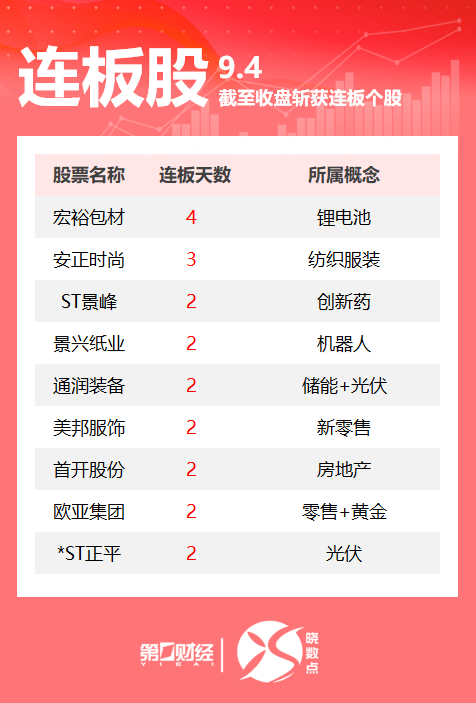
上美股份(02145):主品牌抖音龙头地位稳固,多品牌多品类布局日益完善
Orient Securities· 2025-09-04 06:07
Investment Rating - The report maintains a "Buy" rating for the company [5][10] Core Views - The main brand, Han Shu, has solidified its leading position in the Douyin beauty sector and is experiencing rapid growth on other e-commerce platforms, with a strong performance across multiple platforms [9] - The second growth curve has formed with the mid-to-high-end baby and child brand, Yi Ye, showing a significant revenue increase of 147% year-on-year, contributing to the company's growth [9] - The company launched a new high-end professional makeup brand, NAN beauty, which is expected to enhance its multi-brand strategy [9] - The company's multi-brand and multi-category layout is becoming increasingly mature, supported by effective management and incentive mechanisms [9] Financial Forecast and Investment Recommendations - The earnings per share (EPS) forecasts for 2025-2027 are adjusted to 2.78, 3.55, and 4.37 RMB respectively, with a target price of 103.21 HKD based on a 34x PE ratio for 2025 [4][10] - The company’s revenue is projected to grow significantly, with 2023 revenue at 4,191 million RMB and expected to reach 12,411 million RMB by 2027, reflecting a compound annual growth rate [4][10] - The gross margin is expected to remain stable around 75%, while the net profit margin is projected to improve from 11.0% in 2023 to 14.0% in 2027 [4][10]
午评:沪指跌近2%,科创50指数大跌超5%,消费板块逆市活跃
Zheng Quan Shi Bao Wang· 2025-09-04 05:11
Market Overview - The stock indices in the two markets experienced significant declines, with the Shanghai Composite Index dropping nearly 2% and falling below 3800 points, while the STAR Market 50 Index plummeted over 5% [1] - By midday, the Shanghai Composite Index was down nearly 2% at 3738.32 points, the Shenzhen Component Index fell by 2.37%, the ChiNext Index decreased by 3.2%, and the STAR Market 50 Index dropped by 5.38% [1] - The total trading volume across the Shanghai, Shenzhen, and Beijing markets reached 161.89 billion yuan [1] Sector Performance - The semiconductor and military sectors saw the largest declines, while insurance, non-ferrous metals, pharmaceuticals, and banking sectors also experienced downturns [1] - Conversely, sectors such as tourism, catering, retail, food and beverage, and textiles and apparel showed gains, with solid-state batteries and duty-free concepts being particularly active [1] Market Dynamics - According to Industrial Securities, the market has shown extreme structural differentiation recently, with volatility significantly increasing, reaching a new high since June 23 in the current upward trend [1] - The increase in volatility is attributed to the need for the market to digest and consolidate after a continuous rise, indicating that for the current "healthy bull" market to sustain, sectors must alternate and rotate upward [1] Future Outlook - Looking ahead, as new momentum sectors begin to flourish, there are numerous sub-sectors within the technology growth sector that warrant exploration, emphasizing the importance of structure over rhythm [2] - For the market to progress further and remain healthy, a "multi-point blooming" approach is necessary, with a focus on the rotation and expansion of five key areas: Hong Kong internet, semiconductor equipment and materials, software applications, innovative pharmaceuticals, and the new energy industry chain [2]
两市股指大幅下探 科创50指数大跌超5%
Zheng Quan Shi Bao Wang· 2025-09-04 03:22
Market Overview - On the 4th, the stock indices experienced significant declines, with the Shanghai Composite Index dropping nearly 2%, the ChiNext Index falling over 3%, and the STAR Market Index plummeting over 5% [1] - Sectors such as semiconductors and military industries saw the largest declines, while tourism, retail, food and beverage, and textile and apparel sectors showed gains [1] Market Trends - According to Zhongtai Securities, the market is expected to exhibit characteristics of volatility and structural rotation rather than a broad-based rally, with the Shanghai Composite and CSI 300 Index likely to remain in a range-bound state [1] - The defensive value of dividend stocks is becoming more prominent, which, despite not being the main focus in the short term, is expected to provide important support to the market amid tightening liquidity and pressure from major shareholder sell-offs [1] - Short-term volatility in the STAR and ChiNext markets is anticipated to increase, with outflows from ETFs and institutional funds observed recently. However, the medium-term logic for the technology sector remains solid, especially with the upcoming Fourth Plenary Session in October expected to introduce a "14th Five-Year Plan" centered on "new quality productivity" [1]
万里马:关于签订日常经营重大合同的公告
Zheng Quan Ri Bao· 2025-09-03 13:12
Core Points - Wanlima announced that it has been pre-selected as a candidate for the procurement project of general labor protection products for the China Southern Power Grid's personal mall (Hertz Shopping) for the years 2025-2026 [2] - The public announcement of the project candidates was made on July 18, 2025, with the public notice period ending on July 21, 2025 [2] - The company signed a purchase and sales agreement with Southern Power Grid Internet Service Co., Ltd. on August 18, 2025, regarding the procurement project [2]

安踏体育(02020):2025H1中报点评:2025H1业绩稳健,看好多品牌矩阵发展
Guohai Securities· 2025-09-03 12:31
Investment Rating - The investment rating for the company is "Buy" (maintained) [1][10] Core Views - The report highlights a stable performance in H1 2025, with a revenue of 38.54 billion, representing a year-on-year increase of 14.3%, while the net profit attributable to the parent company was 7.03 billion, down 8.9% year-on-year, but adjusted for the impact of Amer Sports' listing, it shows a 14.5% increase [4][6] - The company is optimistic about the development of its multi-brand matrix, with strong growth in outdoor brands and a focus on refined store operations [6][9] Financial Performance Summary - In H1 2025, the company's revenue by brand showed a year-on-year increase: Anta brand revenue increased by 5.4% to 16.95 billion, FILA brand revenue increased by 8.6% to 14.18 billion, and other brands saw a significant increase of 61.1% to 7.41 billion [6] - The gross profit margin slightly decreased by 0.7 percentage points to 63.4%, primarily due to a decline in Anta's gross margin by 1.7 percentage points to 54.9% and a decrease in FILA's gross margin by 2.2 percentage points to 68% [6] - The operating profit margin increased by 0.6 percentage points to 26.3%, while the adjusted net profit margin decreased by 1.2 percentage points to 17.1% [6] Store Network and Operational Efficiency - As of H1 2025, the company operated 7,187 Anta stores, 2,722 Anta Kids stores, 2,054 FILA stores, 241 Descente stores, 199 Kolon stores, and 50 MAIAACTIVE stores, indicating a strategic focus on enhancing store efficiency and consumer experience [7] - The average inventory turnover days increased by 22 days to 136 days, while accounts receivable turnover days remained stable at 19 days, and accounts payable turnover days also remained stable at 52 days [6] Future Earnings Forecast - The company is projected to achieve revenues of 79.56 billion, 88.05 billion, and 97.57 billion for 2025, 2026, and 2027 respectively, with growth rates of 12%, 11%, and 11% [9][10] - The net profit attributable to the parent company is expected to be 13.52 billion, 15.34 billion, and 17.05 billion for the same years, with a decrease of 13% in 2025 followed by increases of 13% and 11% in subsequent years [9][10]

万里马:签订日常经营重大合同
Mei Ri Jing Ji Xin Wen· 2025-09-03 12:13
Core Viewpoint - Wanlima announced a significant contract with Southern Power Grid Internet Service Co., which is expected to positively impact the company's performance in 2025 and enhance profitability [1] Group 1: Contract Details - Wanlima received a procurement contract for general labor protection supplies from Southern Power Grid for the 2025-2026 period, with a contract signing date of August 18, 2025 [1] - The estimated contract amount is approximately 44.6 million yuan, which represents 7.60% of the company's audited revenue for the fiscal year 2024 [1] Group 2: Impact on Business - Successful implementation of the project is anticipated to create a favorable sales environment for the company and improve its profitability [1] - The execution of the related agreement is not expected to have a significant impact on the company's business independence [1]