数字服务

Search documents
美加贸易缓和未提振加元,美元兑加元1.3650震荡,聚焦非农数据!
Sou Hu Cai Jing· 2025-07-02 08:11
Group 1 - The trade relationship between the US and Canada shows signs of easing, but this positive development has not had the expected uplifting effect on the Canadian dollar exchange rate, which is currently fluctuating around 1.3650 against the US dollar [1][2] - The Canadian government has announced the cancellation of the digital services tax, which paves the way for the resumption of trade negotiations between the two countries. This decision ends a heated dispute over the tax, which was set to impose a 3% tax on revenues from digital services provided to Canadian users by tech companies [2] - The US government strongly opposed the digital services tax, arguing that it primarily affects large American tech companies such as Amazon and Google, and previously threatened to halt all trade negotiations with Canada [2] Group 2 - The technical analysis of the USD/CAD exchange rate indicates significant resistance, with the price facing selling pressure each time it approaches the 20-day exponential moving average. The relative strength index is hovering around 40, and a drop below this level would signal further bearish sentiment [3] - The key support level is at the June 16 low of 1.3540, and if this level is breached, it could open up a decline towards the psychological level of 1.3500 [3] - The upcoming US non-farm payroll data is a central focus for the market, with expectations that the Federal Reserve will maintain interest rates at the July meeting, while a 25 basis point rate cut in September has been fully priced in [3]
最终对决将开启,马克龙向美国放狠话,王毅将访欧,这是要变天了?
Sou Hu Cai Jing· 2025-07-02 06:34
Group 1 - The trade war between the US and the EU has intensified, with French President Macron criticizing certain countries' tariff policies as tools of coercion, specifically targeting the US [1][3] - Macron's proposal for a "zero tariffs for zero tariffs" strategy has become a central countermeasure for Europe, warning that if the US maintains a 10% baseline tariff, Europe will implement equivalent retaliatory measures [3][4] - The EU's trade deficit with the US has expanded to $158 billion in 2024, with significant imbalances in aerospace and digital services [3] Group 2 - The European Commission is preparing to impose tariffs on $95 billion worth of US goods, while also implementing restrictions in digital tax and public procurement [3][4] - The actual impact of tariffs is evident in Europe, with a report indicating an 18% decrease in EU steel capacity utilization and a €2.3 billion reduction in automotive exports [4] - If the trade war escalates, GDP growth in the US and EU could decline by 0.8% and 1.2%, respectively, prompting European companies to make defensive adjustments [4] Group 3 - China's Foreign Minister Wang Yi's visit to Europe is significant, coinciding with the 50th anniversary of China-EU diplomatic relations and the first strategic communication after the EU Commission's reshuffle [6][9] - The visit aims to provide a platform for direct communication and lay the political groundwork for the upcoming China-EU leaders' meeting [6] - The EU is experiencing a strategic dilemma, trying to maintain economic sovereignty while not fully aligning with either the US or China [6][9] Group 4 - The trade war's ripple effects are impacting global supply chains, with the UN warning that the most vulnerable economies are suffering the most from US tariff policies [7] - Wang Yi's visit offers Europe a strategic opportunity, aligning China's open and cooperative approach with the EU's goal of strategic autonomy [7][9] - Despite existing tensions, both sides have reached a consensus to restart negotiations on price commitments, indicating a potential for cooperation [7][9]


关税“大限”将至 美国与各方谈得怎么样了?
Zhong Guo Xin Wen Wang· 2025-07-02 04:42
Core Viewpoint - The ongoing trade negotiations between the U.S. and various countries are facing significant challenges, with deadlines approaching and differing priorities among the parties involved [2][4][5]. Group 1: U.S.-EU Negotiations - The EU is preparing for potential retaliatory tariffs on U.S. imports worth €210 billion, with possible increases of up to 50% [2] - The EU is considering accepting a 10% "baseline tariff" from the U.S. but seeks exemptions for key sectors such as pharmaceuticals and semiconductors [2] - EU officials are evaluating new U.S. proposals while preparing for the possibility of negotiation failure [2][3] Group 2: U.S.-UK Negotiations - A framework agreement has been reached between the U.S. and the UK, eliminating tariffs on certain goods, but steel and aluminum tariffs remain unresolved [4] - If no agreement is reached by the deadline, the current 25% tariff on UK steel and aluminum could double to 50% [4] Group 3: U.S.-Canada Negotiations - Canada has withdrawn a proposed 3% digital services tax to facilitate trade negotiations with the U.S. [5][6] - The U.S. has halted trade talks due to Canada's insistence on the digital services tax, which could cost U.S. tech companies billions [5] Group 4: U.S.-Japan Negotiations - Japan prioritizes automotive tariffs in negotiations, but the U.S. remains unwilling to make concessions [8] - Recent discussions have not yielded progress, with Trump expressing skepticism about reaching an agreement [8] Group 5: U.S.-South Korea Negotiations - South Korea is seeking an extension of the tariff suspension period as negotiations approach the deadline [9] - Domestic protests in South Korea highlight public discontent with U.S. tariffs [10] Group 6: U.S.-India Negotiations - India is in extended negotiations with the U.S., focusing on agriculture and dairy products as key issues [11][12] - Despite some optimism from U.S. officials, disagreements on tariffs for automotive parts and steel persist [12] Group 7: U.S.-ASEAN Relations - Southeast Asian countries are adopting a mixed strategy to negotiate with the U.S. and avoid high tariffs [13] - Countries like Vietnam and Indonesia are making adjustments to facilitate trade discussions with the U.S. [13]
竟敢反击美国,特朗普一看对手不是中国,果断掀桌子,事情闹大了
Sou Hu Cai Jing· 2025-07-02 03:34
Group 1 - The Canadian government has announced a 3% digital services tax on certain tech companies, effective from June 30, 2022, targeting companies with global revenues exceeding $833 million and digital service revenues in Canada exceeding 20 million CAD (approximately 1.05 billion RMB) [5] - Companies affected by this tax include major U.S. digital service providers such as Amazon, Apple, Google, Meta, Uber, and Airbnb [5] - U.S. President Trump has labeled the tax as a "direct and blatant attack" on the U.S. and has decided to terminate all trade negotiations with Canada in response [3][8] Group 2 - Canadian officials are calling for trade diversification to reduce reliance on the U.S. following the announcement of the digital services tax [1] - Canadian Prime Minister Carney expressed a desire to continue negotiations with the U.S. in a manner that serves the best interests of Canadians, despite the abrupt termination of talks by the U.S. [5] - Canadian economist Jim Stanford suggested raising the digital services tax rate to 25% as a countermeasure to U.S. threats, aligning it with U.S. tariffs on Canadian steel, aluminum, and automotive products [7]
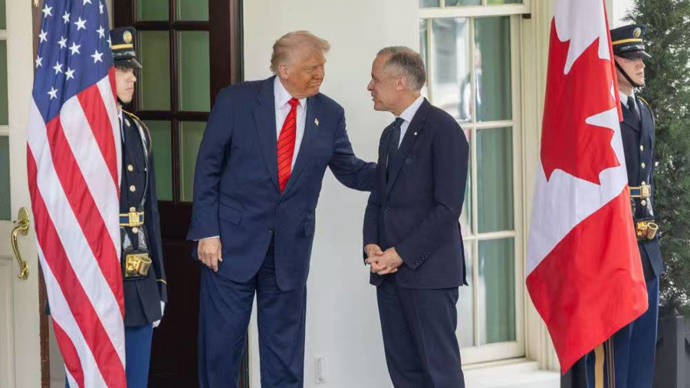
【环球财经】加拿大取消数字服务税 重启与美贸易谈判
Xin Hua She· 2025-07-01 09:09
Group 1 - Canadian Prime Minister Carney announced a phone conversation with US President Trump on June 29, resulting in the decision to resume trade negotiations with a deadline set for July 21 [1] - The Canadian government announced the cancellation of the digital services tax, originally set to take effect on June 30, to facilitate trade talks with the US [1] - The US National Economic Council Director Kevin Hassett stated that the US would "immediately resume" trade negotiations with Canada following the cancellation of the digital services tax [1] Group 2 - In 2020, the Canadian government proposed a digital services tax targeting large multinational digital companies, aiming for a fair contribution from these companies to the local market [1] - The digital services tax, set to be enacted in 2024, will impose a 3% tax on revenues from digital services provided to Canadian users, retroactive to 2022 [1] - The US Trade Representative's Office reported that most digital services taxes are discriminatory against US companies, with the Canadian tax potentially leading to an initial bill exceeding $2 billion for US firms if retroactive [2] Group 3 - Canadian Finance Minister Chrystia Freeland confirmed the implementation of the digital services tax on June 30, prompting an immediate halt to trade negotiations by the US [2] - Reactions in Canada to the US's threats were mixed, with some business leaders suggesting that Canada should cancel the digital services tax to revive trade talks [2] - Trade lawyer Lawrence Herman warned that yielding to US pressure to cancel the digital services tax could weaken Canada's negotiating position and damage relations with Europe [3]
外媒:欧盟愿接受特朗普的普遍关税,但寻求关键行业豁免
Guan Cha Zhe Wang· 2025-07-01 05:30
Core Points - The EU is willing to accept a 10% general tariff proposed by the Trump administration but seeks exemptions for key industries [2][5] - Canada has decided to abandon its digital services tax to facilitate trade negotiations with the U.S. [9][10] Group 1: EU's Trade Negotiations - The EU is negotiating a trade agreement with the U.S. that includes a 10% general tariff on many goods exported to the U.S. while requesting lower tariffs in critical sectors such as pharmaceuticals, alcohol, semiconductors, and commercial aircraft [2][4] - The EU is pushing for quotas and exemptions to reduce the 25% tariff on automobiles and parts, as well as the 50% tariff on steel and aluminum [2][5] - The EU estimates that U.S. tariffs currently cover products worth €380 billion, accounting for about 70% of the EU's total exports to the U.S. [5] Group 2: Canada’s Trade Position - Canada has canceled its digital services tax, which was set to take effect in 2024, to advance trade talks with the U.S. [9][10] - The digital services tax would have impacted major U.S. tech companies, including Amazon and Google, by imposing a tax on their digital service revenues in Canada [9][10] Group 3: Potential Outcomes of Negotiations - The EU has outlined four possible scenarios before the July 9 deadline: reaching an acceptable asymmetric agreement, the U.S. proposing an unbalanced agreement, extending the deadline for negotiations, or Trump exiting negotiations and increasing tariffs [8] - The EU is aiming for a "fair" tariff agreement that provides more predictability for businesses [6]
美股大幅拉升!关税谈判,突传利好!
天天基金网· 2025-07-01 05:05
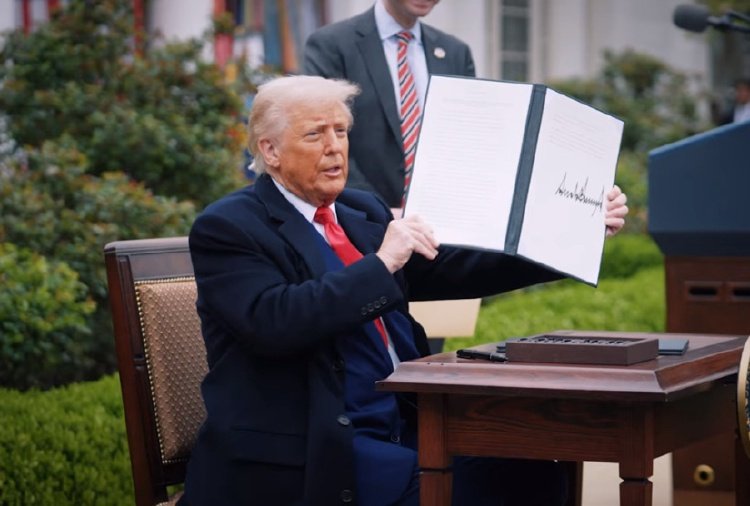
Group 1 - Canada announced the cancellation of the digital services tax to advance broader trade negotiations with the United States, aiming to reach an agreement by July 21 [1][2] - Following the announcement, U.S. stock index futures saw significant gains, with Dow futures up 0.54%, Nasdaq futures up 0.70%, and S&P 500 futures up 0.47% [1] - The Canadian government stated that the cancellation would facilitate important progress in negotiations regarding a new economic and security relationship with the U.S. [2] Group 2 - The digital services tax was initially proposed by former Prime Minister Trudeau during the 2021 federal election and was set to be implemented on June 30, 2024, imposing a 3% tax on certain tech companies [5][6] - The tax would apply to companies with global annual revenues exceeding $833 million and digital service revenues in Canada exceeding 20 million CAD (approximately 10.5 million RMB) [6] - Major U.S. tech companies such as Amazon, Apple, Google, and Uber would have been affected by this tax, which led to strong opposition from the U.S. government [6][7] Group 3 - The U.S. has historically been opposed to Canada's digital services tax, viewing it as a direct attack on American tech giants [3][6] - The trade relationship between Canada and the U.S. is significant, with Canada being the second-largest trading partner of the U.S., purchasing $349.4 billion worth of U.S. goods last year [4] - The cancellation of the tax is seen as a move to improve trade relations and avoid further escalation of trade disputes [2][4]
加拿大“屈服”了 欧洲还在坚持 特朗普又抱怨日本不买美国大米
Xin Hua She· 2025-07-01 00:19
Group 1: Canada and US Trade Negotiations - Canada has agreed to cancel its digital services tax to facilitate trade negotiations with the US, which the White House claims is a significant victory for American tech companies [2][3] - The US will "immediately resume" trade talks with Canada following the cancellation of the digital services tax, with a goal to reach an agreement by July 21 [2][3] - The White House attributes this change to President Trump's strong negotiation style and emphasizes the importance of maintaining good trade relations with the US [2][3] Group 2: EU's Position on Digital Legislation - The European Union has stated that its digital legislation, including the Digital Markets Act and Digital Services Act, will not be part of the trade negotiations with the US [4] - The EU remains firm on its sovereign decision-making regarding digital legislation and aims to reach a trade agreement with the US by July 9 [4][5] - The US has previously criticized the EU's digital regulations as unfair and has imposed significant fines on American companies for violations [4][5] Group 3: US-Japan Trade Relations - President Trump has expressed dissatisfaction with Japan's refusal to import US rice despite facing a rice shortage, indicating a potential letter to Japan regarding trade [6][7] - Trump has labeled the US-Japan trade relationship as "unfair," highlighting a significant trade deficit and suggesting that Japan should import more US goods [7][8] - The US has imposed a 25% tariff on imported cars, and negotiations with Japan regarding tariffs are ongoing, with a deadline set for July 9 [8]
加拿大让步 美加关税谈判重启
Bei Jing Shang Bao· 2025-06-30 14:45
美加贸易谈判被特朗普叫停后,加拿大宣布取消数字服务税,以推进与美国的贸易谈判。6月30日,据媒体报道,加拿大宣布取消数字服务税。加拿大总理 卡尼和美国总统特朗普同意,双方将恢复谈判,以期在7月21日前达成贸易协议。目前,距离7月9日所谓"对等关税"90天暂停期结束仅剩10天,美国与各贸 易伙伴的谈判进度不及预期。截至目前,英国是唯一与美国达成所谓"贸易协议"的国家。 取消数字服务税 加拿大财政部在一份新闻稿中说,加拿大总理卡尼与美国总统特朗普已同意双方将恢复谈判,以期在7月21日前达成协议。卡尼在声明中表示,"今天的声明 将有助于重启谈判,以实现本月七国集团(G7)领导人峰会上提出的2025年7月21日的时间表"。 "应减少对美依赖" 加拿大取消数字服务税的决定被视作向特朗普政府的让步,但这一决定并不让人意外。在特朗普27日"炮轰"加拿大开征数字服务税的决定并叫停谈判后,加 拿大政商界人士和相关协会纷纷迅速向卡尼施压,要求取消该税项。 加拿大商业委员会的CEO Goldy Hyder曾表示:"为了使贸易谈判重回正轨,加拿大应立即提出一项方案,以便取消数字服务税,换取美国取消关税。"但商 鹏飞一度称不会推迟这一 ...

加拿大让步!取消数字服务税后,美加贸易谈判就能恢复?
第一财经· 2025-06-30 14:41
Core Viewpoint - Canada has decided to cancel its digital services tax to facilitate trade negotiations with the United States, aiming for an agreement by July 21, 2025 [1][3]. Group 1: Digital Services Tax Cancellation - The Canadian government announced the cancellation of the digital services tax, which was set to impose a 3% tax on revenues from tech companies providing services to Canadian users, effective from June 30 [1][3]. - The decision to cancel the tax is seen as a concession to the Trump administration, following pressure from Canadian business leaders and associations [3][4]. - The cancellation is expected to help establish a new economic and security relationship with the U.S. and create job opportunities for Canadians [3][4]. Group 2: Trade Negotiations Context - The trade dispute escalated quickly, with the U.S. halting negotiations after Canada announced the tax, leading to potential new tariffs on Canadian goods [1][3]. - The Canadian Business Council's CEO emphasized the need for Canada to propose a plan to cancel the tax in exchange for the U.S. lifting tariffs [4]. - Experts have criticized the Canadian government's approach, suggesting that the unilateral cancellation of the tax may not significantly impact the broader trade negotiations [4]. Group 3: Broader Trade Negotiation Challenges - Despite the cancellation of the digital services tax, U.S. trade negotiations with various partners, including the UK, have not progressed as expected, with only limited agreements reached [5]. - Ongoing investigations into tariffs on products like semiconductors and pharmaceuticals have created uncertainty in U.S. trade discussions with major partners [5]. - Legal disputes regarding the imposition of tariffs under the International Emergency Economic Powers Act have added further complexity to the trade landscape [5][6].