航空业

Search documents
航班紧急备降,机上病亡乘客不是中国公民
第一财经· 2025-12-26 13:17
Group 1 - The Chinese Consulate in Almaty confirmed that the deceased passenger on the Lufthansa flight from Munich to Beijing is not a Chinese citizen [1] - The flight LH0722 made an emergency landing at Almaty International Airport due to a passenger losing consciousness [1] - Medical personnel later confirmed that the passenger had died during the flight [1]



大摩:消费者出行意愿保持韧性 北美航空业“具有吸引力”
智通财经网· 2025-12-26 09:28
Core Insights - Potential merger discussions are ongoing between Spirit Airlines and Frontier Airlines, with a possible announcement as early as this month [2] - The U.S. Department of Transportation has released a national strategy for advanced air mobility from 2026 to 2036, focusing on safety, security, defense, and economic competitiveness [2] - American Airlines is tightening its loyalty program by discontinuing mileage and elite qualification points for basic economy ticket purchases starting December 2025 [3] - Delta Airlines' President Glen Hauenstein will retire in February 2026, with Joe Esposito set to succeed him [3] Market and Consumer Insights - Capacity planning for Q2 2026 shows varied adjustments among major North American airlines, with American Airlines' short-haul international capacity up 7.6% year-over-year [4] - Consumer travel intent remains strong, with 58% planning to travel in the next six months, slightly down from 62% year-over-year but higher than the previous month [4] - Higher-income households show a strong travel intent, with 79% of those earning over $150,000 planning to travel [4] Investment Views and Stock Ratings - Morgan Stanley maintains an "attractive" industry outlook for North American airlines, updating stock ratings and target prices for nine major airlines [5] - Alaska Airlines, American Airlines, Delta Airlines, United Airlines, and Southwest Airlines are rated "overweight," while Allegiant Travel, Frontier Airlines, and JetBlue Airways are rated "hold" [5] - Delta Airlines is favored for its strong balance sheet and leading loyalty program, while United Airlines excels in execution [5]




强势升值!离岸人民币收复7.0 成本进口型行业受益
Sou Hu Cai Jing· 2025-12-25 23:21
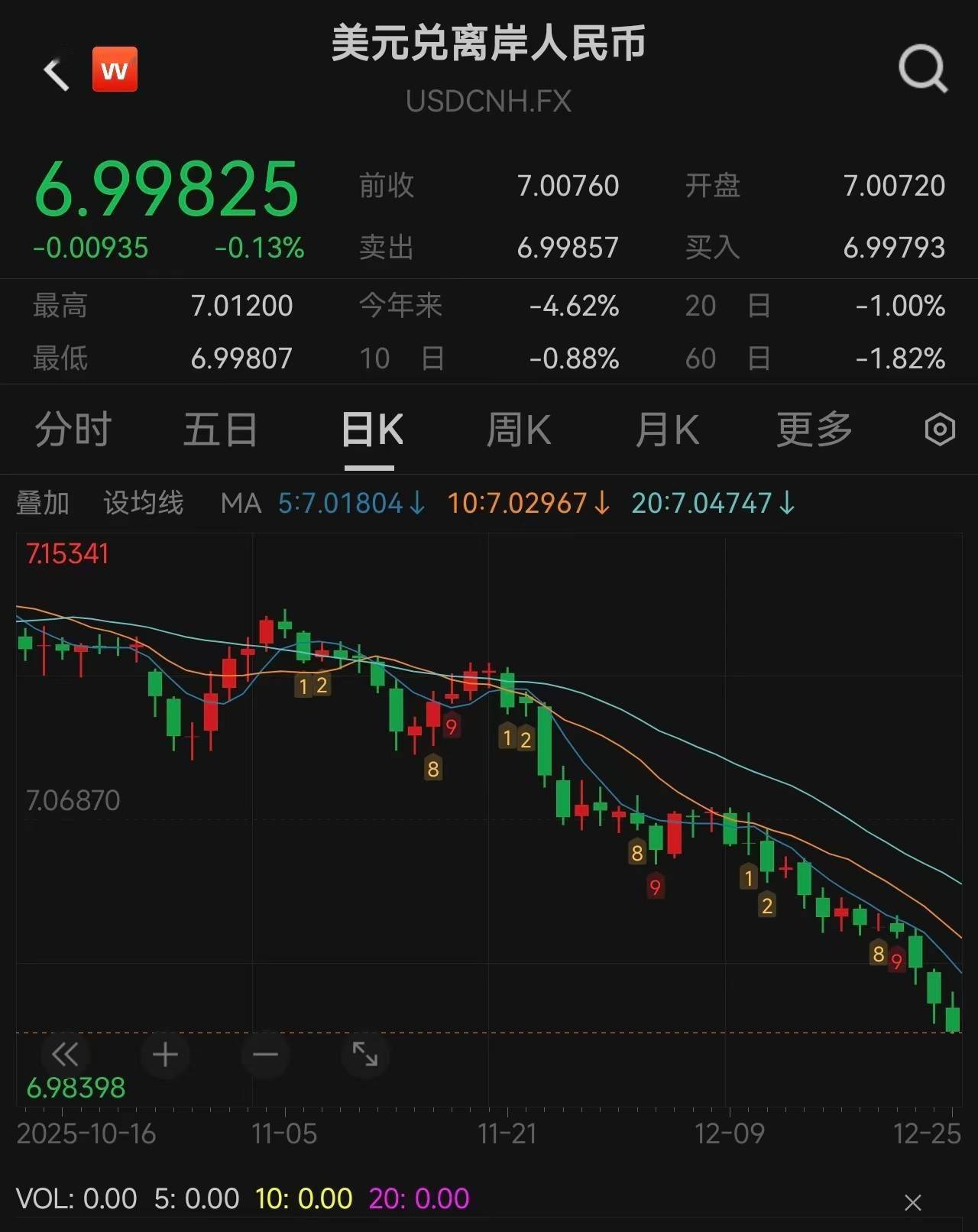
Group 1 - The offshore RMB against the US dollar has strengthened, breaking the key level of 7.0, reaching a high of 6.9965, marking a new high since September 2024 [3] - Industries benefiting from RMB appreciation include commercial aerospace, paper manufacturing, and cross-border payment, which have shown strong performance in the secondary market [3][4] - The appreciation of the RMB has reduced the procurement costs of raw materials priced in US dollars for cost-importing industries like aviation and paper, leading to exchange rate gains [4] Group 2 - Export-oriented industries such as home appliances, electronics, textiles, and machinery face short-term pressure due to RMB appreciation, which may weaken international price competitiveness and erode exchange rate gains and profit margins [4] - Despite the appreciation, analysts suggest that it will not significantly alter the overall depreciation of the RMB against most non-USD currencies for the year, limiting the impact on export competitiveness [4] - The appreciation of the RMB enhances purchasing power for ordinary citizens, making overseas travel and study more affordable, while also helping to stabilize domestic prices by reducing the costs of imported energy and raw materials [6] Group 3 - Major blue-chip stocks, consumer leaders, and core technology companies are expected to receive liquidity support from foreign capital, with strong performances noted in the robotics and semiconductor sectors [5] - Institutions maintain a cautiously optimistic outlook on future exchange rate trends, with expectations of further RMB appreciation driven by seasonal capital flows and export settlement needs before the Spring Festival [6] - The breakthrough of the RMB at a key level is anticipated to boost market sentiment, benefiting consumer staples and growth sectors favored by foreign investors, although sustainability requires fundamental support [6]
中日航线瞬间归零,46条航线停摆,日本免税店门可罗雀
Sou Hu Cai Jing· 2025-12-25 21:38
Economic Impact - Japan's economy is facing significant challenges, with a sharp decline in hotel occupancy rates and a noticeable drop in activity at Kansai International Airport, reflecting a broader economic downturn [1][2] - The cancellation of approximately 2,200 flights between China and Japan has severely impacted business opportunities and household incomes, leading to widespread discontent among the Japanese populace [2][3] - The Japanese tourism industry is projected to suffer a revenue shortfall exceeding 1.2 trillion yen due to the absence of Chinese tourists, with related industries facing losses as high as 3.5 trillion yen [14][15] Trade Relations - Despite the downturn in the aviation sector, China's rare earth exports to Japan surged by 34.7% in November, reaching 304 tons, indicating a complex trade dynamic where China maintains control over critical resources [2][3] - Japan's high-end manufacturing sectors, particularly automotive and electronics, are heavily reliant on rare earth materials, highlighting the strategic leverage China holds over Japan's manufacturing capabilities [3][4] Political Context - The political statements made by Japanese politician Sanae Takaichi regarding Taiwan have escalated tensions with China, leading to economic repercussions that the Japanese government appears ill-equipped to address [1][6] - The Japanese government is perceived as ineffective in responding to the economic fallout from its political decisions, with business leaders expressing urgent concerns about the future of Japan's manufacturing sector [15][19] Social Consequences - Rising living costs coupled with decreasing incomes are creating a financial strain on the Japanese middle class, leading to a growing sense of frustration among the populace [17][19] - The political gamble taken by Takaichi is seen as detrimental to ordinary citizens, raising questions about the sustainability of Japan's social fabric amid economic challenges [19][20]

品质为大·诚信为友
Xin Lang Cai Jing· 2025-12-25 17:24
Group 1 - The core viewpoint of the article highlights the achievements and growth of Dayou Group since its establishment in 2000, emphasizing its diverse business operations in the automotive, finance, aviation, and real estate sectors [4][6] - Dayou Group has received numerous accolades, including being recognized as one of the "Top 100 Automotive Dealers in China" and "Top 100 Private Enterprises in Jinan," showcasing its strong market presence and reputation [4][6] - The company operates a wide network of authorized 4S dealerships across Shandong province, focusing on luxury and mid-to-high-end automotive brands, with significant market shares in brands like Dongfeng Honda and GAC Toyota [4][5] Group 2 - The establishment of the AITO authorized user center in Jinan marks Dayou Group's commitment to the new energy vehicle market, with plans to expand its service network further in 2025 [5] - Dayou Group is enhancing its automotive industry chain model by integrating online and offline sales, after-sales services, and innovative service offerings such as "lifetime warranty" and "doorstep maintenance" [5] - The company has been recognized for its social responsibility and operational excellence, receiving awards such as "Best Automotive Group in Qilu" and "Advanced Tax Contribution Unit" [6]

破7 离岸人民币对美元汇率创新高
Xin Lang Cai Jing· 2025-12-25 17:24
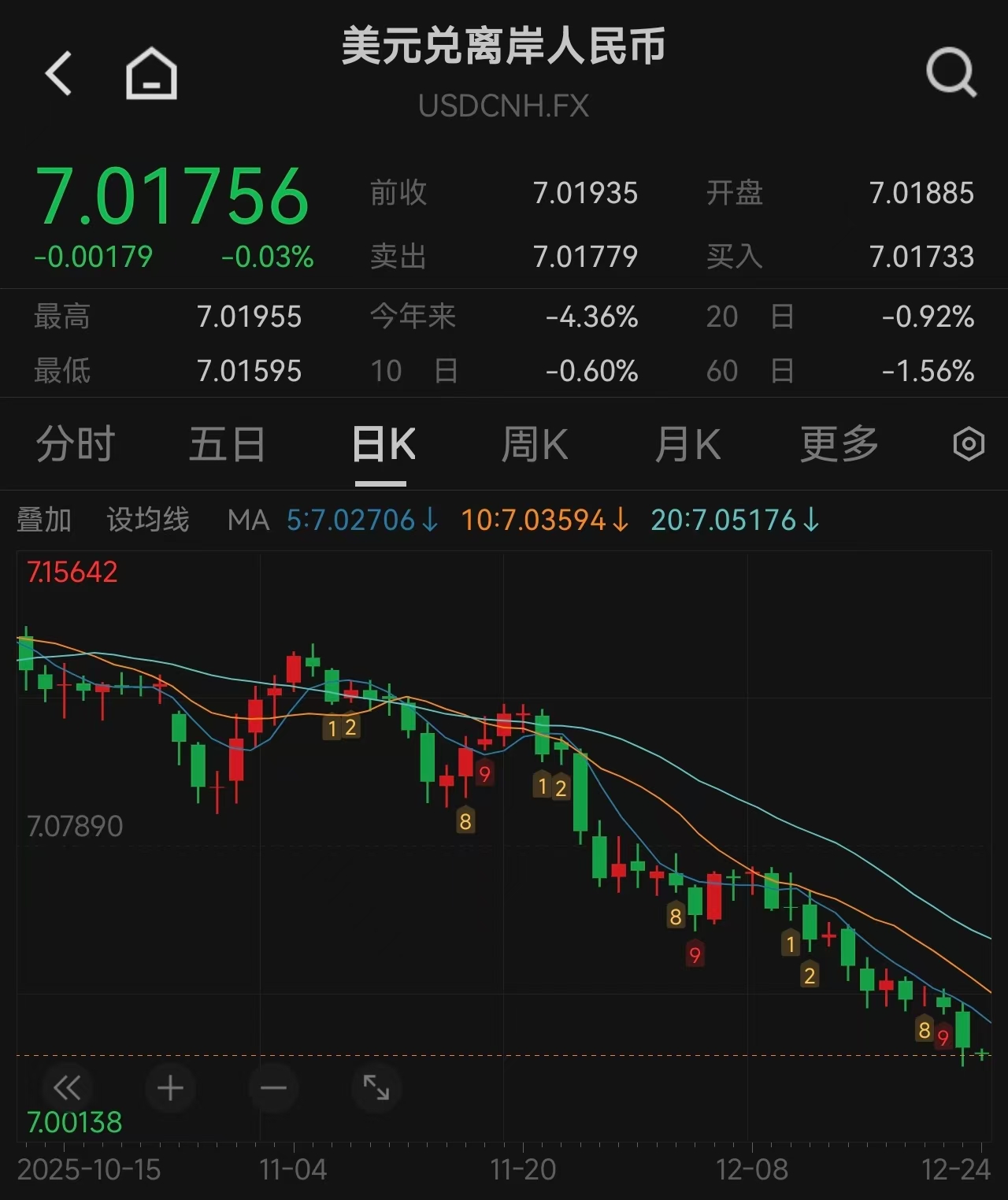
Core Viewpoint - The recent appreciation of the Renminbi (RMB) against the US dollar has significant implications for both individual investors and the broader Chinese economy, with the RMB breaking the 7.0 mark for the first time since September 2024, indicating a shift in market dynamics and potential investment opportunities [1][4]. Group 1: Impact on Individuals - Individuals holding USD deposits are experiencing negative returns due to the RMB's appreciation, as seen in the case of a resident who lost approximately 1,033 RMB on a USD deposit despite earning interest [2]. - Families with children studying abroad benefit from the RMB's strength, as it reduces the cost of tuition and living expenses in foreign currencies, with one family saving around 17,000 RMB on exchange costs compared to earlier in the year [3]. Group 2: Market Dynamics - The RMB's appreciation is driven by a combination of external pressures easing, internal economic resilience, and market expectations shifting, particularly in light of anticipated interest rate cuts by the Federal Reserve [5][6]. - The recent trend of RMB appreciation is expected to positively influence the Chinese stock and bond markets, as it enhances the attractiveness of RMB-denominated assets to foreign investors [7]. Group 3: Economic Implications - A stronger RMB is likely to lower import costs for raw materials and advanced technology, supporting China's economic transition from price competition to brand and technology diversification [8]. - Industries reliant on imports, such as energy and agriculture, as well as sectors with significant USD liabilities, are expected to benefit from the RMB's appreciation [8]. Group 4: Capital Market Effects - The appreciation of the RMB is anticipated to attract capital inflows, benefiting various asset classes including stocks and bonds, through valuation enhancement, increased foreign investment, and improved market confidence [9]. - A 0.1 percentage point increase in the RMB's value could lead to a 3% to 5% increase in stock valuations, making RMB-denominated assets more appealing to foreign investors [9].
离岸人民币对美元升破7.0关口!为2024年9月以来首次,对A股市场影响几何?
Sou Hu Cai Jing· 2025-12-25 02:42
Group 1 - The offshore RMB has surpassed the 7.0 mark against the USD for the first time since September 2024, currently reported at 6.99825 [1] - The People's Bank of China (PBOC) aims to enhance the resilience of the foreign exchange market and stabilize market expectations, preventing excessive fluctuations in the exchange rate [3] - The appreciation of the RMB is expected to increase the attractiveness of RMB-denominated assets, particularly for foreign investors focused on exchange rate gains [3] Group 2 - Historical data indicates that during periods of RMB appreciation, foreign capital, represented by "northbound funds," tends to show accelerated net inflows, favoring liquid assets that align with international valuations [3] - A-share market valuations are currently at historically low levels, and a stronger RMB may catalyze long-term foreign capital to reassess and increase allocations to Chinese assets, potentially stabilizing or boosting market indices [3] - The impact of RMB appreciation on listed companies is not uniform; export-oriented industries such as home appliances, electronics, textiles, and machinery may face reduced price competitiveness in international markets, leading to potential downward pressure on profit expectations [4] Group 3 - Beneficiaries of RMB appreciation include industries with significant dollar-denominated liabilities, such as airlines, which may see improved financial statements due to increased exchange gains [4] - Cost-importing sectors, like paper and basic chemicals, will benefit from reduced procurement costs for raw materials, enhancing profit margins [4] - The psychological impact of RMB appreciation is significant, as it signals economic stability and effective policy, which can fundamentally boost market risk appetite [4] Group 4 - The significance of the RMB surpassing the 7.0 mark is more psychological and directional rather than indicative of long-term trends; sustainable appreciation is contingent on confirmed domestic economic recovery and substantial improvements in corporate earnings [5] - Investors should closely monitor upcoming key economic data releases and monetary policy trends from major economies to gauge the sustainability of RMB appreciation [5]
兴业证券:供需支撑航空业景气上行 迈入弹性临界点
Zhi Tong Cai Jing· 2025-12-24 02:09
兴业证券发布研报称,展望2026年,航空行业供需紧平衡态势有望持续,超高的客座率有望向票价有效 传导,叠加油价中枢下行、政策支持等积极因素,航司将正式迈入利润上行周期,旺季票价弹性值得期 待。该行认为,后续多重利好有望拉动国内及国际航空需求的"量价齐升"。 兴业证券主要观点如下: 行业景气度见底回升,迈入上行周期临界点 国际油价中枢预计下行,为航空公司提供了坚实的成本支撑。此外,民航局"整治内卷式竞争"的明确表 态及《航空客运自律公约》的发布,有望遏制恶意低价竞争,促进票价收益回归合理水平。 中长期多重利好支撑,驱动"量价齐升" 贸易摩擦导致波音飞机交付中国航司进度缓慢,同时普惠PW1100G发动机的粉末冶金缺陷问题导致空 客A320neo机队停场检修,有效运力投放受到挤压,航空业供给端预计将持续保持紧平衡态。 需求侧韧性强劲,国际航线表现亮眼 整体出行需求保持较强韧性,国内旅客量稳步增长,而多批次免签政策的实施,以及全球经济的逐步回 暖,共同驱动2025年1-10月国际航线旅客量实现23.2%的累计同比增长,成为拉动需求增长的核心引 擎。 成本端改善与政策利好叠加,盈利能力有望提升 经过2023-2024年 ...

人民币创14个月新高,对A股市场影响几何?谁喜谁忧?这些板块迎“汇率红包”
Jin Rong Jie· 2025-12-24 01:33
Core Viewpoint - The offshore and onshore RMB have both strengthened against the USD, reaching their highest levels in 14 months, which is expected to attract foreign investment into Chinese assets [1][3]. Group 1: Impact of RMB Appreciation - The appreciation of the RMB enhances the attractiveness of RMB-denominated assets, particularly for foreign investors focused on exchange rate gains [3]. - Historical data indicates that during periods of RMB appreciation, foreign capital, represented by "northbound funds," tends to show accelerated net inflows, favoring liquid, well-valued assets that align with China's economic growth [3]. - The current A-share market is at a historically low valuation, and the strengthening RMB may catalyze long-term foreign capital to reassess and increase allocations to Chinese assets, potentially stabilizing or boosting market indices [3]. Group 2: Beneficiaries and Losers - Export-oriented industries, such as home appliances, electronics, textiles, and machinery, are likely to suffer as RMB appreciation reduces their price competitiveness in international markets, potentially eroding exchange gains and profit margins [3][4]. - Beneficiaries of RMB appreciation include industries with significant dollar-denominated liabilities, such as airlines, which will see improved financials due to reduced exchange losses [4]. - Cost-importing sectors, like paper and basic chemicals, will benefit from lower raw material costs due to RMB appreciation, enhancing their profit margins [4]. Group 3: Market Sentiment and Trends - The psychological impact of RMB appreciation is significant, as it signals economic stability, effective policy, and international capital recognition, which can fundamentally boost market risk appetite [4]. - In an appreciating currency environment, "core assets" are likely to perform better, with large-cap value stocks benefiting from their close ties to the macroeconomy and foreign capital preferences [4]. - The importance of sustained RMB appreciation is emphasized, as lasting trends rather than short-term fluctuations will have a more profound impact on the A-share market [4][5].
湛江至万象国际航线开通 开启粤西联通东盟新通道
Zhong Guo Xin Wen Wang· 2025-12-23 15:15
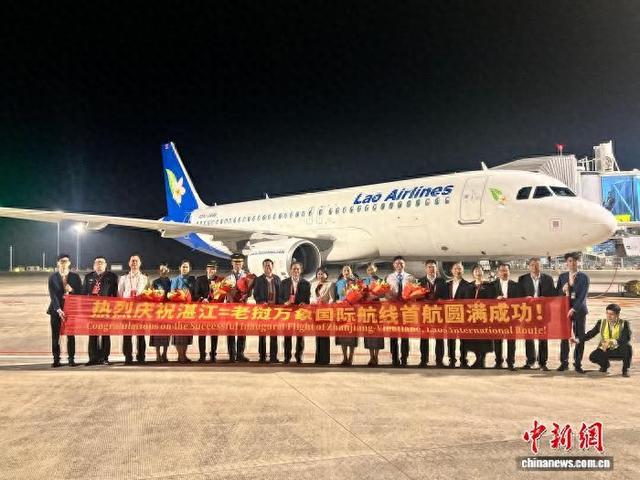
湛江至万象国际航线采用空客A320机型执飞,每周二、四、六定期往返,万象瓦岱国际机场16:40起 飞,19:15抵达湛江;湛江20:15起飞,20:55返回万象(均为当地时间)。航线开通后,粤西市民"家门口直 飞东盟"的诉求成为现实。 湛江地处粤港澳大湾区、海南自由贸易港、西部陆海新通道三大国家战略交汇点,是中国大西南、华南 地区通往东盟最便捷的沿海城市之一。湛江吴川国际机场位于湛江、茂名两市几何中心,与广湛高铁、 深湛铁路、广湛高速、渝湛高速等交通干线无缝衔接,构建立体交通网络。此次湛江至万象国际航线开 通,让空港枢纽与湛江港、中欧班列、中老铁路形成国际海陆空多式联运体系。(完) 12月23日,广东湛江,湛江至万象国际航线正式开通。(广东机场集团 供图) 中新社湛江12月23日电 (记者 郭军 梁盛)12月23日19时许,老挝航空QV863航班平稳降落湛江吴川国际 机场,并缓缓通过象征民航最高礼仪的"水门礼",标志着中国湛江至老挝万象的国际航线正式开通。 这是吴川国际机场2022年转场投运以来正式通航的首条国际航线,也是外籍航空公司首次开通粤西国际 航线,开启粤西联通东盟新通道。 作为国家一类国际航空口岸, ...