锂离子电池制造

Search documents
行业首单 “数字资产质押” 贷款落地 平安银行为科技企业注入发展动能
Zheng Quan Ri Bao Wang· 2025-11-03 10:18
Core Insights - Ping An Bank's Guangzhou branch has successfully implemented the first "data asset pledge + digital RMB loan" in the highway industry, marking a significant milestone in transforming data resources into capital [1][2] - The collaboration with Guangdong United Electronic Services Co., Ltd. demonstrates Ping An Bank's innovative approach to financing technology enterprises by utilizing data assets as collateral, addressing the financing bottleneck faced by many tech companies [2][3] Group 1: Data Asset Transformation - Traditional credit systems rely on tangible assets for collateral, but many tech companies possess core value in intangible assets like patents and data, which are often overlooked [2] - Ping An Bank has identified this gap and pioneered a new model that allows data assets to be included in the bank's credit asset pool, validating the future value of data assets [2] Group 2: Financial Services Innovation - The use of digital RMB as a loan disbursement method provides clients with an unprecedented "payment upon settlement" experience, enabling instant fund availability [3] - Timely access to funds allows tech companies to seamlessly connect R&D investments and technology upgrades, enhancing their market competitiveness [3] Group 3: Tailored Financial Solutions - Ping An Bank has established long-term partnerships with various tech companies, providing continuous financing support throughout their growth stages, from initial credit loans to comprehensive financing products [4][5] - A customized credit solution of 100 million yuan was developed for a leading fintech company, addressing its unique needs through a combination of working capital loans and performance guarantees [5] Group 4: Comprehensive Financial Ecosystem - Ping An Bank has created a "full lifecycle companion" service model that adapts to the different stages of a tech company's development, ensuring that financial services align with their specific needs [6] - The bank has also introduced tailored supply chain financing solutions to address challenges faced by tech companies, enhancing their operational stability and growth [7] Group 5: Future Outlook - By supporting various tech enterprises, Ping An Bank is building a complete ecosystem for technology financial services, positioning itself to leverage opportunities in the evolving tech finance landscape [7]

全国前三季度锂电行业同比增29.8%,宁德时代营收2830.72亿元
鑫椤储能· 2025-10-23 07:33
Core Viewpoint - The article highlights the robust growth in the energy storage market and the significant performance of CATL, emphasizing the company's strategic expansion in production capacity and its focus on new technologies and products in the battery sector [2][3][4]. Group 1: Economic Context and Industry Growth - The National Bureau of Statistics reported that policies aimed at expanding domestic demand have positively impacted various manufacturing sectors, including lithium-ion battery manufacturing, which saw a year-on-year increase of 29.8% in value added [1]. - The production of new energy vehicles, electric bicycles, and tablets also experienced substantial growth, with increases of 29.7%, 27.1%, and 9.5% respectively [1]. Group 2: CATL's Financial Performance - CATL reported a third-quarter revenue of 104.19 billion yuan, a year-on-year increase of 12.9%, and a net profit of 18.55 billion yuan, up 41.21% [2]. - For the first three quarters, the company achieved a revenue of 283.07 billion yuan, reflecting a 9.28% growth, and a net profit of 49.03 billion yuan, which is a 36.2% increase [2]. - The net cash flow from operating activities was 80.66 billion yuan, a 19.6% increase year-on-year, while cash outflows for investment activities were significant due to capacity expansion and equity investments [2]. Group 3: Energy Storage Business Expansion - CATL's energy storage business is a key focus, with approximately 20% of its third-quarter shipments being energy storage products, amounting to around 180 GWh [3]. - The company is currently expanding its energy storage capacity across multiple locations, with significant increases expected, particularly in its Jining base, which is projected to add over 100 GWh of capacity by 2026 [3]. Group 4: Market Trends and Policy Support - The global energy storage market has seen remarkable growth, with shipments reaching 246.4 GWh in the first half of 2025, a 115.2% increase year-on-year, and China leading with 232.03 GWh, up 118.4% [4]. - Recent policy changes from the National Development and Reform Commission and the National Energy Administration are expected to further stimulate the energy storage market, with a target of 180 million kilowatts of new energy storage capacity by 2027 [4]. Group 5: Commercial Vehicle Battery Developments - CATL's commercial vehicle battery shipments are approaching 20% of total shipments, driven by significant growth in the new energy commercial vehicle sector, which saw a 180% increase in sales of new energy heavy trucks in the first eight months of the year [5]. - The company is focusing on creating a battery swapping ecosystem for heavy trucks, anticipating that by 2030, the penetration rate of new energy heavy trucks could exceed 60% [5][6].



“向新逐绿”成制造业走强核心密码
Zheng Quan Ri Bao· 2025-10-21 16:23
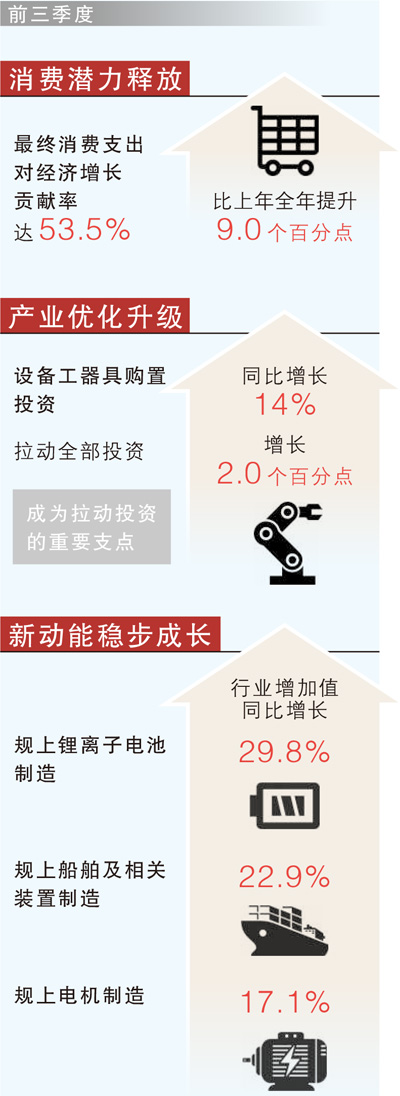
Core Insights - The data released by the National Bureau of Statistics indicates significant growth in specific manufacturing sectors, with lithium-ion battery manufacturing, shipbuilding, and electric motor manufacturing increasing by 29.8%, 22.9%, and 17.1% respectively, all surpassing the overall industrial growth rate of 6.2% [1][2] Group 1: Policy and Innovation - The combination of policy support and technological innovation is strengthening the foundation for development, with policies promoting smart and green manufacturing driving production expansion and technological iteration [2] - The high growth in lithium-ion battery manufacturing is attributed to technological breakthroughs in energy density improvement and cost reduction, showcasing the impact of innovation on green technology applications [2] Group 2: Global Green Demand - The global shift towards green technologies is creating robust demand, particularly in the lithium battery sector, where the sales of new energy vehicles reached 11.228 million units, a year-on-year increase of 34.9%, and energy storage battery shipments reached 430 GWh, growing over 30% [4] - China's exports of new energy vehicles reached 1.758 million units from January to September, marking an 89.4% increase, highlighting the competitive edge of Chinese green products in international markets [4] Group 3: Industry Collaboration - The three highlighted industries are not developing in isolation but are creating a synergistic effect within the green industrial chain, with lithium battery technology enabling the electrification of ships and electric motor efficiency improvements aiding battery energy savings [5] - The collaborative model across the lithium battery, shipbuilding, and electric motor sectors is transforming scattered resources into concentrated advantages, facilitating systemic breakthroughs in technology and efficiency [5]
前三季度GDP增长5.2%,这“稳稳的幸福”来之不易
Sou Hu Cai Jing· 2025-10-21 11:38
Economic Performance - In the first three quarters, China's GDP reached 101.5 trillion yuan, with a year-on-year growth of 5.2% [1] - This growth rate positions China among the top economies globally, with the economic total in Q3 reaching 35.5 trillion yuan, surpassing the projected total for the third-largest economy in 2024 [1] Industrial Growth - Significant growth in new industries and technologies is evident, with industrial robots, service robots, and high-speed trains seeing production increases of 29.8%, 16.3%, and 8.6% respectively [2] - The manufacturing value added in lithium-ion battery production, shipbuilding, and motor manufacturing grew by 29.8%, 22.9%, and 17.1% respectively, indicating a robust transformation towards new production capabilities [2] Consumer Spending - Final consumption expenditure contributed 53.5% to economic growth, an increase of 9.0 percentage points compared to the previous year [2] - The implementation of a long-term special government bond policy supporting the replacement of old consumer goods has shown effectiveness, with over 8.3 million applications for vehicle replacements by September 10 [2] Green Transition - The production of new energy products such as electric vehicles and solar batteries has seen substantial growth, with increases of 29.7%, 46.9%, and 14.0% respectively [3] - The growth in wind and solar power generation also reflects a strong commitment to green transformation, with both sectors achieving double-digit growth [3] Economic Indicators - Positive indicators are accumulating, with the manufacturing purchasing managers' index rising for two consecutive months as of September [3] - The domestic travel during the Mid-Autumn and National Day holidays reached 888 million trips, indicating strong consumer engagement and activity [3]
透过“三季报”看中国经济稳步前行
Ren Min Ri Bao· 2025-10-21 06:28
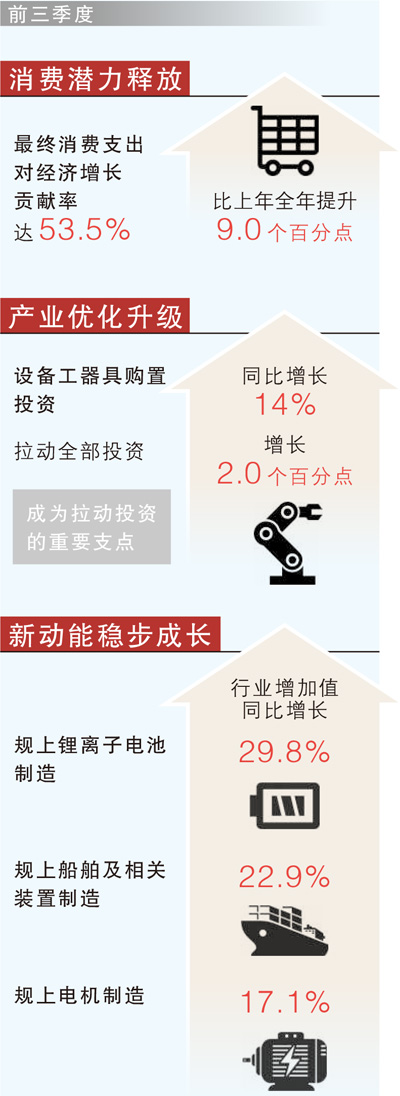
Economic Overview - The GDP growth for the first three quarters is 5.2%, with a third-quarter growth of 4.8%, indicating a stable economic performance [3][4][9] - The economic increment reached 39,679 billion, which is an increase of 1,368 billion year-on-year [4] - The average urban unemployment rate for the first three quarters is 5.2%, remaining stable compared to the first half of the year [4][10] Consumption and Investment - Final consumption expenditure contributed 53.5% to economic growth, an increase of 9.0 percentage points compared to the previous year [6][7] - Investment in equipment and tools increased by 14%, contributing 2.0 percentage points to overall investment growth [7][8] Industry Performance - The added value of the lithium-ion battery manufacturing industry grew by 29.8%, while shipbuilding and related equipment manufacturing increased by 22.9%, and motor manufacturing rose by 17.1% [8] - The proportion of added value from equipment manufacturing and high-tech manufacturing reached 35.9% and 16.7% respectively [5] Trade and International Relations - The total import and export volume increased by 6.0% year-on-year, with foreign exchange reserves maintaining above 3.3 trillion USD [10] - The resilience of foreign trade is highlighted by the historical high in goods import and export scale [4][10] Policy Impact - Macro policies have been effectively implemented to stabilize the economy and support long-term development [6][11] - The government has issued 300 billion yuan in special bonds to stimulate consumer demand through trade-in programs [6][7]
经济新方位丨透过“三季报”看中国经济稳步前行
Ren Min Ri Bao· 2025-10-21 02:24
Core Viewpoint - The national economy shows a steady growth trend with a GDP growth of 5.2% year-on-year in the first three quarters of 2023, indicating resilience and progress despite external challenges [1][3][6]. Economic Performance - GDP growth reached 5.2% year-on-year, with an increase of 39679 billion yuan, which is 1368 billion yuan more than the previous year [3]. - The urban unemployment rate remained stable at 5.2%, while the Consumer Price Index (CPI) slightly decreased by 0.1% year-on-year, with core CPI rising by 0.6% [3]. - External trade showed strong resilience, with import and export volumes reaching historical highs, and foreign exchange reserves maintained above 3.3 trillion USD [3][11]. High-Quality Development - The share of high-tech manufacturing and equipment manufacturing in industrial value added reached 16.7% and 35.9%, respectively [5]. - Non-fossil energy consumption increased by approximately 1.7 percentage points year-on-year, indicating progress in green and low-carbon transformation [5]. - The per capita disposable income of residents grew in line with economic growth, and the income gap between urban and rural residents continued to narrow [5]. Economic Resilience - Despite external pressures and domestic demand challenges, the economy grew by 5.2%, ranking among the top in major economies [6][10]. - The economic structure is undergoing adjustments, and the overall development trend remains stable and progressive [6][12]. Policy Impact - Macro policies have been effectively implemented to stabilize the economy and support long-term growth [7]. - Consumer spending contributed 53.5% to economic growth, with significant increases in retail sales of household appliances and vehicles [7][8]. - Investment in equipment and tools rose by 14.0%, significantly contributing to overall investment growth [8]. Future Outlook - The third quarter GDP growth of 4.8% remains higher than most major economies, with a total economic output of 35.5 trillion yuan [10][11]. - The manufacturing sector shows signs of recovery, with the Purchasing Managers' Index (PMI) indicating improved supplier delivery times [9][11]. - Positive factors are accumulating, with increased domestic travel and consumer activity during holidays, reflecting economic vitality [11].
国家统计局:2025年前三季度规模以上锂离子电池制造行业增加值同比增长29.8%
Guo Jia Tong Ji Ju· 2025-10-21 01:53
Economic Overview - The GDP growth for the first three quarters of 2023 was 5.2%, an increase of 0.2 and 0.4 percentage points compared to the previous year and the same period last year, respectively, with an economic increment of 39,679 billion yuan, which is 1,368 billion yuan more year-on-year [2][6] - The urban unemployment rate averaged 5.2% in the first three quarters, remaining stable compared to the first half of the year, while the Consumer Price Index (CPI) slightly decreased by 0.1% year-on-year, but the core CPI, excluding food and energy, rose by 0.6% [2][7] Industry Performance - The manufacturing value added of lithium-ion batteries, shipbuilding and related equipment, and electric motors increased by 29.8%, 22.9%, and 17.1% year-on-year, respectively [11] - The production of new energy vehicles, electric bicycles, and tablet computers grew by 29.7%, 27.1%, and 9.5%, respectively [11] - The production of wind and solar power saw double-digit growth year-on-year in the first three quarters [11][15] High-Quality Development - The proportion of value added from equipment manufacturing and high-tech manufacturing reached 35.9% and 16.7% of the total industrial value added, respectively [3] - Non-fossil energy consumption accounted for approximately 1.7 percentage points more of the total energy consumption compared to the previous year [3] New Energy and Technology - The production of lithium-ion power batteries for automobiles increased by 46.9% year-on-year [15] - The production of solar batteries grew by 14.0% year-on-year [15] Policy Impact - The implementation of macroeconomic policies has effectively supported economic stability, with a focus on expanding domestic demand and enhancing market vitality [10][12] - The final consumption expenditure contributed 53.5% to economic growth in the first three quarters, an increase of 9.0 percentage points compared to the previous year [10] Innovation and R&D - R&D expenditure increased by 8.9% compared to the previous year, with a notable rise in the number of R&D personnel [13][17] - The value added of high-tech manufacturing increased by 9.6% year-on-year, with significant growth in integrated circuit manufacturing and electronic materials [14] Green Development - The production of renewable energy products, including new energy vehicles and solar batteries, showed significant growth, with new energy vehicle production increasing by 29.7% [15][20] - The comprehensive utilization of waste resources increased by 14.4% in the first three quarters [15]
经济观察丨中国经济稳定增长护航民生基本盘
Zhong Guo Xin Wen Wang· 2025-10-21 01:39
Economic Growth and Employment - China's GDP grew by 5.2% year-on-year in the first three quarters, accelerating by 0.2 and 0.4 percentage points compared to the previous year and the same period last year respectively, providing a solid foundation for employment and income stability [1] - The average urban unemployment rate from January to September was 5.2%, with quarterly averages of 5.3%, 5.0%, and 5.2%, showing overall stability in the employment situation [1] - Economic growth serves as a "ballast" and "stabilizer" for the job market, encouraging businesses to invest and expand, thus creating more job opportunities [1] Policy Support and Employment Measures - China has implemented targeted support measures for key employment groups, including special subsidies and expanded employment channels, aiming to deliver policy benefits to those in need [2] - The country is actively guiding and supporting the development of industries related to new productive forces, such as high-tech manufacturing, digital economy, and green industries, to create new employment opportunities [2] Resident Income and Consumption - The per capita disposable income of residents reached 32,509 yuan, a nominal increase of 5.1% year-on-year, with a real growth of 5.2% after adjusting for price factors, aligning with economic growth [3] - The ratio of urban to rural residents' disposable income decreased from 2.46 to 2.43, indicating a slight improvement in income distribution [3] - The increase in wage income, net operating income, and net transfer income are the main factors supporting the growth of residents' income [3] Price Trends and Market Signals - The Consumer Price Index (CPI) slightly decreased by 0.1% year-on-year in the first three quarters, while the core CPI, excluding food and energy, rose by 0.6%, indicating the effectiveness of policies aimed at expanding domestic demand and promoting consumption [4] - The Producer Price Index (PPI) fell by 2.8% year-on-year, with a narrower decline of 2.9% in the third quarter compared to the second quarter, reflecting an improvement in domestic market competition and price recovery in certain industries [4]
核心CPI持续回升
Sou Hu Cai Jing· 2025-10-20 22:53
Group 1 - Consumer prices remain stable, with core CPI showing a continuous rebound. In the first three quarters, the overall consumer price index (CPI) decreased by 0.1% year-on-year, while the core CPI, excluding food and energy, rose to 1% in September, marking the highest level in nearly 19 months. The core CPI increased by 0.6% year-on-year, an expansion of 0.2 percentage points compared to the first half of the year [2] - Food prices saw a larger decline, with a year-on-year decrease of 1.8% in the first three quarters, which impacted the CPI by approximately 0.32 percentage points. Energy prices also remained low, with a 3.3% year-on-year decline, affecting the CPI by about 0.25 percentage points [2] Group 2 - The Producer Price Index (PPI) decreased by 2.8% year-on-year in the first three quarters, with a smaller decline of 2.9% in the third quarter compared to a 3.2% drop in the second quarter. The PPI's year-on-year decline narrowed in August and September due to improved market competition and the ongoing construction of a unified national market [3] - Certain industries experienced a reduction in price declines, with the prices of photovoltaic equipment, lithium-ion batteries, and new energy vehicles decreasing by 11.4%, 5.1%, and 1.2% respectively, but with a narrowing of declines compared to the first half of the year [3] Group 3 - High-tech industries are witnessing price increases driven by macro policies and the development of new productive forces. The prices of integrated circuit packaging and testing rose by 3.0% year-on-year, while the prices of arts and crafts manufacturing surged by 12.7% due to the release of upgraded consumer demand [4]
透过“三季报”看中国经济稳步前行(经济新方位)
Ren Min Ri Bao· 2025-10-20 22:10
Economic Overview - The GDP growth for the first three quarters is 5.2%, with a 4.8% growth in the third quarter, indicating a stable economic performance [4][10] - The economic increment reached ¥39,679 billion, which is an increase of ¥1,368 billion year-on-year [5] - The average urban unemployment rate for the first three quarters is 5.2%, remaining stable compared to the first half of the year [5][10] Consumption and Investment - Final consumption expenditure contributed 53.5% to economic growth, an increase of 9.0 percentage points compared to the previous year [7][8] - Investment in equipment and tools increased by 14%, contributing 2.0 percentage points to overall investment growth [7][8] - The retail sales of household appliances and audio-visual equipment, cultural office supplies, furniture, and communication equipment all maintained double-digit growth [8] Industry Performance - The added value of the lithium-ion battery manufacturing industry grew by 29.8%, while shipbuilding and related equipment manufacturing increased by 22.9% [8] - The high-tech manufacturing sector's added value accounted for 16.7% of the total industrial added value, indicating a shift towards high-quality development [6][11] - The production of new energy vehicles and electric bicycles saw significant increases of 29.7% and 27.1%, respectively [8] Trade and International Relations - The total import and export volume increased by 6.0% year-on-year, showcasing strong resilience in foreign trade [11] - Foreign exchange reserves remained above $3.3 trillion, with the RMB exchange rate showing stability [5][11] Policy Impact - The implementation of macroeconomic policies has effectively supported current economic stability and long-term growth potential [7][12] - The government has allocated ¥300 billion in special long-term bonds to stimulate consumer demand through trade-in programs [7][8] - The manufacturing purchasing managers' index (PMI) has shown signs of recovery, indicating improved market conditions [9][11]