
Securities

Search documents
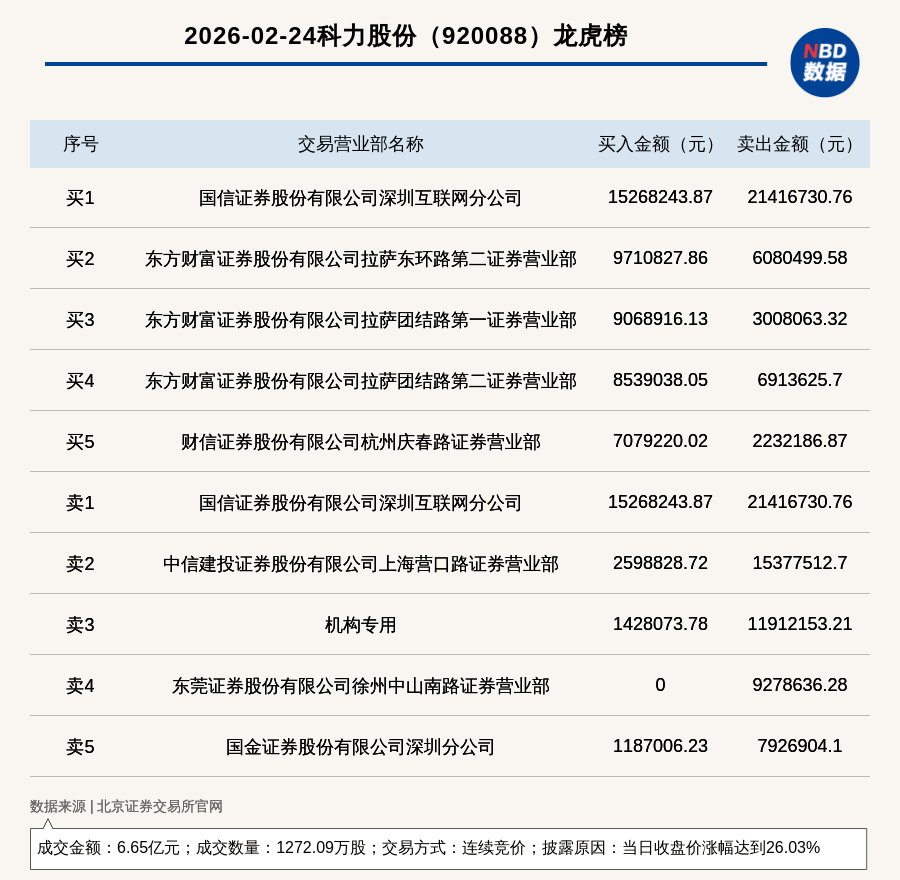
机构席位卖出1191.22万 北交所上市公司科力股份登龙虎榜
Sou Hu Cai Jing· 2026-02-24 09:07
Core Viewpoint - Keli Co., Ltd. (stock code: 920088) experienced a significant stock price increase of 26.03% on February 24, 2026, closing at 54.61 yuan, with a trading volume of 12.72 million shares and a total transaction value of 665 million yuan [1]. Trading Activity Summary - The top buyer was Guosen Securities Co., Ltd. Shenzhen Internet Branch, purchasing shares worth approximately 15.27 million yuan [2]. - The top seller was also Guosen Securities Co., Ltd. Shenzhen Internet Branch, selling shares worth approximately 21.42 million yuan [2]. - Other notable trading activities included purchases from Dongfang Caifu Securities and sales from various branches of Guosen and CITIC Jianzhong Securities [2].

一周流动性观察 | 节后超2.7万亿元资金回笼 央行大概率呵护流动性边际宽松
Xin Hua Cai Jing· 2026-02-24 07:19
Core Viewpoint - The People's Bank of China (PBOC) is actively managing liquidity in the market through various monetary policy tools, particularly focusing on reverse repos to ensure stability during the post-Spring Festival period [1][2][3]. Group 1: Monetary Policy Operations - On February 24, the PBOC conducted a 7-day reverse repo operation of 526 billion yuan, resulting in a net withdrawal of 926.4 billion yuan from the market due to the maturity of previous reverse repos [1]. - In the week leading up to the Spring Festival, the PBOC injected a total of 1.25 trillion yuan in short-term funds through reverse repos, effectively addressing liquidity needs during the holiday [1]. - The PBOC's actions included an excess rollover of 500 billion yuan in 6-month reverse repos and a net injection of 100 billion yuan in 3-month reverse repos, cumulatively releasing 600 billion yuan in medium to long-term funds in February [1]. Group 2: Market Liquidity and Interest Rates - Despite the seasonal demand for cash and over 700 billion yuan in government debt repayments, the pressure on liquidity was manageable, with overnight rates peaking at 1.46% and 7-day rates not exceeding 1.60% [1][2]. - Analysts expect that post-holiday liquidity will generally ease, with a significant drop in 7-day funding rates anticipated, although the upcoming tax payments and large reverse repo maturities may limit the extent of this decline [2][3]. - The PBOC is expected to maintain a supportive stance on liquidity, with forecasts suggesting that overnight rates may settle between 1.35% and 1.45% and 7-day rates between 1.50% and 1.60% [2]. Group 3: Economic Indicators and Future Outlook - The PBOC's recent monetary policy report indicates a commitment to maintaining ample liquidity, with social financing growing by 8.2% year-on-year and M2 increasing by 9%, both outpacing nominal GDP growth [3][4]. - There is a consensus among analysts that the PBOC will likely continue to adopt a loose monetary policy environment, especially in light of weak credit demand and the need to support economic growth [4].
2025年上海地区证券投顾机构现场检查通报来了!内控合规等七大问题待解
Bei Jing Shang Bao· 2026-02-24 02:31
北京商报讯(记者 李海媛)2月24日,上海市证券同业公会(以下简称"公会")发布2025年上海地区投 资咨询机构自律规范现场检查情况的通报。据悉,公会分别于2025年4月和11月对上海地区部分投资咨 询类机构开展了自律规范执行情况现场检查。 在内控制度与合规管理方面的问题,检查发现,被检查机构未健全内控制度、制度实际执行力和合规意 识较为薄弱,在业务开展过程中未切实做好合规管理。例如,合规人员占比普遍存在不足,个别机构合 规人员仅占员工总数的1.9%;投顾人员与客户数量配置严重失衡,个别机构最低投顾人员与客户占比 为11.4%,个别机构平均每人服务客户高达2383人;对从业人员合规培训频次不足、内容与实际业务结 合不紧密,影响培训效果。 在投资者适当性管理方面的问题,检查发现,被检查机构的适当性管理制度和培训不完善。例如,未制 定适当性管理制度;未对在售产品进行分类分级管理;未对产品或者服务进行风险等级评估,确定其风 险等级;未对适当性管理制度的执行情况进行定期自查;部分客户存在同一自然日多次进行风险测评修 改,以达到特定风险测评等级。 在客户投诉管理方面的问题,检查发现,部分被检查机构客户投诉率较高,有的机 ...
A股开盘集体大涨,三大指数均涨超1%
Feng Huang Wang Cai Jing· 2026-02-24 01:39
Group 1 - A-shares opened higher with the Shanghai Composite Index rising by 1.15%, the Shenzhen Component Index by 1.52%, and the ChiNext Index by 1.7%, driven by gains in sectors such as non-ferrous metals, oil and gas, and computing power [1] Group 2 - Industry outlook remains positive post-holiday, with expectations for a new upward trend in A-shares supported by the resolution of overseas risks and domestic macroeconomic catalysts [2] - The technology growth style is anticipated to rebound as concerns over AI giants' performance ease, and catalysts from robotics and large models emerge [3] Group 3 - The focus on global physical assets is shifting from AI-driven investments to broader industrial sectors, with a favorable environment for the recovery of the global manufacturing cycle due to a smoother path for U.S. interest rate cuts [4] - Key sectors include copper, aluminum, oil, and various manufacturing segments such as electrical equipment, energy storage, and petrochemicals, which are expected to benefit from returning capital and easing pressures [4]
1月金融数据整体向好,宽信用政策效果持续显现
Sou Hu Cai Jing· 2026-02-24 00:30
Group 1 - The core viewpoint of the articles indicates that the financial data for January 2026 shows a stable and slightly better-than-expected performance, driven by a moderately loose monetary policy, concentrated credit issuance at the beginning of the year, and increased fiscal spending [1][2] - The social financing scale increased by 7.22 trillion yuan in January 2026, which is 1.662 trillion yuan more than the same period last year, marking a new high for the same period [1] - The total social financing stock reached 449.11 trillion yuan at the end of January, reflecting a year-on-year growth of 8.2%, indicating sustained support for the real economy from wide credit policies [1] Group 2 - M2 money supply grew by 9.0% year-on-year, with a 0.5 percentage point increase from the previous month, indicating reasonable liquidity [2] - M1 increased by 4.9% year-on-year, showing a significant rebound, and the M2-M1 spread narrowed to 4.1 percentage points, reflecting improved business activity and liquidity [2] - The financial data for January is expected to boost market risk appetite, benefiting sectors such as finance, cyclical, and growth, with banks and brokerages gaining from credit recovery and stable interest margins [2]
Japanese securities giant to issue $65 million worth of XRP-paying blockchain bonds
Yahoo Finance· 2026-02-22 11:01
Group 1: Company Developments - SBI Holdings plans to issue approximately $65 million worth of onchain bonds, with a fixed interest rate between 1.85% and 2.45%, maturing in early 2029 [1] - The bonds will provide owners with $1.29 worth of XRP for every $645 worth of bonds owned, targeting retail investors [1][4] - SBI's CEO Yoshitaka Kitao confirmed a 9% stake in Ripple Labs, while dismissing claims of holding $10 billion worth of XRP [4] Group 2: Market Trends - Ripple and consulting firms like Boston Consulting Group predict "exponential" mid-term growth in tokenised financial products, potentially reaching a market size of $68 trillion by 2030 [2] - Major financial firms in Japan, including Mitsubishi UFJ Financial Group and Nomura, are entering the tokenised securities market, with Nomura having announced a $52 million securities token issuance [3] - Global tokenisation efforts are also seen in Europe and the US, with firms like BlackRock and Franklin Templeton utilizing blockchain networks for tokenisation [7] Group 3: Technological Integration - SBI's new bond issuance will utilize the ibet for Fin platform developed by blockchain startup Boostry, which also provided services for Nomura's token offerings [5][6] - Only account holders at SBI's crypto exchange subsidiary, SBI VC Trade, will qualify for the XRP rewards program associated with the bond issuance [6]
The SEC Just Opened the Door for Stablecoin Adoption
Yahoo Finance· 2026-02-20 20:27
Core Viewpoint - The SEC has made a significant regulatory shift regarding stablecoins, allowing broker-dealers to apply a 2% haircut on proprietary positions in payment stablecoins, which is a major change from the previous 100% haircut policy [2][3][6]. Regulatory Changes - The SEC's new guidance indicates that it will "not object" to a 2% haircut on stablecoins, which is a substantial reduction from the previous treatment of stablecoins as speculative assets with a 100% haircut [3][6]. - The SEC emphasized that a 100% haircut was "unnecessarily punitive" given the underlying reserve assets backing payment stablecoins, such as U.S. dollars and short-term Treasuries [4][5]. Impact on Broker-Dealers - The change from a 100% to a 2% haircut allows stablecoins like USDC to be treated as a gold standard for regulation, significantly improving their capital treatment for broker-dealers [7]. - For example, if a broker-dealer holds $10 million in stablecoins, only $200,000 would be deducted, allowing $9.8 million to count as valid capital, akin to cash treatment [7]. Future Implications - This regulatory shift signals that the CLARITY Act, aimed at establishing a regulatory framework for digital assets like stablecoins, is likely to be voted on soon [8].
US Treasury Department offers secure AI advice to financial services firms
Yahoo Finance· 2026-02-20 10:59
This story was originally published on Cybersecurity Dive. To receive daily news and insights, subscribe to our free daily Cybersecurity Dive newsletter. The U.S. Treasury Department has begun releasing guidance meant to help financial services companies securely use artificial intelligence while adhering to regulatory obligations. “Treasury will release a series of six resources developed in partnership with industry and federal and state regulatory partners to enable secure and resilient AI across the U ...
抓50万亿存款到期机遇 多家券商加速推进应对方案
智通财经网· 2026-02-20 07:26
Core Insights - The impending maturity of over 50 trillion yuan in fixed-term deposits presents a significant opportunity for brokerage firms to capture this wealth through innovative financial products and services [1] - Brokerages are actively developing strategies to address the expected influx of funds from depositors seeking better returns in a declining interest rate environment, with a focus on wealth management solutions [1] Group 1: Strategies for Wealth Management - Brokerages are prioritizing "fixed income +" as a core strategy to attract maturing deposits, creating a diversified product matrix that caters to various risk appetites and investment horizons [2][3] - Companies like Shanxi Securities are innovating wealth management solutions inspired by insurance models, offering products that combine fixed returns with periodic dividends to align with customer preferences for stability [2] - Other firms, such as Western Securities, are focusing on low-risk investment products to meet the demand for stable returns, creating a "combination fortress" of investment options [3] Group 2: Enhanced Advisory Services - Brokerages are upgrading their advisory capabilities, transitioning from traditional sales to a buyer's advisory model, enhancing service quality through specialized teams and tailored solutions [5][6] - Galaxy Securities has developed a comprehensive advisory service system, targeting different customer segments with personalized investment strategies [5] - Western Securities emphasizes a "principal service" model, providing diversified investment solutions through a team of selected advisors [5] Group 3: Technology-Driven Solutions - Brokerages are leveraging technology to create a full lifecycle service model, offering integrated support from pre-investment to post-investment phases [7][8] - Companies like Galaxy Securities are utilizing digital tools to enhance customer experience and streamline service delivery, ensuring a seamless interaction between online and offline channels [7] - Eastern Wu Securities is building a collaborative ecosystem with banks and insurance firms to provide comprehensive wealth management services [8] Group 4: Regional Focus and Differentiation - Some brokerages are adopting a regional focus to build specialized service capabilities, particularly in high-net-worth client segments [9][10] - Eastern Wu Securities is concentrating on the Yangtze River Delta region, particularly Suzhou, to develop a professional service ecosystem tailored to local economic strengths [9] - Galaxy Securities is creating scenario-based wealth management solutions to address specific client needs, enhancing the personalization of their services [10]
AI-Driven Filings, Opt-In Momentum, And More Than $4B in Recoveries Reshape Global Securities Class Actions, Broadridge Report Finds
Prnewswire· 2026-02-19 12:00
Core Insights - Global securities class action litigation resulted in over $4 billion in investor recoveries in 2025, a decrease from $5.2 billion in 2024, but still indicative of a robust recovery environment amid market volatility [1] - The report highlights a significant increase in AI-related litigation, a rise in opt-in and collective actions, and a focus on ESG claims, reflecting a rapidly changing landscape for institutional investors [1] Group 1: Recovery Trends - SPAC-related settlements accounted for a significant portion of total recoveries, despite a broader range of new case filings [1] - Federal securities filings in the U.S. slightly decreased to 205 cases in 2025, just 3% below the four-year rolling average, indicating stability in enforcement activity [1] - Financial antitrust activity saw a decline, with only four settlements totaling $179 million, down from nine settlements the previous year [1] Group 2: Class Action Dynamics - Broker-dealers are increasingly providing end-to-end claim-filing and asset recovery services, addressing low participation rates among retail shareholders [1] - ESG-related litigation continued to grow, driven by projected ESG investments reaching $30 trillion by 2030 and increased use of class actions for governance and sustainability [1] - Interest in opt-in litigation surged, with over 100 collective redress claims filed in Europe and many more globally in 2025 [1] Group 3: Notable Cases - The report identifies the top 10 most complex class action settlements of 2025, including: 1. Alibaba Group Holding Ltd. Securities Litigation - $433.5 million 2. Grab Holdings Ltd. Securities Litigation - $80 million 3. Viacom Archegos Securities Litigation - $120 million 4. BCS PLC Securities Litigation and Fair Fund - $219.5 million (combined) 5. British American Tobacco Opt-in Litigation - Pending 6. Interest Rate Swaps Antitrust Litigation - $71 million 7. Alta Mesa Resources Inc. Securities Litigation - $126.3 million 8. BHP Group Ltd. Securities Litigation - AUD $110 million 9. Turquoise Hill Resources Ltd. Securities Litigation - $138.75 million 10. EQT Corporation Securities Litigation - $167.5 million [1]

