游戏

Search documents
2025年Q3中国移动互联网流量季度报告
艾瑞咨询· 2026-01-18 00:06
Core Insights - The report indicates a slight growth in mobile internet traffic in Q3 2025, with user behavior shifting towards low-frequency deep usage. Monthly active devices reached 1.452 billion, a 0.83% increase from Q2 2025. Daily usage frequency decreased by 2.9% to 59.8 times, while usage duration increased by 2.3% to 282.9 minutes, indicating deeper user engagement [1][2][6]. User Changes - The proportion of unmarried users increased to 32.7%, up 1.39% year-on-year, with growth driven by the unmarried demographic in mid-to-high tier cities. Users aged 35 and below accounted for 49.1% of the total, with a 4.2% increase in users from second-tier cities and above [2][8]. - User preferences vary significantly by age, with younger users (post-2000s) favoring gaming and entertainment, while those aged 25-30 lean towards parenting and family content [2][16]. Industry Changes - The food delivery sector saw a temporary surge in traffic due to intense competition among major players, but growth momentum has weakened post-surge. The travel sector continues to show strong demand, with a 15% year-on-year increase in usage duration [3][61]. - Artificial intelligence applications are experiencing rapid growth, with monthly active users reaching 470 million and a year-on-year increase of 321% in user scale, reflecting high market demand and acceptance [3][37]. - The gaming service sector is facing overall decline, with intensified competition among existing players, although MOBA and shooting games are experiencing growth [4][76]. APP Changes - In September 2025, the top three apps with over 100 million monthly active users were Railway 12306, Doubao, and Quanmin K Ge, while the top three apps with over 50 million monthly active users included Tencent Yuanbao, Soda Music, and Zhuanzhuan [5][81][82].


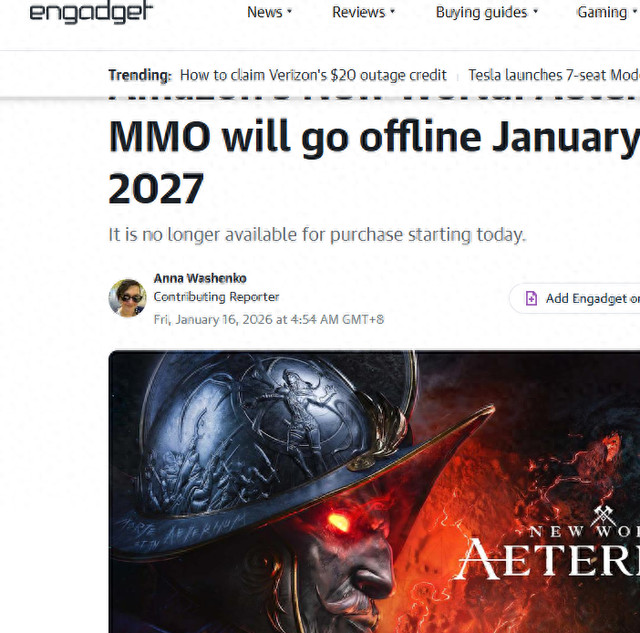
从巅峰5万玩家到黯然停服,亚马逊旗下《新世界:永恒》即将谢幕
Huan Qiu Wang· 2026-01-17 10:48
Core Insights - Amazon's classic MMO "New World: Eternal" will be officially discontinued, with servers shutting down on January 31, 2027, allowing players a year to say goodbye [1][3] - The game, launched in 2020, initially attracted over 51,000 peak concurrent players but saw a significant decline to around 1,200 daily players due to lack of innovation and content updates [3] Group 1 - The game will be removed from sale immediately, and new players will no longer be able to purchase it [1] - Existing players can continue to play until the server closure date, with in-game purchases being disabled by July 20, 2026 [3] - Refund options will be available for recent purchasers who were unaware of the impending shutdown [3] Group 2 - Amazon had previously adjusted its game development strategy in October 2022, ceasing new content updates for "New World: Eternal," leading to speculation about its closure [3] - The game was initially seen as a significant step for Amazon into the AAA gaming sector, but ultimately could not sustain its player base [3]


微信小游戏生态日益成熟 开发者数量超40万
Zhong Guo Jing Ji Wang· 2026-01-17 03:48
Group 1 - The core viewpoint of the articles highlights the rapid growth and significant user engagement of WeChat mini-games, with monthly active users reaching 300 million for IAP mini-games and 400 million for IAA mini-games [1] - The developer ecosystem for WeChat mini-games has surpassed 400,000 developers, with over 5,000 developers publishing their first works on the platform in 2025 [1] - The mini-game ecosystem is becoming a new fertile ground for IP value derivation, with 70 mini-games achieving daily active users in the millions and over 300 games generating quarterly revenues exceeding 10 million [1] Group 2 - 80% of the developers on the WeChat mini-game platform are teams of 30 or fewer members, allowing smaller teams to find opportunities in a market dominated by larger investments [2] - The introduction of a new incentive policy for IAP mini-games, increasing the maximum incentive for newly launched games to 4 million, is a key driver for the growth of the mini-game ecosystem [2] - The revenue-sharing model has been adjusted, with developers receiving an additional 15% discount on top of the 70% revenue share, enhancing financial support for smaller teams [2] Group 3 - The contribution of mini-games to Tencent's financial performance is evident, with growth in video account live service revenue and mini-game platform service fees contributing to a 5% increase in social network revenue in Tencent's Q3 2025 financial report [3] Group 4 - The "going global" strategy for mini-games is accelerating, with the PC segment becoming the fastest-growing area, showing a 30% increase in active users and a 35% increase in in-game purchases in 2025 [4] - WeChat mini-games will launch a high-performance mode for PC mini-games in 2026, supporting higher quality art resources and larger game content [4] - AI technology is being integrated into the mini-game ecosystem, with a new initiative providing developers with cloud development resources, AI computing power, data analysis, and advertising monetization support [4] Group 5 - The changes in the mini-game landscape indicate a shift towards quality, long-term operation, and intelligent development, suggesting that the industry is maturing and will focus on comprehensive operational capabilities [5]

沐瞳科技深化泰国市场布局,2026年全面赋能创作者社区与电竞生态
Xin Lang Cai Jing· 2026-01-17 01:16
Core Insights - The core focus of the article is the strategic expansion of Mu Tong Technology's flagship game, Mobile Legends: Bang Bang (MLBB), into the Thai market through localized operations and community engagement, aiming to enhance the growth of the esports sector in Thailand [1][4]. Group 1: Market Strategy - Mu Tong Technology plans to fully upgrade its market strategy in Thailand by implementing deep localization, empowering creator communities, and building an esports ecosystem [1][4]. - The company has established a long-term partnership with influential figure GuyNgid, who has over 9 million followers on social media, to enhance game promotion and content development [3][4]. - A budget of over 20 million Thai Baht will be allocated to support local creators through competitions and social media initiatives [3][4]. Group 2: Esports Ecosystem Development - The launch of the MLBB Thailand Super League (MSL Thailand) is a key component of the strategy, aiming to reintegrate Thailand into the global MLBB esports ecosystem [4][5]. - The inaugural season of the Thailand Super League will feature eight top local teams, enhancing the competitive landscape and nurturing local talent [4][7]. - The initiative is expected to strengthen the training system for local esports talent, paving the way for the next generation of players to compete on the international stage [5][7]. Group 3: Industry Context - Thailand is recognized as one of the most mature esports markets in Southeast Asia, having hosted several international esports events [5]. - MLBB has been a consistent gold medal event in the Southeast Asian Games for four consecutive editions, highlighting its significance in the region [5]. - Mu Tong Technology's efforts in Thailand represent a broader trend of Chinese gaming companies expanding their global footprint through localized operations [7].

游戏厂商争先布局UGC 能否打造中国版“Roblox”?
Xin Lang Cai Jing· 2026-01-16 20:08
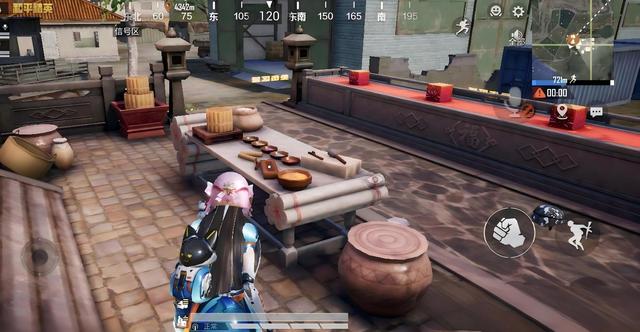
Core Insights - The article discusses the growing trend of User-Generated Content (UGC) in high Daily Active User (DAU) games, allowing players to create and share their own game content, which helps alleviate development pressures and enhances social engagement [2][6][10] Group 1: UGC Implementation in Games - Major DAU games are adopting UGC models to distribute development tasks to players, enabling them to create diverse gameplay experiences and address content development bottlenecks [2][6] - "Genshin Impact" launched its UGC mode "Thousand Star Realm" in October 2025, attracting over 30,000 creators and generating over 150 million total play sessions by January 3, 2026 [3] - Tencent's "Peacekeeper Elite" introduced its UGC mode "Oasis Genesis" in 2021, achieving over 33 million daily active users by Q3 2025, with player-created content expanding beyond traditional shooting genres [3][4] Group 2: Economic Impact of UGC - "Oasis Genesis" has reportedly distributed over 100 million yuan in incentives, with revenue from top player-created content reaching 5 million yuan in a single month [4] - UGC models provide additional monetization channels beyond traditional in-game purchases, allowing creators to earn from in-game transactions while platforms benefit from increased content consumption [7] Group 3: Challenges and Opportunities - The UGC model faces challenges in China, where previous attempts like Roblox struggled due to high entry barriers for creators and a lack of supportive infrastructure [9] - However, the current landscape shows promise, with a large user base in DAU games and improved support systems for creators, indicating potential for successful UGC implementation [10] Group 4: Role of AI in UGC Development - The advancement of generative AI is expected to lower the barriers for UGC creation, enabling faster game prototype development and enhancing the creative process [10][11] - AI tools are being integrated into UGC platforms to assist in content creation, quality assessment, and gameplay enhancement, potentially transforming the complexity and variety of UGC offerings [11]


累计开发者数量超40万 微信小游戏生态日益成熟
Zheng Quan Ri Bao· 2026-01-16 16:49
Group 1 - The core viewpoint of the articles highlights the rapid growth and significant user engagement of WeChat mini-games, with monthly active users reaching 300 million for IAP mini-games and 400 million for IAA mini-games [1] - The developer ecosystem for WeChat mini-games has surpassed 400,000 developers, with over 5,000 developers publishing their first works on the platform in 2025 [1] - Mini-games are becoming a new fertile ground for IP value derivation, with 70 mini-games achieving daily active users in the millions and over 300 games generating quarterly revenues exceeding 10 million yuan [1] Group 2 - 80% of the developers on the WeChat mini-game platform are teams with fewer than 30 members, allowing smaller teams to find opportunities in a market dominated by larger investments [2] - The introduction of a new incentive policy for IAP mini-games, increasing the maximum incentive for newly launched games to 4 million yuan, is a key driver for the growth of the mini-game ecosystem [2] - The revenue-sharing model has been adjusted to provide developers with an additional 15% discount on top of the 70% revenue share, enhancing financial support for developers during the critical launch period [2] Group 3 - The contribution of mini-games to Tencent's financial performance is evident, with growth in video account live service revenue and mini-game platform service fees contributing to a 5% increase in social network revenue in Tencent's Q3 2025 financial report [3] Group 4 - The "going global" strategy for mini-games is accelerating, with low-cost, short-cycle development of light games at its core, relying on overseas traffic platforms for user acquisition [4] - The PC segment is becoming the fastest-growing area for mini-games, with a 30% increase in active users, a 35% increase in in-app purchase revenue, and a 50% increase in payment penetration rate in 2025 [4] - The integration of AI technology into the mini-game ecosystem is being supported by a new growth plan for AI applications and online tools, providing developers with comprehensive resources [4]
49.5万留学生“集体回家”!政策红利拉满!一线城市抢人、大厂开招聘专场!
Sou Hu Cai Jing· 2026-01-16 16:41
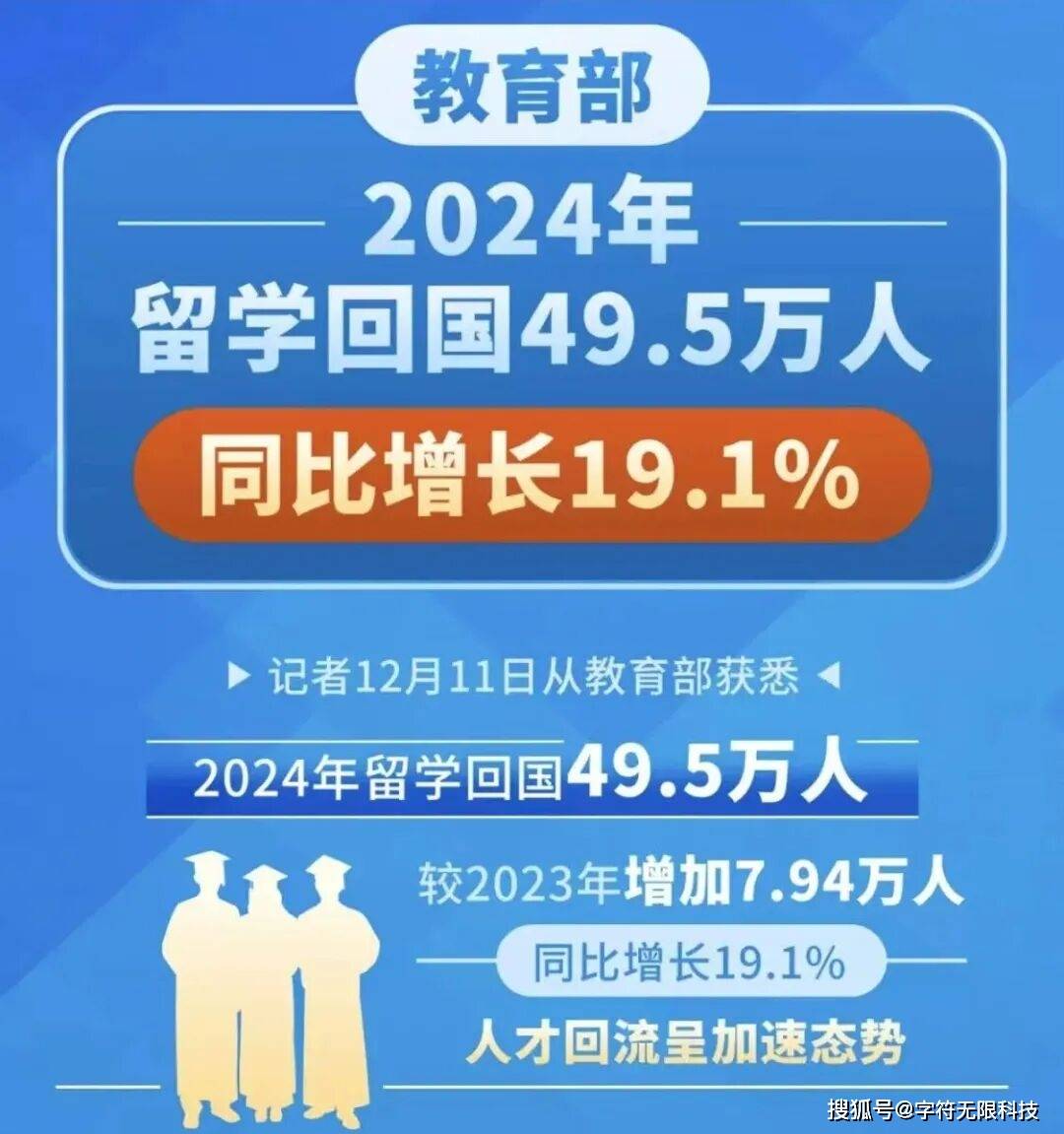
Group 1 - The core trend of returning overseas students is confirmed, with the number of returnees in 2024 reaching 495,000, an increase of 79,400 from 2023, representing a year-on-year growth of 19.1% [1] - From 1978 to 2024, a total of 8.88 million individuals have studied abroad, with 6.44 million choosing to return after completing their studies, indicating that two out of three students opt to return home [1] - The "returning heat" is not a short-term trend but a long-term phenomenon expected to continue for the next decade [1] Group 2 - The overseas job market is becoming increasingly challenging, with the H-1B visa acceptance rate in the U.S. dropping to a ten-year low of 14% in 2023, and other countries like the UK and EU tightening their immigration policies [3][5] - In contrast, domestic opportunities are growing, with the government integrating returning students into the national talent system, providing support for settlement, employment, and entrepreneurship [5][6] Group 3 - National policies are increasingly favorable towards returning students, with the Ministry of Education emphasizing their importance in the national talent pool and development strategy [6] - Major cities like Shanghai and Beijing have introduced attractive policies for returning students, including direct residency applications for graduates from top universities without social security payment requirements [9][10] Group 4 - Cities like Shenzhen are offering substantial subsidies for returning students starting businesses in strategic emerging industries, with potential grants reaching up to 1 million yuan [11][13] - Various provinces and cities are implementing their own entrepreneurial support and loan subsidy policies to attract overseas talent [13] Group 5 - Major tech companies are increasingly favoring returning students, with dedicated recruitment events for overseas graduates, allowing them to secure job offers independently from traditional recruitment processes [14][16] - Companies like Tencent, Huawei, and Alibaba are actively recruiting overseas talent, recognizing the need for interdisciplinary skills in emerging technology fields [16][18] Group 6 - The most popular fields for returning students include business and computer science, with business administration and finance being the top choices due to their promising career prospects [19][20] - The IT, internet, and gaming industries are significant employment sectors for returning talent, accounting for 15.4% of the job market for returnees [21] Group 7 - The domestic gaming market is thriving, with actual sales revenue reaching 350.79 billion yuan in 2024, a year-on-year increase of 7.68% [23] - Despite some companies closing overseas studios, the domestic gaming industry remains vibrant, with a significant demand for talent in game design and development [25][28]
恺英网络:公司积极拓展海外业务,已初步建立起一套海外发行策略
Zheng Quan Ri Bao Wang· 2026-01-16 15:14
证券日报网讯1月16日,恺英网络(002517)在互动平台回答投资者提问时表示,公司积极拓展海外业 务,已初步建立起一套海外发行策略,通过深挖核心用户,精准引流,口碑拓圈等组合推广方式,实现 公司近三年境外收入的持续增长。公司将继续贯彻IP产品战略,用IP价值赋能文化出海,持续以"优质 内容、精准营销、全球布局"为核心,不断丰富产品矩阵,做好长线发行运营。深耕中国港澳台、韩 国、东南亚等国家/地区,发力突破日本及欧美国家/地区。具体海外营业收入数据请以公司披露的定期 报告为准。 ...

知名游戏大厂,3人被刑拘
Nan Fang Du Shi Bao· 2026-01-16 15:01
Core Viewpoint - Perfect World Co., Ltd. has announced the criminal detention of three art-related personnel for corruption, primarily involving issues in art outsourcing and procurement management [1][3]. Group 1: Corruption Allegations - Three employees from the Qingyun and Lingxiao studios are implicated in corruption, with specific allegations of collusion with suppliers to inflate procurement prices and accepting bribes [1][3]. - Diao Mouqi, the art department leader for the "New Zhu Xian World" project, is accused of leveraging his position to collude with suppliers and has been dismissed with a "never to be rehired" clause [3]. - Song Mouyang and Wang Mouliang, both from Lingxiao studio, are also under investigation for similar misconduct, including the illegal outsourcing of procurement to close associates and accepting substantial bribes [3]. Group 2: Company Response and Historical Context - Perfect World has previously reported on anti-corruption efforts, with announcements in July 2025 regarding eight employees involved in collusion with suppliers, and in August 2024 regarding bribery and embezzlement by staff from the Xingyun studio [4]. - The company has stated that all relevant information is contained within the official announcement [3]. Group 3: Financial Performance and Shareholder Actions - On January 5, 2024, the actual controller of Perfect World, Chi Yufeng, reduced his shareholding by 6.86 million shares, amounting to over 100 million yuan, decreasing his ownership from 32.35% to 31.99% [5][6]. - The company has faced significant operational challenges, with a reported revenue of 5.57 billion yuan in 2024, a 28.5% decline year-on-year, and a net loss of 1.29 billion yuan compared to a profit of 490 million yuan in 2023 [7]. - However, the launch of the game "Zhu Xian World" at the end of 2024 has led to a recovery in performance, with a reported revenue of 1.73 billion yuan in Q3 2025, a 31.45% increase year-on-year, and a net profit of 162 million yuan, marking a turnaround from previous losses [7].


米哈游双公司港股上市!揭秘游戏巨头的资本版图,青岛学到什么?
Sou Hu Cai Jing· 2026-01-16 14:37
Group 1 - The core focus of the article is on miHoYo's strategic investments and its dual role as both an investor and a client in the gaming and technology sectors [2][3] - miHoYo holds 7.34% of MiniMax, an AI company that provides technology for intelligent NPCs and scene generation in games, showcasing its investment and client relationship [5] - miHoYo also owns 11.86% of Suplay, which sells merchandise related to miHoYo's IP, indicating a strategy of leveraging investments to enhance its own product distribution [5][7] Group 2 - miHoYo has expanded its investment portfolio beyond gaming, venturing into AI, XR, nuclear fusion, and brain-computer interfaces, reflecting a significant shift in its business model [7][9] - The company was founded in 2011 by Cai Haoyu and has grown to become the highest-grossing game company globally (excluding the Chinese market) by 2021, with a valuation of 1.75 trillion [9][12] - The article highlights the collaboration between miHoYo and Qingdao through the "Qingdao Tongge Phase I" fund, which focuses on investing in hard technology sectors like integrated circuits and virtual reality [12][14] Group 3 - Qingdao's VR industry has lagged behind other cities, despite its historical prominence, with only one company making it to the top 50 VR companies in 2025 [14][16] - The article suggests that Qingdao can learn from miHoYo's success by fostering professional investment institutions and attracting talent to enhance its industrial development [16][20] - It emphasizes the importance of aligning investment strategies with emerging sectors and ensuring a robust supply chain to retain businesses [22][24]