半导体制造

Search documents
安森美半导体(ON.US)Q2营收超预期但同比下滑15.5% 股价下跌近5%
智通财经网· 2025-08-04 13:35
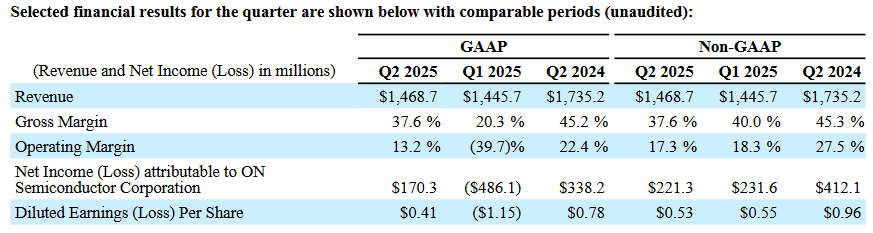
Core Viewpoint - ON Semiconductor reported Q2 revenue of $1.47 billion, exceeding market expectations but down 15.5% year-over-year. Non-GAAP adjusted earnings per share were $0.53, consistent with market expectations [1][2]. Financial Performance - Q2 2025 revenue was $1,468.7 million, compared to $1,735.2 million in Q2 2024, reflecting a 15.5% decline [2]. - Gross margin for Q2 was 37.6%, down from 45.2% in the same quarter last year [2]. - Operating margin was 13.2%, a significant drop from 22.4% year-over-year [2]. - Net income attributable to ON Semiconductor was $170.3 million, recovering from a loss of $486.1 million in Q1 2025 [2]. - Diluted earnings per share were $0.41 under GAAP and $0.53 under Non-GAAP, compared to $0.78 in Q2 2024 [2]. Future Outlook - The company expects Q3 revenue to be in the range of $1.47 billion to $1.57 billion, with earnings per share projected between $0.54 and $0.64 [3]. - CEO Hassan El-Houry stated that the ongoing transformation is leading to a more predictable business model, indicating confidence in long-term value creation and market recovery [3][4].


芯联集成:上半年实现营收34.95亿元 同比增长21.38%
Zhong Zheng Wang· 2025-08-04 12:55
Core Insights - The company reported a significant improvement in operational quality, achieving a positive net profit for the first time in a single quarter, with a net profit of 0.12 billion yuan in Q2 2023 [1] - The global semiconductor market is experiencing a "divergent recovery," with increased chip demand in sectors like electric vehicles and AI servers [1] Financial Performance - The company achieved revenue of 34.95 billion yuan in the first half of 2023, representing a year-on-year growth of 21.38% [1] - The net profit attributable to shareholders decreased by 63.82% year-on-year, indicating a reduction in losses [1] - The net cash flow from operating activities reached 9.8 billion yuan, up 77% year-on-year [1] Market Segments - Revenue from the automotive sector grew by 23% year-on-year, while the industrial control sector saw a 35% increase [1] - AI, as the company's fourth core market direction, accounted for 6% of total revenue in the first half of 2023, contributing to sustainable growth [1] Research and Development - The company maintained high R&D investment, totaling 9.64 billion yuan, which is over 10% higher than the previous year [1] - There was continued growth in the number of R&D personnel and the total number of authorized patents [1] New Projects and Client Engagement - In the electric vehicle sector, the company secured over 10 new projects for 6-inch SiC MOSFETs, with 5 automotive client projects entering mass production [2] - The company’s first domestic 8-inch SiC production line has achieved mass production, with key performance indicators leading the industry [2] - The company is expanding its automotive business from single components to chip system solutions, covering five major domains [2] Product Development - The company is optimizing its 180nm BCD platform technology to meet customer demands in audio, digital power, and protocol chips [2] - There was a 140% increase in the number of analog IC products and a 25% increase in customer numbers in the first half of 2023, successfully covering over 70% of mainstream design companies [2]

古法黄金第一股,大涨
Zhong Guo Ji Jin Bao· 2025-08-04 10:49
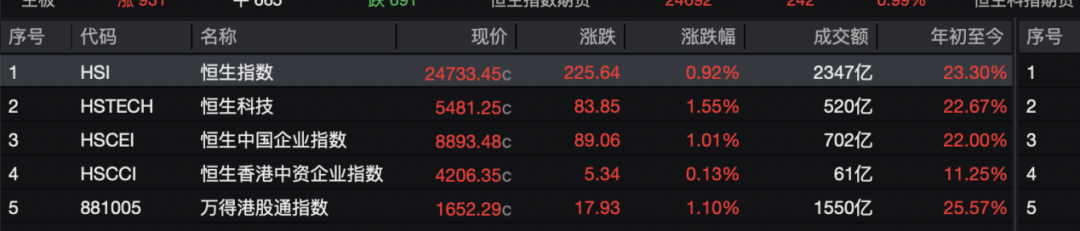
Market Overview - The Hong Kong stock market indices collectively rose on August 4, with the Hang Seng Index increasing by 0.92% to close at 24,733.45 points, the Hang Seng Tech Index rising by 1.55%, and the Hang Seng China Enterprises Index up by 1.01% [1][2] - The total market turnover for the day was HKD 234.7 billion, with a rare net outflow of southbound funds amounting to HKD 18.092 billion. Year-to-date, as of August 1, southbound funds have accumulated a net inflow of HKD 879.049 billion into Hong Kong stocks [1][2] Semiconductor Sector - In the semiconductor sector, InnoCare Technologies saw a significant increase, closing at HKD 75.15 per share with a rise of 30.47% and a trading volume of HKD 4.733 billion. The company announced a partnership with NVIDIA to promote the large-scale implementation of an 800 VDC power architecture in AI data centers [6] - Other semiconductor stocks also performed well, with Hua Hong Semiconductor rising by 8.69% and SMIC increasing by 2.90% [7] Gold Sector - The gold sector experienced a notable surge, with Lao Pu Gold rising by 6.23% to close at HKD 733.00 per share, marking a year-to-date increase of 179.85%. The demand for gold as a safe-haven asset has been driven by international uncertainties [14] - Lao Pu Gold projected a revenue of RMB 12 billion to 12.5 billion for the first half of the year, representing a year-on-year growth of 241% to 255%, and a net profit of RMB 2.23 billion to 2.28 billion, up 279% to 288% [16] - Other gold stocks also saw positive performance, with Shandong Gold rising by 10.7% and Chifeng Gold increasing by 8.89% [16] Real Estate Market - In the real estate sector, the number of property sale agreements in Hong Kong for July 2025 was reported at 7,212, a decrease of 0.8% month-on-month but an increase of 37.1% year-on-year. The total value of these agreements was HKD 54.6 billion, down 17.8% month-on-month but up 28% year-on-year [17] - Residential property agreements accounted for 5,766 of the total, with a month-on-month decrease of 3.2% but a year-on-year increase of 54.9%. The total value of residential agreements was HKD 46.4 billion, down 24.1% month-on-month but up 29.9% year-on-year [17] Company-Specific Movements - Zhongke Biological experienced a dramatic increase of 47.76%, closing at HKD 0.99 per share. There are expectations that it may be included in certain indices, which could drive passive fund allocation [8][10] - Conversely, China New City saw a significant decline of 27.86%, partially reversing earlier gains, although it still recorded a year-to-date increase of 26.25% [11][13]
A股早盘维持窄幅震荡走势,沪指盘中震荡上扬,军工板块爆发
Zheng Quan Shi Bao· 2025-08-04 10:15
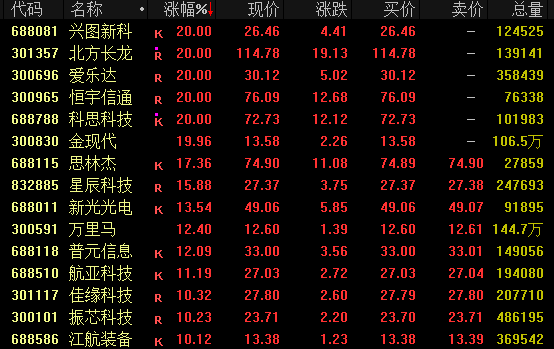
Market Overview - The Shanghai Composite Index rose by 0.66% to 3583.31 points, while the Shenzhen Component Index increased by 0.46% to 11041.56 points, and the ChiNext Index gained 0.5% to 2334.32 points, with the STAR 50 Index up by 1.22% [1] - Total trading volume in the Shanghai and Shenzhen markets reached 15,184 billion yuan, a decrease of over 1,000 billion yuan compared to the previous day [1] Military Industry - The military sector experienced a significant surge, with stocks like Beifang Changlong and Changcheng Military Industry hitting the daily limit and reaching historical highs [4] - The current military sector is considered to have a moderate level of crowding, making it a suitable area for investment, especially with upcoming events like military parades and the "14th Five-Year Plan" meeting expected to catalyze growth [6] - The military industry is anticipated to benefit from a new wave of orders due to the intersection of domestic planning and global competitiveness, with expectations of improved fundamentals in the sector [6] Robotics Sector - The humanoid robotics concept saw renewed activity, with stocks such as Xingyun Co. and Riying Electronics hitting the daily limit, and several others reaching historical highs [8] - Tesla's CEO Elon Musk announced that the design for the third version of the Optimus robot is ready for mass production, which is expected to drive interest in the robotics sector [10] Semiconductor Industry - The semiconductor sector showed positive momentum, with Dongxin Co. hitting the daily limit with a 20% increase, and other companies like Xindao Technology and Xinyuan Co. rising over 10% [12] - The demand for semiconductor hardware is expected to grow steadily due to the rise of AI applications and the ongoing trend of domestic substitution, benefiting companies with self-controllable capabilities [14][15]
龙图光罩:为英诺赛科提供半导体掩模版
Zheng Quan Shi Bao Wang· 2025-08-04 07:48
Core Viewpoint - Longtu Guangzhao (688721) has established a close partnership with InnoSilicon, serving as a major supplier of semiconductor mask plates for InnoSilicon's gallium nitride products [1] Group 1 - Longtu Guangzhao is an important supplier for InnoSilicon, providing essential semiconductor mask plates [1] - The collaboration between Longtu Guangzhao and InnoSilicon is characterized by a strong cooperative relationship [1]
火锅巨头业绩暴雷,股价被“涮”成仙股
Shang Hai Zheng Quan Bao· 2025-08-04 05:21
Group 1: Market Overview - The Hong Kong stock market opened lower but rebounded, with the Hang Seng Index closing at 24,627.25 points, up 119.44 points, or 0.49% [1] - The Hang Seng Tech Index also rose, closing at 5,447.62 points, up 50.22 points, or 0.93% [1] - Gold stocks in Hong Kong surged, with Shandong Gold and Chifeng Gold rising over 9% due to increased attractiveness of gold amid Fed rate cut expectations [1][16] Group 2: Company Performance - Xia Bo Xia Bo - Xia Bo Xia Bo, known as the "first rotating hot pot stock," announced a projected revenue of approximately RMB 1.9 billion for the first half of the year, a year-on-year decrease of about 18.9% [3] - The company expects a net loss between RMB 80 million to 100 million, with a year-on-year decline in losses of approximately 63.2% to 70.5% [3] - Since 2021, Xia Bo Xia Bo has faced continuous losses, accumulating a total loss of approximately RMB 1.326 billion from 2021 to 2024 [4] Group 3: Stock Performance - Xia Bo Xia Bo - Xia Bo Xia Bo's stock price fell nearly 4% in early trading, with a cumulative decline of over 92% since its peak in January 2023, leaving a market capitalization of only HKD 815 million [5] - The stock price was reported at HKD 0.75 per share, reflecting a drop of 3.85% [5][6] Group 4: Gold Market Dynamics - The recent surge in gold prices, with London gold spot prices rising over 2% to USD 3,362.64 per ounce, has been attributed to increasing expectations of a Fed rate cut [16] - This rise in gold prices has led to a significant increase in the stock prices of gold companies in Hong Kong, with several stocks rising over 8% [15][16] Group 5: InnoTek's Market Activity - InnoTek's stock price increased by over 40% in two trading days, driven by a partnership with NVIDIA to promote an 800 VDC power architecture for AI data centers [9][12] - The stock price reached HKD 62.65, with a market capitalization of HKD 56.03 billion [11]
东芯股份录得5天3板
Zheng Quan Shi Bao Wang· 2025-08-04 04:03
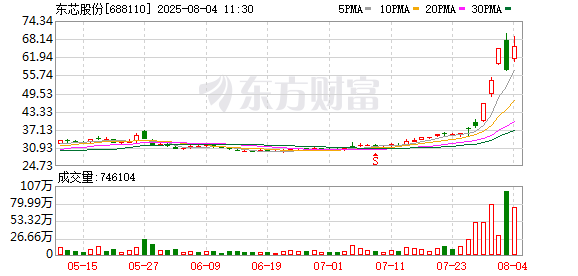
近日该股表现 | 日期 | 当日涨跌幅(%) | 换手率(%) | 主力资金净流入(万元) | | --- | --- | --- | --- | | 2025.08.01 | -11.37 | 22.39 | -81583.26 | | 2025.07.31 | 19.99 | 7.22 | 12976.31 | | 2025.07.30 | 17.33 | 17.67 | -47842.20 | | 2025.07.29 | 20.01 | 11.46 | 4197.50 | | 2025.07.28 | 2.62 | 11.59 | -3275.25 | | 2025.07.25 | 4.33 | 5.73 | 2477.73 | | 2025.07.24 | 0.90 | 3.40 | -4306.88 | | 2025.07.23 | -0.06 | 2.13 | -1583.37 | | 2025.07.22 | -0.03 | 3.19 | 272.23 | | 2025.07.21 | 3.02 | 2.57 | 254.46 | (文章来源:证券时报网) 东芯股份再度涨停,5个交易日内录得3 ...

台积电消费应用接单转淡 第4季营收恐无法再创高
Jing Ji Ri Bao· 2025-08-03 23:20
Group 1 - The core viewpoint indicates that the impact of U.S. tariffs is leading to a conservative consumer outlook for the second half of the year, with expectations that demand for terminal products like PCs and smartphones during the year-end holiday season may not meet expectations [1] - TSMC's orders related to consumer applications are weakening, and there are concerns that TSMC's revenue in Q4 may decline from the historical high in Q3, marking the first time in nearly a decade that Q4 performance may not exceed Q3 [1] - Approximately 40% of TSMC's terminal applications are in the consumer sector, which is being affected by tariffs and economic changes, leading to a slowdown in growth for the peak season in Q4, although it is still expected to outperform the same period last year [1] Group 2 - TSMC's revenue in the first half of the year increased by about 40% year-on-year, with Q4 revenue estimated to be between $31.8 billion and $33 billion, averaging $32.4 billion, indicating a quarter-on-quarter decline despite being better than the same period last year [2] - The estimated decline in Q4 revenue is projected to be in the high single to mid-double digit percentage range compared to Q3 [2]
理想回应碰撞测试,中国汽研介绍测试情况;局地超42℃!陕川渝鄂高温或破历史极值;电影《731》定档9月18日丨每经早参
Mei Ri Jing Ji Xin Wen· 2025-08-03 22:54
Group 1 - Li Auto released a statement regarding the safety collision test of the Li Auto i8, clarifying that the test aimed to validate and enhance the passive safety performance of the i8 and was not intended to evaluate the quality of other brands [8][9] - The test utilized a second-hand Dongfeng Liuzhou brand truck as a movable barrier, and Li Auto expressed no intention to make quality assessments of the truck [8][9] - The China Automotive Technology and Research Center confirmed that the test was solely for the Li Auto i8's safety verification and did not involve safety performance evaluations of other brands [9] Group 2 - Hong Kong's economy showed positive growth, with a GDP increase of 3.1% in the second quarter compared to the same period last year, and the government expects continued growth in the third quarter [3] - The biopharmaceutical industry is preparing for a significant shift as the Anhui Provincial Medical Procurement Platform announced the collection of information for the centralized procurement of monoclonal antibodies, indicating a potential market reshuffle worth nearly 30 billion yuan [4] Group 3 - SAIC Motor reported a sales figure of 338,000 vehicles in July, marking a year-on-year increase of 34.2%, achieving seven consecutive months of sales growth [10] - Changan Automobile announced a 23.43% year-on-year increase in sales for July, with significant growth in new energy vehicle sales, which rose by 74.05% [12] - BAIC Blue Valley's subsidiary reported a 6.38% decline in July sales, although cumulative sales for the year still showed substantial growth [14] Group 4 - Chipone Technology announced a major asset restructuring plan to acquire 100% of Jishun Technology for 403 million yuan, aiming to enhance its position in the power semiconductor sector [18]







重大收购,600703还透露光芯片新进展
Zheng Quan Shi Bao· 2025-08-02 11:36
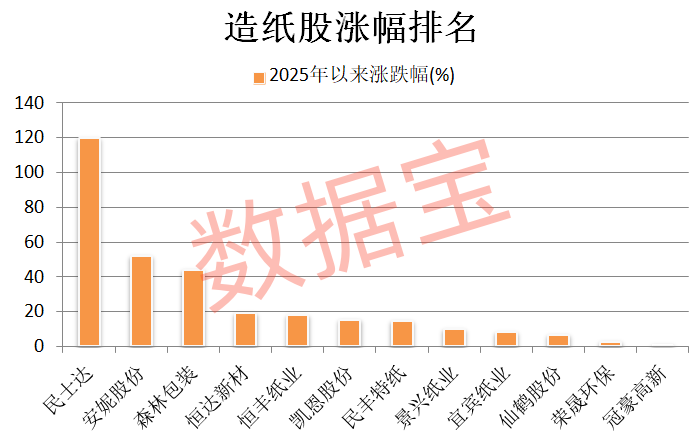
Group 1: Company Developments - Sanan Optoelectronics plans to jointly acquire Lumileds Holding B.V. for $239 million, with a total investment of $280 million to establish a joint venture in Hong Kong [2] - Sanan Optoelectronics is a leading company in the domestic compound semiconductor sector, with advanced core technology and R&D capabilities [2] - The company has achieved mass production of 400G optical chips and small batch production of 800G optical chips, while 1.6T optical chips are still under development [2] Group 2: Industry Trends - Multiple paper companies have announced price increases, with some raising prices four times in a month, and corrugated paper prices increasing by 30 to 50 yuan per ton [3] - The rise in waste paper prices, which increased to 1567 yuan per ton by the end of July, is the main reason for the current paper price hikes [3] - The paper industry is experiencing a "de-involution" trend, with a focus on optimizing capacity and enhancing innovation to escape low-price competition [4] Group 3: Market Performance - As of August 1, the A-share market capitalization of the paper industry is 157.6 billion yuan, with several companies like Sun Paper and Xianhe Co. exceeding 10 billion yuan in market value [6] - The average increase in paper stocks this year is 9.49%, with three stocks rising over 40% [6] - Four paper companies reported positive earnings, with Minshida achieving a net profit of 63 million yuan in the first half of 2025, a 42.28% year-on-year increase [6][11] Group 4: Valuation Insights - As of August 1, seven paper stocks have a rolling P/E ratio below 30, indicating potential undervaluation [9] - Nineteen stocks have a P/B ratio below 2, with some companies trading below net asset value [9] - The paper industry is expected to benefit from the "de-involution" trend, with limited new capacity expected in 2025-2026, which may improve overall industry conditions [5]